Thursday, October 27, 2011

WHO IS JEFFREY WELLS AND WHY IS HE SAYING THOSE TERRIBLE THINGS ABOUT ME?


Last week I passed along heartfelt appreciation for my inclusion on a short list of film bloggers mentioned by critic Charles Taylor as being among the best at what they do. Taylor was writing in Dissent magazine and felt moved to mention me alongside true heavy-hitters like Farran Nehme Smith and Kim Morgan, and believe me, that mention has fueled me for the past two weeks and given my writing batteries (and my confidence) a real charge. Taylor has never been one to suffer fools in print, and to know that someone with a brain and talent like his finds value in the writing of a self-started film blogger like me is rich encouragement indeed.

But for every giddy, delirium-inducing peak, there must be a corresponding valley, right? Here I was tonight, still buzzing over Taylor’s comments (to myself-- I’ve driven enough people to distraction over my excitement already to know that it’s high time to just shut up) and getting ready to go to sleep after a thrilling World Series Game 6 in which the Cardinals staved off the end of their season twice, both times down to their final strike, David Freese delivering a triple to tie the game in the ninth and then a walk-off home run to win it in the 11th. Then came the text message from a close friend. “Did you see this?” it said. “Check out Hollywood Elsewhere!” So I clicked on the link, Hollywood Elsewhere not being prominent on my “Favorites” tab, and there it was. Jeffrey Wells runs the entirety of the paragraph I quoted from Taylor’s piece last week and then ends with this:

“I love Morgan and Smith but who the hell is Cozzalio? I haven't been to Sergio Leone and the Infield Fly Rule once in my life. Not once.”

Did I say “valley”? Not exactly. I’m as giddy about this as I was being mentioned by Charles Taylor. Maybe more! What better radar to not be on than that of Jeffrey Wells? Never have I been so happy to toil in obscurity. And I love Wells’s emphatic, self-serious “Not once,” especially as it is preceded by a link to my home page. Could this be the exposure I need to really hit the big time?!

********************************************

Wednesday, October 26, 2011

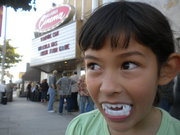
BAD SEED: HORROR KID NONIE COZZALIO READS EDGAR ALLAN POE'S THE BLACK CAT


Being a parent who loves the horror genre has made the journey of fatherhood I daresay more interesting (at least to me) than it might have been had my interests stayed in a somewhat less controversial arena. For instance, no one ever called my dad out on trying to pass along to me his appreciation for fishing under a cloud of the sport’s dubious morality, or his love for hanging out on a Sunday afternoon watching football. (However, some might have objected when he gave me a 30.06 rifle and tried to spark in me an interest in deer hunting.) But I’m a dad whose idea of fun is talking my daughters into joining him for a double feature of The Fearless Vampire Killers… and Dracula Has Risen from the Grave, so I guess I shouldn’t be surprised if some eyebrows get raised, especially since both daughters are still classifiable as pre-teens. (One of the things I love about being a Horror Dad is being part of a group of like-minded daddies who all understand…)

Rest assured, I try to be as responsible as possible in attempting to pass along some of the love I’ve had for horror movies and a genre in general that I’ve been interested in for as long as I can remember. (Exactly when that interest went from an ember to a flame is a subject best left discussed when I get around to this week’s quiz duties.) No, I’m not one of these parents who drags their kids along to Saw VII or Final Destination 5 just because I can’t get a baby-sitter. And when I do sense curiosity on the part of my kids, I try not to overstep boundaries and scare them off or otherwise induce mental trauma with something I know they’re not ready for. (A certain friend of mine and I look forward to the day when suddenly Chucky becomes cool instead of mind-scarringly terrifying.)

However, part of learning to love the genre, I think, has to do with overstepping those boundaries on your own occasionally, testing the waters to see what you can take. That kind of experimentation has to be self-motivated. I was 10 years old at a time when Dark Shadows was already four years old, a prime time for bathing in the bloody waters of Hammer, American International Pictures, Famous Monsters of Filmland and untold others areas of interest that would slowly reveal themselves to me over the next few formative years. And I was extremely lucky that my junior high school library, though it may have been wanting in other areas, had a copy of the collected works of Edgar Allan Poe, which I snapped up and began reading at an age that some might have judged to be much too young to be soaking up Poe’s doom-laden tales of obsession, paranoia, misanthropy, ill-fated romance and, most intriguing to me, taphephobia, the fear of being buried alive.

(Come to think of it, my junior high school experience was a great one for being exposed to Poe, and to taphephobia, for that matter—as a reward for scoring highest in some academic endeavor or another, my homeroom class was marched to the auditorium one morning and treated to a movie, which we soon found out was a 16mm version of Roger Corman’s adaptation of Poe’s The Premature Burial. Just imagine the hue and cry that would result from a school-endorsed entertainment choice like that one today!)

So when my youngest daughter Nonie, who cannot bear the visage of Chucky but whose literary and visual imagination paradoxically runs toward the distinctly morbid, unearthed a copy of The Big Book of Horror that I’d purchased for her and her sister a couple of years ago and announced she wanted to read a story from it to me, the news was received by me with a distinct shiver of happiness (and with some trepidation by my wife). The Big Book of Horror features tales edited and adapted for preteens by Alissa Heyman, with illustrations by Pedro Rodriguez, from original works by Edgar Allan Poe, Guy de Maupassant, Charles Dickens, Sheridan le Fanu, Robert Louis Stevenson and several others, and while I would prefer she read the real thing—I have a sneaking suspicion she will eventually—right now these stories have served as a tantalizing introduction to the literary side of horror. Heyman has, by necessity, lost the poetry and skillful language of a story like Poe’s “The Facts in the Case of M. Valdemar” or Stevenson’s “The Body Snatcher” or de Maupassant’s “The Hand,” but the intrigue within those stories, especially for young readers, remains intact.

So does the occasional morbidity and gore, as we found out when Nonie decided to read aloud to me the adaptation of Edgar Allan Poe’s “The Black Cat.” As I said, I had read the original when I was about her age (10), but I still wondered how she would respond. I needn’t have worried. She dug into the experience with relish, and I have to say it was a delight hearing her wrangle fairly elegantly with some of the sophisticated wording, which again is nowhere near the level of Poe but pretty complicated for a nine-year-old nonetheless. And she loved the story’s morbid fatalism and inevitability.

As Nonie finished on the final note of horror, she began laughing and immediately wanted to read another one. So she did. And soon we’ll get through the entire volume, I’m sure. But I was so taken by her youthful enthusiasm, which makes a pretty heady and unlikely combination with Poe’s ghastly narrative, that I knew I would have to find some way to share it with you all. And now, through the magic of YouTube, that day has come, just in time for Halloween. So join with me now, or cluck your tongue in disapproval if you must, as we take nine minutes and 10 seconds out of a busy day to get sucked into the world of fear, murder and madness as could only be conjured by the tag team of Edgar Allan Poe and my beautiful little girl Nonie. What lurks behind the wall? What is that awful yowling? You will be terrified when you discover the secret of “The Black Cat”!


****************************************

Wednesday, October 19, 2011

DR. ANTON PHIBES’ ABOMINABLY ERUDITE, MUSICALLY MALIGNANT, CURSEDLY CLEVER HALLOWEEN HORROR MOVIE QUIZ


If there were a holiday devoted to breaking traditions (violently and with malice and glee), it seems that Halloween would be a likely candidate. So it is in that spirit that we here at SLIFR University have stepped away from the usual school schedule of midterms and semester breaks to offer you this unique opportunity to shrug off the expectations surrounding this most terrifying of annual occasions. While others are out begging for candy, egging passing cars, bobbing for rotten apples or dressing like porn star versions of their favorite movie monsters and/or generic public servants and professionals, you could be inside, safely tucked away from the chilling gusts of wind that carry with them the unsettled spirits of the dead, hard at work on this first-ever Halloween-themed SLIFR quiz. And who better to inaugurate our Halloween fun than SLIFR U’s own renowned professor of musicology, the talented and rather single-minded Dr. Anton Phibes? Phibes joins our academic staff here after two rather successful seasons wreaking revenge upon the surgeons who caused his wife’s death (that’s his version of the story anyway) and those who would prevent him from obtaining the Egyptian scrolls of life necessary to secure her resurrection. Those grueling seasons were a good 90 years or so in the past, so after a long embalmed rest the stars have aligned in just the proper fashion to kick his clockwork resuscitation chamber into gear. The old tunesmith has had all the blood pumped back into his surprisingly resilient shell, which has allowed for his heralded arrival here on the SLIFR campus, where he’s ready for another great year of opening students’ eyes to the wonders of musical expression and concocting elaborate scenarios of vengeance and murder to visit upon those who slight him by daydreaming, snoozing in class or scoring less than 75% on his quarterly exams.

Asked to introduce his edition of the SLIFR quiz, Dr. Phibes was quick to sternly remind us that speech is still somewhat of an elaborate endeavor for him—even with the advances in audio technology that have occurred whilst he indulged in his truncated version of the Big Sleep, Phibes quaintly insists on using the same neck-connected Victrola he’s always employed for the occasional audible, halting expression of his most desperate desires and evil plots. (Ought to make his lectures a real hoot to listen to as well, wouldn’t you say?) Still, Phibes did offer a brief explanation to potential test-takers of his expectations as to their performance and what the test might hold in store for them. His terse statement, in its entirety, went a little something like this:

“You have only until the acid flows down to the end of this tube to complete this quiz! Do not dawdle or otherwise waste these precious moments, for if time runs out and the quiz goes incomplete, the acid, flowing surely, inexorably downward, will drip out onto your keyboard, and then your computer will have a face… like mine!”

It is, of course, up to you, Dear Student, to take or leave Dr. Phibes and his warnings with as much salt as you care to apply, while remembering, of course, his expert abilities in the handling of bloodthirsty bats, angry bees, swarming locusts, mean-spirited scorpions and the occasional brass unicorn launched from a great distance with pinpoint accuracy in order to fatally pin his adversaries to the wall like helpless butterflies. The staff at large will insist only upon the usual suggestions while taking the test here. We ask that you copy and paste your answers in the comments thread below, and to please make sure to copy the questions as well as the answers so readers might more easily determine to what questions you are referring with your answers. We also encourage lengthy or detailed answers in all instances—the longer the answer, the more entertaining and illuminating it (usually) is.


One last thing: in honor of Vincent Price, who once so vigorously and brilliantly portrayed the good doctor in two extremely amusing and creepy pictures in the early ‘70s, we’d like to call attention to a big event coming up here in Los Angeles the Sunday after next, October 30, at the Los Angeles County Museum of Art. New film curator Elvis Mitchell is making a splash with his many new programs and series at the Bing Theater, none of which has me more excited than the Halloween Eve All-Day Vincent Price-a-Thon 100, in honor of the actor’s 100th birthday this year. LACMA will run six Price classics, starting with The Pit and the Pendulum and moving straight through The Masque of the Red Death, House of Wax, The Tingler and The Fly and culminating with a rare theatrical screening of The Witchfinder General, known here in the U.S. by the title The Conqueror Worm. Best of all, admission to the entire festival is free, so get there early!


Also, if seeing the actor on screen piques your interest in his second career as an art collector, you might be interested in being reminded of the recent reopening, also in commemoration of Price’s 100th birthday, of the Vincent Price Art Museum on the campus of East Los Angeles College. So do yourself a favor-- broaden your mind and slake your thirst for all things Vincent Price here in Los Angeles this Halloween at two of the city’s finest locations for the absorption of art. Your mind (or what will be left of it after six great horror movies) will thank you.

But now, we’ve got a test to take. Pick up your #2s and open up your Blue Books. Let the quizzing commence!

***********************************************

1) Favorite Vincent Price/American International Pictures release.

2) What horror classic (or non-classic) that has not yet been remade would you like to see upgraded for modern audiences?

3) Jonathan Frid or Thayer David?

4) Name the one horror movie you need to see that has so far eluded you.

5) Favorite film director most closely associated with the horror genre.

6) Ingrid Pitt or Barbara Steele?

7) Favorite 50’s sci-fi/horror creature.

8) Favorite/best sequel to an established horror classic.

9) Name a sequel in a horror series which clearly signaled that the once-vital franchise had run out of gas.

10) John Carradine or Lon Chaney Jr.?

11) What was the last horror movie you saw in a theater? On DVD or Blu-ray?

12) Best foreign-language fiend/monster.

13) Favorite Mario Bava movie.

14) Favorite horror actor and actress.

15) Name a great horror director’s least effective movie.

16) Grayson Hall or Joan Bennett?

17) When did you realize that you were a fan of the horror genre? And if you’re not, when did you realize you weren’t?

18) Favorite Bert I. Gordon (B.I.G.) movie.

19) Name an obscure horror favorite that you wish more people knew about.

20) The Human Centipede-- yes or no?

21) And while we’re in the neighborhood, is there a horror film you can think of that you felt “went too far”?

22) Name a film that is technically outside the horror genre that you might still feel comfortable describing as a horror film.

23) Lara Parker or Kathryn Leigh Scott?

24) If you’re a horror fan, at some point in your past your dad, grandmother, teacher or some other disgusted figure of authority probably wagged her/his finger at you and said, “Why do you insist on reading/watching all this morbid monster/horror junk?” How did you reply? And if that reply fell short somehow, how would you have liked to have replied?

25) Name the critic or Web site you most enjoy reading on the subject of the horror genre.

26) Most frightening image you’ve ever taken away from a horror movie.

27) Your favorite memory associated with watching a horror movie.

28) What would you say is the most important/significant horror movie of the past 20 years (1992-2012)? Why?

29) Favorite Dr. Phibes curse (from either film).

30) You are programming an all-night Halloween horror-thon for your favorite old movie palace. What five movies make up your schedule?


**********************************************

Friday, October 14, 2011

NOW PLAYING: WENT THE DAY WELL? (1942)


“Went the day well?
We died and never knew
But, well or ill,
Freedom, we died for you.
Went the day well?”
- John Maxwell Edmonds

On first appearance the little hamlet of Bramley End, England seems a placid and happy place; there’s a certain mournfulness that is apparent only upon closer inspection and introduction to a memorial plaque and a small graveyard in the middle of town. The town verger turns and speaks directly to the camera, a nod to the homespun worldview of Thornton Wilder, and begins to relate the tale of the Battle of Bramley End. Immediately the apparent tone of Went the Day Well? (1942), an early entry from the very same Ealing Studios which would eventually define its own spirit of British whimsy with comedies like Passport to Pimlico, The Lavender Hill Mob and The Ladykillers, seems set. The verger leads us to a small graveyard whose occupants he reveals as a division of German soldiers who were defeated here in the Battle of Bramley End, the same way, as it turns out, that invading Nazi forces at large were defeated by British and Allied forces.

But wait—the movie’s framing device is set in 1942, the year of the movie’s actual release, when the real-life outcome of the war with the Germans was still very much in question. What gives Went the Day Well? (based on a Graham Greene story) a very real power is its embodiment of the sheer force of will that could allow for its existence in the first place. Its potency as propaganda is completely embedded in the fact that, at the time the movie was produced, that triumphant outcome over the German invaders was not yet historical fact but the merely the projection of the very plucky British optimism and spirit of togetherness in which the movie appears to be grounded. And what gives the movie its ferocious power as cinema is its subtle subversion of that surety of British fighting spirit, even as it functions as pulse-pounding propaganda, to reveal a portrait of a besieged citizenry both entirely vulnerable to enemy infiltration and, more shockingly, one with a capacity for violence barely hinted at on its whimsical surface, a violence more readily associated with the savagery of the enemy.

Directed with documentary immediacy by Brazilian Alberto Cavalcanti (who three years later would direct the Michael Redgrave segment of the seminal British anthology thriller Dead of Night), Went the Day Well? posits a world of quaint charm into which the enemy finds his way with frightening ease. The convoy of soldiers which makes its way down the well-trodden paths leading to the village look for all the world like British troops. When their commander reveals to the townspeople the purpose to set up and review defenses in the area, and consequently presents a request that housing for 60 men be provided, the villagers, doing their duty for God and country, accommodate them with little question. It is soon revealed to the audience, and eventually more deliberately to the villagers, that the soldiers are in fact Germans who intend to use Bramley End as a gateway for an invasion of the whole of England. The rate at which the suspicions begin to trickle into the general populace provide the movie with its incredible suspense, as the familiar archetypes of domestic British comedy and drama—among them, the gossipy postmistress, the gracious, though condescending lady of the manor, the timid spinster, the ever-present, mild-mannered vicar, and the nosey Cockney—find the structure of their quiet rural life being undermined and overtaken by the forces of a very real evil.

Soon one of them discovers a suspicious chocolate bar embossed ”Chockolade-Wien” on the personage of a parachutist on maneuvers, and the veil hiding the true peril is lifted. For as easily as the German soldiers are assimilated into British country society, the very welcoming citizenry of that society, who pride themselves on their inclusiveness and upstanding tradition, will access a level of justifiable savagery in defense of that society that most would deny in pleasant company.

Went the Day Well? is that rarity in English-speaking war films, the thriller that seems rooted in the sweet-tempered satiric tradition which would emerge from the Ealing Studios, but whose roots extend terrible tendrils that wend their way through the history of English-speaking cinema. The films touched by its influence range from the magically placid, besmirched pastorals of Powell and Pressburger (A Canterbury Tale, 49th Parallel) to the acrid and vicious assessment of the (British) capacity for violence found in works as disparate as Sam Peckinpah’s Straw Dogs, Wolf Rilla’s Village of the Damned, Mike Leigh’s Naked, the whole of the postwar British film noir movement, the delirious fantasias of British life coursing through the work of Nicolas Roeg and Ken Russell, and even forward to the Quentin Tarantino of Inglorious Basterds, in its gamesmanship with European identity and its wild projections of a victory that was hardly secured at the time the film was made. The vision at the heart of Cavalcanti’s film is potent and unyielding enough to be shocking even to an audience well heeled in the range of potential viciousness, incivility and even transcendence ripe within all of those films; it is, amazingly, completely of its time and simultaneously capable of reaching out and appearing frighteningly modern some 60 years after it was released, a vision of cheerful patriotism and absurd humor in which the conservative forces of good reveal an uncomfortable affinity with the blood-red force of vengeance.


Rialto Pictures has mounted a beautifully restored 35mm presentation of Went the Day Well?, which premiered this past May at the Turner Classic Film Festival and is now settling in for a glorious week-long run at the New Beverly Cinema. The movie, not well known before this summer even in its country of origin, is being rediscovered as one of the great classics of the movies, and that reputation is both refreshingly free of hyperbole and richly deserved. Headed by a cast of great British character actors such as Leslie Banks, Elizabeth Allan, Basil Sydney, Mervyn Johns, David Farrar, Frank Lawton, Valerie Taylor and Thora Hird, Went the Day Well? is a thrilling and vital piece of film history, and the opportunity to catch it on the big screen is not one that should be undervalued. The film plays solo through the weekend (five shows on Saturday and Sunday), and to make the program even more attractive during the week, the New Beverly has paired it with three classics of postwar British cinema, all also by way of Graham Greene, that will illuminate and expand the experience of Cavalcanti’s superb thriller. You can see it Monday night, October 17, doubled with Carol Reed’s luminous and foreboding The Fallen Idol (1948), on Wednesday October 19 with another Carol Reed feature you may have heard of-- The Third Man (1949)-- and both Tuesday October 18 and Thursday October 20 with the rarely screened Brit noir Brighton Rock (1947), directed by John Boulting and starring Richard Attenborough, Carol Marsh and Hermione Baddeley. Whatever day you choose to see it, that day will indeed go well and with much pleasure at discovering a great, uncompromising classic of suspense that goes far toward proving that no one inspired the masses toward a noble cause of defense in World War II quite like the British, even so far as exposing with vigor and acuity the ruthlessness behind common civility that might be called up when stiff upper lips come face to face with the enemy.

******************************************

A SIMPLE THANK YOU


And now a simple thank you from me to New York writer and teacher Charles Taylor, who easily made my entire week (and probably that of two other writers I know) with a brief paragraph inside his essay "The Problem with Film Criticism," published in the current issue (Fall 2011) of the New York-based sociopolitical journal Dissent. Here's what Taylor had to say:

"Bloggers and the writers who turned out well-crafted pieces on their own Web sites are free to write what they want. The best of them, such as Dennis Cozzalio at Sergio Leone and the Infield Fly Rule or Kim Morgan at Sunset Gun or Farran Nehme Smith at The Self-Styled Siren, give public voice to the way movies function as private obsession. Their film knowledge is broad and deep, but they wear that knowledge lightly. They understand that the true appreciation of any art begins in pleasure (and not in the "work" of watching movies). To read them is to read people grounded in the sensual response to movies, in what the presence or look of a certain star, or the way a shot is lit stirs in them. Reading these writers, I often feel that I'm in the presence of people dedicated to the notion of collective cultural memory in an era when instant obsolescence is the rule."

Whew. Could there be any assessment more confirming than that? This mention was entirely unexpected; I didn't know of it until a week ago today. But it comes at a time when encouragement on my part was sorely needed, and I take much encouragement from it and from being mentioned in the company of two fine writers who have both my respect and my friendship. Thank you very much, Mr. Taylor, on behalf of all of us!

***************************************

DO YOUR THING


Well, the jury is still out on Matthijs van Heijningen's 2011 prequel to John Carpenter's 1982 take on The Thing. Hell, Universal didn't even run an ad for it in today's Los Angeles Times Calendar, which is either the sign of a studio dump or confidence that the front-page Calendar feature on star Mary Elizabeth Winstead and Michael Phillips' (syndicated) positive review printed inside was advertising enough. Phillips notwithstanding, critical reaction has been generally negative-- Stephanie Zacharek complained about the movie's tendency toward literalizing what was mostly (and agonizingly) implied in Carpenter's version via Rob Bottin's nonetheless graphic, groundbreaking surrealist effects. But even so, we got the treat of the first paragraph of her review; with writing this clever, she might have spun out of orbit if she'd actually liked it. (See below for the entirety of Zacharek's blissfully silly intro.)

Less expected was the unbridled enthusiasm dished out by writers like Steven Boone and Ian Grey which, even though I haven't seen the entirety of the movie yet, both seem out of kilter at least with my own luke-warm reaction. (One thing everyone seems to be able to agree on is the general wonderfulness of Mary Elizabeth Winstead's poker-faced commitment to what amounts to a gender-switched take on Kurt Russell's cynical stature from the 1982 film. I love the slight tilt of the head and the impatient intonation she gives to the line "Open your mouth" when examining survivors for metal fillings, the inorganic tell-tale evidence of who might not be exactly who he thinks he is.)

So until we get to see for ourselves, why not spend some time revisiting the events of Carpenter's version, as interpreted by Ol' Blue Eyes, or at least a reasonable (and pretty hilarious) facsimile thereof. Jon and Al Kaplan are two brothers who are dedicated, perhaps to an unhealthy degree, to reinterpreting the landmarks of 1980s sci-fi cinema through the power and majesty of the pop song, and here they lend their interpretive and impressionistic talents to a jaunty reconsidering of the 1982 movie Sinatra-style. Their Chairman inhabits the soul of that doomed husky who opens Carpenter's version in flight from a Norwegian helicopter with the ease and wile of the Thing itself, making over a classic of horror strangely, insinuatingly in his own image. My thanks to Terry Morgan for passing this along, thus brightening my day, and hopefully yours too.


P.S. Here's the lead paragraph to Stephanie Zacharek's pan of The Thing (2011). Enjoy!

"As we all know by now, Matthijs van Heijningen Jr.’s The Thing is not a remake of John Carpenter’s 1982 The Thing, which in turn wasn’t really a remake of Howard Hawks and Christian Nyby’s 1951 The Thing from Another World. So now we have two Things that are only tangentially related to the first Thing, although the thing about the third Thing is that it explains how the Thing of the second Thing demolished the Norwegian explorers who were dead by the time that Thing was even a thing. The Thing of the third Thing basically does the same thing we saw it do in the second Thing, so the third Thing probably isn’t for you if the second Thing wasn’t your thing."

:)

****************************************

Friday, September 30, 2011

FEAR AND LOATHING IN WEST VIRGINIA: TUCKER AND DALE VS. EVIL


Whoever it was that first uttered that deathless show biz adage “Dying is easy; comedy is hard,” might well have appreciated the narrative and tonal pickle (or pickled egg) that director Eli Craig and writer Morgan Jurgenson have served up for themselves in Tucker and Dale vs. Evil, which debuts in theaters nationwide today after a brief preview stint on HDNet. The movie is a genial genre subversion looking to do for backwoods redneck thrillers like Wrong Turn, The Texas Chainsaw Massacre and The Hills Have Eyes what Edgar Wright, Simon Pegg and Nick Frost did for zombie films (Shaun of the Dead) and buddy cop thrillers (Hot Fuzz). (It seems to be unconcerned, however, with the most nightmarish of them all, Deliverance.) But as Wright et al. or a veteran parodist like Mel Brooks might have told them, rich tribute to a beloved, familiar cinematic type is more easily proposed than achieved, no matter how clever is the premise, no matter how beloved is the source. The premise of Tucker and Dale vs. Evil is clever—a pair of Appalachian good ol’ boys (Alan Tudyk and Tyler Labine) are mistaken for backwoods psychopaths by a group of hard-partying college kids who refuse to believe the titular rednecks aren’t trying to slaughter them. Misunderstandings ensue and escalate when T & B rescue one of the young beauties (30 Rock’s Katrina Bowden) and their good deed is mistaken for a kidnapping, but the filmmakers never transcend the cleverness of their narrative switcheroo or expand the broadness of their initial inspiration into anything more precise than simple genre funnin’, anything more cutting than a cheerful display of whirling buzz saws, whizzing chain saws and buckets of blood.

The movie starts off well, capturing for better and worse the crass party-hardy sensibility of the typical group of clueless college kids that usually gather for the slaughter in this kind of picture. Headed by the obnoxious Chad (Jesse Moss), whose major is obviously Macho Overcompensation, and his girlfriend Allison (Bowden), who is probably a bit smarter than the rest of her pool of peeps but still terrified by the sight of Tucker and Dale at a gas station mini-mart lined up for PBR and pickled eggs. By this point we already know these two chuckleheads are amiable and harmless-- they’re embarking on a vacation into the woods to spruce up Tucker’s recently purchased vacation home, which turns out to be located uncomfortably near the college kids' weekend campsite (and looks like it was decorated by Leatherface). The movie’s comic highlight comes early, when Dale, crushing from afar on Allison’s apparently sweet demeanor, works up the nerve to talk to her at the gas station while clutching one of his work tools, an impossibly large scythe which does nothing to dispel the group’s fears that both fellas’ intentions might be homicidal. Tucker has advised Dale to laugh and smile while talking to Alison—“It shows confidence.” So Dale shuffles up to Allison, framed by that scythe like a redneck angel of death, and with his best jovial (sinister) chuckle inquires, “You guys… going camping?!


It’s not exactly downhill from there, but neither does it escalate much other than the ridiculous gore and hysteria of the cast. Both Tudyk and Labine, terrific character actors, have a great time as comic leads, and their performances are often surprisingly nimble; they never settle for the easy, obvious stereotypes when an unexpected beat or sideward glance might result in a richer laugh. (One can imagine Big Jim McBob and Billy Sol Hurok weeping with gratitude.) But they’re also good enough to make you wish the script itself were smarter, more alive to the possibilities within the set-up—the scenes where Dale tries to convince Allison of his honorable intentions, or the movie’s big confrontation/summit meeting which climaxes in gore and explosions, go on too long with too little reward beyond the obvious. The villains, of course, end up being this rather stock group of kids who turn out to be—surprise-- stupid, obnoxious and hateful (as they believe Tucker and Dale to be), who refuse to believe T&D could be anything but menacing monsters, and who through their own hysterical fear end up causing their own deaths, which the survivors of course blame on our beer-swilling heroes. Unfortunately, the gore isn’t much funnier than the absurdity of those self-inflicted kills, all of which lack the wit of an average Final Destination episode—the exception being one kid’s head-first dive into a wood chipper, which inspires Dale to an utterance of disbelief too funny to spoil here.

Eventually, the initial cleverness of the movie’s conceit settles into fulfilling the very genre tropes it seems to have been intended to parody—there’s nothing in the big showdown that ends Tucker and Dale that you haven’t seen before. Craig and Jurgenson toy with the wide-screen frame, but they haven’t yet learned how to create visual jokes with it the way Edgar Wright does, and the movie never finds a subject to lift it beyond parody, the way Shaun of the Dead became a hilariously spiked examination of a soulless British society in lockstep to routine and working desperately to deny the grim (and ever grimmer) realities of life and death. (Shaun was scary too, eventually eclipsing its obvious model, George A. Romero’s first three Dead movies, atop the zombie heap as shivering, shrieking social satire.) By comparison, the director and writer manage only to extend their subversion of this subgenre of terror films, which has a tendency to rub the audience’s nose in ever-increasing perversity and gruesome fate, by fashioning it to be, of all things, a movie with surprising faith in the ability of good intentions to overcome all. (The final shot is pointedly absent the ghastly screams that often punctuate and ensure the perpetuation of thrillers of this sort.) This geniality is in itself kind of refreshing, but it’s a geniality that generates only occasional smiles, not big laughs, and it can’t wash away the movie’s slightly undercooked feeling, one that suggests that the creators of Tucker and Dale vs. Evil settled for a great idea without figuring out how to flesh it out into a movie with real meat on its bones.

**********************************************