
Friday, August 19, 2016

THE SLIFR GUIDE TO DRIVE-IN MOVIES PART 1: A BRIEF HISTORY


It might seem that celebrating the drive-in movie season during the dog days of August is a celebration that is coming about two, maybe three months too late. Isn’t summer just about wrapped up? Ha! Only if you’re in still in grade school—my kids went back to their respective halls of education on August 8! For them summer, in a single but significant way, is over. But for everyone else (including students), especially if you’re in the southwestern part of the country, the hot days of summer aren’t giving way to cool temperatures anytime soon, regardless of the insistence of the calendar. In Southern California, climate change has made summer-style heat a staple well into October, and sometimes beyond. Here it’s always drive-in season, even in January, and that’s the silver lining of a sizzling autumn for fans of the specific joys of outdoor cinema.

And each year around this time, a big bunch of my friends and I get together at one of SoCal’s primo ozoner destinations, the Mission Tiki Drive-in, to salute the demise of another calendar summer in high tailgating, starlit movie style. (If you’re in the Los Angeles area and would like to join us, check out our official Facebook event page and come on out! It’s happening tomorrow night, Saturday, August 20!)

In honor of our drive-in party weekend, and in honor of this being the 83rd summer since the first drive-in was opened, I thought it might be fun to revisit the history of the drive-in movie theater and celebrate some of the reasons why, despite a sharp decline in the drive-in theater population in the last couple decades, the drive-in is still with us, even enjoying a most unlikely renaissance.

It was eight years ago that I was commissioned by the now-defunct Green Cine Daily, a wonderful aggregator site dedicated to corralling the Internet’s best writing on film which went dark in 2015, to create what they called “a drive-in primer,” a guide to the progression of drive-ins and drive-in culture throughout the 20th century.  It was a fun article to write, especially since I never thought that I’d be writing anything about drive-ins in 2008 that wasn't dedicated exclusively to their inevitable demise, which by then I would naturally have assumed would be an event long seen only in the rear-view mirror. By the time I published the article for Green Cine Daily, I’d been writing about the resurgence in Southern California drive-ins at my own blog for about three years, ever since I and several like-minded fanatics founded the Southern California Drive-in Movie Society during the summer of 2005. (SoCalDIMS has been dormant for a couple of seasons now, but we still maintain a very active Facebook presence.)

Eight summers have passed since I did my little investigation into this distinctive, but not exclusively American phenomenon, and since the original article is no longer accessible through Green Cine Daily I have obtained their permission to spruce it up a bit and reshare it with you, for this weekend and beyond. (Though it was originally one long piece, it is presented here in three parts—parts two and three to follow on Saturday and Sunday.) Many thanks go out to Jonathan Marlow for securing the permission to reprint the piece here, and especially to David Hudson, who so kindly featured many of my earliest articles at Sergio Leone and the Infield Fly Rule on the pages of GCD, thus ensuring me a much larger audience than I would have ever gained on my own, and to OG GCD editor Craig Phillips, who was the fella who asked me to write the piece for them. I hope you enjoy it and that it inspires you to seek out a drive-in near you, especially if you haven’t done so in a while.

***************************


(Photo courtesy of Jen Kipp Sherer)

During the summer of 2000, my newborn daughter went to her first movie. My wife and I took her to the Foothill Drive-in, along fabled Route 66 in Azusa, California, to see that revered children's classic Mission: Impossible 2. All right, she was three months old and she slept through most of it-- so did my wife, truth be told. But regardless of what was actually playing, being there at the drive-in with my first daughter was a moment of bittersweet significance for me. I finally had a child of my own, who I hoped would grow up with an appreciation of the movies, and yet it seemed entirely likely she would never know the kind of fun to be enjoyed at a drive-in movie.

I walked her around the Foothill's near-empty lot and told her stories about the drive-in movie theaters of my past-- how I worked on the snack bar and clean-up staff of my hometown passion pit; how being friends with the son of the theater owner got me on to the crew for the drive-in's annual 4th of July fireworks show; and how movies weren't necessarily better at a drive-in-- in fact, the projection and sound were usually a downgrade from what you could see and hear at an indoor theater-- but they were always special, and often somehow more memorable for having been taken in under the stars.

I carried my daughter around the lot, and we eventually approached one of those old-style speaker posts, which still had the speakers attached even though the Foothill was now sporting FM radio sound originating from a low-wattage transmitter in the projection booth. That speaker pole was now a totem to memories left in the wake of technological advancement. Gone were the days of bouncing from parking spot to parking spot in search of the one speaker whose sound didn't seem like it was originating from 1933, and from inside a rattling cellophane bag. Nevermore would drive-in patrons forget to replace the speaker after the end of the movie and either tear the pot metal device from the post or shatter their driver's-side window as they absent-mindedly pulled out of their spot to head for the exit. As I told my daughter with sincere melancholy, drive-ins would likely soon vanish altogether-- rising property values combined with the cost of maintaining drive-in businesses in the home video age would likely ensure that the few remaining drive-ins which were still flickering in 2000, like the one we were standing in, would remain perched squarely in the crosshairs of cultural irrelevance, marked for a swift and steady disappearance.

Standing there, holding my daughter in the shadow of the Foothill's drive-in screen tower, I honestly believed that by the time she was old enough to put on her pajamas, load up in our car with a bunch of pillows, blankets and bags of home-popped popcorn and head to the drive-in like I did with my family when I was a kid, the drive-in movie theater would be a true dinosaur-- gone, baby, gone.

Fortunately, and against all indications, I was wrong. Although they are far less in number than they were during their peak in the late '50s (in 1958, specifically, there were 4,058 drive-ins in operation across the nation), the drive-in movie theater still exists. The number of drive-ins showing movies has remained at slightly above 400 over the last 18 years - the last precipitous drop occurred from 1998-1999, when 134 drive-ins closed during that single year. (Less than a year after we last visited with my daughter in 2000, the Foothill Drive-in closed. It has been dark for several seasons, its screen torn down, though its lavish marquee, a noted attraction along Route 66, remains standing.) But since 1999 the total number of drive-ins has stabilized; fewer have closed and disappeared. Going to the drive-in in 2016 is a rarified experience, to be sure-- Californians in 1958 had 223 separate drive-ins in this state alone from which to choose. When I wrote the first version of this article in 2008, that number was down to 19. On the occasion of this updating, on the 83rd anniversary of the opening of the first drive-in back in 1933, that number has actually increased—  the Paramount Drive-in in Lakewood, California reopened three years ago after a 22-year dormancy.


The drive-ins which remain, here in California and all over the country, are experiencing a renewed commitment from their owners, and especially a renewed commitment from customers who cherish the outdoor movie vibe as one that is extremely friendly to families, family budgets and family viewing habits. Most drive-ins have admission prices that are five to six dollars per person less expensive than their indoor cousins, and some don't charge admission, or charge only a minimal $1 fee, for children under the ages of 9 to 11. Modern drive-ins cater to budget-conscious families by playing double features of first-run commercial fare, with an emphasis on family-oriented pictures - blockbuster releases and animation from the likes of Pixar and DreamWorks. And many here in California and elsewhere have invested thousands of dollars to maximize the experience of the theater itself, upgrading everything from the snack bar and surrounding grounds (tiki décor, '50s diners and California orange groves are just three of the themes adorning drive-ins in the Los Angeles area) to the technical presentation, with FM car radio sound and super-bright digital projection which rivals that seen on indoor screens. The heyday of the drive-in may be gone, but then so too are the days of squinting to make out shadowy images on badly illuminated screens and listening to crackly sound heard through antiquated, poorly maintained speakers.

One way that drive-ins really have changed, however, is the kind of movies they feature. If one were to take an informal survey of drive-ins across the country and what they were showing midway through this past summer, the list would probably boil down to some combination of the Ghostbusters reboot, The Legend of Tarzan, Finding Dory, The BFG, X-Men: Apocalypse and Star Trek: Beyond. The men and women who book drive-ins live for a schedule of releases like these, because they know there is endless family appeal there that can be extended and reshuffled well into the summer season. In this regard, the current incarnation of the drive-in is hardly the familiar picture of a passion pit exclusively showing cheaply produced fare targeted at restless youth—no, they’ve got their sights set squarely on the broad appeal of mainstream Hollywood releases. And in that regard, 21st-century drive-ins are no different than drive-ins were in their infancy, into the 1940s and 1950s.


During the years just after Richard Hollingshead opened the very first drive-in theater in New Jersey in 1933, drive-ins showed what every other theater showed - any and all features, big and small, that they could get hold of. And after World War II, when the baby and the drive-in booms really began, drive-ins were still considered family-friendly establishments. Many installed playgrounds and other fun attractions underneath the screens to encourage parents to bring the kids. Even if the fare on screen was more of an adult nature, the kids would play outside until the movie began, indulge in the snack bar cuisine of the evening and then either settle in for an exciting western or crime picture, or fall asleep during a less interesting romantic drama or serious story intended more for the grown-ups. For many kids of this generation, drive-ins were one of the main ways for kids to gain exposure to the kind of movie fare that parents would be otherwise less naturally inclined to offer to their children.

By the 1950s the drive-in boom was well underway. From less than 1,000 theaters in 1948 to near 5,000 in 1958, the drive-in theater had arrived and was busy making its mark on pop culture. (During this same period, over 5,000 indoor theaters closed.) The All-Weather Drive-in in Copiague, New York, was an early winner of the "my-drive-in's-bigger-than-your-drive-in" competition, boasting a 28-acre lot capable of holding 2,500 cars. (This was before the advent of multiple-screen lots, remember-- the All-Weather had one screen.) It also made room for a 1,200-seat indoor viewing area that was heated and air-conditioned, hence the "all-weather"claim, in addition to its playground facilities, cafeteria and full-service restaurant. The All-Weather Drive-in was so big it even featured a shuttle service to carry customers to the various locations on the 28 acres, presumably even to their cars.


As the sizes and numbers of drive-ins increased during the '50s, so too did the variety of extra attractions drive-ins offered. Many would open up to three hours early to offer families access to such pre-movie excitement as miniature trains, pony rides, boat rides (!), talent shows, animal shows and even miniature golf. It was around this same time, at the beginning of the '50s, that drive-in snack bar menus began to expand, offering everything from fried chicken and barbecue to chili and cheeseburgers, pizza and frozen ice cream treats. To promote these new and exciting offerings, the drive-in intermission film was born.

But the '50s also brought a new home-based medium into the mix, and as the boom of the '50s gave way to the leveling off of the appearance of new drive-ins, television began to force changes to the kinds of movies being made and how they were distributed. Indoor theaters competed with TV by innovating the sheer size and scope of the image, accommodating wider aspect ratios and better sound quality. Drive-ins, on the other hand, were already becoming popular destinations for the teenaged crowd, and they competed fiercely for the attention of motion picture distributors and drive-in theater owners who began to cater much more to their taste in exploitation movies, disposable comedies and low-rent horror and science fiction.


A good drive-in movie was one that ostensibly wouldn't suffer if you missed a portion of it while on a snack bar run, or socializing with buddies on the lot, or because the windshield of your sedan got all steamed up for whatever reason. Independent producers began churning out tons of low-budget fare designed specifically to play on double and triple features at drive-ins. These were usually disreputable pictures that more often than not either skipped engagements at indoor theaters altogether or were relegated to downtown grindhouses.

In any case, even if one or two A-list titles managed to make it onto the drive-in screen during this period, they were often accompanied by a couple of low-budget titles whose specific purpose was the filling out of the B and C slots of a drive-in program, hence the adoption of the term "B movie" to describe them. (For a look at a typical assortment of advertisements touting exactly this sort of eclectic drive-in programming culled from newspapers during this time, and news on upcoming drive-in events all over the country, check out the Nostalgic Drive-in Newspaper Ads page on Facebook.)


By the beginning of the 1970s drive-in attendance had plateaued and the amount of theaters in existence in 1982 was only just over half that of the peak year of drive-ins, 1958, when nearly 5,000 screens dotted the landscape of America's urban jungles and rural backroads. The movies were still there, for the most part-- there was no lack of cheap horror films and lurid sex fare in the early '80s, to be sure, but drive-ins, in an attempt to stay liquid, began to turn into second-run venues for mainstream Hollywood fare, and even hard- and soft-core porn, which led to much community consternation and, eventually, a bunch of chained-up entrance gates and abandoned lots. By the time the home video movement was in full swing in the late '80s, the demise of traditional Hollywood entertainment outlets was not coming about in the way heralded by doomsayers who predicted that the Betamax would undermine entertainment industry profits. Instead, home entertainment options were driving more and more nails into the coffins of established drive-in theaters, who were giving over their ever-more-expensive lots out to swap meets or folding altogether due to lack of patronage.

Yet somehow, through all the battles over expensive tracts of land giving way to urban sprawl and encroaching Wal-Marts and mini-malls that characterized the '90s and the beginning of the 21st century, the drive-in never succumbed to extinction. Stalwart independent owners, small real-estate corporations and even some large exhibitor chains never quite relinquished their hope that the drive-in, though an unlikely candidate for a full-scale comeback, still had life in it yet and could be nurtured by the right management and supported by a new generation of drive-in fans who remembered the experience and wanted to actively pass that love on to their kids.
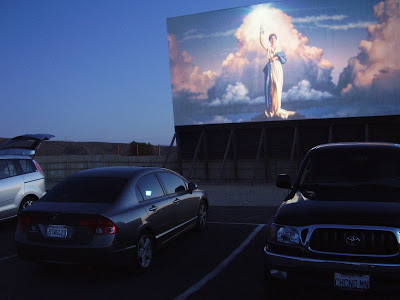

So here we circle back around to the year 2000 and me standing on that lot in Azusa, California, hoping that my three-month-old daughter would someday see and love drive-ins on her own, yet never realistically thinking it would happen. Well, she's 16 years old now, and she and her 14-year-old sister are 11-year veterans of many summer (and winter) trips to the few Southern California drive-ins that are still going strong, theaters that play to year-round record business and the delight of people like my girls and me. The future of the drive-in seems, for the moment at least, assured by its appeal to economically minded families looking for inexpensive ways to have fun together.

No, the drive-in may never again achieve the particular vibrancy afforded it by the lowbrow pop culture that ran through its veins and its projectors in the '50s, '60s and '70s. But for those who value the experience above all, this is a small price to pay. Many of these theater owners are working hard to ensure that attending a drive-in movie remains an activity that harkens back to the good old days and fashions fresh, happy memories for a new generation at the same time. As long as there are theaters like these, I feel confident that the drive-in will still be around in 30 years, when my daughters want to take their own children and tell them about their own good old days of movies under the stars.

**********************

(NEXT: In tomorrow’s installment of the SLIFR Guide to the Drive-in Movie, we take a look at one company that specialized in creating movies tailored toward the popularity of the drive-in in the ‘50s and ‘60s, as well as a baker’s dozen movie directors who had the drive-in sensibility coursing through their veins and their movies.) 

*********************

Saturday, August 13, 2016

NOW PLAYING: ELEVATOR TO THE GALLOWS (1958)


The sound of an electric pencil sharpener masks the crack of a shot that initiates what might have been the perfect murder in Louis Malle’s debut film, Elevator to the Gallows (1958), now touring theaters in a gorgeous 4K digital restoration courtesy of Rialto Pictures. Malle’s movie, distinct from the more naturalistic comedies and dramas that characterized his primary directorial focus, and certainly also from his later documentary work, is a fatalistic French film noir that exists tremulously in the space between a more classical, American-derived style and the first, faint signals of the French New Wave, which it seems to foreshadow with longing and a swoon of sustained anticipation.

The movie indicates the unusual silvery and shadowy visual pleasures of its brilliant cinematographer Henri Decae (Bob Le Flambeur, The 400 Blows, Purple Noon, Le Circle Rouge) right from the start: a masked close-up of the eyes of Florence Carala (Jeanne Moreau) which expands into an extreme close-up on her desperate, almost pleading features. She’s on the phone with Julien Tavernier, her lover (Maurice Ronet), and it’s clear they have something planned for the woman’s husband, a shady French arms dealer and industrialist whose company employs Tavernier and who stands in the way of the adulterous couple’s idealized bliss.  

Julien sneaks into his boss’s office, confronts him and then, as his secretary grinds away on that pencil sharpener, plugs him with a shot from the man’s own revolver, setting up what will look like an obvious suicide. After being escorted out of the building with the secretary by the building’s security officer, Julien realizes he’s left the rope and grappling hook he used to gain entrance to his boss’s penthouse office dangling from the outdoor balcony. (In an age where paranoia is defined somehow more pervasively, it’s strange to think on a not-so-distant past when skulking about the outside of a city building without worrying about being seen was somewhat more plausible than it is now.) But before he can complete the elevator ride back to the top floor to retrieve the evidence, the security officer shuts down the building’s power and locks the place up, leaving Julien trapped in dangerous proximity to the scene of the crime.


It’s a perfectly claustrophobic situation, but Malle exploits it for suspense, not suffocation. The rest of Elevator to the Gallows plays out in relatively open spaces, where the breeze of freedom is intertwined with an inexorable foreboding which suggests that, for Moreau and for the young couple who impulsively steal Tavernier’s car when he heads back upstairs, the pleasures of everyday life will always be mirages, just out of reach. After seeing that stolen car pull away with a young woman in the passenger seat, not stopping to pick her up as had been previously arranged, Florence presumes Julien has scurried away with a younger flame, so she sets out into the nightlife of the Parisian neighborhood where they live, asking about her lover. In these sequences Moreau glides down the sidewalks, observing casual conversations and unfettered relationships the likes of which she may never experience again, murmuring to herself and hinting at mysteries of motivation and devotion, almost a phantom on Decae’s street-lit, chiaroscuro-and-pearls canvas. She’s further propelled by Miles Davis’s insinuating improvisational jazz score, which Malle uses in counterpoint to the structure of tightly-wound tension evoked by the story. Davis’ impetuous trumpet functions almost like a siren calling ahead past plot function to a realm of validation of American cool that would help to characterize the oncoming French New Wave.

Meanwhile, the young couple, with impulses toward lawlessness but little accompanying experience, vision or ambition, encounters a pair of married German tourists at a roadside motel, and the situation that develops there only serves to tighten the noose around Julien’s neck. These two—she a young worker in a floral shop with fantasies of escaping her dreary routine, he a directionless, indifferent would-be thug who hides his fear beneath a leather jacket—function almost like alternate-world versions of Florence and Julien, literally driving down one of the roads that circumstances, including their own joyriding intervention, have prevented the older couple from taking as a means of escape from a fate of their own devising. (The boy even assumes Julien’s identity at one point and conjures a tall tale revolving around a military history he’s at least 20 years too young to have experienced.) The boy and girl also cast the film’s eye forward— in Jean-Luc Godard’s Breathless (released two years later, in 1960), Jean-Paul Belmondo and Jean Seberg would serve as fully fleshed-out echoes of the doomed youngsters in Malle’s film.


At the end of her aimless night out Florence has been arrested for drunken disorderliness along with a bunch of acquaintances, and when her identity as the wife of the local corrupt captain of industry (whose ultimate fate has not yet been discovered) is determined by the police she is immediately released. She makes her way to the car that has been sent to retrieve her, and as she gets in she catches her own reflection, barely perceptible in the deep black of the vehicle’s finish, and offers a self-assessment: “I look awful. I’m mad.” (Moreau is marvelous without question in this picture.) That reflection peers back with a faint ghostliness courtesy of Decae that registers more chilling than ever as seen in this restored version, and though her demeanor remains placid in the moment, there’s a feeling that we’re seeing the first, tiniest crack in a beautifully modulated façade, that to take her at her word here would be justified. Elevator to the Gallows is much more classically structured than Godard’s stutter-stop pop culture projectile, but looking back it’s hard not to imagine Malle having a strong sense that the fascination with American forms that characterized his fellow French filmmakers and critics, a fascination in which his own movie is drenched, would soon break out and find itself splintered and reflected in new forms, new ideas, new directions, which would, in their greatest expressions, lead to new truths. As it stands shimmering on the border between traditional and a more radical, unfamiliar film language, Elevator to the Gallows looks better, more prescient than ever from a distance of 58 years.

*****************************

Sunday, August 07, 2016

BLOOD SIMPLE, SWEET CHARLOTTE, SUICIDE SQUAD AND OTHER SCATTERED SHOTS AND SHORT ENDS


I’ve been back from my Oregon vacation for a couple of weeks now, and though the getaway was a good and necessary one, I’m still in the process of mentally unpacking from a week and a half of relaxing and thinking mostly only about things I wanted to think about. (I also discovered a blackberry cider brewed in the region, the source of a specific sort of relaxation that I’m still finding myself pining for.) It hasn’t helped that our time off and immediate time back coincided with the bombast and general insanity of the Republic National Convention, followed immediately by the disarray and sense of restored hope that bookended the Democrats’ week-long party. The extremity of emotions engendered by those two events, coupled with a profoundly unsettling worry over the base level of our current political discourse and where it may lead this country, hasn’t led to a lot of restful sleep either. 

So, yeah, I’m feeling discombobulated, and that isn’t a very good place from which to try and put words together so that they, you know, make sense. What I’ve got this week amounts to a series of brief thoughts and links to other places where more coherent and comprehensive writing is available, scattered shots and short ends about movies, of course, and about life. Don’t expect any unifying theme here this week. It’s all bits and pieces, flotsam and jetsam, the dust bunnies hiding in the corner waiting to get swept up.

***************


I first saw Blood Simple during its theatrical run in 1984, and at the time it seemed like a classic case of overhyping. I thought the movie was okay, a cleverly constructed, nasty little thriller that was perhaps just a little too self-conscious for its own good. But it’s never been a favorite. In fact, I’ve always been happy to think that maybe  the most amusing thing to arise from the existence of the Coen Brothers’ calling-card first feature was the introduction to the re-release version by the gloriously pompous “Mortimer Young” of “Forever Films,” and the subsequent audio commentary by faux audio commentary by faux film expert “Kenneth Loring” released on the 2001 DVD edition that continually takes the piss out of the boys’ cocksure confidence as filmmakers, as well as the level of obviousness and self-absorption of the average commentary track. As sustained one-joke premises go, it’s, well, sustained, and dryly funny, more so the more of these sort of point-out-the-obvious audio commentary tracks you’ve personally endured.

But then I saw the movie again last week. After 32 years of getting to know the Coen Brothers’ films, and after having watched a generation of Quentin Tarantino-fed movie brats endlessly Xerox his sort of self-conscious movie-osity until you can see through each successively faded copy as not only pastiche but commentary on pastiche, the Coens come out looking like classicists. I liked Blood Simple a lot more this time around, not only for the leisurely stretch of time it takes to get its dirty little job done, but also for the awareness it betrays of its sources that never slips into braggadocio—the Coens’ cool detachment wears surprisingly well.


The movie still feels underwritten in the character department, especially the two adulterous and romantically doomed leads, and though Frances McDormand (who we now know would soon come into a measure of glory under the Coen auspices as well as elsewhere) comes out looking as good as possible, the same can’t be said of John Getz, whose blank, nondescript presence just does not generate the sort of desperate empathy which came so effortlessly to actors like Fred MacMurray or John Garfield when they found themselves tangled in similarly unforgiving webs of deceit and murderous intent. Fortunately, the movie’s ace in the hole is M. Emmet Walsh as the beyond-sleazy, undoubtedly aromatic  Loren Visser, a private investigator of dubious morality who moves with the urgency and determination of a banana slug—in his rumpled, sweaty, two-or-three-weeks-past-desperate-need-of-dry-cleaning jacket he looks like one too. Walsh provides the juice that seems beyond Getz and McDormand—his performance has electricity and unseemly energy even if his character doesn’t. Walsh has been hired by McDormand’s husband, a bar owner played by Dan Hedaya who emits his own peculiar scent of moral rot, and when presented with the evidence of his wife’s dalliance with an employee, Hedaya reminds Walsh of the ancient Greek tradition of cutting off the head of the messenger who brings bad news. Without missing a beat or breaking his indifferent stare back at his employer, Walsh croaks with an unsettling smile, “Gimme a call whenever you wanna cut off my head. I can always crawl around without it.”

The Coens have a lot of fun in Blood Simple—that famous tracking shot down the length of a bar, with Barry Sonnenfeld’s camera hopping blithely over a patron slumped drunkenly in its path, has been duly noted by the film’s many enthusiasts, but there’s also the unexpected thwack of a newspaper delivery late in the film which puts the perfect disorienting exclamation point on the lovers’ dwindling sense of stability. Their visual style seemed assured, and only slightly ostentatious, from the beginning, gaining full bloom in their follow-up, Raising Arizona. But it’s the confidence with which they guide the entire movie, that measured pace in communion with the noir ghosts they’re conjuring, and the slimy brilliance of Walsh’s work—the first great performance in a Coen Brothers career which now seems littered with them—that raises Blood Simple far above the level of the occasionally inspired stunt I took it for in 1985.

(A spiffy new 4K digital restoration of Blood Simple is touring the country in theaters now in anticipation the release of that same restoration in a beautiful package from the Criterion Collection which hits the streets on September 20.)

*******************

About three years ago New Beverly Cinema employee Julia Marchese set out to document the history and the then-current glory of this Los Angeles landmark, the last traditional repertory cinema left from the revival heyday of the ‘70s and ‘80s. In between the completion of the film and its release into the world, the New Beverly went through some tumultuous changes, including Marchese’s parting ways with the theater. As a result, her movie, called Out of Print, which functions both as a tribute to the New Beverly, it’s original ownership, and as a call for support of the 35mm film technology which, ironically, played a part in the unexpected ownership change wrought on the theater, feels even more like an epitaph for an era than it might have before. Out of Print is the very definition of a labor of love, and it’s a bitter irony that more people will probably see it on their iPads than projected in the format to which it pays homage. But see it anyway for the sense of community it documents that lives on, as does the New Beverly, even though some of the faces and the circumstances may have changed. (Full disclosure: I’m one of the talking, gesticulating heads featured in the film, alongside New Bev regulars like directors Joe Dante, Rian Johnson, Stuart Gordon and a whole lot more.)

****************** 


‘Tis the season for the revealing of the Muriel Awards Hall of Fame inductees, class of 2016. As a Muriels voter, I’ve been participating in the induction of great films into this collection since we began the MHoF in 2013, and a mighty hall has been assembled so far. (Click here for a full list of 2013-2015 inductees with links to essays for each individual film.) The films announced for inclusion so far for this year are, no surprise, a stellar bunch as well. They include Roman Polanski’s Repulsion (1965), Douglas Sirk’s All That Heaven Allows (1955), Jean-Luc Godard’s Breathless (1960), David Lean’s Brief Encounter (1945), Nicholas Ray’s In a Lonely Place (1950)  and Buster Keaton and Clyde Bruckman’s The General (1925).

Keep checking the Muriels Hall of Fame blog, Our Science is Too Tight, for more updates as the inductees keep rolling in.

***************************


And speaking of The General, one of the things I did while I was Oregon was bike the Row River Trail, which starts in Cottage Grove, where the parade scene in National Lampoon’s Animal House was staged, and winds up through the woods along the edge of Dorena Lake and beyond, approximately 30 miles from start of trail to its end and back. It’s a beautiful ride, converted to a path dedicated to biking, hiking, running and even horseback riding from an old, long-out-of-use railway… which just happens to be the one on which Keaton shot The General. We stopped by the hotel where Keaton and his crew stayed, which is decorated with a mural and a plaque commemorating his visit, and had breakfast at Buster’s, the hotel’s café, where Keaton memorabilia as well as posters from other films shot in the area grace the walls. The pre-trail railway can also be seen in films like Robert Aldrich’s Emperor of the North Pole (1975) and Rob Reiner’s Stephen King adaptation Stand by Me (1983), and as we rode the trail there were a couple of spots where I snapped out of my reverie of riding through nature, jarred by recognition into a feeling as if I’d suddenly been transported directly into film history.

**************************


Stand by Me is a major reference point for Stranger Things, the hit summer series on Netflix about a group of young kids, apparently Xeroxed directly from every ‘80s movie you’ve ever seen, who discover an eerie parallel world, populated by monsters and observed by the requisite cold, calculating men in suits—hazmat and black-coat-and-tie variety—when one of their own suddenly disappears and is presumed dead. Stranger Things seems to reference every ‘80s movie you can think of—E.T., Poltergeist, Stand by Me, WarGames, Revenge of the Nerds, any number of the films of John Carpenter, even Risky Business and All the Right Moves, for Christ’s sake—and if you’re of an age to find the burgeoning appeal to ‘80s nostalgia invigorating you’ll probably enjoy it. I found the series watchable, but I also found its insistent touching of all the expected bases suffocating at times. And I really could have done without the near-comatose father of the featured ingénue, whose performance is somnambulantly over (or should it be under) the top, and so evocative of the favored perspective of the films of the day which made sure we knew that all the kids were sharp and their parents hopelessly dull, all stacked evidence not exactly being to the contrary.

Eighties “icons” Winona Ryder and Matthew Modine are also on hand, in case we didn’t already get the joke, and between Ryder’s unmodulated mania and Modine’s stiff, not-at-all-scary sleepwalking, the comic value of said joke runs dry pretty quickly. With all its nudge-nudge references, including an odd score that cross-pollinates the droning musical style of Carpenter’s efforts as a composer with that of a sort-of bargain basement Tangerine Dream, I felt like Stranger Things might have actually been made in the ‘80s, a complaint that could be taken as a compliment in some quarters, I suppose.


But here’s a real compliment: the best thing about Stranger Things is the utterly compelling face of fledgling actress Millie Bobby Brown, who holds (steals) the screen effortlessly as Eleven, the telekinetic 11-year-old escapee from a mysterious compound where all manner of weird, invasive experimentation seems to be afoot, who befriends our young heroes and who may hold the key to finding their missing friend. Brown is magnetic, and she delivers the sort of quiet, understated, suggestive performance which seems decades beyond her immediate elders in sheer sophistication. While Ryder and Modine and everyone else are mired in the ‘80s, Brown seems well equipped for the 21st century.

******************


Who needs air conditioning? I didn’t find it difficult at all to keep cool yesterday while baking in the routine heat of another Los Angeles summer. The shivers induced by John Carpenter’s The Thing (1982) did the trick just fine. Carpenter’s picture was ignored by an E.T.-infatuated America during the summer of 1982, and it didn’t do too well by critics either—I recall Carrie Rickey panning it in the Village Voice.  But I loved it upon first watch and it’s been really satisfying to track this movie’s stature as it has grown over the past 34 years. It’s a clean, brutally terrifying movie, easily Carpenter’s best. And the director creates a true collaboration here with Rob Bottin, whose makeup effects work achieves a fusion level of surrealistic horror that contrasts with, and is amplified by, the stark, unforgiving environments of Antarctica and Carpenter’s clean, shadow-pocked Panavision frames.

******************


Robert Aldrich’s Hush… Hush, Sweet Charlotte (1966) doesn’t quite have the juice of the director’s previous hag horror classic What Ever Happened to Baby Jane? (which may have been provided at least in part by the leads' disdain for each other). But it does have Olivia De Havilland pouring on the honey (“Charlotte, dear, you must get your rest”) and then (SPOILER ALERT) getting convincingly steely and mean, a side she didn’t get to show on film as often as she may have liked. And it has Bette Davis, again essaying a creature damaged by past horrors—she’s believed to have chopped her lover into pieces after an unceremonious rejection. But this time around it’s Davis in a considerably more minor key. If Davis’s Charlotte is not as instantly memorable as her tear through Aldrich’s 1962 film as former child star Baby Jane Hudson, it’s at least a more tenderly observed performance from the get-go, this despite her entering the film by trying to shoot construction foreman George Kennedy when he attempts to bulldoze the crumbling mansion of her damaged youth. Early on, a sympathetic British journalist who documented Charlotte’s tumultuous London exile in the wake of the ghastly crime admits his fascination and claims to know well everything that was written about her at the time. “You’re my favorite living mystery,” he tells her, to which she responds, with something like playful hopefulness, “Have you ever solved me?” It’s one of my favorite moments in this actress’s long and storied career, and it helps keep us engaged as the movie goes about the measured, occasionally elegant business of doing just that.

*********************


What is it about the sound of someone in a movie furiously typing, especially if they’re supposed to be decrypting some mysterious malware network, that I find so maddeningly annoying? It seems to usually be a signifier of some sort of technological acuity or dexterity you’re—or, more specifically, I’m—presumed to be too ignorant to comprehend. (Whole movies built around people furiously typing in the cool blue glow of their monitors are absolutely designed to make me emphatically misplace my shit.) For me this furious typing has become the new chewing gum or eating while talking. It’s usually some smart-ass wearing a bowling shirt or a well-worn Rage Against the Machine tee doing it too. And if he/she’s chewing gum and typing at the same time, all the while spewing out impressive-sounding gobbledygook meant to take the place of actual character delineation that’s supposed to sound cool and wired and ironically detached and smarter than anyone else could possibly be, well, it makes me want to shut down whatever it is I’m watching and head straight to any pre-1960 movie where the apex of technology is a phone that has to be cranked in order to get in touch with Bertha the operator so she can patch the call in to the police station for ya, sweetie, so just hang on a second, will ya, thank you. Where are my headache pills? Maybe Bertha knows.

********************


If it weren’t for Margot Robbie, and probably more importantly Viola Davis, Suicide Squad would be a forgettable wash, and it’s already pretty close to one as it is. The new would-be blockbuster is just one more war picture masquerading as a superhero romp, and though it’s about as subtle as a sledgehammer face-plant, this may be what passes for lighthearted fare in DC’s already much-maligned foray into the enterprise of cinematic universe-building. The movie starts off well and gets your hopes up for a good time as writer-director David Ayer, constantly looking over his shoulder at Deadpool, introduces, and then reintroduces, and introduces again his cadre of villainous ne’er-do-wells who will, over the course of fighting a witchy woman with a predilection for gyrating in the glow of a big swirling light orb hovering over fictional Midland City, prove to be honorable after all. But then the movie settles into its generic pattern of fetishized gun battles, gooey decapitation of a generic army of monsters, and would-be witty exchanges between the Squad, and it practically curdles on screen before your very eyes. There is a nifty, nonsensical break in the action near the end as our heroes stop off at a local (abandoned) bar for a drink before plunging into the final skirmish, a break that is much more entertaining than the movie’s general plan of action. Bilge Ebiri notes the scene as well in in his review for the Village Voice, as close to a thumbs-up as the movie has gotten amidst a sea of pans, and like Bilge I’m glad it’s there. But the scene is only a break, a breather, hardly a redemption.


Thank goodness, then, for Davis, the government operative who hatches the ridiculous Suicide Squad idea—she’s mean and tough as nails driven into nails, and you can’t take your eyes off of her. And that goes double for Robbie’s Harley Quinn, whose fun-loving, off-the-charts and, yes, lascivious physical presence harbors a screwball queen’s spirit, all the while indicating that there is something human (however deranged) in the DC Universe after all. The movie is certainly no great shakes, and it’s not a patch on the Captain America movies, or Deadpool, whose anarchic spirit it so covets but hasn’t the nerve to genuinely pursue. But I’d watch Suicide Squad again in a second before ever subjecting myself to another go at Zack Snyder’s bombastic Superman duds.

And as far as the cranky basement-dwellers who are petitioning, however facetiously, to have Rotten Tomatoes shut down over the plethora of bad reviews Suicide Squad is gathering—as if the aggregate site is responsible for the content of the reviews they collect—I can only say, please find another pointless game to play. I have a lot fewer problems with comic book movies themselves than the hostile mob mentality that erupts every time somebody dares to criticize them. (This ain't the Republic National Convention... is it?) It continues to impress/astonish/depress me, the degree to which these movies apparently must be given good reviews in order to appease a fan base for whom good or bad reviews, to say nothing of film criticism, ultimately matter not a damn.

**********************


Speaking of the conventions, with each passing week offering new and uncharted weirdness on the would-be presidential playing field, I wish ever more that Robert Altman was around to observe and chronicle what is going on. Nashville accurately presaged the emergence of populist national politics which would flower first in Ross Perot’s candidacy and then erupt over the political landscape like a pungent fungus with Donald Trump’s. And there has been no other movie or series better than his Tanner ’88, created in collaboration with Doonesbury’s Garry Trudeau, to surgically analyze the primary process. What would Altman have made of Trump, and Pence, and Hillary, and Debbie Wasserman Schultz, and Khizr Kahn, to say nothing of Scott Baio? The madness of this particular season might have been enough to bring a fanciful realist like Altman into a full-on Fellini turn, a return to the surrealist circus imagery that punctuated Brewster McCloud. 

************************

Jeez. I rented up this DVD of The Lobster on Tuesday, and I returned it Saturday morning without watching even a minute of it. It could be that I don’t want to see this movie all that much. Maybe I’ll pick it up again next week…

************************


PROFESSOR ABRONSIUS'S ROBUSTLY RANDOM, ECCENTRICALLY INQUISITIVE, GARLIC-INFUSED MID-SUMMER BACK-TO-SCHOOL QUIZ


The classroom has been dark and dormant for far too long, dear and loyal and trustworthy friends. It's time to get back to the business of sharpening your #2s, putting your head in your hands and submitting to yet another quiz from the hallowed halls of SLIFR University!

As kids start getting ready to go back to school (mine head back to high school tomorrow-- what in the hell ever happened to the concept of summer vacation?), we turn inward, hoping as always to learn something about ourselves, our beliefs, our shared assumptions, the legends and tales we tell ourselves to stave off the despair and terror that lurks in the night, amongst the shadows. And the perfect guide through such a journey can be none other than one of SLIFR U's brightest stars, a fellow who has been around the fringes of academia for what seems like centuries-- he'll admit to having navigated only three of them, but you have a look at that face and tell me if you think he might be being a tad modest. Prepare to turn yourself over to SLIFR's latest adventure in learning at the hands of the esteemed head of the SLIFR U Folklore and Mythology Department, formerly of the University of Konigsberg and just back from an invigorating field trip to the mountains of Transylvania, Professor Abraham Abronsius.

Professor Abronsius offers you, the student, an invitation to see the world as only he can present it, finding perspective on our collective dreams and projections, evaluative insight on what they might mean, and the chance to get a really good grade in a class that will add almost nothing of import or substance to your academic résumé. It is his hope that you will find the entire quiz experience revealing and only slightly maddening, and he asks only that you exhibit tolerance for the exceeding stench of garlic that permeates the professor's lecture hall of choice-- it is a personal preference that we here at SLIFR U feel happy to indulge, in deference to the professor 246-year career as a thinker dedicated to the preservation of the minds, to say nothing of the eternal souls, of all those under his tutelage who may also come to find themselves under the influence of another influential... drinker.

Professor Abronsius asks only, in a longstanding tradition of SLIFR U quizzes past, that you copy your answers into the comments section accompanied by the questions so that readers may more easily access the queries to which your responses refer.

So while there's still time, put away your belongings, sit up straight and prepare yourselves. The sun is starting to sink to the horizon. We haven't much time. Behold, Professor Abronsius's Robustly Random, Eccentrically Inquisitive, Garlic-Infused Mid-Summer Back-to-School Movie Quiz!

****************************************

1) Name the last 10 movies you've seen, either theatrically or at home

2) Favorite movie feast

3) Dial M for Murder (1954) or Rear Window (1954)?

4) Favorite song or individual performance from a concert film

Excluding another film from the same director, if you were programming a double feature what would you pair with:

5) Alex Cox's Straight to Hell (1986)?

6) Benjamin Christensen's Haxan: Witchcraft Throughout the Ages (1922)?

7) Federico Fellini's I vitteloni (1953)?

8) Vincente Minnelli's The Long, Long Trailer (1953)?

9) Sam Peckinpah's The Ballad of Cable Hogue (1970)?

10) George Englund's Zachariah (1971)?

11) Favorite movie fairy tale

12) What is the sport that you think has most eluded filmmakers in terms of capturing either its essence or excitement?

13) The Seventh Seal (1957) or Wild Strawberries (1957)?

14) Your favorite Criterion Collection release

15) In the tradition of the Batley Townswomen's Guild's staging of the Battle of Pearl Harbor and Camp on Blood Island, who would be the featured players (individual or tag-team) in your Classic Film Star Free-for-all Fight?

16)  Throne of Blood (1957) or The Lower Depths (1957)?

17) Your favorite movie snack

18) Robert Altman's Quintet-- yes or no?

19) Name the documentarian whose work you find most valuable

20) The Conversation (1974) or The Godfather Part II (1974)?

21) Favorite movie location you've visited in person

22) If you could have directed a scene from any movie in the hope of improving it, what scene would it be, and what direction would you give the actor(s) in it? (question submitted by Patrick Robbins)

23) The Doors (1991) or  JFK (1991)?

24) What is your greatest film blasphemy or strongest evidence of your status as a contrarian? (H/T Larry Aydlette)

25) Favorite pre-1970 one-sheet

26) Favorite post-1970 one-sheet

27) WarGames (1983) or Blue Thunder (1983)?

28) Your candidate for best remake ever made

29) Give us a good story, or your favorite memory, about attending a drive-in movie

30) Favorite non-horror Hammer film

31) Favorite movie with the word/number "seven" in the title (question submitted by Patrick Robbins)

32) Is there a movie disagreement you can think of which would cause you to reconsider the status of a personal relationship?

33) Erin Brockovich (2000) or Traffic (2000)?

34) Your thoughts on the recent online petition demanding that Turner Classic Movies cease showing all movies made after 1960

************************************

Saturday, July 09, 2016

LOOKING FOR ALBERT BROOKS IN THE NETFLIX WORLD


In the hierarchy of significance in what made news this past week, the sudden availability of the entirety of Albert Brooks’ output of feature films as a writer-director via Netflix Streaming may not carry the urgency of, say, the alarming continuance of African-American deaths under police fire, the attack on a peaceful protest against police violence by shooters who killed five law enforcement officers and wounded several more in Dallas, the ongoing partisan bloviating inspired by the FBI’s decision to not charge Hilary Clinton with federal crimes, or the frightening clown circus of offenses that characterizes the dawning of each new day in Donald Trump’s  presidential campaign. But art can, among many other things, provide a momentary respite from pain, sometimes even while examining some of the more frustrating, self-centric and petty dissonances within our own, or someone’s else’s worldview, and in this Brooks’ films at their best might just be the most unexpected sort of tonic during this weird, desperate and uneasy moment.

That may sound like a strange premise, and as I’m typing this I’m still not entirely convinced that it’s not at least a somewhat facile one. I don’t mean to suggest that Brooks’ films offer some sort of heretofore unexhumed sociopolitical element that, when generously applied, might somehow provide the balm for a society which seems to be intent on tearing itself apart. But in that their subject matter, film to film, is concerned largely with the surgical examination of a persona (that of “Albert Brooks”) whose towering self-absorption is matched only by his inability to see past his own nose, or to appreciate the presence of others (to say nothing of the “other”) only as they orbit and effect his world, there’s probably some satirical value to be gleaned by a potential audience whose insulation increases as our Facebook pages increasingly become our most significant connection to the world around us.

Oh, and let’s not forget the old bromide about laughter being the best medicine. Albert Brooks’ movies are still some of the most fearlessly hilarious movies you will likely ever see. And if for some reason you have not as yet indulged yourself—if, for some reason, you know Brooks’ great, Oscar-nominated work as an actor in Broadcast News, or in movies as diverse as Finding Nemo, Taxi Driver, Out of Sight and Drive, but are ignorant of his brilliant stand-up comedy or the great shorts he directed for Saturday Night Live, from which his feature work naturally evolved—then the bounty made available by Netflix will be an even bigger treat. Among the seven movies Brooks has directed to date, there are three bona fide masterpieces, maybe four, and three others that don’t measure up to those heights  but still bear the pleasurable evidence of a unique comic genius at work. That’s a pretty good batting average. And regarding the ones that fall short, a friend talking to me about Brooks recently said it best: if only other great director’s worst movies were as good as Albert Brooks’ “duds.”


After a series of short films, one made for PBS and the majority for the first incarnation of Saturday Night Live, Brooks took his persona and his poker-faced visual style, which seemed to emerge fully formed from the beginning, and applied it to his first feature. That feature, Real Life (1979), is a scathing satire of directorial hubris built around a parody of the 1971 PBS series An American Family, now considered the first reality TV series, which was originally intended to document the daily life of a Santa Barbara family, the Louds. Instead, it ended up chronicling the breakup of that family through separation and divorce, as well as becoming (and this is the part that really interests Brooks) a furious seminar in media literacy when the Louds later claimed the series, culled down from 300-plus hours of footage, had been edited to emphasize the dysfunction— the disruptive influence of the camera’s presence already having been made clear. 


Brooks structures his movie as a similar familial chronicle, but the on-screen “Albert Brooks,” a nightmarishly neurotic and venally self-absorbed filmmaker who very much resembles the man in Brooks’ short films, is clearly more interested in documenting his own invasion of the lives of his subjects than the people themselves, and he’s only vaguely aware of the ways in which the truth he’s ostensibly seeking is being altered by his crass mauling of documentary license. Real Life handily skewers a movement in cinéma vérité which gets crossed up with the most wrongheaded indulgences of personality cults and first-person gonzo journalism, and it may have proved to be even more chilling in its prescience than Network. Brooks literally burns down the family’s house in order to provide a spectacular finish for his documentary, but of course that fire has long since moved from his metaphor to our Kardashian-infused reality, a TV landscape in which the director is less likely to disrupt his subjects than be absorbed by them.


For me, Real Life is Brooks at his purest, certainly the movie in which his persona and his concerns are most acutely integrated with the consistently surprising wit and meaning of his long takes and otherwise deadpan visual style. But it’s entirely possible that his follow-up, Modern Romance (1981), cuts even deeper-- this is the rom-com from which Matthew McConnaughey, Kate Hudson and all their legions of fans will run screaming. Here Brooks is Robert Cole, a film editor assembling a cheapjack space epic starring George Kennedy, and his work provides just one of the many roadblocks in his relationship with his preternaturally patient girlfriend Mary (Kathryn Harrold), most of them self-generated, of course. Robert is petty and conceited, and also irrationally jealous, but what makes Modern Romance resonate beyond the squirm-inducing limits of Robert’s self-destructive behavior is the way it explicitly ties up the concept of modern romance with that of codependency—this couple’s pattern of break-up and reunion, followed by another break-up which immediately inspires Robert’s desperate yearning for the way things were (that is to say, the way they never were), sends out queasy vibrations long past its ending, which itself suggests these two are tangled in a self-perpetuating web from which they may never escape. 


And if David and Linda Howard, the yuppie couple at the heart of Brooks’ Lost in America (1985), can be considered Robert and Mary’s logical, if not literal extensions, then escape is a fantasy, but hardly an option. At the beginning of this brutally incisive comedy, David impulsively quits his high-paying advertising job, the Howards liquidate their “nest egg” assets, buy a Winnebago and set out to find America and themselves, a journey which David frames as their own wrinkle on Easy Rider—itself a counterculture time capsule which probably holds up better as the sort of inspirational fantasy for which David uses it than as actual life strategy. During a Vegas stopover, Linda lets loose her pent-up rage toward David and gambles away all their money, which sets the couple on a course of savings-deprived self-discovery neither had anticipated. 

But the lessons learned by David and Linda aren’t so much inspirational as they are rooted in self-preservation, specifically the preservation of the values in which their selves are inextricably entwined. Some have found the ending of Lost in America too easy, too abrupt—David jumps at the chance to grovel at the feet of the execs who he previously spurned in order to get his cushy job back. But a return to the comforts and support systems of home and (high-paying) employment were always where these two were headed, so the eagerness with which the film sets them back on that road seems genuinely earned. It certainly doesn’t feel like a betrayal of previously held counterculture values—David only ever pays lip service to the idea of setting off like Dennis Hopper and Peter Fonda, whose own nest egg David points out was secured by a big cocaine deal. One of the many remarkable things about Lost in America is the degree to which Brooks takes a torch to the lingering fantasies of his peers, and at a point on the cinematic timeline just after the popularity of The Big Chill, which came out two years earlier, had done so much to reanimate them. Thirty-one years later, Lost in America still has its finger on the pulse of what really cooled some members of a generation sparked by the energy of revolution, then hemmed in by the unforgiving economics of day-to-day survival.


I consider Real Life, Modern Romance and Lost in America genuine comic masterpieces, and Mother (1996) comes really close to that level too. If it’s a bit more conventionally conceived than his other pictures had been up to that point, Mother is still offers very sharply observed character comedy that doesn’t worry about whether or not Brooks and his frequent co-scenarist Monica Johnson have provided an entirely likable or even pleasant protagonist to build that comedy around.  Here Brooks plays John Henderson, a science fiction novelist with a newly failed marriage behind him (his second) who figures that the best way to root out the issues with the women in his life, as well as those surrounding his blocked creativity, is to move back in with the one woman from whom the conflict seems to have sprung-- his mother, played by Debbie Reynolds. Reynolds, who hadn’t had a starring role in a movie since 1971’s  What’s the Matter With Helen?, is the movie’s secret weapon—she’s so confident, so alert in her comic timing, her every gesture and indication of confusion and age-old annoyance with her son delivered with precision and a glancing touch that renders their 40-year relationship absolutely convincing. Outside of the director’s own presence in his movies, Reynolds delivers what has to be the best performance ever given in an Albert Brooks movie, and that she was virtually ignored during award season is simply unaccountable.


Mother plays like a crowd-pleaser, though in a distinctly Albert Brooks mode, and it’s a little pat in its conclusion. But Brooks and Johnson, and Reynolds, have to be given a huge amount of credit for everything that gets us to that conclusion which, too tidy or no, is still satisfying, and we manage to arrive there without enduring the more obvious pitches for audience acceptance that marked the otherwise agreeable, but in my memory second-tier, Defending Your Life (1991). (Of all the Brooks films now available on Netflix, I’m perhaps looking forward to revisiting this one, if only because so many smart people I know seem to hold it in much higher regard than I ever did. Plus, it’s got Lee Grant and Rip Torn in it.) The Muse (1999), probably the director’s weakest effort, feels like Brooks’ version of The Player—he’s a struggling Hollywood screenwriter, taking meetings and bumping shoulders with celebrities (Jennifer Tilly, James Cameron, Cybill Shepherd among them), who enlists the help of a muse (Sharon Stone)—who may be the incarnation of Zeus’ daughter— to help him get his career back on track. If the concept itself sounds a little more fanciful than the usual Albert Brooks affair, the fancy is compacted by the movie’s too-inside feel, which softens the edges of Brooks’ satirical framework in preparation for the strange sentimentality that the movie settles into. The Muse has its moments, but it’s the only Albert Brooks movie that feels indifferent and underimagined.


I missed Brooks’ last directorial effort to date, Looking for Comedy in the Muslim World, when it played (briefly) in theaters in 2005, catching up to it only last week courtesy of the current Netflix revival, and based on the largely negative reviews my expectations were certainly dialed in low. I remember mistakenly imagining upon its release that the movie might be some sort of sincere documentary investigation of what makes Muslims laugh, a sort of All Things Considered-tinged undertaking meant to foster understanding and goodwill and long-winded government reports, or perhaps even a more irreverently mounted inquiry along the lines of Bill Maher’s Religulous. So now, after having seen it, my only question remains: What the hell’s the matter with me?! 

Brooks’ last movie is perhaps a little lighter on the “comedy ha-ha” than any of his Big Four, all movies which in their description might not sound funny at all-- my own accounts in this piece don’t exactly make Brooks’ pictures sound like laff riots, even though any random five minutes from any one of them contains more gut-busting comedy than, say, the entire Hangover trilogy. But LFCITMW remains true to Brooks’ raison d'être, that is, the filtering of a global concept—social perception, male-female relationships, generational delusion, parental reconciliation, and now cultural and religious tension—through the neurotic, narcissistic narrowcasting of the “Albert Brooks” persona.


For the first time since Real Life, Brooks plays Albert Brooks by name. Down on his luck in getting acting jobs—all that Pixar money apparently does nothing to assuage his wounded ego over being rejected for the new Penny Marshall movie—Brooks accepts an assignment from a government task force headed up by ex-Senator Fred Dalton Thompson to fly to a post-9/11 Middle East and, in the name of cross-cultural understanding, conduct a study on the apparently mysterious Muslim sense of humor. Brooks balks at the general tenor of the task, but even more so at the proposed 500-page report Thompson insists will be required at project’s end— he’s obsessed with the daunting idea of the report, to the exclusion of any attempt to construct an effective plan by which to even approach the business of inquiring about the Muslim funny bone, to say nothing of whether or not the question should even be broached in such a monolithic fashion.

The hopelessness of Brooks’ charge is indicated early on when it’s revealed that Thompson is sending Brooks, along with two bureaucratic aides (Jon Tenney and John Carroll Lynch), to New Delhi, India, with a planned side trip to Pakistan. New Delhi, it is noted, has a significant Islamic population, but its citizenry is primarily Hindi—it’s clear that Brooks hasn’t landed in Baghdad or Damascus or some other considerably hotter spot. Once Brooks decides that his best initial approach is a stand-up comedy show pitched at the Indian Islamic community, he spends an inordinate amount of time determining just who it is in the city’s teeming population that will comprise his ideal audience. The staged show turns out to be a classic Brooksian scenario of crossed wires, miscommunication and misunderstanding (based on a fundamental ignorance of and disinterest in Islamic culture), and it sends Brooks the would-be comedic diplomat into a frenzy of collapsing confidence and desperation. 


A classic visual gag, in which Brooks and company argue the finer points of their strategy while the splendor of the Taj Mahal, which they’ve come to visit, goes ignored in the background of a beautiful tracking shot, recalls the unleashing of the Howards’ grievances toward each other in Lost in America on top of the Hoover Dam. As David and Linda vent, they are dwarfed by the setting, and as he does in the latter movie, Brooks proves Rick Blaine’s notion that the problems of (two) little people don’t amount to a hill of beans in this crazy world.

The initial reception of Looking for Comedy in the Muslim World seems to suggest that the short-sighted presumptions of the Brooks character and the US government, which are perfectly in line with his compulsion to distill the complexities of a given situation down to the finer points of whatever it is that affects his world, were mistaken by the film's critics for the filmmaker’s actual point of view. Brooks the character goes along with the narrow, misidentified focus of the location of the Muslim comedy campaign because it’s the path of least resistance, no matter that it puts him in no real position to achieve the aim for which he initially set out. Strange, and very difficult to imagine then, that it was assumed by many upon the movie’s initial release that Brooks, the writer-director of LFCITMW, had also accepted that misinformation in apparently, and illogically, accepting “Albert Brooks’” self-absorbed methodology, or lack thereof, as his own.


What’s challenging and interesting about the movie, beyond whether or not it generates as many guffaws as previous Brooks pictures—it doesn’t, but it’s still pretty darn funny—is how willing it seems to weave a portrait of a society of Americans almost entirely, willfully ignorant of Muslim culture and the degree to which a steep learning curve should be rapidly undertaken. (No better time than this election year to get that campaign started.) Looking for Comedy in the Muslim World ends as most Brooks pictures do, Real Life being the significant, more disturbing exception-- with order somewhat restored and the Brooks character brought back into the cocoon of the world he knows, safe once again in a state of ignorance which promises no happiness or satisfaction, only relief from the immediate pressures by which the character has been previously taunted. 

Perhaps we’re not as transparent in our neurotic selfishness as “Albert Brooks” is, but as we watch this Albert Brooks movie, and all the others that are now available on Netflix, the folly of that ignorance is there to register even as we appreciate a fearless, ruthless comic vision unique in American movies and laugh in confidence that an asshole such as the one Brooks conjures could never be us.


******************************************