Thursday, July 16, 2015

VIVE LE DISCOUNT MOVIE HOUSE!


$3.00 admission all day, every day! $1.50 on Sundays and Tuesdays! Free parking! $1 hot dogs that are actually safe to eat, and tasty! Digital projection! Good popcorn! Family-friendly environs! Do you have a discount theater in your neighborhood? If so, count yourself very lucky indeed. Where I live, in Glendale, CA, USA, I’m within cycling distance of at least three overpriced, technically underwhelming “luxury” cinemas which charge outrageously high admission fees for the “privilege” of posh seating (there’s usually a heavily padded recliner involved) and even in-your-seat service which, so far as I’ve seen, equals and sometimes even beats the shining beacon of a cell phone light or a loud conversation between movie pals as a distraction from the picture on the screen. But I only have to pedal a little ways further (truth be told, I usually drive) to avail myself of the second-run pleasures of two little ramshackle discount multiplexes that offer all the bargains listed above, and probably a couple others I have yet to sniff out.


The Academy Theater in Pasadena, owned and operated by the Regency Cinemas chain, is a hastily renovated movie palace that still looks a bit rundown on entry to its once-ornate lobby. (It was originally the Fox Theater, designed by the same gentleman who created the plans for Pasadena’s other movie palace, the Rialto, and became in the Academy in the late ‘50s.) Inside, the auditoriums are laid out as though the architect’s main tool was a chainsaw, but the Academy is still a great place to catch up on any big, popular, or would-be popular mainstream Hollywood fare mired in the purgatory between first-run theatrical engagements and the promised land of Blu-ray, streaming and digital downloads.


And though the Academy is geographically closer to where I live, I tend to gravitate toward the Valley Plaza 6 in North Hollywood, Regency’s real success story in bargain movie multiplex culture. The Valley Plaza 6 is no great shakes in the architecture department either. Once owned by the United Artists chain, it’s a pretty typical ‘70s-‘80s cracker-box complex—two auditoriums built to hold around 500 customers, the other four around 150, with little to no amenities of style or presentation, all function, no form. With the advent of new and even bigger multiplexes featuring stadium-style auditoriums and reserved seating, this old school Cineplex looked to be on the way out. But several years ago Regency refashioned it as a discount house and now the place flourishes as a reasonable alternative to $15 first-run ticket prices.

In many ways, the success of the Valley Plaza 6 and other theaters like it mirror the mini resurgence that drive-in theaters, in Southern California and elsewhere around the country, have enjoyed over the past 10 years. Once thought of as a fleapits attracting exactly the sorts of audiences (young, rude, possibly criminally oriented) that would keep the general populace tucked safely away in front of their 60-inch screens at home, drive-in movie theaters are now, against all odds, primarily family-friendly locations, emphasizing affordable entertainment options for parents and children who want a fun moviegoing experience without having to take out a loan to pay for it.


Similarly, you used to be able to count on a show outside the Valley Plaza 6, located on the border of North Hollywood and Panorama City in the San Fernando Valley, where street racers and other young toughs would loiter after dark in the theater’s vast parking lot, spinning 360s in their tricked-out rides and unnerving moviegoers headed back their own far-more-modest vehicles. But these days, the Valley Plaza 6 has been co-opted by audiences who wouldn’t look out of place at the drive-in—parents and excited children, alongside young couples looking for an affordable night out, everyone having a good time undoubtedly fueled by the buzz that only buying a $3 ticket to see an (almost) new movie can provide. (Those prices are cheaper than drive-in admissions even!)

And I used to think of second-run houses as places where the discounted admission was code for a trade-off that almost always included seeing a beat-up print that had been abused by indifferent or incompetent projectionists on its journey to the end of the theatrical road. But no more. The presentation at the Valley Plaza 6 has benefited greatly from the presence of 35mm’s mortal enemy, digital projection. When the Valley Plaza 6 was running film, the projection was always highly variable in quality and one could never count on whether or not the movie would even be shown in the correct aspect ratio. (Scope prints were routinely masked down to 1.85:1 in the smaller auditoriums.) But now, also like drive-ins, the Valley Plaza 6 offers projection that is comparable, and sometimes even better, than some of the higher-priced options around town—a few weeks ago I saw Spy at a renovated first-run multiplex with fancy recliner chairs and reserved seating and was horrified to discover the digital presentation of the feature looked no different than the flimsy, washed-out video quality of the pre-show “content.” For $13 a ticket!

Programming at the Valley Plaza 6 is hit and miss, as it is in first-run houses, but especially so if you tend to keep up with new releases and arthouse fare at other venues. However, it’s always a good idea of keep an eye on the schedule (I get e-mail alerts every week), because sometimes the stars they do align and room is made for something other than crappy comedies (I’m looking at you, Paul Blart: Mall Cop 2) or CGI animation. This past weekend my daughter and I found ourselves at the Valley Plaza 6 for a do-it-yourself double bill of the recent Poltergeist remake and Brad Bird’s Tomorrowland, neither of which exactly set the box office on fire and both of which made their way out of first-run theaters with relative haste, and we had a great time.

A quick look at the schedule for the upcoming weekend at the  Valley Plaza 6 reveals that both Poltergeist and Tomorrowland (and Paul Blart: Mall Cop 2) will continue their runs, along with the addition of Ted 2, Pitch Perfect 2 and the Reese Witherspoon-Sofia Vergara chase comedy Hot Pursuit. Meanwhile over at the Academy Theater in Pasadena, if you’re among those who wish they could have caught (or were afraid to catch) Insidious Chapter 3, Entourage or Cameron Crowe’s much-maligned Aloha upon their initial releases, well, here’s your chance, and at prices that won’t make you feel utterly cheated, should the movies themselves turn out to be as bad as their reputations. If you live in another part of the country and have a discount house near you, there’s probably a similar roster of programming available this weekend as well, so take heart. As admission prices continue to rise, it’s nice to know there are options for economically minded audiences who choose to read the fine print of the newspaper listings (Newspaper? What’s that?) or click on the theater’s Web site  and take advantage.

Vive le $3 ticket! Vive le $1 hot dog! Vive le discount movie house, wherever it may be, whatever form it may take!

****************************************


(Critical aside: The Poltergeist remake is certainly unnecessary, but even so it stands up well against the 1982 original, which I’ve never held in very high regard. The new version is clearly much more grounded in PG-13-scaled horror, as opposed to the Hooper/Spielberg film, which as I rediscovered in watching it again last night, is more a Spielbergian light show than a haunted house movie, the entire cast directed to stare into the strobes displaying the director’s patented Gaping Maw of Awe as if the movie were a supernatural wrinkle on Close Encounters of the Third Kind, which maybe it is. The remake trades in the original’s very charming loosey-goosey family dynamic for one imbued with a more stressful 2015-ready economic uncertainty, but it doesn’t really pay off. Where the new version shines is in its casting. As good as Craig T. Nelson is, Sam Rockwell’s is the more interesting paternal performance, and the paranormal tag team of Jane Adams and Jared Harris represent a significant upgrade over Beatrice Straight and Zelda Rubenstein. However, as good as she is, Rosemarie DeWitt can’t touch JoBeth Williams, without whom the 1982 would have no reason to exist. Both movies are ultimately underwhelming, but the new Poltergeist is much better than Rotten Tomatoes would have you believe, and my daughter and I enjoyed its many effective scares.


That goes double for Tomorrowland, a movie marketed as a kids’ adventure tale (and none too ably marketed, I guess) which, in the tradition of the most serious and socially engaged science fiction literature and films, has some deadly serious things to say about our pop culture’s romance/infatuation/obsession with all things dystopian. Critic David Edelstein rightly called it “a major pop-culture statement with all sorts of implications, both vital and nutty,” locating the “nutty” part somewhere near director Bird’s assertion of “imagination over knowledge.” Bird suggests that recognition of problems like global warming, which might well lead to the sort of post-apocalyptic fate movies and television shows and young-adult literature are so in love with, shouldn’t be allowed to overwhelm our need to band together and create solutions to preserve our future. I couldn’t quite make the leap toward accepting that Bird’s movie believes that those most vocal about impending disaster are dampening the creative spirits of those most likely to find a way to right our listing global ship. But even if that’s the feeling you take from it, at least it’s a position that can be argued and examined in the aftermath of the exhilarating storytelling buzz the movie leaves you with. Bird's ability to conjure access to both the grandeur of classic sci-fi and the swift grace and sharp wit of his animated features is at a peak in Tomorrowland. Critical aside concluded.)

*************************************

Thursday, July 09, 2015

THE CORRECT ANSWERS TO MS. ELIZABETH HALSEY'S ROTTEN APPLE, HOT FOR (BAD) TEACHER SUMMER MOVIE QUIZ


Better late than never, right? That one rarely worked on my teachers in high school, and almost never at the university level. But it’s all I’ve got, so I’m trotting it out in the hopes that my loyal readership will just look the other way. Whichever way you look, these are the answers I’ve got, my responses to the fiery inquiry at the heart of Ms. Elizabeth Halsey’s Rotten Apple, Hot for (Bad) Teacher Summer Movie Quiz! Have at ‘em, and don’t grade me too harshly! It's still summer, right?

         1)    Name a line from a movie that should've become a catch phrase but didn't 


“Well, you can do what you want to us, but we’re not going to sit here and listen to you badmouth the United States of America! Gentlemen!”

2) Your second favorite William Wellman film


With this question I find myself echoing the refrain of several folks who have undertaken this quiz: It appears I am woefully undernourished when it comes to William Wellman. I’ve only seen eight of the 83 directorial credits listed on his IMDb page. I wish The Boob (1926) were one of them so I could claim it as my second favorite, something I would consider doing on the basis of the title alone. But I’m all about integrity here, so I’ll stick to the ones I know. Nothing Sacred is the clear favorite in my book. And as much as I like Night Nurse (1931), The Public Enemy (1931) and Wings (1927), I award second place to The Ox-Bow Incident (1946), a marvel of tension and the dense interpersonal politics of conscience clocking in at a lean 75 minutes. (Take that, Quentin Tarantino.) The one Wellman I haven’t yet seen that I am most keen to? I’ll say Westward the Women (1951), though now it might really be The Boob.

3) Viggo Mortensen or Javier Bardem?


Bardem delivered one for the ages as Anton Chigurh in No Country for Old Men and he was almost as good in John Malkovich’s The Dancer Upstairs,  but his supporting turns in Skyfall , The Counselor and Vicky Christina Barcelona were pitched at the level of the movies themselves--  overkill, druggy camp, low-gear sexy, respectively, and all less than inspired. Mortenson, on the other hand, has not only the eye candy credit in the Lord of the Rings trilogy, but also weird and/or searing turns in pictures like The Indian Runner, Carlito’s Way, The Prophecy, A Perfect Murder and Gus Van Sant’s Psycho retool. (IMDb also says he starred as Jimmy Kowalski in a TV movie remake of Vanishing Point—whaaa????!) But Mortenson gets my vote on the strength of lead performances in his two movies for David Cronenberg—A History of Violence and Eastern Promises—plus The Road and one especially close to my heart, Hidalgo. And I’m very keen to see him in Lisandro Alonso’s Jauja.

4) Favorite first line from a movie


There are a lot of really good examples in the comments section of the original quiz post (like Weigard’s example from Billy Wilder’s One Two Three). But for me, no opening line in any movie so succinctly encapsulates, given the context, the shadows within the story to come quite so perfectly as the one Mario Puzo and Francis Ford Coppola crafted to open their 1972 classic:

“I believe in America.”

5) The most disappointing/superfluous “director’s cut” or otherwise extended edition of a movie you’ve seen? *


I’m really not much of one for keeping up with altered versions of beloved or otherwise familiar movies—I have a hard-enough time just keeping pace with everything I’d like to see, current releases as well as past classics, to find time to sit around comparing the theatrical cut against the director’s cut or the unrated extended version or whatever the marketing department happens to choose to call it. And I’m also not interested in having my memories of the original film jumbled with other versions, which may have excised (and sometimes for quite justifiable reasons) elements or scenes that I love or remember well, particularly if it’s a movie I’ve seen several times in its release form. All of which means the “special edition” of Close Encounters of the Third Kind (1980) is probably the one I’m most familiar with and the one that strikes me as the most egregious example of what can happen when a director (with or without the studio’s insistence) begins to second-guess himself. Spielberg’s decision to let us see the inside of the mothership, after crafting a sense of mystery and emphasizing the elements of communication between humans and an unknown alien species over the entire film, is clearly meant to augment the awe generated by the original cut, but it only deflates that mystery, justifying all by itself the famous show-biz edict to leave ‘em wanting more. The “special edition” is actually three minutes shorter than the theatrical cut, which means that other scenes inside the film were also tightened, replaced or excised altogether. I can’t even trust my recall of what’s in what version anymore, thanks to the proliferation of this “special edition” in the ‘80s. But some of my favorite moments of Spielberg doodling in the margins—I’m thinking mostly of the scenes involving Roy Neary and his family—have been spoiled by the presence of overwrought additional scenes (Neary’s son screaming “Crybaby! Crybaby!” at his dad) that I wish weren’t cluttering up my memory bank.

6) What is the movie you feel was most enhanced by a variant version? *


Even though what the meaning of a director’s cut really is remains pretty fluid in the age of digital video, especially when it comes to reconstructing a film based on the notes of an artist who is no longer among the living, I can say that both Pat Garrett and Billy the Kid (1974) and Once Upon a Time in America (1985) are both movies which have benefited from the home video-inspired retooling of their bowdlerized theatrical cuts. Sergio Leone’s movie is available in a newly reconstructed four-hour version, which I haven’t seen but which reportedly is magnificent and as close to Leone’s original vision of his final film as we’re likely to ever see. And the history of Peckinpah’s movie and the endless tinkering and reshuffling that it has been subject to is a fascinating story unto itself, as witnessed by Paul Seydor’s recent book The Authentic Death and Contentious Afterlife of Pat Garrett and Billy the Kid: The Untold Story of Peckinpah's Last Western Film.

But I also hold in very high regard Oliver Stone’s Alexander Revisited: The Final Cut. And even though I realize that I’m probably more in love with the theatrical cut, the extended version of 1941, which doesn’t move as swiftly as the choppier version originally released in 1979, at least has one classic sequence left out of the shorter version—Christmas tree salesman Hollis “Holly” Wood (Slim Pickens) being set upon by kidnap-minded Japanese sailors who are all somehow disguised as seasonal pines.

7) Eve Arden or Una Merkel?


For Mildred Pierce alone (oh, and Stage Door, and Cover Girl, and That Uncertain Feeling), but also for so much more (and I would even include in that bounty her stint on the ‘60s sitcom The Mothers-in-Law), it’s all about Eve. Though I do love Una too. Una, Arden? Arden, Una? What a choice…

8) What was the last DVD/Blu-ray/streaming film you saw? The last theatrical screening?


Blu-ray: Maps to the Stars, by which I was pretty much floored. Who knew that Cronenberg’s clinical cool would be such a perversely apt match with Bruce Wagner’s turned-to-11 bile-infused Hollywood satire? And a publicity shot of Julianne Moore in this role should be forever placed in Webster’s next to the word “fearless.”

Streaming: Django Unchained, which I was surprised to discover didn’t have much impact a couple of years removed from its release. (I’d only seen it once theatrically before seeing it again this week.) When it was over, my wife remarked, “Well, that seemed kinda silly,” and reflecting on the movie’s various excesses and the vague sense of being a little too big for its britches-- the movie begs for the crispness that the late Sally Menke  always brought to even the director’s talkiest pieces—I had to agree. There are plenty of things to like, still—Christoph Waltz and Samuel L. Jackson among them-- but the movie doesn’t have even close to the formal or textual audacity of Inglourious Basterds and it trots when a good, sturdy gallop would better suit the moment. And I’m still puzzling over QT winning the screenplay Oscar for this— the structure seems lumpier than usual, and there’s not a single exchange of dialogue here that’s in the same league as the least of the many memorable confrontations in Inglourious Basterds

Theatrical: The Wolfpack, Crystal Moselle’s supremely empathetic, defiantly non-exploitative documentary about the Angulo brothers, a group of siblings brought up in a Lower East Side Manhattan apartment completely shut off from the outside world, whose vision of the way the world works (and, as it turns out, their inspiration for striking out on the own outside the walls of that apartment) is derived entirely from the movies.

9) Second favorite Michael Mann film


My favorite has to be The Insider, so I’ll bestow honorable mention status upon The Last of the Mohicans (1992). It strikes me that these two are the ones that stand furthest apart (excepting maybe The Keep) from what I’ve come to think of as the Michael Mann Existential Hero Formula. So does my high regard for his Miami Vice feature automatically classify it as a guilty pleasure, even though I feel no guilt at all about enjoying it?

10) Name a favorite director’s most egregious misstep


I don’t know if they could be called Brian De Palma’s most egregious missteps—I might reserve that label for the potentially career-killing trifecta of The Black Dahlia, Redacted  and  Passion—but it seems to me that the one-two punch of Scarface (1983) and Body Double (1985) might qualify on some level. De Palma followed a career and style-defining run of films, from Sisters (1973) through Blow Out (1981) with the overscaled, sloppy excess of Scarface (from an Oliver Stone screenplay), which was the focus of an intense battle between filmmaker, studio and the MPAA, who originally saddled the movie with an “X” rating, presumably for violence. (The movie also hit high-water marks for swearing—IMDb cites uses the word “fuck” in Scarface, including its derivatives, at 226, for an average of 1.32 “fucks” per minute—and the vacuuming-up of a certain powdered narcotic.)

De Palma took the rating battle personally—in interviews he railed against what he saw as the MPAA’s overly stern tsk-tsking of his movie, and vowed that if they wanted a “X,” next time he’d give ‘em one. The presumable result of the director’s outrage, Body Double, found him being self-conscious about his own body of work for the first time, making “a De Palma movie” instead of one from the charred and blackened heart. (I wrote about the movie at length here.

From here on out there would be masterworks (Casualties of War, Carlito’s Way, Femme Fatale), top-drawer Hollywood work for hire (The Untouchables, Mission: Impossible) and bizarre misfires (Wise Guys, The Bonfire of the Vanities) along the way. But I look at the Scarface/Body Double combo as the point when De Palma, a master of cinematic control, began to sense a shift in the Hollywood paradigm within which he’d functioned as an independent voice for a decade and responded not with focus or even rage, but with a sort of infantile contempt unbecoming such a master manipulator of image and sound.

11) Alain Delon or Marcello Mastroianni?


Delon’s better looking, and he shared the screen with Claudia Cardinale in The Leopard, but Mastroianni has the Fellini connection, and he shared the screen with Claudia Cardinale in 8½. Advantage: Marcello!

12) Jean-Luc Godard famously stated that “all you need for a movie is a girl and a gun.” Name one other essential element that you’d add to the mix.

Snarky answer: A whole bunch of unexposed film.
Serious answer: A good reason to make one.

13) Favorite one-sheet that you own, or just your favorite one-sheet (please provide a link to an image if you can)

This one hung in my rooms for years, throughout college and beyond. 


I also like this variation.


14) Catherine Spaak or Daniela Giordano?


I first encountered the undeniably lovely Daniela Giordano in Mario Bava’s satisfyingly strange sex comedy  Four Times That Night, but I can recall ever seeing her elsewhere only in the 1970 spaghetti western Have a Nice Funeral, My Friend! Sartana Will Pay! But Catherine Spaak started off on a high note in 1962, with Dino Risi’s Il Sorpasso among her first efforts. In addition to lots of Italian sex comedies, she also has Dario Argento’s Cat O’ Nine Tails, Antonio Margheriti’s (say it like Eli Roth) Take a Hard Ride, Damaniano Damiani’s A Complicated Girl and, of course, her tag-team comedy with Claudia Cardinale, Certo, certissimo, anzi... probabile, a.k.a. Diary of a Telephone Operator. For all that, and those awesome glasses, advantage Catherine!

15) Director who most readily makes you think “Whatever happened to…?”


The name that immediately pops to the top of my brain is Bill Forsyth. After a string of wonderful comedy/dramas in the ‘80s, including That Sinking Feeling, Gregory’s Girl, Local Hero, Comfort and Joy and Housekeeping, he made the largely ignored Burt Reynolds comedy Breaking In in 1989, followed it with the almost universally reviled Being Human (1994) starring Robin Williams, took another five years to come up with a sequel to one of his breakthrough films, Gregory’s Two Girls (1999) and has not been heard from on screen since. He won a lifetime achievement award from the Scottish branch of the British Film Institute in 2009, for which occasion he made a short film:


A quote on his IMDb page may provide a clue as to his diminished output over the past 15 years:

“And so the passion ultimately fizzles out because of the limitations of the goal; because movies are really not that important. At the very end of the day you're sitting with an audience of four or five hundred people and all they want is to be entertained. You see we're dealing with a medium which really only wants to involve itself in the superficial manipulation of emotions.”

Be all that as it may, based on Local Hero alone, I’m sorry there aren’t twice as many Bill Forsyth films as there are.

Here's a good piece on Forsyth from the New York Times.

16) Now that some time has passed… The Interview, yes or no?


Speaking as someone who hated Pineapple Express and had only marginally more tolerance for This Is the End, I thought The Interview was terrific, and it’s not even the weirdest James Franco comedy I’ve liked. (That award goes to Your Highness.) 

17) Second favorite Alberto Cavalcanti film


If Went the Day Well? (1942) is my favorite (and it is), then second place must go to his nifty noir They Made Me a Fugitive (1947) starring Trevor Howard and the indescribably luscious Sally Gray. I disqualified Dead of Night (1945) because Cavalcanti was one of four directors on that omnibus film, but it’s still damn good.

18) Though both displayed strong documentary influence in their early films, Wim Wenders and Werner Herzog have focused heavily on the documentary form late in their filmmaking careers. If he had lived, what kind of films do you think Rainer Werner Fassbinder, their partner in the German New Wave of the ‘70s, would be making now?


With Berlin Alexanderplatz as exhibit #1 in evidence, I’d like to think he’d have a home at HBO or Showtime or one of those joints making the sort of long-form TV that has everyone glued to their iPads these days.

19) Name a DVD you’ve replaced with a Blu-ray. Name another that you decided not to replace. 


I happily replaced my MGM Midnite Movies double bill of The Vampire Lovers (1970) and Countess Dracula (1971) with Synapse Video’s lush, feature-packed Blu-rays and will never look back. Synapse also put out gorgeous Blu-ray transfers of Twins of Evil (1971), Vampire Circus (1972) and Hands of the Ripper (1971), all of which grace my bookshelf and which make my house the place to be in Glendale if you have an itch for some early ‘70s Hammer!

And I don’t see any point in upgrading my Jackass: The Movie, Jackass 2 and Jackass 3-D collection to Blu-ray. Picture quality is not the raison d’etre here, and those shiny Blu-ray discs will just get smudged with all manner of debris anyway.

20) Don Rickles or Rodney Dangerfield?


Who do you think, dummy? The Man with the X-Ray Eyes! Casino! Kelly’s Heroes! Toy Story! Run Silent, Run Deep! Beach Blanket Bingo! CPO Sharkey! Come on! Advantage: Mr. Warmth!

21) Director who you wish would hurry up and make another film


The answer to this one and to #15 seem as though they might be interchangeable, but I don’t necessarily think so. Bill Forsyth may have discovered that the creative fire that kept him going 30 years ago is too difficult to light now. So what we’d get if Bill Forsyth churned out another movie might be (would most likely be) more on the uninspired order of Being Human than another uniquely entrancing creation like Local Hero or Comfort and Joy or Gregory’s Girl. 

It might be cheating a bit to say Hou Hsiao-hsien, since The Assassin has already screened at Cannes and it's just a couple of months away from hitting the States. So I’ll say Walter Hill, whose recent Bullet to the Head proved he’s still got the chops. He just needs a stronger screenplay.

22) Second favorite Michael Bay film


The great American satire Pain & Gain gets my top spot here, so the runner-up award for Michael Bay’s second-best film is Bad Boys II, which is a movie that has a lot of junk in it—it’s two and a half hours long. How could it not?—but is still a lot of fun, especially when everybody starts flinging fast-moving cars at each other. Missing the second-place cut by a hair is Transformers: Dark of the Moon.

23) Name a movie that, for whatever reason, you think of as your own


National Lampoon’s Animal House (1978) for the obvious reasons. For perhaps less obvious ones, Federico Fellini’s Amarcord (1974) and Boris Ingster’s Stranger on the Third Floor (1940), which I saw on the second half of a late-night Sinister Cinema double feature back in the early ‘70s. It made me feel like I’d discovered a movie no else knew about. Which wasn’t true, of course, but it still made me love the movie even more than I would have already. (I call up the great opening title music in my head whenever life doesn’t seem quite dramatic or urgent enough…)

24) Your favorite movie AI (however loosely you care to define the term)

Right now it’s a toss-up…


25) Your favorite existing DVD commentary track *


I will put in one very decisive vote for the commentary track featuring Steven Soderbergh and Lem Dobbs on the DVD for The Limey. There’s a time and place for friendly back and forth, and then there’s a time for a screenwriter to confront his director about choices made that he disagrees with. This commentary track is the time for the latter.

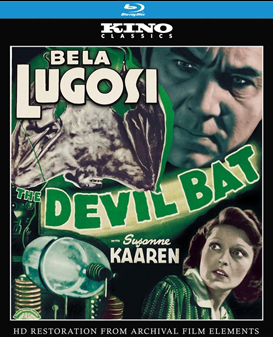
And I will also make room to urge you to listen to Richard Harland Smith’s informative and enlightening track on Kino’s recent Blu-ray remastering of the 1940 Poverty Row production The Devil Bat. The movie itself is unlikely to impress anyone who doesn’t already have a taste for horror marginalia or a fond memory of watching it on late-night TV as a kid, but Smith, a more-than-worthy host and raconteur, will open up this Bela Lugosi sort-of classic to you like no one else could. (Above: Richard hanging out with one of his many acolytes.)

26) The double bill you’d program on the last night of your own revival theater


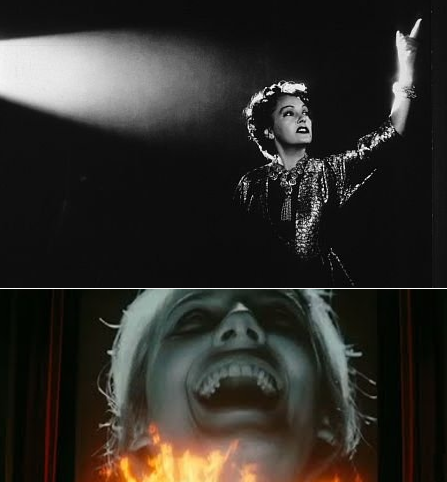
There are so many combos floating around in my head, some of which wouldn’t be quite right for the last night of a presumably beloved cinema. But I think a movie that stretches back to the silent era and points a poison pen toward the heart of Hollywood, combined with a movie that revels in the form of epic Hollywood (and international moviemaking) as well as the audacious use of those forms to unexpected ends, which itself concludes with the burning of a big, beautiful movie house, would seem to fit the requirements of the evening.

May I suggest Sunset Boulevard and Inglourious Basterds?

27) Catherine Deneuve or Claudia Cardinale?


Well, unlike Alain Delon, Marcello Mastroianni or Catherine Spaak, as far as I know Catherine Deneueve never made a picture with Claudia Cardinale, so…. Like there was ever a contest here! Advantage: Claudia!

 ***************************************************** 


Friday, July 03, 2015

WILD, DANGEROUS IMPERFECT GRANDEUR: ELEVEN DOUBLE FEATURES ABOUT AMERICA


The United States is “my country, right or wrong,” of course, and I consider myself a patriotic person, but I’ve never felt that patriotism meant blind fealty to the idea of America’s rightful dominance over global politics or culture, and certainly not to its alleged preferred status on God’s short list of favored nations, or that allegiance to said country was a license to justify or rationalize every instance of misguided, foolish, narrow-minded domestic or foreign policy.
And now more than ever we seem to be living in a country poised at the edge of some sort of transition, with all the attendant tension and conflict and intense conviction that can be expected on either side of the chasm that prevents us from a true state of national togetherness. Just last week we celebrated a Supreme Court decision that finally offered legality (and legal protection) to the notion of same-sex couples living together in marriage, a prospect many might have thought impossible only 10 years ago. On the very same day, we mourned the deaths of American citizens gunned down in a house of worship, the victims of a lone murderer warped by fear, paranoia and racism, the beneficiary of a culture which, in the face of increasingly bloody reason, maddeningly refuses to adjust its addiction to guns.
The emerging tolerance and new understanding has its dark underbelly. Those threatened by progress, by a lack of understanding of the fullness of love, by the exercise of intellect and articulate reason, by the looming Other, are already shoring up for battle, now ever further entrenched against the forces they see chipping away at American values. And there can be no darker underbelly than the taught and perpetuated rage still felt against African-Americans and other people of color who, 60 years after the first sparks of the Civil Rights Movement, still must fight against marginalization, against physical threat, even as they make inroads into American popular and political culture that prove that in many ways this country is not the same as it was even just a generation ago.

Even with all the increased tension and misunderstanding and violence, coexisting amid all the changing tide of tolerance and acceptance that moves America toward a more responsive and responsible nation for all, I still love this country, and I love looking at it with a quizzical eye and a sense of challenge. I believe that patriotism entails honesty, a willingness to celebrate not only the energy and enthusiasm of living in a society like ours, but also confronting the enduring implications of its wildness, its inequities, its self-delusions, its diversity, its restlessness, its brutality, its paranoia and its political and social mythologies. And movies are now, as they always have been, excellent prisms through which to judge the progress of our nation, its self-image, its myths.
 
So as “go-to” as a movie like Yankee Doodle Dandy might seem on July 4, my cinematic tendencies on this holiday run more toward films that look to examine the quality of a land that is more than ever bursting at the seams, in both the positive and negative, movies that attempt to grapple with America and all the shades of its messy, imperfect grandeur. I want to see movies that shed light on the dark corners which might somehow reflect back a heightened clarity about how we got to this point in our history, where increasing understanding of people who have been oppressed in this country for centuries still coexists with alarming, religious-based bigotry, intolerance and fear, and where belief in hard work and dreams of prosperity are continually dampened and smothered by economic hardship and unparalleled greed.
I love movies about America that deal with its blissful possibilities, the transcendent and potentially dangerous fireworks of its culture, the slumbering animal located under the surface of the country’s self-image that occasionally awakens and wreaks political and social havoc. And most of all, I love movies about America that celebrate its orneriness, its blue-collar professionalism, its pugnacious worship at the altar of an ever-shifting notion of togetherness, movies that recognize the cheerful comedy of our self-aggrandizement, that suggest the greatest myth about this country might be that of our collective loss of innocence, landmarked by whatever chosen, significant social event, as if there was ever any innocence to lose.

Here then are 11 double features, some unlikely combinations perhaps, that begin to encompass, for me, the vast wonder and folly of life in America over the past 239 years, the movies that make me grateful for the freedoms of artists who aren’t afraid (occasionally, anyway) to see America for what it is and also what it isn’t.


Ace in the Hole (1951; Billy Wilder) and Used Cars (1980; Robert Zemeckis)

Two masterpieces on the dissection of American hucksterism. Wilder’s brutal drama blisters upon first touch, an examination of the extremes (which if anything have become even more extreme) of our culture of rubbernecking and appropriation of tragedy as journalistic entertainment. Zemeckis and cowriter Bob Gale perhaps don’t cut as deep as Wilder does, but their vision of the gleefully pervasive nature of corruption in small-time American business and politics (which is, of course, a reflection of the big time) is just as cynical and difficult to refute. The added bonus comes in the release of all those toxins in the form of the bitterest of belly laughs.


Buffalo Bill and the Indians, or Sitting Bull’s History Lesson (1976; Robert Altman) and Once Upon a Time in the West (1969; Sergio Leone)
A great American iconoclast examines the legacy of a great blowhard of the American west, locating the nexus of personal celebrity and national self-delusion, while a great Italian iconoclast tempers his romantic vision of that same West with an unblinking nihilism and digs deep into the iconography of a nation’s self-created mythological underpinnings. (It’s amusing to remember that Altman’s film, one of the bitterest comedies about America, was his bicentennial gift to the nation. America thanked him by largely ignoring it and heading out to a big summer picnic. And Leone’s movie didn’t do too well over here either.)


The General (1925; Buster Keaton) and The Right Stuff (1983; Philip Kaufman)
Technological progress in American history, courtesy of Keaton, in which he tours the landscape of the Civil War (and the first hints of the industrial revolution) while on a great locomotive chase that keeps him in dire straits and treacherous contortions for the entire hilarious ride. Likewise, Philip Kaufman’s treatment of Tom Wolfe’s brief history of the space program finds satirical purpose in sending western-infused American can-do integrity up against the well-oiled machine of patriotic promotion in contrasting flight pioneer Chuck Yeager with the Mercury astronauts. The two movies reflect ideas about the purpose of and control over the machines that helped make this country with brashly distributed energy and vision and not just a little insouciant charm.


The Godfather (I & II) (1972, 1974; Francis Ford Coppola) and Nixon (1995; Oliver Stone)
American history writ large, through the fictionalized saga of the Corleones’ rise to and fall from power, and the factually based, but also intensely speculative history of one of the country’s most reviled political figures. (Who knew RMN would have, less than 30 years later, such vigorous competition for that standing?) The tangled, bitter roots of the American dream have rarely been traced with the emotional gravitas that Coppola brings to his film, and Stone’s patented political hysteria (and surprising empathy) has never resonated more deeply or as sharply as it does here.


Lone Star (1996; John Sayles) and The Texas Chainsaw Massacre (1974; Tobe Hooper)

On the surface it wouldn’t seem these two pictures would have much in common beyond their setting somewhere near the Texas-Mexico border. Sayles spins a tale of mystery and the long-buried secrets of a small town in Texas which along the way refashions itself into a twisty meditation on race relations and, perhaps more importantly, familial boundaries that proves to be an even testier, more pertinent treatise in our current political climate than it was when the movie was released. Similarly, Hooper’s deceptively straightforward masterpiece cloaks secrets of its own. This guided tour through the halls of a ramshackle slaughterhouse of horrors connects up uncomfortable notions of the function of family as both a predatory force and an insulated defense against the apparent arrogance of sanity which deepen the sociopolitical influences of the times that shaped its making and continue to resonate within our national shadows. (Feel free to shuffle the cards and program The Texas Chainsaw Massacre along with The Godfather, or perhaps even Fall from Grace, for another rich reflection on the American family.)


Mandingo (1975; Richard Fleischer) and Fall from Grace (2007; K. Ryan Jones)
Fleischer’s lurid adaptation of Kyle Onstott’s lurid novel of degradation in the 19th-century American slave trade remains the great, underappreciated movie on the subject. (I wrote about it here in 2008.) And Jones’ searing documentary about Fred Phelps and the Westboro Baptist Church is all the evidence you’ll ever need that hatred and intolerance are alive and well and just as inexplicable in the 21st century. Seen together, in a semblance of art and reportage, the two comprise a despairing vision of a country that can claim some progress on the (overt) racism front but which remains hard-pressed in some quarters to remember that Phelps’ hysterical bile is precisely the sort of religious justification once used to prop up slavery and segregation.


Nashville (1975; Robert Altman) and 1941 (1978; Steven Spielberg)

The damnedest things I ever saw. Altman’s movie is a snapshot mosaic of a country in crisis that recognizes just how often joyous release and crippling despair go hand in hand. (The freeway accident that turns into a tailgate party is one of the movie’s great metaphors.) And Spielberg’s great, graceful mastodon (directed from another Zemeckis/Gale script) glories in how pop culture patriotism is often a disguise for every form of socially acceptable and unacceptable insanity. The two movies, in their form and attack, might seem quite dissimilar, but I think they’re united by a musically informed vision of America as a land where only the slimmest lines of red, white and blue separate exuberance from hysteria, and paranoia from indifference.


Night of the Living Dead (1968; George A. Romero) and No Country for Old Men (2007; Joel and Ethan Coen)

The sleeping beast in residence at the dark heart of the national soul wakes up and takes a lumbering, unstoppable stroll through the countryside. Romero’s brutal, vital nightmare vision of social upheaval and undead onslaught has been widely (and tediously) imitated—Romero himself would never live up to it—and it had ties to just about every crisis of the tumultuous decade from which it came. Nearly 40 years later, the Coens translated Cormac McCarthy’s searing vision of an America of lost dreams and despairing landscapes, accessing imagery derived from movies as diverse as 2001 and Bring Me the Head of Alfredo Garcia, and in the process setting loose a killer who would no more be denied than one of Romero’s flesh eaters. The countries glimpsed through the savagery of these two movies certainly aren’t for old men, and they bode sleepless nights for the young as well.


Only Angels Have Wings (1939; Howard Hawks) and Convoy (1978; Sam Peckinpah)
Two exhilarating celebrations of blue-collar American men and women at work and the independent spirit beneath their pursuit of professional, existential passions. Hawks’ band of pilots, stationed at a remote South American trading port, routinely risk treacherous conditions to get the job done, weaving a crackling camaraderie in between interpersonal struggles and tragedy. For them it’s as much about the ability to take to the air, to fulfill a purpose in flight, in motion, as it is about a paycheck. Similarly, in Peckinpah’s movie, what starts out as a small group of truckers hoisting a middle finger to the injustices of the highway patrol soon gathers momentum, and trucks, until relentless forward motion becomes its own sort of political statement. The highway continues in a seemingly endless stretch, its contours warped by heat and fatigue, but Peckinpah suggests, with customary orneriness, the cussed glory even at the bloody end of the road.


Quiz Show (1994; Robert Redford) and The Bad News Bears (1976; Michael Ritchie)
The aforementioned myth of American innocence lost gets a good thrashing from these two films. Redford’s movie, from a Paul Attanasio script detailing the televised Van Doren game show scandal of the ‘50s, suggests that while there may have been no real innocence to lose, there sure was a lot of integrity at stake— little of which has seemed to survive television’s ever-increasing hold on the reality-show-obsessed consciousness of a nation more grafted than ever to the electronic teat. In much the same way, Michael Ritchie and writer Bill Lancaster operate from the premise that Little League is no field of dreams but instead a scuffed diamond populated with familiar forms of corruption and less than stellar adult role models. It’s the fight in the Bears the filmmakers find admirable, a sense that, now as much as in 1976, there’s something representative of the citizenry in the great American pastime worth fighting for. Quiz shows and baseball have always harbored cheaters and ne’er-do-wells, but these movies suggest there are still ways to win by playing the game.


Smile (1975; Michael Ritchie) and The King of Kong: A Fistful of Quarters (2007; Seth Gordon)
And by the way, forget American innocence— the shit gets knocked off that statue with a swift kick by these two surprisingly warm-hearted dissections of the spirit of self-aggrandizing, cutthroat competition at the heart of the American dream. Ritchie’s small-town satire, centered on the fictional California Young American Miss Pageant, was released just a month after Nashville, and the two movies would make their own great double bill of slightly soured, yet still exuberant Americana. But seen alongside The King of Kong, the ambitions which in Smile seemed affectionately exaggerated and reflective of similar designs on a grander, national stage, gain a weird poignancy. Gordon’s documentary uncovers the desperation lurking beneath the attempt to best a long-standing world-record Donkey Kong video game score and suggests, as much as Smile does, the real costs of a shot at glory, no matter how trivial the pursuit.


(This article originally appeared in a shorter version here at SLIFR in July 2012.)