Tuesday, February 28, 2006

A TIP OF THE HAT TO DON, DARREN AND DENNIS


I’m not sure there’s a lot left to be said that hasn’t already been covered in the papers and by other bloggers regarding the deaths this past week of of Don Knotts, Darren McGavin and Dennis Weaver, but I feel the need to say something anyway. I feel the need to at least acknowledge their place in the foundation of my own awareness, growing up immersed in the relatively new medium of television, an awareness of those certain personalities and faces that stood out amongst the sea of personalities and faces transmitted into my childhood living room, even in pre-cable days when just the two channels we had in rural Oregon felt like a bounty.

But those two channels carried Gunsmoke, The Andy Griffith Show and, later, Dan Curtis’s original TV movie The Night Stalker. Weaver’s Chester Goode and Knotts’s Barney Fife were both iconic and exaggerated comic portraits of the kind of folks I grew up around in my small town—friendly, doggedly enthusiastic, and in Fife’s case, desperate for a bit of respect, responsibility, big-city validation. Knotts’s characterization is truly one for the ages, and he was lucky enough to find himself in a splendid setting—Mayberry and The Andy Griffith Show-- that seems as good-natured and complete a portrait of small-town life, TV fantasy division, as anyone might ever need. Indeed, Griffith and Leave It to Beaver are two of the only shows from the period that fulfill the requirements of that fantasy vision, of viewer nostalgia, and of a high quality of television comedy-- that is, the shows are genuinely funny and remain so, some 50 years after they first aired. In the case of Griffith, that is due in no small measure to the exasperation, the bug-eyed tension, and the very sweet soul of Barney Fife. (I loved him too in The Incredible Mr. Limpet and, perhaps my favorite Don Knotts movie, The Shakiest Gun in the West. In fact, I remember actually wanting to be Don Knotts in that movie, if only for the occasional opportunity to bump up against the lovely Barbara Rhoades.)

Weaver, like Knotts, seemed to always be on the tube when I switched it on. I used to get him mixed up, when I was very young, with comedian Charley Weaver, so that may account for some of his seeming ubiquity. (And, believe it or not, I used to own this toy when I was about three years old—my, how standards have changed!) Gunsmoke was a weekly ritual for our family, but I knew Chester Goode mostly from syndicated repeats—by the time I was a regular prime-time viewer Chester had moved on, replaced by Ken “Festus” Curtis. But Weaver still made an impression on me in those repeats, as a character and an actor—I can always remember thinking I could imaging liking him in real life. (This was one of the first stirrings, I think, of the concept of respect in my tiny little head.) But, of course, Weaver made his biggest impression on those of my generation in Steven Spielberg’s landmark TV-movie Duel, a mean bastard of an efficient, terrifying thriller in which Weaver’s ineffectual protagonist (on a road trip we’re led to believe may be at least in part inspired by a desire to escape a badgering wife at home) is tormented by a truck driver (never seen) and driven (literally) into a primal state of self-defense during some of the whitest-knuckle suspense sequences seen up to that time (1971). It remains a standard bearer for TV movies and theatrical films, many which have tried, and failed, to match its unique temperament and technique. But while Spielberg has gotten the lion’s share of credit for the movie’s success, it may be late now but just as necessary to acknowledge the perfectly pitched, weaselly sort of everyman quality that Weaver, who relished the character’s fear and paranoia, brought to the table.

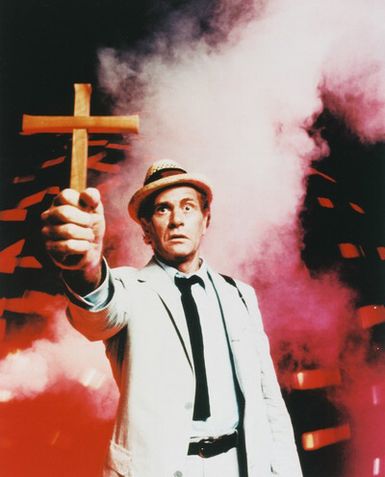
And then there was that other TV movie starring Darren McGavin. As Carl Kolchak, doggedly insistent newspaper reporter who tracked down both The Night Stalker and The Night Strangler in two record-breaking TV movies (before moving on with the character to a disappointingly undercooked ad short-lived series), McGavin brought a new shading of world-weary cynicism to the standard horror film protagonist. Skeptical at every turn, the fun to be had in between bone-chilling scares (at least in the first movie) was in seeing Kolchak’s cynicism slowly stripped away, to watch him becoming a true believer in the bared fangs and sinister seductive power of Barry Atwater’s elusive vampire. Of course, once that cynicism had fallen away, the second movie (and the series) became less fun because Kolchak was already predisposed to believe the most outlandish explanations for the shocking events that seemed to follow him around wherever he went. But there was always McGavin’s exasperation at his boss, Simon Oakland, at Oakland’s refusal to accept Kolchak’s wild stories, which both actors milked for as much comedy as possible, usually with success. And the way he wore that rumpled khaki suit and straw hat, you just knew he was a TV icon in the making. (McGavin has a small role in David Lean’s 1955 romance set in Venice called Summertime, starring Katherine Hepburn and Rosanno Brazzi, and there’s a shot of him waiting for his wife to board a gondola that made me rub my eyes—he’s wearing an almost perfect match of Kolchak’s uniform, sans hat, and I suddenly feared that a giant sea serpent might rise out of the canal and swallow him whole.) But McGavin was almost as memorable as Ralphie’s forever-swearing (in beautifully rendered mock cusses) dad in Bob Clark’s rumpled and hilarious A Christmas Story-- his symphony of obscenity inspired by poor Ralphie spilling a hub cap full of lug nuts into the snow while trying to help Dad change a tire is as gaspingly funny as anything I saw on a movie screen in the beleaguered ‘80s.

A friend of mine commented to me the other day that it’s strange, being of a certain baby boomer age, to see these people we grew up with on TV starting to reach old age and death. It’s different than seeing the old guard of movie stars, whom we perceive as being from a different age, passing on. And it’s different too from seeing people like John Belushi and River Phoenix, who passed away too young from excesses of lifestyle to which we might not all be able to relate. Folks like Knotts, Weaver and McGavin were three faces who we literally grew up watching, seeing them grow older in much the same way we might watch an uncle or a grandparent age. I think we can forgive ourselves, then, our lapses into a certain sentimentality, our feelings of sadness that men whom we never really knew, men who gave us Barney Fife, Chester Goode and Carl Kolchak, are no longer with us.

Saturday, February 25, 2006

OFF-SEASON?! WHAT OFF-SEASON?! Chronicles of a Southern California Drive-in Winter


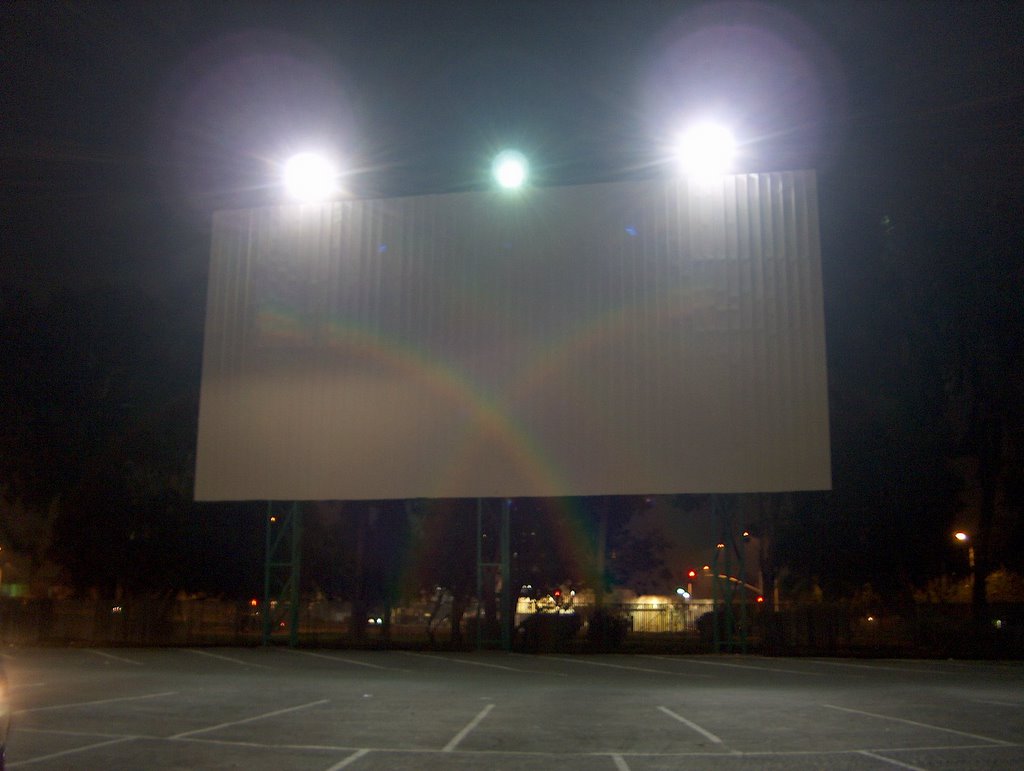
A great perk of living in Southern California (and those of you who know me know I’m perfectly serious here) is the fact that there is no drive-in off-season. And when you’re surrounded by great drive-ins like the Mission Tiki, the Vineland, the Rubidoux and the Van Buren, every day can hold a little bit of summer (even if you have to bundle up against the occasional 38-degree desert night). Couple that with the fact that the Southern California Drive-in Movie Society has, like a baseball team with a whole lot of money, had a very interesting off-season (the metaphor breaks down here very quickly, as SoCalDIMS actually has no money) and you get some idea of why I’m chattering on excitedly about hitting the drive-ins in the relatively frigid months of January and February.

One of the things SoCalDIMS has been up to, besides meeting at local drive-ins once a month to beef up signatures for our e-mail list and raise awareness of the extent to which drive-ins are still thriving in Southern California (and the ones that are here are thriving, believe me), is helping, in whatever way we can, to prepare for the upcoming 50th anniversary celebration being planned for August out at the Mission Tiki. Not a lot of details are available for general distribution at this time, but I can say that what is being bandied about is pretty damn exciting, and if the folks at DeAnza (the company that owns and operates the MT) have their way, we’re in for a hell of a party—a real dusk-to-dawn affair—come August.


Teri Oldknow, who is heading up the organization of the big event, is a real treat, a wildly enthusiastic film fan with a really sharp head for what can work in a situation like this one. When SoCalDIMS member Sal Gomez and I met with her and DeAnza film buyer Frank Huttinger in January to discuss ideas for the big night, we bandied about terrific prospects and possibilities for a couple of hours and came away from the meeting wishing that we’d wake up the next morning and find that it was suddenly August, just so we could roll right up to the Mission Tiki box office that very day and take that jazzed feeling we were riding right into the big event itself. It’s nice to know that someone heading up a big drive-in 50th anniversary is well versed in film, particularly the variety of popular and exploitation fare that graced drive-ins in their heyday (Teri dropped references to Jack Hill and Samuel Z. Arkoff with delight) and that that person isn’t a bullshit artist, that she actually knows of what she speaks and can deliver the goods-- she’s the one largely responsible for swinging the wildly popular Drive-invasions at the Starlight Drive-in in Atlanta. There are a lot of other exciting prospects attached to the Mission Tiki’s 50th Anniversary celebration, and as they get firmed up I’ll be sure to keep you updated and informed. I can tell you this much, however—circle August 5 on your calendar now and keep it clear.

SoCalDIMS has also been keeping a close eye on developments at the Vineland Drive-in in City of Industry. When our group formed this past July, the Mission Tiki was the only drive-in that was fully Technalight operational, meaning that the super-clear illumination system was installed on all four projectors on site. We visited the Van Buren in August, and not long after that we were informed that DeAnza would be installing Technalight on all three screens there, which it has since done. And now the Rubidoux is Technalight complete as well. The Vineland, the only operational drive-in in Los Angeles County, was now the only ozoner in the immediate Southern California area still operating on the old school system. Sal had struck up a friendship with Juan Gonzalez, manager of the Vineland, and facilitated our group communicating to Pacific Theaters, through Juan, the merits of Technalight for the Vineland, which also celebrated its 50th anniversary this past summer. After some footwork by Sal, and a whole lot of effort by Juan, the Vineland’s first Technalight illumination system was installed in mid-December, and it looks spectacular (King Kong was the first movie to jump off the screen in Technalight there). SoCalDIMS made it back out to the Vineland last month to help Juan celebrate the Technalight revolution going on there, and we had a wonderful time, as usual, visiting with this genuinely affable and likable man who so loves the world of the drive-in and its history and isn’t afraid to say so.
Vineland Nights: SoCalDIMS member Sal Gomez, Me, Vineland manager/projectionist Juan Gonzalez, and SoCalDIMS member Kathy Beyers

We also got to meet a lot more people and sign them up for our cause, including Entertainment Weekly writer Chris Willman, a huge drive-in fan who was out with his family (as was I) to take in Hoodwinked. What’s interesting about seeing Technalight at the Vineland is that right now there’s a perfect chance to do a side-by-side comparison with the way things used to be. The screen showing Hoodwinked was perfectly serviceable in terms of illumination—perhaps due to the bright color palate of the computer-animated film—but all I had to do look to the left at screen #2, which was showing the dark-hued vampire thriller Underworld: Evolution to see just how much brighter, how much more vivid and clear a movie presented in Technalight can be. Even from a full lot away, it was perfectly obvious how much better that movie looked than the movie we were watching, from about four rows in front of our screen. The nice thing is, apparently Pacific Theaters representatives also a little comparing in the month since Technalight premiered at the Vineland, because Juan was able to tell us, with not just a little bit of excitement in his voice, than Pacific has decided to pony up for Technalight on the remaining three screens there. If all goes well, the Vineland will be completely Technalight operational by the inaugural weekends of the summer drive-in season. That means that whereas only four drive-in screens in Southern California were equipped with Technalight in mid-summer 2005, by mid-summer 2006 there will be 14 screens on which to enjoy spectacularly bright drive-in projection the likes of which we could only dream about at the drive-ins of our youth. Every single drive-in screen in Southern California will look crystal-clear and bright—the last real barrier separating the quality of drive-ins and indoor cinemas (at twice the price, not including snacks) will have been effectively eliminated. That is incredible news indeed, and news we could have never anticipated when the first meeting of the Southern California Drive-in Movie Society convened last summer.

To close out February, SoCalDIMS is headed out to the Rubidoux Drive-in in Riverside tonight-- sorry for the short notice—for our very first meeting there. If you’re a drive-in fan and have yet to join us on one of our excursions, I really urge you to come on out, stop by the snack bar and chew the fat with us for a while, and of course take in for a double feature under the Riverside County stars, beneath a Technalight screen that rivals those stars in brightness, if not beauty. This is the joy of a Southern California winter-- that we can gather in these open-air cathedrals of popular cinema year round. Add to that the fact that the drive-ins are themselves, every one, are of such high quality, thanks to conscientious and creative individuals like Juan Gonzalez at the Vineland, Frank Huttinger and Teri Oldknow of DeAnza, the mighty Jeff Thurman at the Mission Tiki, and Ron Bacon at the Rubidoux, whose acquaintance we look forward to making just a few short hours from now, and it becomes exceedingly clear that there are some very tangible blessings for film fans to be counted here. And as winter becomes spring, and spring becomes summer, it’s gonna be a lot of fun counting them with my good friends in the Southern California Drive-in Movie Society and all the rest of you who have kept the drive-in flame burning for a whole new generation to discover and come to hold dear.


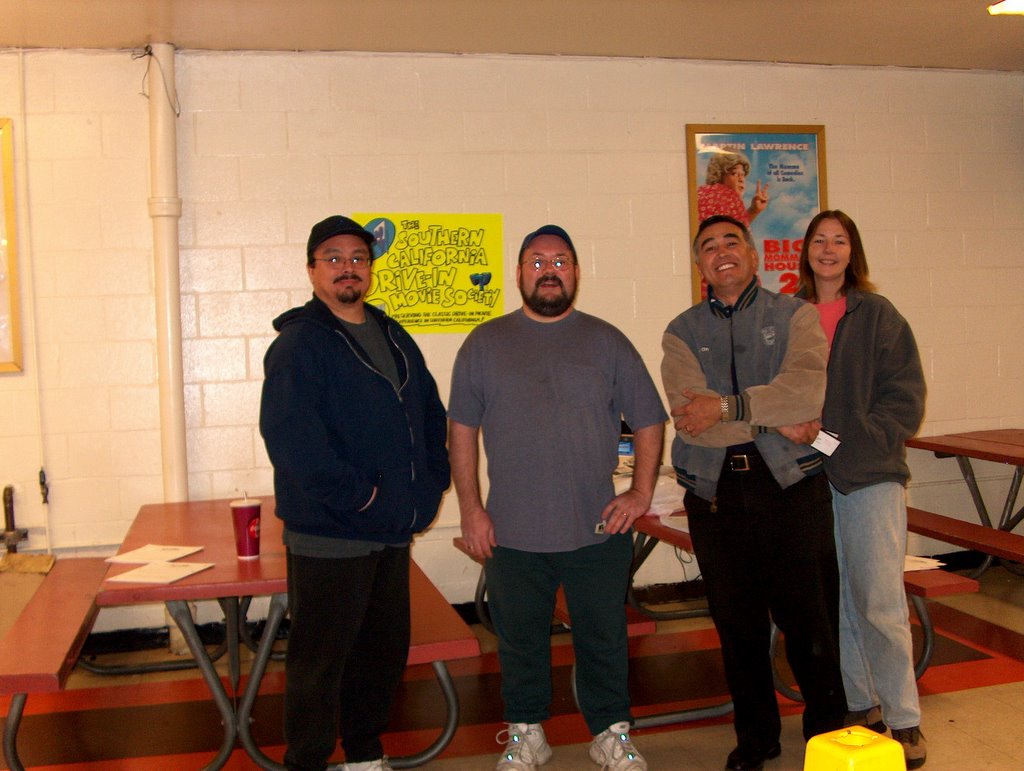
A putrified post-script: My buddies Steve and Paul joined me on a 38-degree night (along with friends Haruka and Max Straight, not pictured) for a Sunday evening of fun and frolic at the Mission Tiki in mid-January. The double feature-- Hostel and Saw II. (Now you see where the fun and frolic comes in, right?) But the fun wasn't restricted to the silver screen, no! Mere seconds after this picture was taken, Steve, long-renowned for his gifts in the fine art of distributing the most foul flatulence imaginable (followed by an endearing cry of "There's nothin' on it!") let fly an epic blast worthy of the Scatology Hall of Fame. In the crisp, cold, open air, mind you, and from a distance of at least ten feet between either Paul or I and the, um, point of origin, it was dense and powerful enough to send us both bolting around the back side of my van in search of some leaking sulphur, or perhaps some rotten trash, which would surely cleanse our violated olfactory systems with a smell surely far less offensive than what Steve had just introduced to our little drive-in party. I'm sorry. I don't know why I felt compelled to tell that little story, except perhaps to illustrate yet another advantage of the drive-in-- if you're enjoying a movie at an indoor theater and somebody delivers something on the order of Steve's very thoughtful gift, there's nowhere to run, and you've probably got others sitting on either side of you, blocking the route to fresh, unpolluted air. But at the drive-in, you can do what Paul and I did-- you can run like hell and hope you live to tell your grandkids about the Man Who Pooed Too Much. Thanks for the memories, Steve!

Friday, February 24, 2006

THE CONFEDERATE STATES OF AMERICA


From D.W. Griffith's The Hunt for Dishonest Abe, the film he would have made instead of Birth of a Nation: "I ain't no president; I's a darkie!"

The Confederate States of America, a new film by Kansas University history professor Kevin Willmott, is making the rounds right now, and the reliable word is that, though it might take a little research to find out where it’s playing and a little effort to get there (it’s gonna be a little harder to seek out C.S.A. than, say, Date Movie or Running Scared), it will most likely be worth the research and effort. Blogger friend Robert Hubbard (he of (mim-uh-zeen) & other loss leaders, out of Topeka, Kansas)has been a good source of information and updates regarding C.S.A. and other locally produced films. He'ss been enthusiastic about the C.S.A. project for quite some time now and has posted a complete list of upcoming play dates from around the country on his site (you can find them on the movie’s official Web site too). He also points the way to an article regarding Willmott’s next project, a biography of Wilt Chamberlain.

Elsewhere, the film review site Rotten Tomatoes reveals that a whole lot of other film critics are catching up with Hubbard’s enthusiasm too, including Ty Burr (the Boston Globe), Owen Gleiberman (Entertainment Weekly), J. Hoberman (The Village Voice), Mick La Salle (the San Francisco Chronicle), Kenneth Turan (The Los Angeles Times) and Stephen Whitty (the Newark Star-Ledger). Manohla Dargis (The New York Times) is perhaps the highest-profile naysayer, unless you include Armond White at The New York Press, who dropped a less-than-subtle hint of what he thought of the film into the middle of his pan of Lars von Trier’s Manderlay:

Manderlay is so ignorant of authentic American behavior that the calculated outrageousness of its premise is dull rather than scandalous. Its story would have to be convincing to be insulting (like the unholy jumble of history and flippancy in the recently released mockumentary CSA which posits what America would be like had the South won the Civil War—a lunacy worthy of von Trier).”

One wonders if the infamous contrarian White might have got wind of what fellow New York Press critic Matt Zoller Seitz thought of the film and decided upon a preemptive strike, for in the following week’s edition Seitz gave the film a rave:

“It’s like Jean-Luc Godard directing a screenplay by Dave Chappelle. It succeeds simultaneously as a comedy, a historical epic, an experimental feature, a send-up of PBS-cable documentary clichés, a dense and intricate work of speculative fiction, an inquiry into the terrifying arbitrariness of human events, a primer in how to achieve brilliance on a budget of nickels and dimes and a film editing achievement (by Sean Blake and David Bramley) in the same weight-class as Zelig, JFK and Fahrenheit 9/11…”

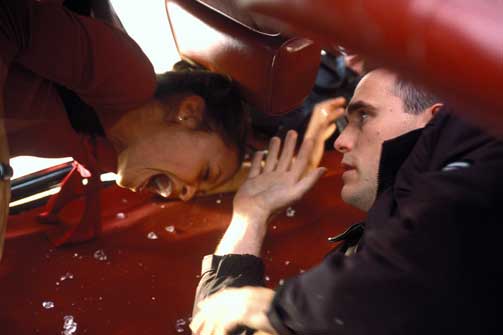
(Meanwhile, in the same issue White was making space to write a welcome and thoughtful consideration of Final Destination 3, which sounded almost as if White thought it was the first in the series, instead of the third.)

But rave reviews or not, C.S.A. looks to take a provocative premise—what would our country be like if the South won the Civil War?—and run with it, and if it only turns out to be half as complicated and funny and rewarding as Seitz and the others seem to think, then perhaps a little footwork on the part of the viewing public might just be worth it. And not that it’s an either-or situation, but I know I’d rather see C.S.A. than Date Movie.

(The Confederate States of America opened today (Friday) in downtown Los Angeles at Laemmle's Grande Four and at the Academy in Pasadena. It also opened today (Friday) at the Roxie in San Francisco, Brian!)

(This post was updated 2/25/06 at 2:22 p.m. A couple of facts were initially reported incorrectly and have been fixed. Thanks, Robert!)

Thursday, February 23, 2006

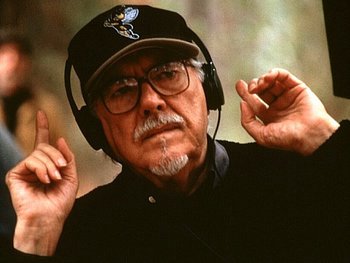
81 CANDLES FOR ROBERT ALTMAN (Part 2)

(NOTE: This is part two of my personal retrospective on the films of Robert Altman, in honor of the director's 81st birthday and his upcoming honorary Oscar, to be presented during the telecast of the Academy Awards on March 5. You can access part 1 of this article by scrolling down this page or by clicking here.)

***********************************************************************

Before we get revved up again, I'd like to pass along a couple of other items recommended for further research that are appropriate for this stage of the game.

First, there's a detailed and engrossing article over at 24 Lies at Second by Robert Cumbow entitled "Altman and Coppola in the '70s: Power to the People" which looks at perhaps the two most emblematic figures in what has become widely thought of as the last great creative period of American filmmaking.

Anyone interested in Altman's biography, his working methods and detailed history of the production of his films have a couple of good sources available-- Patrick McGilligan's warts-and-all portrait Robert Altman: Jumping Off the Cliff and Jan Stuart's detailed look at the making of the director's most acclaimed film, The Nashville Chronicles: The Making of Robert Altman's Masterpiece.

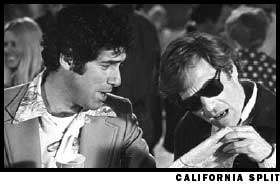
A worthwhile critical appraisal of the director's work can be found in Robert Self's book Robert Altman's Subliminal Reality. And David Sterritt offers Robert Altman: Interviews as part of his "Conversations with Filmmakers" series. And the BBC Four offers some brief audio clips of interviews that are worth a quick listen. For that matter, Altman is one of the few modern directors of stature (Scorsese is probably the only other one) who has produced consistently worthwhile audio commentaries on many of the DVDs of his films, and they are perhaps the best source of information film-to-film to be obtained directly from the filmmaker. Some of the best include track on the DVD releases of Nashville, Dr. T and the Women, Short Cuts, Secret Honor, California Split and, if you can find them, the laserdisc editions of The Player and Thieves Like Us.

And perhaps most impressive is Ray Sawhill's perceptive reconsideration of Nashville, published in Salon in 2000, on the occasion of the movie's 25th anniversary and its first release on DVD.

************************************************************************

Finally, Matt Zoller Seitz has thrown down the gauntlet and proposed an Altman Weekend Blog-a-Thon to coincide with the director's career honor at the Academy Awards the weekend after next. Bloggers who are interested in participating will write about any film or other fascinating aspect of the director's career and post on Friday, March 3 or since, as Matt says, "the Altman spirit demands keeping things loose," anytime over the weekend before the Academy Awards ceremony will do. This should be a lot of fun, both to write and to collect up and read in the afterglow of the Oscars. Reading all the individual, idiosyncratic takes on this great director's career should do wonders toward offsetting any bad taste left in the mouth by upsetting upsets, embarrassing exhibitions on the part of out-of-control winners, or, perhaps, a not-so-shining performance of your own in the office Oscar pool. Remember, next weekend isn't Oscar Weekend, it's Altman Weekend-- get ready for it.

(And in the all-inclusive, democratic community spirit of the director's films, anyone who is without a blog of their own but would like to contribute a piece to the Altman Weekend Blog-a-Thon is more than welcome to submit their pieces to me via e-mail for publication alongside my own article next Friday, March 3. I encourage your submissions and look forward to reading them, along with everyone else's, next weekend.)

************************************************************************

Robert Altman hit a career high in terms of the critical reception of Nashville. Of course neither his admirers, his collaborators nor he himself would have any idea this was the case as it was happening, nor would any of them have any way of knowing that the director was about to embark on the phase of his career that most would term as his most creatively trying and challenging. Indeed, Altman proceeded along his career path taking each obstacle as it came, not seeming to care much about his vexed box-office record or betraying much worry about creative methods and inspiration. The way most of Altman's films feel, particularly those of the period from 1976 through the mid '90s, seem to be pretty much the way they were conceived and executed-- still in a very loose, intuitive, collaborative manner, yet with an increasing sense of being hermetically sealed off from the industry wihin which they circulated, and with decreasing concern for connecting with a mass audience. By the first few months of 1980, he had, for all intents and purposes, given up that pursuit altogether.

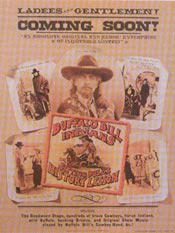
BUFFALO BILL AND THE INDIANS, or SITTING BULL'S HISTORY LESSON (1976) In the wake of my disastrous initiation into the world of Robert Altman at that screening of Nashville in 1975, let's just say I wasn't the ideal audience for the director's follow-up feature. Yet, because my hometown theater, the Alger, booked it, probably figuring it might hold some appeal to local viewers who still held westerns in high regard (and boy, would those unsuspecting folks have had a surprise coming to them if they took the bait), and because there would be no other movie in town for a whole week, there I was, on opening night of the movie's five-day engagement, bored to frustration. Yet even then I recognized a kernel of what Altman was up to right from the get-go-- Buffalo Bill featured the most elaborate example yet of one of Altman's signature moments, the self-consciously attention-grabbing opening credit sequence that announced the movie as a movie and at the same time hinted at the film's ultimate inquiry into the tissue of lies that compose the entertainer's (and the filmmaker's) bag of tricks, and by extension (through Buffalo Bill's interactions with Sitting Bull) those of a certain manifest destiny-inclined world power celebrating its bicentennial in the year the film came out. It took me another 10 years to revisit the movie and realize I hadn't given it anywhere near a fair shake. And in the years since it's initial release its reputation hasn't grown much, even within the community of Altman devotees, beyond its status as a signifier of expectations raised by the triumph of Nashville that ultimately went unfulfilled. But the movie has expanded in my mind much further beyond that narrow perception, and as I think about it now I realize that it is the movie I'm gravitating toward as the Altman Weekend Blog-a-Thon draws ever nearer. Stay tuned. (By the way, the Buffalo Bill one sheet pictured is my favorite from all Altman's films, and one of the few one-sheets that I actually own-- I procured it from that Alger Theater run in 1976.)

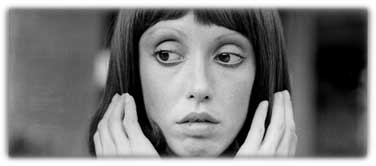
3 WOMEN (1977) If Thieves Like Us planted the suspicion that Shelley Duvall might just be my favorite actress, Altman's insinuatingly sinister, gossamer dreamscape confirmed it. Altman tended to feature Duvall in roles that required her to expose herself to an uncomfortable degree through harsh or sometimes inexplicable behavior, and her Millie Lamoreaux here is initially likable but increasingly, insistently pathetic, a performance of real daring in terms of flirting with creating a character cut so close to the bone as to be painful, one who tears the audience between wanting to see Duvall at work and wanting to turn away from the agonizing level to which the actress lays herself bare. And that she creates such a realistic, nuanced performance within Altman's diaphanously realized and haunted canvas of splintered personality dream logic is perhaps the ultimate testament to her achievement here. 3 Women (the other two are Sissy Spacek, as Millie's roommate Pinky, and Janice Rule as a mysterious, pregnant woman who paints eerie murals on the bottom of a swimming pool) finds Altman dabbling again in the psychological gamesmanship of Images, but this time he's unmoored himself from the reliance on literal symbolism-- the images invoked and inspired by the titular females' shifting, interchanging personalities are slippery, intangible, frighteningly suggestive yet elusive. However, you never get the sense that Altman is playing the "whatever-you-think-it-means-is-what-it-means" shell game. In fact, you can sense the director himself trying to grapple with the implications of the imagery he's processed here (some of which, according to legend, originated in one of Altman's own dreams).

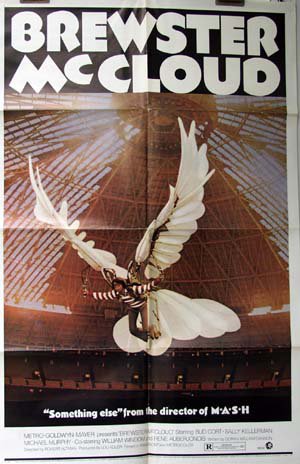
A WEDDING (1978) Or, 48 Outlines of Characters In Search of a Movie. A Wedding finds Altman self-consciously revisiting the narrative strategy of Nashville (which itself was an expansion upon the groundwork initially laid in Brewster McCloud, a film that could just as easily have been called Houston) and upping the ante, doubling the amount of balls he attempts to juggle. The scenario (the reception following the Chicago society wedding between corrupt old money and the grotesquely nouveau riche) would seem to justify the experiment, and the movie's on-the-fly construction is admirable. But it's a movie seriously leached of the element of high spirits that helped keep Nashville soaring. Instead, A Wedding skirts a joyless diagrammatic approach that finds time for the humiliating of almost every one of its 48 "characters" (they seem to me more like nicely dressed chess pieces on a board seriously near being upended) in the name of bitterly funny social observation. Where Nashville was breezy yet down-to-earth, intricate yet liberating and free-associative, A Wedding just seem overstuffed and overly determinate. Even so, there are wonderful performances, which seemed even better when I revisited the movie late last year-- I treasure the unmoored cadences of Nina Van Pallandt's drug-addicted mother of the groom, especially after she gets high and the actress's normally muted, unactressy line readings really take off to Slurrrrsssvillle; and Vittorio Gassman, as the father of the groom, who has lived a life of indentured servitude to the racist family matriarch ever since his own wedding and who, upon discovery of the matriarch's death, suddenly finds himself free-- his reunion with a long-lost brother, whose presence he fears will violate the terms of his servitude (before he has realized he's no longer bound) is a hilarious comic explosion of anger and flustered reconciliation; and, of course, Lillian Gish as the matriarch, who opens the film, speaks briefly, then promptly dies, but whose poisonous spirit hangs over the entire proceeding (for good and bad, I think)-- Altman honors Gish in the way he frames her character in a window at the onset, the then still-living patron saint of the history of cinema, but he never finds a way to honor her through the processional of his own film.

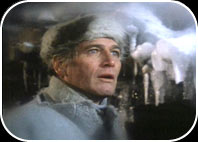
QUINTET (1979) If you would have asked me two years ago what film of Robert Altman's I held in least regard, I would have said Quintet, which remains the nadir of Altman's puzzle-picture trilogy (Images and 3 Women being the other, more successful pieces). It's a suffocatingly lugubrious chunk of heavy-handed sci-fi allegory set in a frozen future wasteland and built on the characters' all-consuming obsession with a backgammon-like game, played to the death and overseen by the phonetically maddening Fernando Rey, the rules of which remain as mysterious to us at the end of the film as they were when it started. But the defiantly esoteric, visually irritating Quintet (the entire film, already rather fuzzily rendered by cinematographer Jean Boffety, is decorated with a Vaseline smudge around the edges of the frame) has been supplanted at the bottom of the barrel-- the actual bearer of Least Regarded Altman Film in my estimation may come as a surprise to some, as it is generally thought of as a brilliant piece of work, and I will leave it to be revealed at the appropriate time. The movie's humorless pretense is in no way redeemed, but it is leavened somewhat by an unintentionally hilarious scene between Rey, Bibi Andersson and Vittorio Gassman (who here burns through the good will he generated in A Wedding) in which they debate the fatal implications of the game. Gassman and Andersson are seated on either side of the freshly killed corpse of Nina Van Pallandt, who stares lifelessly ahead with a spike sticking through her head while these European stars gnaw hopelessly on the clunky English dialogue supplied by Frank Barhydt and their director. Meanwhile, star Paul Newman presides over the film with appropriate dourness, a blue-eyed deer caught in the headlights. SLIFR reader That Little Round-Headed Boy asked me recently if there was an Altman film that I found too unbearable to sit all the way through. My answer was no, I've never walked out on an Altman film. But I can remember the cold and rainy Sunday afternoon when Blaaagh and I sat in a cavernous (and empty) movie palace in downtown Eugene and endured Quintet for the first time. I know both of us wanted to bolt, but we stayed to the bitter (and I do mean bitter) end.
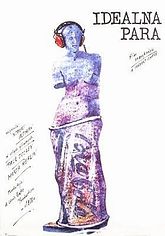
A PERFECT COUPLE (1979) I remember very little of this light, somewhat odd romantic comedy starring Paul Dooley and Marta Heflin, apart from it being structured around the performances of a rock band with a rather overwrought name (something in the neighborhood of Takin' It to the Streets) whose front man was none other than Ted "Jesus Christ" Neeley. But the opportunity to revisit it again is on the immediate horizon-- it's being released in DVD box package with Quintet, M*A*S*H, A Wedding (all of which, by the way, bear the stamp of the subtitles and closed-captions created by myself and SLIFR readers Thom McGregor and the Mysterious Adrian Betamax). And if you're feeling adventurous, you could venture to win that box set by visiting Aaron at Cinephiliac and keeping your "Eyes on the Prize". (Be warned, though: you'll be in direct competition with me, and as of week #1 anyway I'm doing pretty well.) An interesting bit of A Perfect Couple trivia courtesy of IMDb: the role of Sheila Shea was originally written for Sandy Dennis. But Dooley was seriously allergic to cats, and cat-lover Dennis would come to the script readings with up to five cats in tow, causing Dooley at one point to be hospitalized. As a result, screenwriter Allan Nichols refashioned the role from an earth mother type to the young singer/groupie played eventually played by Heflin.

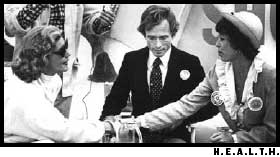
H*E*A*L*T*H (1980) Altman again revisits the cacophonous, multi-character canvas of Nashville (and, rather too strenuously and self-consciously, the acronymic nomenclature of M*A*S*H) for this bizarre comedy centered around a political battle staged during a convention of health food entrepreneurs. The effectiveness (or lack thereof) of its attempt to engage in irreverent political allegory on the eve of the Reagan era was pretty much lost, either through the movie's torturously delayed premiere (it was basically dumped by 20th Century Fox as unreleaseable, which added somewhat to its briefly enjoyed reputation as a buried treasure) or its own overly tangled narrative web. The movie mixes high and low comedy in a distinctly Altmanesque style that is very reminiscent of the similarly messy (and, I think, underrated) Pret-a-Porter, and as a result it is the very essence of "hit-and-miss," but it's also one I've longed to return to for quite a while. Fox Movie Channel trots it out occasionally; unfortunately, the print shown there (at least when it showed up last month) was irritatingly cropped and derived from a less-than-satisfactory transfer, so I opted out in the hopes that the current mining of Altman's late '70s Fox period would result in a DVD somewhere in the near future. Whatever the circumstances under which I next see H*E*A*L*T*H, I can be sure they will not resemble those of my first encounter with this orphaned Altman oddity. In 1981, fresh out of college, where I spent a third of my senior year immersed in the Altman canon, I drove seven hours from my hometown in Southern Oregon to meet Blaaagh in Portland, where H*E*A*L*T*H was playing an exclusive limited engagement at the Cinema 21 theater. Ah, the unfettered enthusiasm of youth!

POPEYE (1980) The experience of making this movie, under the aegis of producer/bully/bullshit artist extraordinaire Robert Evans, and its ultimate lukewarm reception (with the attendant unearned reputation as a artistic and financial bomb) would finally drive Altman, the iconoclast's iconoclast, from the prescribed madness of Hollywood conservatism and into the wilderness of independent filmmaking as it existed in the days when John Sayles was still fresh off of Return of the Seacaucus Seven and the world had not yet heard of Jim Jarmusch or Spike Lee. Few had the desire, when Popeye was released during Christmas 1980, to look at it apart from the stories generated from its troubled production with anything resembling objectivity (or better yet, intelligent subjectivity). And it has yet to be revisited and reassessed in any satisfying way (which makes me look forward even more to That Little Round-Headed Boy's Altman Weekend Blog-a-Thon entry on it next week). For me, Popeye was and is a marvel of set design and pioneering use of cinematography--I always drift back in my mind to that seaside Maltese village where the characters of the movie live, flattened so expressively by the long lenses of Giuseppe Rotunno's camera into the first real attempts to emulate a cartoon universe in three dimensions. And again, my unabashed awe for the unpretentious talent of Shelley Duvall continued here-- if anyone was ever born to align with a particular cartoon character, it was Duvall and her embodiment of Olive Oyl in a performance that I genuinely felt deserved the Oscar that year (she even outdid her own supremely empathetic work in The Shining from that past summer). But Altman's sensibility was also well suited to the material, despite the insistence of everyone from Evans to the emerging magpie reporting of fledging infotainment shows like Entertainment Tonight that he and Popeye were a strange mismatch (they certainly fit better than Ang Lee and the Incredible Hulk). Altman's propensity for the function of community, in the way he builds the inside of his Panavision frame, and in the generous way he approaches the relentless presence of the multitude of characters (including Williams as the titular sailor and the endearing manner in which he mutters his way through the movie) expands Popeye beyond the limited perspective of the typical blockbuster, and that's probably one of the things that got it in trouble with critics and with audiences. For the next 12 years (in what could only in retrospect be anything more than a coincidence, approximately the length of the Reagan-Bush era) Altman would find himself frozen out of the Hollywood that he so openly eschewed, the formula-driven, blockbuster-addicted system that now openly acknowledged that it had no idea what to do with this one-of-a-kind artist. It would be a journey that would return Altman to the fundamentals of filmmaking (filtered, of course, through his own unique sensibility) and ultimately set the stage for this iconoclast's second run at the Hollywood establishment.

Next: Altman in the dark forest of the '80s, and his (brief) return to Hollywood glory in the '90s.