The buzz (here rather conservatively defined as the appearance of a positive-leaning story in the
New York Times “Arts and Leisure” section, enthusiastic reaction to those beatifically demented bus kiosk and billboards ads all over hell and gone, and the good word of someone I know who has actually seen it) seems to be that
The 40-Year-Old Virgin is going to be an adult (read “R-rated”) comedy to reckon with. The
look on star/cowriter Steve Carell’s face in those ads is a perfect mix of blessed cluelessness and the thinnest patina of twisted mania—he looks sweet and innocent, but it might not be a bad idea to keep your distance. This is, of course, a single image crystallized from Carell’s oddball
Daily Show persona, and that of his brilliantly perverse turn in
Anchorman: The Legend of Ron Burgundy, and that image, combined with the pedigree of director Judd Apatow (producer of
Anchorman and the writer/producer of the believe-the-hype TV series
Freaks and Geeks) suggests that fans of fall-down funny, smarter-than-the-average-European-gigolo-gross-out-fest comedy may have yet another treat in store this coming weekend.
But before the torch is passed, if it is, a word about the summer’s other expectation-defying comedy. In my pre-summer article about the season’s
coming attractions, I dissed the probability of
Wedding Crashers having much at all to offer beyond a headache.

I complained about yet another shuffling of the Owen Wilson/Vince Vaughn/Will Ferrell/Ben Stiller combo platter and, without inside information of any kind, took bets on whether Stiller would worm his way into another “hilarious” cameo appearance. Just over a month passed between my Nostradamus-like prognostications and the release of the movie, and in that time I started hearing some pretty good things from some pretty reliable writers about
Wedding Crashers. Although I had to admit my interest was now somewhat piqued, I couldn’t get past my weariness at the prospect of seeing these actors buddying it up again. The wounds from
Zoolander, I Spy, Starksy and Hutch, The Life Aquatic with Steve Zissou and
Dodgeball: A True Underdog Story were just too fresh.
But the subtle indicators were there that
Wedding Crashers might be the real thing. The director, David Dobkin, had guided Wilson and Jackie Chan through
Shanghai Knights, the equally swift, silly and enjoyable sequel to their
Shanghai Noon success, with a genuinely spirited light touch. Wilson’s role seemed more grounded in the kind of easy-going sensibility of romanticized realism that fits him much better than does the strained absurdity of something like
Zoolander or the curdled irony of
Starksy and Hutch. And Vaughn seemed (in the trailer, at least) much more alive bouncing off of Wilson and vibrant players like Christopher Walken and the bizarrely funny
Isla Fisher than he did wearing Bill Murray’s old gym shoes in
Dodgeball or John Belushi’s “College” sweater in
Old School.
My wife and I decided that
Wedding Crashers might be just the thing for a Saturday matinee, and as we were walking in I remember worrying aloud that we might be in for another
Meet the Parents, where the movie just couldn’t live up to the glow cast by the blurb whores and the cannily-leaked preview audience buzz about how hilarious it all was. About a third of the way through, between belly laughs, I stopped worrying. Halfway through I thought, the reviews were right—this
is good stuff. And by the time the credits rolled I was thinking, no, they weren’t—
Wedding Crashers is actually
better than all the advance praise indicated. It’s turned out to be that rarest of rarities in this age of the blitzkrieg opening weekend, where no phenomenon goes unpackaged or unresearched or unpredicted by incessant infotainment “journalism”—a word-of-mouth hit, and a well-deserving one at that.
By now you’ll have either seen the movie or someone will have blabbed to you enough that it couldn’t possibly seem as fresh as it might without people like me nudging you in the ribs and telling you to go buy a ticket. Fortunately, thanks to my sieve-like capacity for retaining comedy bits and jokes for further telling and retelling in writing and to those I can corner in person, there’s little likelihood I’ll spoil any of the setups or jokes in
Wedding Crashers, nor do I have much of a desire to do so. I can laugh like hell with the best of them, but unless a comedy has stood the test of time with me (
Horse Feathers, Blazing Saddles, The Big Lebowski) there’s no chance I could ruin much of the comedic surprise of a movie like
Wedding Crashers for the uninitiated because, frankly, I don’t
remember many of the specific things that made me laugh my ass off. Now, for someone who tries to write about films with some degree of credibility this can be a big problem. If I could have marshaled my resources and my schedule, or if I had an editor who was paying me and insisting that I have a
Wedding Crashers review ready for opening weekend, then it’s more likely I would have spilled some of the movie’s magical jumping beans in print out of sheer enthusiasm. As it is, I only remember one line that made me laugh out loud—Wilson’s “sincere” pick-up line when he soulfully claims to yet another prospective notch on his bridesmaid bedpost that “some suggest that we only use 10 percent of our brains; I say we only use 10 percent of our hearts”—and that’s a line that indicates much of what is successful about the comedy in
Wedding Crashers, despite its gleeful vulgarity, is based not in tit jokes or exploding toilets but in the movie’s characters instead.
But don’t cry for me, Argentina. I’ve actually come to look upon this inability to corral my memory of movie comedy bits as oftentimes a
good thing. I saw
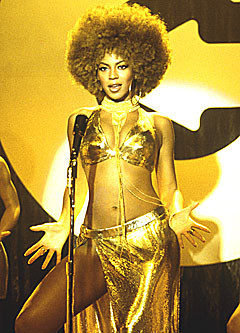
Austin Powers in Goldmember in a theater the summer it was released and happily brayed like a donkey for 90 minutes. Three or four months later, when it debuted on DVD, I couldn’t wait to see it again because, though I remembered loving it and laughing so hard that my eyeglasses were speckled with salt-crusted projectile tears afterward, I could barely remember a thing about the movie beyond the way it looked, and how Beyonce Knowles updated Pam Grier’s
Coffy ‘fro and form-fitting gold lame outfits so, um,
delightfully. Seeing it again, I almost felt like I’d never seen it in the first place. For me, creeping memory loss seems also to mean that comedy, particularly the very silly variety, can be an endlessly renewable resource.
It’s been a month now since I first saw
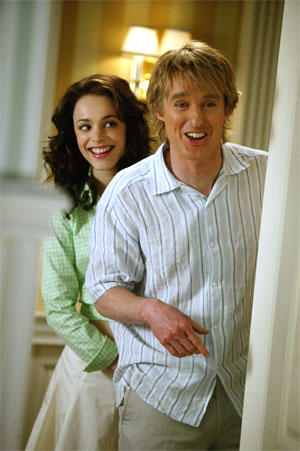
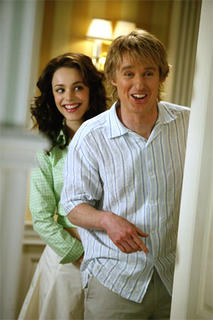
Wedding Crashers, and there are things that I do remember. I can tell you all about how sharp Vince Vaughn’s instincts seem in the movie, how his manic cynicism echoes so well off of Wilson’s heavy-lidded hipster cues and his sincerely dazed responses to the unexpected appearance of true love for bridesmaid Rachel McAdams (all of the sudden, I’m really looking forward to
Red-Eye-- hell, I may even go back and catch
Mean Girls and
The Notebook). Or the delightful visual joke of the six-foot-plus Vaughn slow-dancing with the diminutive
Isla Fisher and casually remarking how small he feels in her arms.

This is probably Vaughn’s finest hour as an actor, and that includes his breakthrough in
Swingers. Earlier I invoked the Vaughn/Bill Murray comparison sarcastically to emphasize how Vaughn can really dog a performance, phone it in and hope that you won’t think less of him while you’re noting the obvious touchstones off which he’s constantly glancing. But seeing Vaughn in
Wedding Crashers made me think he’s the first comic actor who may be worthy of comparison to the Harold Ramis-era Murray of, say,
Stripes, if he can just keep up the energy he’s tapped into here, and not just the nervous tic mannerisms designed to make it look like he’s doing something other than marking time.
I can also tell you about the bristle of anticipatory electricity when the movie opens on Wilson and Vaughn, professional divorce arbitrators playing good cop-good cop while wedged in the wide-screen frame between the delightfully nasty Dwight Yoakam and Rebecca DeMornay, two none-too-happy soon-to-be exes. I can tell you about the twisted gleam in Isla Fisher’s eyes as she bounces and giggles in a post-fornication glow, excitedly chattering about what a wonderful life she and Vaughn will have together, all right in his squirming, flabbergasted face, and about the twist in his character’s progression regarding this perky little insane person that lends
Wedding Crashers one of its many levels of comic richness.

I can tell you how unexpectedly delightful it was to see Jane Seymour on screen again, shedding her Dr. Quinn petticoat (metaphorically speaking) along with her wedding reception ensemble (happily, quite literally speaking) in a brazenly sexual comic riff that, immediate pleasures notwithstanding, unfortunately doesn’t add up to much more. I can tell you that Ben Stiller does not appear in
Wedding Crashers, but Will Ferrell does and, par for the course from the man who breathed life into Ron Burgundy, his appearance is teeth-gnashingly creepy, though not as brazenly funny as his work as San Diego’s best-feathered newsreader. Finally, I can tell you how good it felt watching a movie that really isn’t transgressive in its old-school vulgarity—nobody’s trying to break through any Farrelly-inspired barriers here (hell, even the Farrellys don’t seem much interested in that strategy anymore, to their credit and, most probably, to their agent’s horror)—but one that was still bracingly nasty even as it settled into some very familiar romantic comedy formulas and structures.
Wedding Crashers is, amazingly enough, still hanging around in theaters, and it’s worth catching there for the wide-screen frame director Dobkin uses so well and so unobtrusively, and for the particular fun of laughing loudly and often with others who are similarly caught up in the comedy. And who knows—if
The 40-Year-Old Virgin ends up being half as good, we may be in for a formidably funny double feature coming soon to a drive-in or second-run house near you. *
*************************************************************************************
But then again, what do I know? That’s the unspoken theme here today, so I might as well cash in the latest revelation of my misdirected studio-fed preconceptions. It was the recipient of some of the season’s most witheringly reviews, and even I smelled a
Daredevil-sized skunk myself when I first saw the preview in front of that other
skunk that kicked off the summer.

But about two weeks after the early July release of
Fantastic Four, two weeks being just about enough time for the nearly universal pans to have calcified into accepted conventional wisdom, I got an e-mail from my good friend Andy who took his son to see it and was pleasantly surprised by how much fun it was. Now, though Andy and I often agree on films of this sort (see that skunk link above), we’re just as likely to come down on opposite sides of the fence—I found
Batman Begins to be exceedingly well-crafted and unexpectedly rich in character; he, and his son, thought it was a colossal snooze. So though I valued his recommendation, especially in the face of so much negative reaction, it was no guarantee that his response would reflect my own. Nor was Stephanie Zacharek’s late
endorsement of the movie. She starts her review thusly:
“Fantastic Four is a breezy summer blockbuster that already has the feel of an antique: It exists largely to entertain and delight, which used to be precisely what summer blockbusters were engineered to do. But in the summer of 2005, so far at least, Fantastic Four seems like an anomaly: It's not a "quality" blockbuster -- note the quotation marks – like "War of the Worlds" or "Batman Begins," pictures with heavy, doomy spirits that work overtime to convince audiences they're getting some spinach (or even just some craftsmanship) with their alleged entertainment. Fantastic Four is so light, it sometimes seems in danger of blowing away.”I had reservations about
War of the Worlds too, and obviously I disagree with her description of
Batman Begins as heavy-handed. But was Zacharek’s backing of
Fantastic Four simply a case of sticking up for the poor little beat-up blockbuster, a backlash against the backlash? Or was she on to something about the movie’s lack of pretense, about its desire simply to amuse? Would it be too much to hope that she was right?
Well, as it turns out, no, it wouldn’t.
Fantastic Four is about the least pretentious comic book movie to have been made in the long shadow of Tim Burton’s stylistically influential
Batman and all the graphic novels that have refashioned the origin stories of popular comic book heroes and grafted a certain level of seriousness onto their framework. There’s none of that kind of angst-y inflation going on in
Fantastic Four, and really, when you honestly examine the original comic book, how could there be? After
The Incredibles, wouldn’t we be more likely to chuckle at an overly portentous version of the same sort of material (even if Marvel did get there first), especially since the Pixar film
did end up engaging some serious themes amidst all the spectacular filmmaking? And just what is wrong with resisting that blockbuster urge to justify making gigantic movies out of every known comic book by insisting they each become their own dark night (ooh, I almost said “dark knight”!) of the soul?

Director Tim Story keeps things moving at a lively pace and never bothers to engage some the movie’s (and the comic book’s) surface-level absurdities, like the complete lack of explanation as to what causes each member of the Four to be affected by the same radioactive cosmic cloud in distinctly different ways. And the special effects never strive for
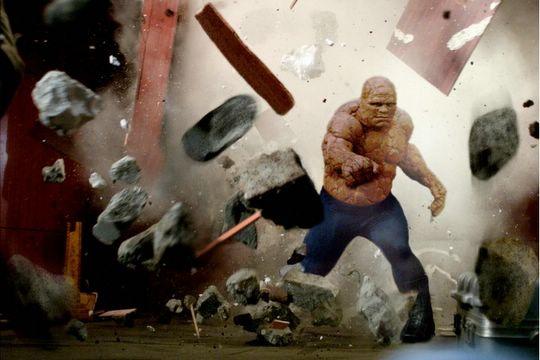
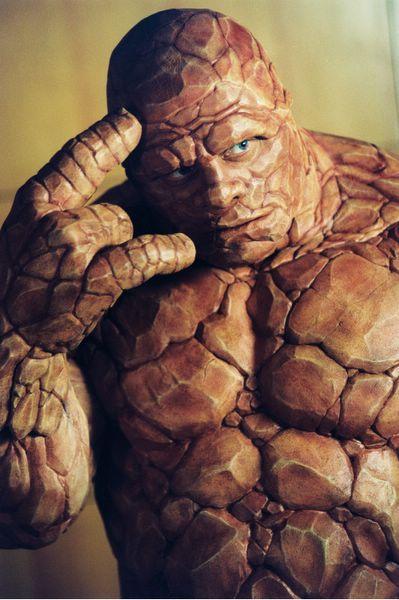
War of the Worlds-level realism—there’s a certain CGI-age cheesiness to them, which may or may not be intentional, but which turns out to be a good thing, especially when one of your main heroes is brought to life by some very remarkable, yet very old-school-style latex rubber appliances made to look like living stone.
Fantastic Four never presses, thematically, much beyond what the acquisition of these powers (or these “symptoms,” as they are initially referred to) means to each of the Four personally, and it surprised me with its genial tone (which is distinctly different from a “gee-whiz” tone, at least here) and its sense of humor (also a trait that can be traced back to the comic book). The movie also doggedly refuses to give the Four’s plight any kind of global significance. The villainous Dr. Doom, who finances Reed Richards’ checkered date with that cosmic cloud and is along on the ship when the D.N.A.-altering storm hits, is angry that he too has been affected—his flesh is transforming into some form of hyper-conductive, super-hard metal—and that Richards has stolen Doom’s biophysicist extraordinaire and love interest, Sue Storm, away from him, and the resulting second-half action is, essentially, a superhero street fight over some very personal issues.
That scaling down (such as it is) of the movie’s narrative ambitions proves to be liberating, and the action scenes are both kinda clunky and kinda limber at the same time. They’re mostly terrifically exciting, too, and I responded to them in much the same way I remembering responding to the incredible dynamism of Jack Kirby’s original illustrations. Don’t get me wrong--
Fantastic Four isn’t a stylistic feature-length money shot along the lines of
Sin City-- I doubt Tim Story would be up to the kind of grand visualization schemes that informed Robert Rodriguez’s adaptation of Frank Miller’s graphic novel earlier this year, and I couldn’t be happier about it. He’s basically got his hands full with the movie we see on screen, and his breezy, workmanlike approach is a refreshing antidote to the kind of self-consciousness that is the hallmark of graphic novels, and movies, like
Sin City.
The actors tap into this spirit of fun too. Michael Chiklis has really only his eyes to work with as Ben Grimm, who gets transformed into the walking rock known eventually as the Thing, but he brings a surprisingly delicate physicality to the table as well, while at the same time conveying the necessary credibility as regards Grimm’s newfound body.

He has several scenes in which play humorously off his inability to use, say, a knife and fork (he gets the reverse moment as well when he’s seen squeezing an entire bag of oranges to make a mixer bowl’s worth of juice), but Chiklis has the grace to underplay what Zacharek aptly describes as a potentially cornball moment—Grimm’s fiancée rejects his new appearance, takes her engagement ring off and leaves it on the street, and Grimm realizes he cannot even pick the ring up off the ground with his gigantic stone digits. It’s time to leave the old life behind, all right, and as he turns and walks away, dressed in a
really oversized trench coat and hat, he looks like a refugee from a ‘40s romantic melodrama, and the bitterness of his understanding carries with it echoes of Bogart. But Bogie could never crumple an entire car and toss it at someone like a paper ball. Chiklis never lets Grimm’s despondence get the best of his characterization, and you can see through the rubber suit the joy he takes in getting to dish out some Clobberin’ Time, when Grimm realizes there might be something to being a man of stone after all.
Chris Evans (of
Cellular) has surprisingly sharp timing as Johnny Storm, the
extreeeeeme kid (Sue Storm’s astronaut brother) who becomes the Human Torch in the aftermath of the space disaster, and who is the only one of the Four who sees the potential for
fun in their newly acquired powers.

It was his character I was dreading the most, based on the trailer, because I wasn’t sure I needed to see more Hollywood genuflecting at the altar of the
extreeeeeeme, and it’s a credit to Evans’ likeability that his prankster persona comes off less annoying (to everyone but Ben, perhaps) and ends up helping to keep the movie on the right track, sensibility-wise. Julian McMahon has the eyebrows that give away Victor Von Doom’s character arc in his first five seconds on screen, but he’s pretty delightful to watch here anyway.

Doom doesn’t relish his villainy in the usual way—it’s too based, at this point anyway, in pure anger and a sense of being wronged for him to much enjoy his power. But that doesn’t prevent McMahon from enjoying himself, and without, significantly, ramping up the stakes in the Can-You-Top-Jack-Nicholson department of superhero foes. His Doom is power mad, and with a sardonic sense of humor that may be a holdover of his national origins—at one point there is a close-up of an award given to him by the people of his home country, fictionally located somewhere in Eastern Europe: “To Victor Von Doom, for all you have done for the people of Latveria.” The plaque, it is revealed as the camera pans up, is attached to a glass-encased
mask, an evil visage made of steel that Von Doom will soon adopt as his signature face plate, once his own bodily transforming becomes too grotesque for family viewing. Who wouldn’t, coming from national stock like that, eventually find pure evil as a viable option? Likewise, who wouldn’t be just a little miffed at having a sex kitten like Sue Storm stolen from you by your old high school nemesis? There are moments, especially on the spacecraft, where Jessica Alba is photographed with the right sensitivity to the spunky luminousness of her facial features, and with her cheerful sexuality never far from the surface, that I thought someone like Roger Vadim would have loved her.
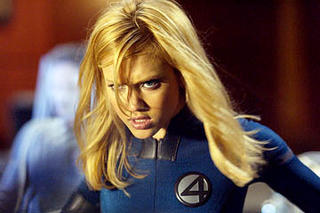
And she’s a good choice for the Invisible Woman—it’s neat to see what she can do when she’s using her powers, but, by gosh, you miss
seeing her when she goes all gossamer. Alba keeps the vamping in check, though, and provides a nice counterbalance to the boyish bickering between Ben and Johnny (even if she’s not particularly believable as a biophysicist—but then, who in Hollywood would be?), and she ends up shouldering perhaps a little more emotional gravitas than one would have ever expected by the film’s conclusion. The only thing she really doesn’t do too well is make us believe that she could ever keep up much interest in Reed Richards, but that, I think, can be laid at the feet of the miscast Ioan Gruffudd, who simply doesn’t bring much intensity or spirit to the character.

Richards has always been the least interesting of the Four, but giving a more dynamic actor in the part, one who didn’t acquiesce so quickly to the character’s own reticence by receding into the background himself, could have solved this particular problem without changing a line in the script (which is fairly sharply written, by the way, by Mark Frost (
Twin Peaks) and Michael France (
Hulk, The Punisher). Fortunately, once Reed starts using his taffy-twisting torso as Mr. Fantastic (the moniker Elastic Man was already taken) the movie comes up with enough for him to do that you momentarily are relieved of the awareness of what a stiff he’s been for the previous 90 minutes.
 Fantastic Four
 is proof enough that not every blockbuster needs to have apocalypse appeal or heavy-duty underpinnings in order to be a success. Unfortunately, a lot of the bad press it has received seems to have been based on the fact that it eschews those elements, that it
is as faithful to its source material as it is. Maybe those who hold the original comic book dear have had their expectations altered over the course of the last 20 years of Hollywood’s raiding of the DC and Marvel vaults. Maybe a revisionist take is what many assumed would be the tack taken. But what of movie critics who have fallen all over themselves deriding the movie as disastrous trash? Could the simple pleasures a movie like this has to offer be beneath some of the critics that raced to overrate a sub-par horror thriller like
Land of the Dead based almost entirely on its directorial pedigree and not, it would seem, on what’s up on screen? Or the Internet infotainment prognosticators who began dumping on the movie as soon as its director was announced, before a frame of film had been exposed? I’m not sure what’s up with the way
Fantastic Four was received in the press. But personally, I’m just grateful for all the different ways it managed to tickle me when I saw it, and that it didn’t, after all, turn out to be a sausage like
Daredevil. It’s a small gift, but I’ll take it.
And now just a couple of words for the double feature that could have been. While out at the 99W Drive-in in Newberg Saturday night I was treated to my second screening of
Herbie Fully Loaded and my third screening in two weeks of
Charlie and the Chocolate Factory. I think Tim Burton’s movie is just fine, perhaps better, in significant ways that have less to do with nostalgia than with performance, than the much-loved Gene Wilder version. In fact, Depp and all five kids have it heads and tails over Wilder and company in the 1971 movie—the new Augustus Gloop is an cosmic Aryan crackup, his pale blue eyes twirling with sugar-fed mania; Violet Beauregard is a hilarious riff on Dakota Fanning, and her mother (
Missi Pyle) has the funniest psychotic stare I think I’ve ever seen; the new Mike Teevee takes video game mania to frightening new heights (helped along by a title card introducing him, over the sounds of gunshots from one of his games, as a resident of Denver, Colorado); the 2005 model Veruca Salt more than holds her own with the 1971 version, though there’s not much variance between the two in terms of the way the character is approached (and James Fox is not as funny as Roy Kinnear was in 1971 playing Veruca’s haplessly indulgent dad); and Freddy Highmore’s take on Charlie Bucket is very Roald Dahl; childlike, clear-eyed, but not a whit sentimental, whereas Peter Ostrum’s gee-whiz Charlie walked through the entire movie with real big tears at the ready, should his Grand Canyon-sized smile ever fail him. As for Depp, I locked in on his bizarre wavelength from the start and found his demented reveries and high-pitched, sing-songy barbs and non sequiturs creepy
and hilarious. If you find this version too weird and disquieting, you may not have seen the 1971 movie in a while—I’d guess it’s probably quite a bit nastier, in its own way, than you remember. Burton’s wonderfully perverse eye has not failed him here, and the Freudian jokes and behaviorally suspect Wonka that Depp offers up are more than satisfactory enough for me. And no Anthony Newley songs!
That said, I don’t need to see it again, that’s for sure. As it turns out,
Herbie Fully Loaded worked much better at the drive-in, what with its artlessly amusing car antics, lowbrow comedy and a lead actress poured into one tight-fitting T-shirt after another.
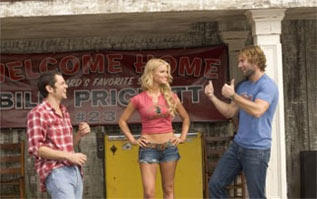
Trade the T-shirts for a bikini top and pair after pair of criminally short shorts, and you basically have
The Dukes of Hazzard, which would have been the perfect co-hit with
Herbie at the drive-in. Alas, it was not to be. So I had to leave my hotel room last night and find an indoor theater near me playing the tender story of Bo and Luke Duke and their pulchritudinous cousin Daisy (admittedly not as difficult as task as tracking down, say, a
Bela Tarr retrospective within driving distance).
I did, however, hesitate for a moment when, just before leaving, I found a review on IMDb that gave me pause:
“This movie is a shame and a disgrace to the Duke family name. I was a huge fan of the show. HUGE. But this was the worst movie I've ever seen in my life(italics mine). John Schneider must be spitting nails to see Stifler in his driver's seat. Calling this film The Dukes of Hazzard was a poor smokescreen for selling a bad film. No matter how hard they tried, none of those jokers are, or will ever be, Dukes. Daisy Duke (played by Catherine Bach) was hot, smart, and sassy. Now don't get me wrong, Jessica Simpson is one of the hottest women alive, but she is no Daisy Duke. Her Daisy was a bimbo who just walked around in a bikini all of the time. Also, I love Willie Nelson, but he wasn't Uncle Jesse, he was Willie Nelson. All in all, this film turned my stomach and did a great dis-service to the name of The Dukes of Hazzard. Nice car and jumps though.”This cogent, level-headed piece of criticism pretty much had me convinced that spending my $8.50 to see
The Dukes of Hazzard might just be one of the biggest mistakes of my life. I was in the act of putting down my wallet and car keys, readying myself mentally to stay in the hotel room and catch the 8:30 pm showing of
Berlin Alexanderplatz on HBO when I read that last line: “Nice car and jumps though.” The language resonated, as did the sentiment. Nice car
and jumps. That was it. I picked up my car keys, raced to the parking lot and peeled as much rubber as my cheap rental car would allow on my way to two hours of redneck bliss.
And, oh, what bliss it was. There hasn’t been a movie this unabashedly idiotic since philosophy major Patrick Swayze took up bar bouncing in
Roadhouse, and the fact that
Dukes director Jay Chandrasekhar (
Broken Lizard’s Super Troopers) revels in the goofiness of the original concept, without turning it into a humorless
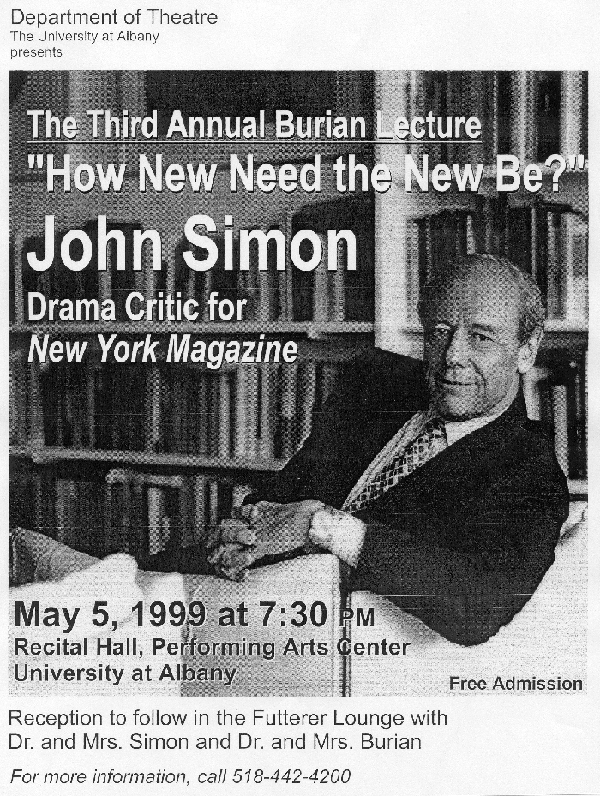
Starsky and Hutch-style condescension-a-thon, just adds to the giddy, wide-screen thrills. Johnny Knoxville cackles and yells “Whoo-hooooo!” real good; Seann William Scott yells “Yee-haaaah!” real good, and he has a creepy-funny sexual attraction to the General Lee that, unfortunately, the studio’s insistence on a PG-13 rating apparently prevented from being fully, ripely explored; and speaking of ripe, Jessica Simpson, despite the objections of
John Simon above, wipes out all vestigial memory of Catherine Ba---? See? I’ve forgotten her name already. When Jessica/Daisy bends over the open hood of her Jeep and begs the help of a pie-eyed sheriff, asking him to check her undercarriage, well, that’s movie heaven right there. No, wait, movie heaven is Jessica/Daisy putting her boot on the neck of a redneck who tosses one too many sexy drumstick cracks her way in a bar. No, wait, movie heaven is all them
car chases, which, whether on the back roads of Hazzard County or on the freeways of Atlanta (where the movie crafty deals with the issue of that confederate flag on the roof of the General Lee), are staged with enough fire and giddy-up to make Hal Needham rock hard with envy and limp with the realization that he never did ‘em half so good. There’s a place for reckless, dumb fun, and right now that place is a seat in any auditorium (or drive-in) showing
The Dukes of Hazzard.
*************************************************************************************
* (By the way, in my
review of
Mr. and Mrs. Smith I took a moment or two to consider Armond White’s rather strong reaction to the movie. White surmised: “You don't have to be Osama bin Laden to think that only a horrible culture would produce an ‘entertainment’ like Mr. and Mrs. Smith. But when a bootleg of this facetious comedy does get satellite-projected to that crazy hermit in a Middle Eastern cave, he'll probably break into an ‘I told you so’ grin.” My own reaction to the movie was sufficiently the opposite of what I considered White’s rather reactionary one that I made a supposition of my own to end my comments: “I can’t wait to find out how Wedding Crashers is so wretched as to justify not only bin Laden’s hatred of America but perhaps further action against its citizenry, and during his lecture White will surely find a way to bring up Mr. and Mrs. Smith yet again.” So, in the interest of fairness, here is Armond White’s review of
Wedding Crashers in its entirety:
“The first half hour ofWedding Crashers makes you expect a comedy classic. Vince Vaughn and Owen Wilson, playing divorce counselors, are also dogs who scheme to bag babes by cruising at the nuptials of complete strangers. It begins with such hilarious aggression (Dwight Yoakam and Rebecca DeMornay as greedy divorcees) that Vaughn and Wilson’s antic complete a satirical portrait of neurotic, new-millennial American appetite. They are allured by the catering as much as the available sex. Director David Dobkin can’t make the humor grow; it devolves into a Meet the Parents knock-off. Just shy of vulgar, there remains the spirit of a perfect, mythic joke premise.”The review basically serves as a segue from a long review of
2046 to three or four more lines on
The Aristocrats, so it’s not like White spends a lot of time considering
Wedding Crashers, which is, I suppose, as good an indicator as any that he liked it—his vitriol tends to get much more free rein when it comes to cinematic offenses. But I felt it only fair, after my own prediction about his reaction, to highlight in print that, in much the same way that I misjudged
Wedding Crashers itself, I misjudged how the
New York Press’s premier contrarian crankpot would respond to the movie.)
Au revoir, Portland!


 Posts
Posts




 Tonight is one of those nights. The world seems smaller and a lot heavier, and I’m not even anywhere near New Orleans. It’s a night to run through the few hours I’m allotted every couple of months or so to feel like it’s all just a little too much. That time will pass, and so will the sensation of being overwhelmed by the everyday, the challenges that, during most every other moment, are not only surmountable but pleasurable, the tugging and chattering and pleas for sympathy and empathy and intervention that are most often sweet music, but which tonight, for those few hours, seemed more like inescapable, burdensome static.