Showing posts sorted by relevance for query rendezvous. Sort by date Show all posts

Tuesday, January 26, 2010

GONE IN 540 SECONDS: CLAUDE LELOUCH'S C'ETAIT UN RENDEZVOUS GETS A MAKEOVER


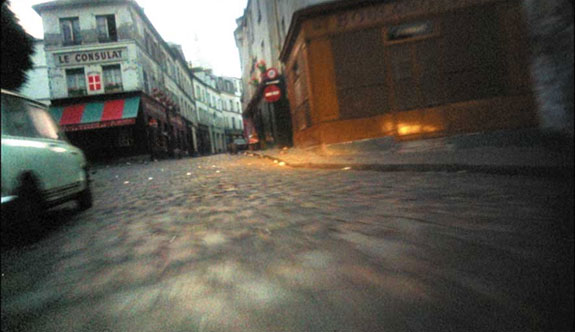
This piece on Claude Lelouch’s infamous nine-minute film C’était un Rendezvous (1976) was first published on the virtual pages of SLIFR nearly five years ago, on April 12, 2005. It is republished here for two reasons. When I first wrote this piece YouTube did not exist and I had to rely on a DVD obtained by my friend Andrew Blackwood from the now-defunct Nicheflix in order to even see it. Now the film is easily available and, through the magic of embedding, available to watch right on the same page on which the article appears. (The original piece was accompanied only by a still frame which, while accurately conveying the velocity of the film, was no substitute for actually seeing it.) Second, today comes word via David Hudson of an Internet remake of the film utilizing footage obtained entirely from Google Street View imagery. Alex Hammond’s video remake is embedded after the original article, alongside a few newly minted comments, for purposes of comparison.

*************************************

French director Claude Lelouch, perhaps best known to American audiences as the man behind the sentimental romantic hit (and Cannes award-winner) A Man and a Woman (1966), starring Anouk Aimee and Jean-Louis Trintignant, and the Oscar-nominated And Now, My Love (1975) is a filmmaker one might easily be forgiven for excluding from a short list of those who have committed memorable car chases to film. John Frankenheimer (Grand Prix, 1966, Ronin, 1998), William Friedkin (The French Connection, 1971, To Live and Die in L.A., 1985), Peter Yates (Bullitt, 1968), Walter Hill (The Driver, 1979), Peter Collinson (The Italian Job, 1969) are all names you might expect to be mentioned for such a roster. Hell, even the name of the late stunt coordinator/director H.B. Halicki, the man behind the 60-minute car chase in the original Gone in 60 Seconds (1974), would come up before that of Lelouch, a filmmaker who Leonard Maltin’s Film Encyclopedia describes as having “a fashion magazine approach to directing.” Trintignant’s character in A Man and a Woman was a race-car driver, but the film was not exactly Grand Prix, or even Winning (1969), for that matter, and that character’s career associations would seem as close to high-octane action as the director has ever come on screen.

In a feature, anyway.

In 1976, sometime after production wrapped on his film Si c’était a refaire (If I Had to Do It All Over Again), Lelouch, as the story goes, had a reel of film stock left over from his shoot-- approximately ten minutes worth—and an itch to scratch. He had recently purchased a Ferrari and had the idea to mount a gyroscopically stabilized camera low on the front end of the car and navigate a predetermined route through the streets of Paris, during the early morning hours when traffic and pedestrians would be relatively sparse, at a ludicrously high rate of speed. It’s at this point in the history of Lelouch’s nine-minute film C’était un Rendezvous (1976) where what is actually known about its production ceases and the rumors and mythology built up over the years since its release overwhelmingly take over. Lelouch screened the short film several times before one of his other movies (which leads one to wonder just how those primed to see one of the director’s gauzy coffee-table romances reacted to Lelouch’s reckless, testosterone-fueled side), but after objections began mounting, and after his arrest following one of the screenings, the film went underground. Lelouch, undoubtedly happy to perpetuate the mystery surrounding the circumstances of its filming, and the mystery surrounding its subsequent unavailability, was entirely silent on the subject, a stance he holds to this day. Car enthusiasts, though, kept the rumor mills buzzing throughout the ‘80s and ‘90s, and poor-quality pirated VHS tapes eventually started popping up on the Internet, adding to the resonance of the film’s outlaw mythology.

Was it actually Lelouch driving the car, as he claimed after the film’s release, or did he hire a Formula One driver to get behind the wheel? Was it done with the cooperation of the Parisian police, allowing Lelouch to choreograph the various obstacles and near-misses that the Ferrari encounters along the way? Or was it done, as Lelouch claims, using only strategically placed radio contacts at various stations along the route, come what traffic may? Did one of those radio contacts actually fail, putting the driver and other cars at far more risk than was even anticipated? And was the car really going as fast as some enthusiasts have claimed, up to 140 mph?


The movie starts on a blank, dark screen, all silence but for the faint beating of a heart, and after a disclaimer stating that no special effects or film speed manipulations were used to make the car appear to be going faster than it actually was. The car emerges from the silence of a dark tunnel into the muted daylight of an early Paris morning, and as soon as it does Lelouch jumps us into what will make up the entirety of the rest of the film’s mesmerizing soundtrack—the high-gear revving of the Ferrari’s engine, alternating with the engine’s growls and shrieks as the driver rapidly gears down, and then back up again, and the sound of the tires squealing on the asphalt and cobblestone of those otherwise relatively quiet Parisian streets.

It’s on the first straightaway, leading to the Arc de Triomphe, when the driver first opens up the racer and builds up some terrific speed, that that disclaimer at the beginning seems, while certainly not untrue, then just a little bit disingenuous. Certainly no special effects, as filmmakers in 1976 understood and employed them, could have been utilized in a single-take situation such as this without being as apparent as a proverbial sore thumb. The same goes for undercranking the film-- exposing fewer frames per second than normal filming speed (24 frames per second) so that when projected at the normal rate the action of the film appears speeded up. This is a technique that anyone who has dabbled in Super 8 and 16mm filmmaking, as I did in my long-lost youth, is undoubtedly familiar with—my friends and I shot several car chases and employed this technique to make similar sequences of us barreling down the highway look as though we were going 80-90 mph, when in fact we were probably only going half that, or less. And undercranking is not just the province of amateur enthusiasts—it has been routinely employed in big-budget features for years. George Miller even used the technique (to much better effect than ours, to be sure) in the elaborate chase sequences featured in Mad Max and The Road Warrior. There’s only one problem with undercranking—it’s extremely detectable, even in The Road Warrior, and therefore distracting as hell. And it’s definitely nowhere in evidence in C’était un Rendezvous. But despite his otherwise sedate oeuvre, Lelouch definitely understands what Frankheimer, Miller and others also understood about the dynamics of filming road action. By mounting the camera relatively low on the front end of the vehicle, Lelouch is able to take advantage of the graphic weight given to the street as it zooms by underneath, and his stunt is helped along to an immeasurable degree by the sense of speed that the camera positioning is able to convey. My suspicion about C’ Etait un Rendezvous is that that camera may be making up, in visual terms, for the speeds of the car that may not always be living up to the mythology. On that first straightaway (and this may be as much a matter of psychologically settling into the spectacle before one’s eyes as the ability to suspend even the slightest sliver of disbelief), if attention is paid not only to the street, to which we are extremely close, but to the cars, both parked and those passed that are in motion, it may appear that Lelouch (or his driver) is not hurtling along as fast as all that (yet).


However true or untrue that suspicion, it hardly makes Lelouch’s film a con job, and given that the route of the film is easily tracked and that we know how much time it takes to run it, it wouldn’t be too difficult for a mathematically inclined viewer (sorry, but that’s not me) to calculate the average rate of speed that would be necessary to negotiate the course we see on the film.

The other mysteries surrounding the film are less easily and tangibly confirmed or denied. A writer at Neon Rebel.com who reviewed the film upon its DVD release believes that Lelouch must have been the driver: “Lelouch…was most likely doing the driving himself, as no Formula One driver would commit so many driving errors.” Unfortunately, the writer chooses not to elaborate upon those errors, for the benefit of the less Formula One-inclined of us. But we don’t just have to take him on his word—it’s apparent that several times along the way the driver hesitates, for reasons having to do with what little street activity there is going on, when choosing which narrow, cobblestone street to go barreling down, and often his preferred route is cut off by the unexpected presence of a delivery truck angled sideways in the road or a parked taxicab partially blocking the street. This feeling of “improvisation,” that the planned route might have undergone some last-second mid-shoot revamping, adds to the edge and the suspense of what may or may not be coming when the car shoots off a street and into a crowded traffic circle or around a darkened corner, and it may be evidence in favor of the less-experienced-Lelouch-as-driver theory. But there are also several rumors that the director had indeed hired a driver to take his car through its paces. And even if one buys the professional driver story, then it’s a matter of deciding which driver was responsible—one legend has the car being driven by Formula One professional Jean-Pierre Beltoise (and in a Matra Le Mans prototype, not the Ferrari), another places driver Jacques Lafitte behind the wheel (of the Ferrari), and still another suggests that a driver of Finnish descent was the perpetrator of the stunt. Whoever actually did the driving, Lelouch, either by an impulse of publicity, protection of the driver, or a sense of personal responsibility for an idea that he generated, always claimed it was he behind the wheel, and it certainly was he who was found responsible by authorities, who had him arrested for reckless driving, briefly held in custody and stopped all further public screenings of the film.

As for the matter of whether Lelouch had the approval of the Parisian police, well, it seems clear by their rather disapproving stance when the film was screened, and their disposition to hold him legally responsible for several counts of reckless endangerment, that they probably did not cooperate by blocking traffic and ensuring the safety of the pedestrians and other drivers who the Ferrari happened upon during its fierce journey. According to a review of the film from the November 2003 issue of Automobile magazine:

“City officials rejected Lelouch’s application to close the necessary streets. Undaunted, he decided to do it without permission and take his chances, reducing the risks by shooting at 5:30 on a morning in August, the month when almost all of Paris shuts down for vacation. The most dangerous part of the route would be the ticket-window area at the Louvre, where there was zero visibility at the courtyard’s exit onto the Rue de Rivoli. An assistant, Elie Chouraqui, stood watch over the exit with a walkie-talkie. The shoot went off as planned. However, with no signal from Chouraqui as he approached the exit of the Louvre’s courtyard, Lelouch floored it and roared through the gates. After the rendezvous, Lelouch headed back to collect Chouraqui and found him fiddling with the walkie-talkie. “What’s up?” Lelouch asked. “It’s this piece of crap!” replied the assistant, pointing to the walkie-talkie. “It broke down at the start of the take!”


The reviewer in Automobile magazine fails to cite his source for this story, although a good guess would be Lelouch himself, perhaps in one of those conversations held in the wake of the movie’s uproarious and outraged reception. But it’s almost immaterial as to what the source is, because perpetuating the mysteries surrounding the film, a source of immense amusement, apparently, for Lelouch himself, and certainly for the enthusiasts who did so throughout the early days of video, before the DVD age, are as much a part of its appeal as the white-knuckle experience of the film itself.

And the visceral power of that experience, whatever one believes to be true or untrue about the film and its genesis, remains undiluted. I’ve screened it for myself and others several times over the past week and each time I feel my own suspicions perhaps not melting away, but at least becoming secondary to the sickening gut rush of hurtling out of two-way traffic and into the less densely populated, but still populated, courtyard surrounding the Arc de Triomphe; the almost involuntary impulse to hit imaginary brakes when the car comes barreling up onto much slower cars, unlucky pigeons, and the occasional genuinely startled pedestrian; or the claustrophobia mingled with fear and excitement generated by hurtling down tight cobblestone streets where every corner is blind, dark and very dangerous. But is that giving way to sensation necessarily a good thing? There are those for whom the morality of a movie that puts real people in real danger is a daunting question, overwhelming all others, and that’s as it should be. This movie’s mythology would be far different if the failure of that walkie-talkie had precipitated a violent crash or the running-down of an old lady carrying home the morning’s groceries—a jolt of pure adrenaline becomes snuff death for the characters in a J.G. Ballard book or a David Cronenberg film. And there are those for whom the movie is adrenaline and nothing more—the fact that laws and lives were possibly flaunted in order to get that action on the screen just adds another layer of goose bumps as they uncontrollably crop up amidst the comfort and safety of the thrill-seeker’s home theater. Perhaps Werner Herzog, in the fevered days of Fitzcarraldo, could have mounted a defense of Lelouch’s methodology, if there was an accompanying argument to be made about the resulting artistic achievement borne of the risk. For me, as undeniably gut-wrenching and exciting as C’était un Rendezvous is, it is, ultimately, not worth the verisimilitude, the knowledge that it is, for all intents and purposes, real. I’m content with the artistic achievements of the stunt coordinators, technicians and directors who have, through hard work and untold hours of preparation, created awe-inspiring stunt sequences in films like Ronin, The Italian Job, The Road Warrior, Bullitt and countless others, without either the loss of life or the indefensible impulse to flirt with the possibility of such a loss. Those films fold stunt sequences into larger works of art, displaying comic and dramatic trajectory to enhance and inform the whole. Lelouch’s C’était un Rendezvous, so unlike anything else he ever made, and on some levels perhaps better, or at least more alive, than anything else he ever made, is an amazing stunt. Unfortunately, given what was at stake, that’s all it is.

**************************************

Rendez-vous Claude Le Street View from Alex Hammond on Vimeo.


Well, as Benjamin Sutton so aptly put it in a post on the L Magazine blog re Rendezvous Claude Le Street View, sans the visceral thrills of the roaring motor, screeching tires and sense of impending disaster, however real or imagined it might have been, this techie remake is simply just not as much fun to watch as the original. If CGI and other everyday tricks of the cinema trade have made the impossible possible (and simultaneously made us trust less and less in the images we see flying past out eyes), then Hammond’s project might just be the reductio ad absurdum version of the analog-digital debate in a 30-second nutshell. Of course no one, especially Hammond, is likely to have thought that such a “reboot” would in any way seriously compare with the impact of Lelouch’s original film—it’s a lark and nothing more, though amusing in a geeky/touristy kind of way.

I do remember seeing something in theaters about 30 years ago, though, that was a version of Hammond’s idea writ somewhat larger. The concept was a literal travelogue, a “high-speed” highway blast from the East Coast of the United States to the West Coast in the span of 15 minutes. Whoever shot the footage, from the passenger seat of a car making that trip, utilized good old single-frame photography obtained, presumably, by a standard cable release or similar device. However many days it actually took to ride the ride, seeing it projected on a theater screen (it showed up a few times as a short subject before the main feature at a couple of movie theaters I attended frequently back in the mid ‘70s during my college days in Eugene, Oregon) was a bit of a rush, one that eventually took on a hallucinatory quality-- the camera hurtles from sunshine through gathering thunderclouds and storms that probably lasted a hour of more but are experienced in a flash of only a few seconds before the skies clear again and some other natural phenomenon of travel gears up to be compressed into an almost comical spasm of imagery. I have searched for this movie, which I remember having the title Across the United States in 15 Minutes, but I have never been successful at finding it. If someone else reading this remembers it and knows from which user-friendly Internet outlet it can obtained, I would surely appreciate the opportunity to attach it here and give that road trip another go.

*************************************

Tuesday, April 12, 2005

GONE IN 540 SECONDS: CLAUDE LELOUCH'S C'ETAIT UN RENDEZVOUS


French director Claude Lelouch, perhaps best known to American audiences as the man behind the sentimental romantic hit (and Cannes award-winner) A Man and a Woman (1966), starring Anouk Aimee and Jean-Louis Trintignant, and the Oscar-nominated And Now, My Love (1975) is a filmmaker one might easily be forgiven for excluding from a short list of those who have committed memorable car chases to film. John Frankenheimer (Grand Prix, 1966, Ronin, 1998), William Friedkin (The French Connection, 1971, To Live and Die in L.A., 1985), Peter Yates (Bullitt, 1968), Walter Hill (The Driver, 1979), Peter Collinson (The Italian Job, 1969) are all names you might expect to be mentioned for such a roster. Hell, even the name of the late stunt coordinator/director H.B. Halicki, the man behind the 60-minute car chase in the original Gone in 60 Seconds (1974), would come up before that of Lelouch, a filmmaker who Leonard Maltin’s Film Encyclopedia describes as having “a fashion magazine approach to directing.” Trintignant’s character in A Man and a Woman was a race-car driver, but the film was not exactly Grand Prix, or even Winning (1969), for that matter, and that character’s career associations would seem as close to high-octane action as the director has ever come on screen.

In a feature, anyway.

In 1976, sometime after production wrapped on his film Si c’était a refaire (If I Had to Do It All Over Again), Lelouch, as the story goes, had a reel of film stock left over from his shoot-- approximately ten minutes worth—and an itch to scratch. He had recently purchased a Ferrari and had the idea to mount a gyroscopically stabilized camera low on the front end of the car and navigate a predetermined route through the streets of Paris, during the early morning hours when traffic and pedestrians would be relatively sparse, at a ludicrously high rate of speed. It’s at this point in the history of Lelouch’s nine-minute film C’était un Rendezvous (1976) where what is actually known about its production ceases and the rumors and mythology built up over the years since its release overwhelmingly take over. Lelouch screened the short film several times before one of his other movies (which leads one to wonder just how those primed to see one of the director’s gauzy coffee-table romances reacted to Lelouch’s reckless, testosterone-fueled side), but after objections began mounting, and after his arrest following one of the screenings, the film went underground. Lelouch, undoubtedly happy to perpetuate the mystery surrounding the circumstances of its filming, and the mystery surrounding its subsequent unavailability, was entirely silent on the subject, a stance he holds to this day. Car enthusiasts, though, kept the rumor mills buzzing throughout the ‘80s and ‘90s, and poor-quality pirated VHS tapes eventually started popping up on the Internet, adding to the resonance of the film’s outlaw mythology.

Was it actually Lelouch driving the car, as he claimed after the film’s release, or did he hire a Formula One driver to get behind the wheel? Was it done with the cooperation of the Parisian police, allowing Lelouch to choreograph the various obstacles and near-misses that the Ferrari encounters along the way? Or was it done, as Lelouch claims, using only strategically placed radio contacts at various stations along the route, come what traffic may? And did one of those radio contacts actually fail, putting the driver and other cars at far more risk than was even anticipated? Was Lelouch arrested after the film’s release? And was the car really going as fast as some enthusiasts have claimed, up to 140 mph?


The movie starts on a blank, dark screen, all silence but for the faint beating of a heart, and after a disclaimer stating that no special effects or film speed manipulations were used to make the car appear to be going faster than it actually was. The car emerges from the silence of a dark tunnel into the muted daylight of an early Paris morning, and as soon as it does Lelouch jumps us into what will make up the entirety of the rest of the film’s mesmerizing soundtrack—the high-gear revving of the Ferrari’s engine, alternating with the engine’s growls and shrieks as the driver rapidly gears down, and then back up again, and the sound of the tires squealing on the asphalt and cobblestone of those otherwise relatively quiet Parisian streets.

It’s on the first straightaway, leading to the Arc de Triomphe, when the driver first opens up the racer and builds up some terrific speed, that that disclaimer at the beginning seems, while certainly not untrue, then just a little bit disingenuous. Certainly no special effects, as filmmakers in 1976 understood and employed them, could have been utilized in a single-take situation such as this without being as apparent as a proverbial sore thumb. The same goes for undercranking the film-- exposing fewer frames per second than normal filming speed (24 frames per second) so that when projected at the normal rate the action of the film appears speeded up. This is a technique that anyone who has dabbled in Super 8 and 16mm filmmaking, as I did in my long-lost youth, is undoubtedly familiar with—my friends and I shot several car chases and employed this technique to make similar sequences of us barreling down the highway look as though we were going 80-90 mph, when in fact we were probably only going half that, or less. And undercranking is not just the province of amateur enthusiasts—it has been routinely employed in big-budget features for years. George Miller even used the technique (to much better effect than ours, to be sure) in the elaborate chase sequences featured in Mad Max and The Road Warrior. There’s only one problem with undercranking—it’s extremely detectable, even in The Road Warrior, and therefore distracting as hell. And it’s definitely nowhere in evidence in C’était un Rendezvous. But despite his otherwise sedate oeuvre, Lelouch definitely understands what Frankheimer, Miller and others also understood about the dynamics of filming road action. By mounting the camera relatively low on the front end of the vehicle, Lelouch is able to take advantage of the graphic weight given to the street as it zooms by underneath, and his stunt is helped along to an immeasurable degree by the sense of speed that the camera positioning is able to convey. My suspicion about C’ Etait un Rendezvous is that that camera may be making up, in visual terms, for the speeds of the car that may not always be living up to the mythology. On that first straightaway (and this may be as much a matter of psychologically settling into the spectacle before one’s eyes as the ability to suspend even the slightest sliver of disbelief), if attention is paid not only to the street, to which we are extremely close, but to the cars, both parked and those passed that are in motion, it may appear that Lelouch (or his driver) is not hurtling along as fast as all that (yet).

However true or untrue that suspicion, it hardly makes Lelouch’s film a con job, and given that the route of the film is easily tracked (and, in fact, has been mapped) and that we know how much time it takes to run it, it wouldn’t be too difficult for a mathematically inclined viewer (sorry, but that’s not me) to calculate the average rate of speed that would be necessary to negotiate the course we see on the film.

The other mysteries surrounding the film are less easily and tangibly confirmed or denied. A writer at Neon Rebel.com who reviewed the film upon its DVD release believes that Lelouch must have been the driver: “Lelouch…was most likely doing the driving himself, as no Formula One driver would commit so many driving errors.” Unfortunately, the writer chooses not to elaborate upon those errors, for the benefit of the less Formula One-inclined of us. But we don’t just have to take him on his word—it’s apparent that several times along the way the driver hesitates, for reasons having to do with what little street activity there is going on, when choosing which narrow, cobblestone street to go barreling down, and often his preferred route is cut off by the unexpected presence of a delivery truck angled sideways in the road or a parked taxicab partially blocking the street. This feeling of “improvisation,” that the planned route might have undergone some last-second mid-shoot revamping, adds to the edge and the suspense of what may or may not be coming when the car shoots off a street and into a crowded traffic circle or around a darkened corner, and it may be evidence in favor of the less-experienced-Lelouch-as-driver theory. But there are also several rumors that the director had indeed hired a driver to take his car through its paces. And even if one buys the professional driver story, then it’s a matter of deciding which driver was responsible—one legend has the car being driven by Formula One professional Jean-Pierre Beltoise (and in a Matra Le Mans prototype, not the Ferrari), another places driver Jacques Lafitte behind the wheel (of the Ferrari), and still another suggests that a driver of Finnish descent was the perpetrator of the stunt. Whoever actually did the driving, Lelouch, either by an impulse of publicity, protection of the driver, or a sense of personal responsibility for an idea that he generated, always claimed it was he behind the wheel, and it certainly was he who was found responsible by authorities, who had him arrested for reckless driving, briefly held in custody and stopped all further public screenings of the film.

As for the matter of whether Lelouch had the approval of the Parisian police, well, it seems clear by their rather disapproving stance when the film was screened, and their disposition to hold him legally responsible for several counts of reckless endangerment, that they probably did not cooperate by blocking traffic and ensuring the safety of the pedestrians and other drivers who the Ferrari happened upon during its fierce journey. According to a review of the film from the November 2003 issue of Automobile magazine:

“City officials rejected Lelouch’s application to close the necessary streets. Undaunted, he decided to do it without permission and take his chances, reducing the risks by shooting at 5:30 on a morning in August, the month when almost all of Paris shuts down for vacation. The most dangerous part of the route would be the ticket-window area at the Louvre, where there was zero visibility at the courtyard’s exit onto the Rue de Rivoli. An assistant, Elie Chouraqui, stood watch over the exit with a walkie-talkie. The shoot went off as planned. However, with no signal from Chouraqui as he approached the exit of the Louvre’s courtyard, Lelouch floored it and roared through the gates. After the rendezvous, Lelouch headed back to collect Chouraqui and found him fiddling with the walkie-talkie. “What’s up?” Lelouch asked. “It’s this piece of crap!” replied the assistant, pointing to the walkie-talkie. “It broke down at the start of the take!”

The reviewer in Automobile magazine fails to cite his source for this story, although a good guess would be Lelouch himself, perhaps in one of those conversations held in the wake of the movie’s uproarious and outraged reception. But it’s almost immaterial as to what the source is, because perpetuating the mysteries surrounding the film, a source of immense amusement, apparently, for Lelouch himself, and certainly for the enthusiasts who did so throughout the early days of video, before the DVD age, are as much a part of its appeal as the white-knuckle experience of the film itself.

And the visceral power of that experience, whatever one believes to be true or untrue about the film and its genesis, remains undiluted. I’ve screened it for myself and others several times over the past week and each time I feel my own suspicions perhaps not melting away, but at least becoming secondary to the sickening gut rush of hurtling out of two-way traffic and into the less densely populated, but still populated, courtyard surrounding the Arc de Triomphe; the almost involuntary impulse to hit imaginary brakes when the car comes barreling up onto much slower cars, unlucky pigeons, and the occasional genuinely startled pedestrian; or the claustrophobia mingled with fear and excitement generated by hurtling down tight cobblestone streets where every corner is blind, dark and very dangerous. But is that giving way to sensation necessarily a good thing? There are those for whom the morality of a movie that puts real people in real danger is a daunting question, overwhelming all others, and that’s as it should be. This movie’s mythology would be far different if the failure of that walkie-talkie had precipitated a violent crash or the running-down of an old lady carrying home the morning’s groceries—a jolt of pure adrenaline becomes snuff death for the characters in J.G. Ballard book or a David Cronenberg film. And there are those for whom the movie is adrenaline and nothing more—the fact that laws and lives were possibly flaunted in order to get that action on the screen just adds another layer of goose bumps as they uncontrollably crop up amidst the comfort and safety of the thrill-seeker’s home theater. Perhaps Werner Herzog, in the fevered days of Fitzcarraldo, could have mounted a defense of Lelouch’s methodology, if there was an accompanying argument to be made about the resulting artistic achievement borne of the risk. For me, as undeniably gut-wrenching and exciting as C’était un Rendezvous is, it is, ultimately, not worth the verisimilitude, the knowledge that it is, for all intents and purposes, real. I’m content with the artistic achievements of the stunt coordinators, technicians and directors who have, through hard work and untold hours of preparation, created awe-inspiring stunt sequences in films like Ronin, The Italian Job, The Road Warrior, Bullitt and countless others, without either the loss of life or the indefensible impulse to flirt with the possibility of such a loss. Those films fold stunt sequences into larger works of art, displaying comic and dramatic trajectory to enhance and inform the whole. Lelouch’s C’était un Rendezvous, so unlike anything else he ever made, and on some levels perhaps better, or at least more alive, than anything else he ever made, is an amazing stunt. Unfortunately, given what was at stake, that’s all it is.

Thanks to Jonas Sjogren, who brought Lelouch's movie to my attention, and who helped immensely with the research for this article, and to Andrew Blackwood for using a rental on his NicheFlix subscription so that I could see it for myself.

Monday, November 11, 2013

2013 AFI FEST: AFTER HOURS (1985)


There’s one explicit reference to The Wizard of Oz in Martin Scorsese’s bleak 1985 farce After Hours, based on a script by Joseph Minion, a movie which was made on the rebound after the director’s first well-publicized attempts to finance a film of The Last Temptation of Christ fell apart. The movie Scorsese did end up shooting isn’t set on anything like Technicolor over-the-rainbow real estate, or even the skuzzy neon-lit urban hellscape of Taxi Driver. Instead, it takes place on the streets of an ominously under-populated bohemia, Soho as an abandoned studio back lot, a concrete, rain-drenched garden of Gethsemane where gloomy pit stops like the Terminal Bar seem to offer comfort but lead only to convolution, misunderstanding and betrayal.

In the wake of his frustration over Last Temptation, it’s not difficult to imagine what appealed to Scorsese about Minion’s premise—set during the late/early hours of one nightmarish New York City night, complacent yuppie Paul Hackett (Griffin Dunne) impulsively pursues a date with Marcy (Rosanna Arquette), a woman whom he meets in a coffee shop. Their tentative relationship starts off well enough, gets inexplicably weirder and then ripples into ever-increasingly disastrous consequences, ending in a rebirth (of sorts) for Paul, but precious little catharsis. Paul, like the Scorsese who found himself with this movie navigating a dark, ostensibly farcical narrative, seems out of his comfort zone immediately. During a careening cab ride downtown toward his late-night rendezvous with Marcy, all of Paul’s money (a single $20 bill) ends up flying out the cab window, leaving him cashless (and apparently credit card-less), at the mercy of the various whimsical and inexplicable influences that will shape his rough journey down the rabbit/sewer hole as he tries to make it back to something like home. 

On the surface, After Hours feels like a lark, though a particularly joyless one which offer few tension-relieving laughs. It has, however, an enviable cast, headed by Griffin Dunne, who manages to carry the movie while barely displaying an impulse that isn’t either whiny or self-serving. Terrific character actors like Fiorentino, John Heard and Verna Bloom make their own impressions, but the movie is highlighted by a pair of not-exactly-lethal blondes who exact sweet, squirming revenge on Paul for his various trespasses.

Catherine O’Hara shows up late, and very happily, as an ice cream truck driver who heads up a mob which mistakenly pegs Paul as a serial thief. But it’s Teri Garr as a disgruntled bipolar waitress (“I have trouble figuring the taxes on checks! So what??!!”) who fixates on Paul and gives off the movie’s best comic buzz. Garr’s impeccable timing was largely taken for granted during the ‘70s and ‘80s, so her brief, fizzy appearance makes revisiting this movie worth the wait. (Stoner icons Cheech Marin and Tommy Chong also pop up as the real burglars, less organic to Soho’s Spring Street than they were making a similar cameo appearance on the Laurel Canyon Boulevard of Joni Mitchell’s 1972 Court and Spark album.)

If After Hours is on one level an expression of Scorsese’s sundry frustrations, then it must also be considered in the light of the derailed career of its screenwriter. According to Vanity Fair contributing editor Andrew Hearst it was hinted, in a 2000 profile of NPR monologist Joe Frank for Salon-- but never reported on in the industry trades during the production or after the release of the film-- that Joseph Minion, whose script for After Hours was presented to Scorsese by producers Griffin Dunne and Amy Robinson, plagiarized many of the details in the film’s first half hour from Frank’s 1982 monologue Lies. Frank apparently sued, and successfully. (Hearst briefly documented the history of the circumstances in 2008 on his personal blog.)


Minion went on to write the inventive screenplay for one of Nicolas Cage’s most notorious films, Vampire’s Kiss (1988), but he has worked only sporadically since then. Is it only coincidence that the character of Paul carries throughout the movie’s second half a very real sense of guilt resulting from the tragic fate of another character, or that there is also a competing theme of Paul’s assumed guilt and pursuit by a neighborhood vigilante group over burglaries which he did not commit? Now seen in the light of the movie’s possible meaning for both its primary creators, what once struck me as an unsettling scenario realized by a director who may have approached it as career filler now feels more personal than ever. As a coffee shop owner played by Dick Miller says when Paul and Marcy finally step out into the Soho night together, “Different rules apply when it gets this late. You know what I mean? It’s, like, after hours.”

********************************************

After Hours plays the 2013 AFI Fest in Los Angeles on Wednesday, November 13, 11:00 p.m. at the Egyptian Theater as one of the featured selections of AFI Fest Guest Artistic Director Agnes Varda. 

********************************************


Saturday, February 02, 2019

NICE GOIN’, KID: DICK MILLER (1928-2019)


A lot of words have already been written this week, and hopefully a lot more will be written in the next few weeks, months and years, about the great and beloved character actor Dick Miller, who passed away Wednesday in Burbank at age 90.  A quick look at his bio page on IMDb will give you the basics about his early life— born in The Bronx, he served in the US Navy and, despite his diminutive stature, even won a prize title as a middleweight boxer. But that’s not why several generations of movie fans know him, love him, or get such a kick out of seeing him pop up, sometimes seemingly out of nowhere, in the over-180 films and TV episodes in which he appeared. 
Miller made his way out to Los Angeles from New York in the mid-50s and thus assured said multiple generations of movie fans of many hours of happiness by getting himself noticed by producer-director Roger Corman, who cast him in his first role, the Indian warrior Tall Tree, in Corman’s low-budget western Apache Woman (1955), starring Lloyd Bridges. Miller soon became one of Corman’s favored actors, appearing in some Corman’s most notable early pictures, including It Conquered the World (1956), Not of This Earth (1957), The Undead (1957) and Sorority Girl (1957). After doing some TV work, it was Corman again who really put Miller on the map and cemented his place in movie history by casting him in the satirical horror comedy A Bucket of Blood (1959) as Walter Paisley, a shiftless busboy who finds acclaim in the art world when his dead cat gets dunked in plaster and is subsequently praised as a significant piece of sculpture. The sudden fame goes to Paisley’s head, bringing out his more sociopathic tendencies, and soon more ex-lifelike sculptures of decidedly more human subjects begin appearing as part of Paisley’s increasingly grotesque portfolio. Comedy and horror ensue.

Walter Paisley turned out to be such a memorable character, and so defined the benignly irascible persona that Miller would perfect over the 50+-year movie and TV career to follow, that even the name would be a hard one to shake, if the good-natured actor ever even had a mind to disregard his legacy in such a way. Director Joe Dante cast Miller in every one of his movies, beginning with Hollywood Boulevard, co-directed by Allan Arkush, in 1976, and in that movie he played an energetic, somewhat shady agent by the name of… Walter Paisley. He was Walter Paisley again for Dante in The Howling (perhaps one of Miller’s most memorable roles, as an occult librarian, also reportedly Miller’s favorite) and in the director’s episode from Twilight Zone—The Movie (1983). He also appeared under that name for other Corman vets, like Arkush (Shake, Rattle and Rock!; 1994) and Jim Wynorski (Chopping Mall; 1986), and as recently as 2015 for writer-director Michael Schlesinger in the Biffle & Shooster short Schmo Boat. The way Walter Paisley followed Dick Miller around from picture to picture, for several different directors over several decades, has to be one of the most unique tributes to any actor in the history of movies.
Corman apparently offered Miller the lead in his follow-up to Bucket of Blood, another horror comedy you may have heard of called The Little Shop of Horrors (1960), but Miller demurred, believing the role of the nebbishy young man who nurtures a bloodthirsty plant by feeding it human meals was too close to that of Paisley. Miller settled instead for his customary supporting role in that picture, and in the doing, as the writer and critic Phillip Dyess-Nugent recently observed, forever denied us the spectacle of seeing the pointy-featured soon-to-be legend squatting on a dentist’s chair, yanking teeth out of the maw of yet another soon-to-be legend, a hysterically, erotically excited pain freak played by Jack Nicholson.
Dante cast Miller in every picture he made, yes, but not always as Walter Paisley, of course—he was Murray Futterman, the apoplectic Kingston Falls citizen haunted by holiday hellions in Gremlins, and then on vacation in New York with Mrs. Futterman in the brilliant hellzapoppin’ sequel Gremlins 2: The New Batch. His scene in the first film, when he drunkenly emerges from the bar followed by a concerned Zach Galligan and Phoebe Cates, hops in his snowblower and warns about how “they” put gremlins in our cars, our radios, our TVs, may not have the subversive notoriety of Cates’ Santa monologue in that picture, but it’s a quiet, understated, memorable and very funny moment, nonetheless. One can imagine it being used if Miller had ever gotten the Oscar that some of us believe he deserved.
But whether he was Walter or Murray or someone else, Miller was always building on that persona, and in Dante’s terrific, criminally undervalued 1985 picture Explorers, in which the director and screenwriter Eric Luke undercut their own Spielbergian framework more subtly than in the dismantling, crash-bang cacophony of Gremlins, Miller got his chance to deepen that persona and tug a few heartstrings in the process. In Explorers, three young boys (Ethan Hawke, River Phoenix and Jason Presson) begin receiving mysterious encoded messages in their dreams which they soon realize are beings bent by alien beings who are providing them instructions for creating a method of space travel to be used for their very own interstellar close encounter. They finally get airborne, using a rusted Tilt-a-Whirl car as their ship (which floats inside an electromagnetic bubble that enables the actual flying), and buzz the town drive-in movie theater in an evocative, ecstatic and hilarious sequence which introduces Miller as Officer Charlie Drake, who, along with Meshach Taylor, gets on their tail in a sheriff’s department helicopter.


The two adults don’t know what to make of this weird ship, which zigs and zags across the gorgeous night sky with no adherence to conventional physics, but they get close enough for Drake to realize, with a mixture of panic and awe, that there’s someone or something inside after glimpsing Phoenix in one of the gas masks the kids are using to provide oxygen during their flight. It’s also an occasion for a great Dick Miller comic moment, the sort he did so well, when, after excitedly explaining to Taylor what he thinks he saw, he stops suddenly, gives a perturbed glance back in the direction of where the Tilt-a-Whirl has just disappeared, and says without looking back at his partner, “I swallowed my gum.”
The encounter sparks Drake to his own investigation of what exactly is going on, and as he inches closer to the truth about what the boys have constructed, and what they intend to do with it, Drake seems at first to emerge as yet another version of the pursuing adult who can’t or shouldn’t be trusted, someone for whom the only reasonable reaction, if you’re covertly building a spaceship in a creek bed out behind your backyard, is quick flight in the other direction. But instead, something has been stirred inside of Drake, and when he confesses to Taylor that he’s lately been dreaming about the ship, he also admits that the dreams remind him of ones he used to have as a kid. In one wonderful scene, Miller takes Drake from potentially unsympathetic cop giving chase to somewhere in the vicinity of Spielberg’s haunted Roy Neary from Close Encounters of the Third Kind, creating the bond of a kindred spirit who would probably like nothing more than to ride along with the kids on whatever adventure they undertake. The subtle shifts in the way Miller plays the moment, with a degree of erosion of the tough exterior he’s probably had to cultivate as an officer of the law, sensitize the viewer in an unexpected way, calling hairs on the back of the neck to attention.


When Drake discovers the hidden Tilt-a-Whirl in the creek bed and deduces what might be going on, he confronts Hawke’s character, Ben, who is understandably freaked out and not even slightly tuned in to the register of panic and desperation beneath Drake’s authoritarian demand for an explanation. Ben runs away, toward his rendezvous with the other two boys, who are at the ship preparing for the ultimate takeoff, but Drake sticks close to him, close enough to be there to see the Tilt-a-Whirl launch from amidst the underbrush and toward… who knows what. Dante completely hands the frame over to Miller here, and as he gazes up to the sky, first with frustration at having missed them, and then with admiration for what they’ve managed to do and wonder at what they’ll see, Drake says to himself, to Ben, “Nice goin’, kid.” It’s a beautiful moment and, watching it this week, knowing that Miller is gone, one for which tears are finally the only and best response. 
Yes, there will be many words written about Dick Miller, and there should be, and most of them will be far more eloquent than mine. (For words and pictures about the great man, you could hardly do any better than Elijah Drenner’s nifty and heartfelt documentary, That Guy Dick Miller, which will, in these days after his death, likely both cheer and sadden those of us who loved his work in equal measure. It’s available right now on Amazon Prime.) I’ve only seen what amounts to a handful of Miller’s appearances in movies—sometimes it feels like he’s been in more movies, numbers wise, than I’ve sat through in my 58 years. Yet it’s impossible to diminish the impact he’s had on me in terms of appreciating the consistent delight he always seemed to supply, stealing scenes left and right in almost every picture he ever appeared in, but also in the way he himself seemed to delight in owning his little corner of character actor posterity. The Bronx native was not a particularly versatile actor, nor was he, beyond Explorers and Bucket of Blood, ever given much of a chance to be. But one of the special pleasures of experiencing a Dick Miller performance is realizing that though he was always good, he didn’t have to be versatile. We loved him anyway, because he was always that guy, Dick Miller.
****************************************