Wednesday, October 09, 2013

WITH SIX YOU GET SCREAMING: CURSE OF CHUCKY


Curse of Chucky, the rousing, funny and genuinely scary sixth entry in the now-25-year-old Chucky the Killer Doll franchise, is not only a terrific thriller in its own right, it also happily bucks a few expectations on the way to its gory, satisfying conclusion. When was the last time the sixth chapter of any ongoing horror franchise could be considered one of the best, if not the best of its breed? Freddy’s Dead: The Final Nightmare? No. Friday the 13th Part VI: Jason Lives? No, no. But it’s certainly the case here, and it’s an even more surprising prospect when considering the fact that this new movie is not, like so many other far-less-worthy sequels, horror and otherwise, even being released to theaters. Curse of Chucky is that rarest of creatures, a movie designed for the direct-to-video (DTV) market that is neither a cynical cash-in nor a chintzy sausage dressed up in big-boy movie clothes designed to distract from its paltry imagination. This is a truly creative endeavor that takes its own legacy seriously enough to have some real fun with it. Curse clearly deserves a full theatrical release, but to worry too much about that at this point would be to potentially miss the spirit and the surprises that Don Mancini, writer of all six Chucky films as well as the director of this one and the unfairly maligned Seed of Chucky, has in store for the faithful and for those ready to be converted.

One of the remarkable things about the Chucky series is how Mancini has avoided regurgitating his clever toy doll slasher formula from movie to movie. Child’s Play 2 gleefully upped the ante on the first film’s simple bad-guy-transposed-into-a-Good-Guy, Twilight Zone-esque premise by following the beleaguered Andy Barclay (Alex Vincent), focus of Chucky’s sinister wrath, to a foster home and staging its clever conclusion inside the toy factory production line where the Good Guys Dolls are stamped out. Sensing formula fatigue after the rushed-into-production Child’s Play 3, which finds Chucky pursing a much older Andy to a military academy, Mancini next took the series in a different, more self-referential and certainly more thematically elastic direction.

The resulting movies, Bride of Chucky (directed by Hong Kong maestro Ronny Yu) and Seed of Chucky (Mancini’s directorial debut), played out profoundly strange and comically delightful wrinkles on familiar domestic dramas—courtship in Bride, familial conflict and gender identification in Seed— all while continuing the stream of bloody mayhem one expects from a Chucky film. In Curse, the comedy doesn’t dominate, as it did, to envelope-bursting effect, in Seed, but is instead woven seamlessly into a much more straightforward approach to horror storytelling and iconography.


But it would be an insufficient reduction to suggest that Mancini has simply gone back to basics in a desperate attempt to win back fans that were put off by the audaciousness of Seed. The director is not in the business here of churning out an ill-considered reboot of the first film. Instead, he sets up the fun by introducing Chucky into a time-tested and beloved staple of the horror genre: the old dark house. The sight of Chucky creeping in and out the shadows, up shadowy staircases and down sinister hallways, delivers a visual beauty that, outside of Bride of Chucky (which was shot by Academy Award-winning cinematographer Peter Pau), has never been a hallmark of the series. Here the visual style feels fresh and sparks the movie with ever-renewable shivers and deliciously claustrophobic, drawn-out tension. However, Mancini also turns his eye to the past and sets up a clever strategy of weaving present tensions into past traumas that ends up enriching not only the new movie but all the previous movies as well.

Sarah (Chantal Quesnelle) is a painter living out what has apparently been a rough and reclusive life in an invitingly creepy and creaky mansion together with her paraplegic daughter Nica (Fiona Dourif). Nica is the focus of her mother's overprotective caution and insinuations of weakness, all of which undermine Nica’s need to establish some sort of independence from her mother’s agoraphobic existence. The two receive a package from an unknown sender containing—surprise!—a very familiar looking Good Guy doll, one which resembles the blankly vacant Chucky v.1.0, minus the scars he earned in Bride and Seed. Of course, the doll’s mysterious arrival sets Sarah even further on edge, and with good reason--the dark and stormy night that follows finds Sarah dead in a pool of blood, an apparent suicide, and Nica in charge of gathering the remaining members of her family for the funeral.


Those family members don’t exactly introduce an element of stability into the situation. Nica’s sister Barb (Danielle Bisutti) is a high-strung, controlling bitch, contemptuous of what she perceives to be familial concessions to her sister’s weakness. Barb wants to sell the house off and divide the profits among the family, divorcing herself from her mother’s unpleasant decline and death altogether. (She sneers at Nica, who remains sentimentally attached to the big, impractical house, one which boasts, among other wheelchair-friendly features, a creaky old elevator.) Barb’s contempt extends also to her husband Ian (Brennan Elliot), an underachieving yuppie whose interest in their sexy nanny Jill (Maitland McConnell) does not go unnoticed. Finally, there’s Barb and Ian’s daughter Alice (Summer Howell), who takes a shine to the strangely creepy doll that always seems to be sitting somewhere nearby… and that often disappears and reappears in a different location without explanation. And what about Chucky? We know he’s alive—in one of many references to the aesthetic of Alfred Hitchcock interlaced within the movie, Chucky is Hitchcock’s bomb under the table whom we know is there, causing us to squirm with dread and fear over just when he’ll go off. But why does this deadly doll seem so intent on killing these folks, every last one?

What’s immediately striking about Curse of Chucky is the rather masterful confidence with which Mancini, as writer and director, establishes the relationships between these people, creating clearly delineated personalities which are given time to live and breathe and push against each other before the slaughter begins. The movie creeps deliberately and stealthily at first, exploiting the atmosphere for all its worth, before moving on to the meat of the scares, comfortable in the trust that it has the audience in its grasp. (And, pointedly, not at all like a typical DTV project, constantly looking over its shoulder and goosing the viewer’s deficit attention span.) There’s plenty of believable dialogue and interplay in this early section, much of which sounds like the way a shattered family might actually speak to each other—it’s not a cleverer-than-thou session of screenwriting in which one-upmanship is all. This not only makes the relatively leisurely paced, suggestive first half-hour more enjoyable but also effective as a preamble to the inevitable freak-outs to come.


And they do come. Mancini and director of photography Michael Marshall stage some delicious set-pieces in this section—a Russian roulette-style chili dinner for which Chucky dusts one of the bowls with rat poison is a highlight—and it’s one of the real pleasures of the movie to see how much the director delights in playing out this sixth movie with so much evocative and cleverly mounted storytelling. It’s notable too that, refreshingly, the references to other films aren’t shouted out with a "Look, Ma! No originality!" braggadocio, but instead creatively integrated into the action. If the viewer spots the nods to not only Hitchcock, but also to Dario Argento, Brian De Palma, Mario Bava and many others along the way, those observations will add to the fun but are certainly not Mancini’s endgame. Instead, they help rejuvenate the initial cat-and-mouse tease leading to Chucky’s eventual one-by-one outing to the family. Curse of Chucky makes great use of the startling pitter-patter of little plastic feet overheard on hardwood and subtle hints of movement that effectively set the audience on edge and lead to the beautifully balanced second half, which juggles humor and scares with deadly assurance. (Those worried about whether or not the gore quotient will live up to previous installments can relax with heightened anticipation.) The jolts and shivers are shepherded nicely by James Coblentz’s deft editing and a kinetic score by Joseph LoDuca (Evil Dead II: Dead by Dawn) which works both as a canny genre pastiche (Goblin and the tag team of Carpenter/Howarth are effectively evoked) and as a lilting beast all its own, propelled by a memorably ominous tinkling toy piano motif.


Of course, none of it would work nearly so well were the movie not so well cast. Bisutti, Elliot, McConnell and Quesnelle and Howell make up a believable family whose members have shades to be revealed, shades which are not hammered home monotonously in the typical one-note fashion of a standard-issue kill movie. (A Martinez also shows up solidly in the rather thankless role of the family priest, but he is compensated with a front and center seat for the movie’s first Grand Guignol showcase number.) But Curse of Chucky rises or falls on the contributions of two actors, both, as it happens, from the same family tree. Fiona Dourif (True Blood, The Master), Brad Dourif’s daughter, proves a resilient heroine, one in which the audience invests in emotionally and without pity. Dourif’s marvelously expressive face sells Nica’s strength, frustrations and fears with graceful modulation. The usual complaints about the credibility of Chucky’s effectiveness as a killer thanks to his diminutive status are all but erased by pitting him against this wheelchair-bound woman, whose limited ambulatory situation may put her closer to Chucky’s level but is no detriment to her resourcefulness. Ms. Dourif rather brilliantly navigates herself through the domestic drama of the first half and the series of revelations and terrors that mark her descent into dark shadows in the second, dispelling possible charges of nepotism through the sheer force of her performance, which stands alongside Jennifer Tilly’s as the best in the series. Plus, she’s a really good screamer.

And then there’s Chucky, the cackling plastic bastard at the center of all the fun. It’s pretty obvious how much energy Brad Dourif has brought to the party over the past quarter-century. In Curse, not only does he actually appear on screen for the first time since the Charles Lee Ray saga began in 1988 (you won’t get from me the how or why), but Dourif’s voice work as his psychopathic alter ego also reaches new levels of profanely malicious wit. Chucky himself is called upon to be meaner and more vicious here than he’s been for a couple of movies now, and the celebrated actor rises to the occasion with a delectable menace which contributes greatly to the movie as an effective horror film, not just a clever concept with occasional bursts of gore. (How strange it must be for Brad and Fiona to watch themselves in such a suspenseful on-screen standoff.) With Curse, I think Dourif moves Chucky rather improbably to the head of the class of a small group-- Leatherface and Freddy Krueger being the others-- of genuinely iconic slasher movie villains, the difference being it can now be said that Chucky is also a great horror movie character.

All that said, the primary element that makes the Chucky series unique in the annals of the slasher film genre is not its nasty-plasty three-foot antagonist, but instead the guiding force of Mancini’s scholarly horror fan perspective. The man has been the consistent creative voice connecting all six movies, a through-line of vision which no other comparable series can boast. That marvelous creativity, combined with inspired participation from the likes of Ronny Yu, Jennifer Tilly, special effects wizards like Kevin Yagher and Tony Gardner, producer David Kirschner (who shepherded all six movies), composer Pino Donaggio, actress Christine Elise (terrific in Child’s Play 2) and, of course, the Dourif family, is what, despite all the possible trap doors of creative lethargy and terminal silliness seemingly built into the concept, has kept the Chucky movies crackling and inventive fun for 25 years.

Curse of Chucky is, above all else, a movie for the audience that has stuck with the franchise, complained about it, obsessed over it and gleefully reveled in its nasty humor and over-the-top gore for the entirety of its long history. The movie comes full circle on the Charles Lee Ray "mythology" in surprising, and surprisingly satisfying ways which enrich not only this newest chapter but all that have come before. It’s just a shame that few will be able to see it, as I was lucky enough to have, with a packed house of Chucky aficionados, that such a riotously effective audience picture has been consigned strictly to the home theater environment. My suggestion: put in the Blu-ray, invite a few friends, turn off all the lights, create your own old dark house and turn Curse of Chucky loose in it. Then scream all you want. Chucky will insist.

*******************************************************


If you need further convincing, here's the trailer...


...and a great interview with Fiona Dourif and Don Mancini conducted just hours before Curse of Chucky was screened to great enthusiasm at London's FrightFest 2013.

*******************************************************

P.S. Propriety would, I suppose, insist that I make it clear that Don and I have been good friends ever since 2005, when I served up a tepid thumbs-midway-up review of Seed of Chucky. But whether you, Dear Reader, are inclined to believe it or not, this review is one I would have gladly given my worst enemy, if the movie were as good as Curse of Chucky, to say nothing of my delight at being able to say a multitude of good things about the work of someone I consider a close friend. Bravo!

*******************************************************

(And PSST! Curse of Chucky is now available on Blu-ray and DVD wherever terrific scary movies are sold!)

*******************************************************

Monday, October 07, 2013

NASHVILLE: MOVING PICTURES, STILL LIFE


No movie has ever been able to sweep me up, take me outside myself, wrap me in its blinkered, effervescent, caustic, yet somehow forgiving mosaic of American individualism and its narcissistic underbelly more effortlessly than Robert Altman’s Nashville. It’s so alive, so hypnotic in its offhanded and overheard style of observation, so richly humored and casual in its connectedness—between its 24 major characters and all those whirling around them, but also between the world in which it was made and, curiously, the world from which we watch it now—that even its rough edges and contradictions (it’s a marvel of surprising visual beauty despite the fact that its lighting, by Paul Lohmann, is often crude and pedestrian) are crucial to its overall effect—they’re intrinsic to its soaring nature, to its status as an authentic, tempestuous satiric vision of this country, to what in fact makes it American.

I think Nashville would make an inspired double feature on a program with Steven Spielberg’s 1941. Pairing it with Altman’s equally brilliant California Split might be too much of a bliss-out even for me, but the conversation between Altman and Spielberg's visions-- one microcosmic, one macro-slapstick, both of an America in transition, perhaps in free fall, teetering on the edge where national pride and confidence give way to the cacophony of community and the fear of the unknown, the road yet to be traveled, would be fascinating.

Even after 38 years and God knows how many viewings-- 25? 30?-- the movie catches me off guard and thrills me in new ways every time I see it, and it’s the only movie since the art form began to mean something to me, around 48 years ago, that I’ve loved so much as to feel compelled to sit through it three times in one day, a side benefit of screenings for my University of Oregon film studies program during the fall of 1980. (Thanks, Bill Cadbury!) 

Seeing it Friday night, projected on 35mm for the last time before its premiere on Criterion Blu-ray in December, the movie continued its revelatory spin through the course of my adult life, embracing me with its loose-limbed confidence, its vision of a world where optimism and defeat are mutually exclusive but can often coexist in the same moment, making meaning with each new apprehensive breath. Friday night the New Beverly Cinema was filled with like-minded admirers sitting among those who had never seen it on the big screen or perhaps never before at all. But we all marveled at this 38-year-old film, that it would still be so vital, would still have so much to say about the world in which we’re still struggling and exulting, in which pop culture still serves as an impetus for us to “keep a-goin’,” even as it sometimes provides too many distractions from the profound cares of our lives which insist themselves upon us entirely outside its influence.

During each one of the multiple times I’ve seen it since 1975, it seems like I’ve always latched onto something new in Nashville, or been the recipient of thoughts, impulses, memories and connections that had never occurred to me before, often sparked by specific images or exchanges that I was certainly familiar with but which lead me to a different way of seeing them depending on where I was in my life at the time. There are many things I could say if I had more time. Instead, I'll let the images speak for themselves, with approximations of some of the thoughts that flashed in my head as those images passed by. Let me show you some of the things that stood out to me this past Friday night. 


"Be the first on your block to marvel at the magnificent stars through the magic of stereophonic sound and living-color picture right before your very eyes without commercial interruption!"

I've often wondered what young people make of this giddy bit of comedy, seeing the movie for the first time and being relatively nonconversant in the sort of TV advertisements being parodied here. It's one of my favorite of the many great opening credit sequences in the career of Robert Altman.

"Featuring the all-time great Dave Peel...!"


Hal Phillip Walker, the down-home Replacement Party candidate, roaming the streets disembodied, echoing against buildings and down streets, a cross between Ross Perot and the Wizard of Oz:

"Fellow taxpayers and stockholders in America. On the first Tuesday in November, we have to make some vital decisions about our management. Let me go directly to the point. I'm for doing some replacing. I've discussed the Replacement Party with people all over this country and I'm often confronted with the statement - 'I don't want to get mixed up in politics,' or 'I'm tired of politics,' or 'I'm not interested.' Almost as often, someone said, 'I can't do anything about it anyway.' Let me point out two things. Number One: All of us are deeply involved with politics whether we know it or not and whether we like it or not. And Number Two: We can do something about it. When you pay more for an automobile than it cost Columbus to make his first voyage to America, that's politics."


The first of many frames within frames: Haven Hamilton, country/western icon, transparent man of the people, immediately set apart from colleagues and admirers, casting disparaging glances from points of isolation and positions of assumed power, looking for Pig and getting Frog.


The traffic jam as block party. Opal from the BBC, Altman and Joan Tewkesbury and Geraldine Chaplin's vicious jab at the very sort of outsider summing up Altman himself would be accused of in some circles, sees it somewhat differently: 

"I wish my cameraman had been here. He's never around when he should be. You see, I need something like this for my documentary. I need  it. It's America. All those cars smashing into each other and all those mangled bodies..."


Linnea, Jimmy, Del Reese and the difference between engagement and the despair of being shut out, even when the separation is self-imposed.


Jim Emerson, from his brilliant essay "String of Pearl: The Lady of Altman's Nashville":

"...There is one, and only one, purple strand running through the Panavision tapestry of Nashville, one character who combines red, white and blue, and that's Lady Pearl, wife of Haven Hamilton and stepmother of Bud Hamilton (who is clothed like an oversized baby in pastel yellow synthetic double-knits). Pearl's hen-on-helium voice, cackling laugh, incandescent red hair and purple-and-white ensembles stand out in Nashville's display of Bicentennial colors, but to follow her thread is to see how tightly she's interwoven with the fabric of the movie as a whole."


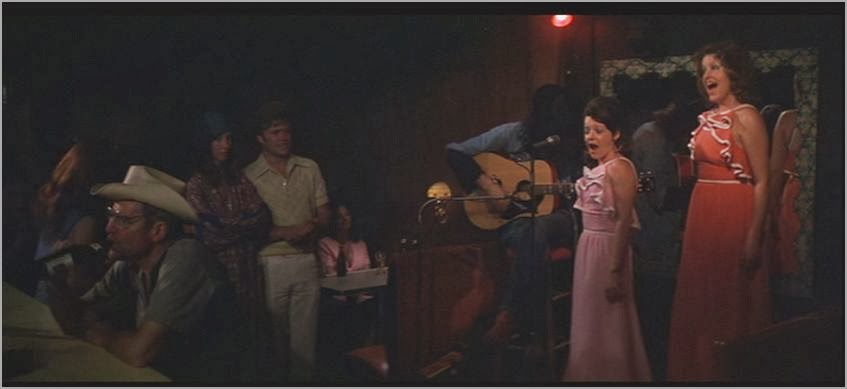
No stage is too small, no talent without its stage. The Smoky Mountain Laurels on open mike night, and Sueleen Gay is next...


Albuquerque is not only indifferent to the chaos she sets in motion-- on some level, conscious or not, she thrives on it, which makes her a perfect drifter through the compressed (and readily unleashed) energy and opportunism floating through Altman's musical city.


As my friend Paul Clark observed, Connie White undoubtedly gets top billing by default, stepping in as Barbara Jean's last-minute replacement at the Ryman Auditorium. One deleted scene I'd love to see is Haven Hamilton's seething indignation at the situation-- he's already repeatedly deferred to Barbara Jean's near-sainted status with the Nashville public, but how could he abide playing second fiddle, even just on a billboard, to a second-tier star like Connie White?


I love Karen Black's evocation of dolled-up singers like Lynn Anderson in her performance here as the catty Connie White, who smiles backstage just long enough to satisfy the photogs before relaxing back into a natural frown. (One of Walker campaigner John Triplette's snotty asides is directed toward her: "Last time I saw a dress like that, I was headed to the junior prom.") And she gets to introduce a real country music legend: "He's the best. It's Vassar!"


"I love you... I love you... I love you." Mary's mantra, delivered to the sleeping Tom while a recording of one of his own songs plays on a reel-to-reel tape deck. If she says it enough times, maybe he'll finally hear it. The song is Keith Carradine's "Honey," one of the movie's best, and perhaps most undervalued tunes, and its sweetly romantic lyrics play in brilliant contrast to the two lovers in bed, one who desperately wants to believe the song is, or could be about her, the other blithely dismissive, even in sleep, of the lyrical sentiments that bear no resemblance to the way he lives his own life. ("Life is short/A precious gift/This thing we have/Please don't let it slip away") Emotional delusion, one of the many recurring threads that bind the men and women of this movie together.


One of my favorites sequences is the one which contrasts the various Sunday worship services attended by some of the characters-- the sober formalism of the Catholic mass attended by Wade (Robert DoQui) and Star (Bert Remsen), and Miss Pearl (Barbara Baxley) with head covering that looks more like a doily-- Sueleen (Gwen Welles) is there too, wearing a fuller mantilla, singing in the choir where she and her musical abilities are finally afforded a modicum of grace; the Presbyterian service where Del (Ned Beatty) brings his kids, a big, ornate Protestant service befitting the mainstream of the Nashville religious community (there's even a sign language interpreter for the benefit of the many deaf worshipers, the Reese children among them) which sees Haven (Henry Gibson) in choral robes, no less pompous in this sacred mode-- like everywhere else, he's there primarily to be seen; Linnea sings with the gospel choir (presumably the one she's seen with at the opening of the film) at a black church-- Tommy Brown (Timothy Brown) is also there-- where the choir provides the background setting for a baptism; and finally, Barbara Jean, seated in a wheelchair at the front of the modest hospital chapel, engaged in a heartrending rendition of "In The Garden" ("Well, He walks with me and He talks with me/And He tells me I am his own...") while her husband Barnett (Allen Garfield), Pvt. Glenn Kelly (Scott Glenn) and Mr. Green (Keenan Wynn) listen intently.


Opal, on the other hand, worships at a different sort of temple, one seemingly ready for any and all metaphorical significance she's willing to dream up at a moment's notice. 


And later Albuquerque sings to a congregation whose lack of receptivity to her message can at least be blamed on the screaming wheels and grinding gears of the culture at large, and not just spiritual vacuity or, perhaps more generously, the potentially hollow habits of worship.


I absolutely adore the way Cristina Raines plays this scene, when Opal begins fumbling around revealing her one-night stand with Tom. She shuts out Opal's faux-modest blathering, the clueless astonishment of the driver, a.k.a. Norman (David Arkin) and her own husband Bill (Allan Nicholls), who suspects Mary's infatuation and passive-aggressively delights in her humiliation, and directs her gaze instead to Tom, on stage, who is about to call her and Bill up for a chance to sing and, of course, for a few more jabs.


On stage together for what will undoubtedly be the last time, Tom, Bill and Mary tear through another of Nashville's two or three best tunes, "Since You've Gone," written by Gary Busey, who was originally slated to play Tom before Keith Carradine became involved. One of the charges most often leveled at Nashville is its inauthentic representation of country music and the country music scene that was prevalent in the early to mid '70s. (Take a listen to Johnny Wright's "Hello, Vietnam" and then ask yourself how exaggerated satiric anthems like "200 Years" or "For the Sake of the Children" sound.) Given the leeway that is not unusual to grant works of satire, this seems like a ridiculous charge, made mostly, I'm guessing, by those who demand , because of its deceptively documentarian style, that the film display some sort of stricter fealty to "reality." Ironically, I've also heard complaints about the film having a slapdash, pieced-together quality, as if Altman were just out there filming what he saw, that creative choreography and dramatic convention were entirely beyond his concern. From Ronee Blakely's gorgeous "Dues" to Karen Black's "Rolling Stone" and straight through to Keith Carradine's "It Don't Worry Me" and the Oscar-winning "I'm Easy," the music of Nashville,  presented with the typical adornments of the day and often by actors who approached their roles as singers with honesty and purpose, remains one of the movie's most consistently pleasurable elements.


Facing the fans at Opryland, deadpan and respectful, and eventually hostile, Barbara Jean melts down, while Barnett, John Triplette and Del Reese look on, helpless, stunned. Many such scenes have shown up in dramatic music biographies, but none, not even the one in Coal Miner's Daughter, in which Sissy Spacek enacts the life of Loretta Lynn, on whom the character of Barbara Jean was partially based, can match the sheer empathy, laced with comedy and even more wonderful singing, that Ronee Blakely generates in this scene. Every time I see the movie, I'm always surprised, during her performance of "Dues," that she doesn't just float away from excess grace.


And at Opryland, Kenny Fraiser (David Hayward) listens in as Opal presses Pvt. Kelly on his Vietnam experience. One of the most satisfying things about Nashville is that it feels no obligation to provide a "satisfying" answer to who Kenny is and why he does what he does. We can listen to him interact with veiled hostility when Del tells him to move his car during the traffic jam, or observe his agonized phone call with his smothering mother, or watch here as he considers, with confusion and apparent rage, the curt, indifferent answers Kelly provides to Opal's insistent questions. But having done so, we are no more equipped to "understand," in a strictly behavioral, psychological fashion, what he imagines he's doing at the Parthenon. We aren't privy to Kenny's version of Arthur Bremer's diaries or the ramblings of Mark David Chapman. We cannot even say "he was a quiet fella who kept to himself; you'd never expect him to do something like this." He is an enigmatic figure from start to finish, whose behavior demonstrates the ultimate unknowability of a person marginalized, set adrift, who finds the brightly lit world of Nashville entirely suitable as he moves through its crevices and cracks in search of... 


"Little more than a year ago, a man named Hal Phillip Walker excited a group of college students with some questions-- "Have you stood on a high and windy hill and heard the acorns drop and roll? Have you walked in the valley beside the brook, walked alone and remembered? Does Christmas smell like oranges to you?" Within a commencement speech, such questions were fitting, perhaps, but hardly the material with which to launch a presidential campaign. Even those who pay close attention to politics probably saw Hal Phillip Walker and his Replacement Party as a bit of frost on the hillside. Summer, if not late spring, would surely do away with all that. Well, now that summer, along with presidential primaries, is heavy upon us and the frost is still there, perhaps we should take a closer look. Hal Phillip Walker is, in a way, a mystery man. Out of nowhere with a handful of students and scarcely any pros, he's managed to win three presidential primaries and is given a fighting chance to take a fourth-- Tennessee. A win in that state would take on added significance, for only once in the last 50 years has Tennessee failed to vote for the winning presidential candidate. No doubt many Americans, especially party-liners, wish that Hal Phillip Walker would go away, disappear like the natural frost and come again at some more convenient season. But wherever he may be going, it seems sure that Hal Phillip Walker is not going away. For there is genuine appeal, and it must be related to the raw courage of this man. Running for President, willing to battle vast oil companies, eliminate subsidies to farmers, tax churches, abolish the Electoral College, change the National Anthem and remove lawyers from government-- especially from Congress. Well, at this point, it would be wise to say most of us don't know the answer to Hal Phillip Walker. But to answer one of his questions, as a matter of fact, Christmas has always smelled like oranges to me."


Hal Phillip Walker and his motorcade approach the Parthenon. Not for nothing does it resemble, in this shot, a funeral procession...


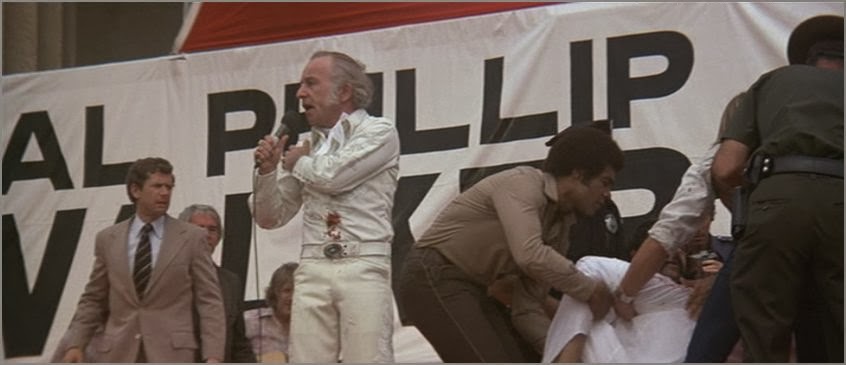
Among all those gathered at the Parthenon on stage for the Hal Phillip Walker rally, only Albuquerque seems natural, relaxed, in her element...


The moments just before and just after an unfurling national nightmare comes home to roost. "They can't do this to us here in Nashville!" shouts Haven Hamilton to a stunned, perhaps even slightly oblivious crowd. But "they" have surely done it. Sueleen knows it, the air of her own self-deluded dreams of stardom flying permanently away on a chorus of gunshot and scarlet sprays of blood.


Albuquerque seizes the moment...


the gathered crowd responds...


and the movie ends on the most exhilarating, cynical, ambiguous refrain of blinkered optimism American movies have perhaps ever produced. Tell me it doesn't resonate still today:

They say this train don’t give out rides, it don’t worry me
And all the world, is taking sides, it don’t worry me
Because in my empire life is sweet, just ask any bum you meet
And you may say that I ain’t free, but it don’t worry me
It Don’t Worry Me, It Don’t Worry Me
You may say that I ain’t free, but it don’t worry me. 
The price of bread may worry some, it don’t worry me
Tax relief may never come, it don’t worry me
Economy’s depressed not me, my spirit’s high as they can be
And you may say that I ain’t free, but it don’t worry me...


*********************************************

Sunday, October 06, 2013

SECRET MOVIES: THEODORE ROSZAK'S FLICKER


My modest contribution to Bill Ryan's "The Kind of Face You Slash" celebration of horror fiction over at his esteemed blog The Kind of Face You Hate is now online, a brief consideration of Theodore Roszak's 1991 novel Flicker. I never really thought of Flicker as a horror novel in the strictest sense while I was reading it-- the first half reads more like a decadent orgy of movie lore woven expertly into a pleasingly reluctant, expertly teased detective story. But the book certainly qualifies as horror in that it shares the obsessive nature of its protagonist, film historian Jonathan Gates, who follows the decaying nitrate trail of long-forgotten genre filmmaker Max Castle all the way down the rabbit hole, beneath the deceptively tacky first layer of the director's strangely seductive imagery and into a nightmare world of secret movies. Here, bathed in the sinister interplay of shadows and light, where something always seems to be just hidden from view, the hooks of the past are set, dragging the academic, and us, into a present where Castle's subliminal text is developing, with the help of a mysterious religious sect and a newly emerging cult phenomenon by the name of Simon Dunkle, into malignant foreground. Flicker's vampires and creatures of the night may remain locked in tattered celluloid, the remains of Max Castle's oeuvre, but like Castle's mysterious technique, the flicker, Roszak's book gets under your skin, makes you shiver, and makes you think about how elastic the horror genre really can be.

Check out my piece and all the other essays in Bill's month-long horror fiction roundup as October rolls along at The Kind of Face You Hate

***********************************************


Friday, October 04, 2013

COMING SOON TO A HAUNTED CRYPT NEAR YOU


It's a fearsome night on Turner Classic Movies for horror fans, kicking off October in style tonight starting at 5:00 pm PST/8:00 pm EST-- Herk Harvey's Carnival of Souls (1962), followed by George A. Romero's Night of the Living Dead (1968), Fritz Lang's The Testament of Dr. Mabuse (1933), James Whale's The Bride of Frankenstein (1935), Terence Fisher's Frankenstein Created Woman (1967), and The Wasp Woman (1959), directed by Roger Corman and Jack Hill. 

********************************************************

From the looks of things around here, you’d never know it’s been a busy month, but it has. Just not in terms of writing, which is reflected in the fact that it’s been exactly a month since I last posted here. (That last post was a long ‘un, though.) It’s been a goodly stretch since the days when I was posting every day, or even every other day—the emerging gray in my beard is testament to the fact that life is different now than it was in 2004, especially as it applies to the energy and inspiration and time I have available to offer Sergio Leone and the Infield Fly Rule. Even so, this little hobby, which I started nine years ago next month and never realistically expected to last through to a first anniversary, is still high on my list of priorities. What’s changed is the (ridiculous) notion that I could or should ever try to keep up that initial pace or that, regardless of whatever attention it might receive, the profile of the blog would ever be raised beyond the level of “boutique” status. (Over this past summer a friend described SLIFR, quite aptly and charmingly I thought, as “one sincere pumpkin patch of a blog.”) 

It’s clear, too, just how much social media has changed—at least for me—the urgency I used to feel about my blogging. The interactive aspect of SLIFR has long since been supplanted by the more immediate and unmoderated connections Facebook and Twitter provide, relegating the comments column to a status of something akin to letters to the editor delivered by snail mail. (I’m just grateful, when I do get comments, that they remain as civil and constructive and creative as they ever were.)

But I’m still here. And if September was a month of tumbleweeds as far as SLIFR is concerned, then what of October? It’s a month that lends itself to considerations of matters of the horror genre and, if you happen to love that genre, opportunities to focus on personal observations about it that stretch beyond the usual dabblers’ notions racking up lists of “The 100 Best Horror Movies Ever Made” or “My Favorite Slasher Movie Villains.” And here at SLIFR I’m going to take the time to spotlight not only own posts but a couple of others that I think will be enjoyed by anybody who feels like digging a little deeper into the foundational ground of the season.

Anyone interested in a fully rounded appreciation of the Halloween season this month should be keeping their eyes on the Friday columns of Richard Harland Smith over at TCM’s Movie Morlocks. Richard’s writing on horror is just about beyond compare, and he’s already begun to illuminate the musty crypts and desolate graveyards of Halloween like a day-glo screaming skull. Posted today, his terrific "Gimme That Old-Time Scaryiligion!" eschews the tendency toward the gory and instead advocates for drinking in the rich atmospherics of many great Halloween movies that you may have never seen:

The older I get, the older I want to be. Which is to say that come Halloween I don’t want to be disgusted, I don’t want to disgust others. I want to heighten my senses, not force them into shutdown mode. I want to savor crispness in the air, a hint of woodsmoke on the wind. I want to hear the swirl of autumn leaves and the peal of churchbells from the kirkyard. (Or, barring that, the peal of kirkbells from the churchyard.) I want magic and mystery. I want to be a child again. And when I was a kid, people kept their guts to themselves… At Halloween, I want the cozy. I want to be in for the night, with rain lashing at the eaves, or at least a high wind rattling the shutters. I want the bridge to be out, the authorities unreachable, and several strangers (or at the very least estranged family members) house-bound and vulnerable to attack by the Bat or the Cat or Dracula or the Ghost of something-something.”

Richard is not one to worry about whether his own tastes come off musty to the hardened, grue-encrusted horror fan, and he’s right not to. He’s having too much fun steeping in the mainstream and the marginalia of horror’s history at the movies, and this article proves that he’s off to another strong and spooky start toward concocting a month-long witches’ brew that will be well worth indulging in.


Another cryptkeeper to keep an eye on this month is Bill Ryan, proprietor of The Kind of Face You Hate. Bill is a talented, colloquial writer with a wicked sense of humor and a great and infectious ease with his own voice, and every October he hosts a month-long festival of daily posts on horror fiction, the literary kind. He calls this annual gathering "The Kind of Face You Slash" and it’s usually Bill, keeping very busy, writing the whole month on a whole host of worthy and serious horror writing. But this year he’s doing things a little differently: 

“`The Kind of Face You Slash’ (is) a project that ordinarily finds me writing about horror fiction -- stories and novels and so forth -- every single goddamn day. Ha ha, not that I don't love it! That's going to happen again this year, starting Tuesday, but this year there's a slight twist. For about half of the month, I will be doing what I always do, which is as previously described, but the other half of the month will be filled out with a roster of guest writers. The rotation will be roughly and alternating-days kind of thing, though this part I can't be certain about exactly, but in any case your takeaway should be: half me, half other folks, each of whom I'm very proud to have on board, and whose posts I think you'll greatly enjoy. There'll be bylines and stuff, even.”

Bill starts out with House of Leaves by Mark Z. Danielewski (“Stephen King and his son, the horror writer Joe Hill, are described discussing ‘what novel should be considered the Moby-Dick of horror’… The answer they settle on is one of the more curious, both in its impact and in its very existence, horror fiction phenomenons of the last thirty years…”), then gives it over to Andrew Leon Hudson (on John Dies at the End). Bill comes back for Thomas Hinde’s The Day the Call Came and Friday (today) is the domain of Jose Cruz on a collection that sounds fascinating, Masterpieces of Terror and the Unknown: A Treasury of Bizarre Tales Old and New edited by Marvin Kaye 

I have no idea what’s on the docket for Saturday—another Bill contribution, as he alternates with his guests all month long—but I do have an inkling about Sunday, as it’ll be my own contribution to the festival, a look at Theodore Roszak’s fascinating, maddening 1991 novel Flicker.

Round these parts, expect to see my review of the long-awaited Curse of Chucky, the sixth installment of the Chucky the Killer Doll franchise (which I celebrating is 25th anniversary this year), as well as a couple of quizzes—a horror-oriented quiz undertaking straight from the catacombs of SLIFR University, and another visual puzzler based on mysterious screen grabs from horror movies throughout cinema history. It won’t be all horror here, though—I’ve got a massive 800-minute Blu-ray box (and accompanying heavy tome) of The Untold History of the United States, the sprawling and provocative documentary written (with Peter Kuznick) and directed by Oliver Stone, sitting on my desk which will most definitely be worth a look. I’ll also be taking some time to look at writer-director Michael Schlesinger’s acclaimed comedy short It’s a Frame-up!  and even, especially if the postseason continues to go well, a look at a couple of baseball movies you may have missed.

And I have it on good authority that the Horror Dads will be reconvening after a long absence for another of our good-natured discussions on matters of bringing up kids in the ominous moonlight of six lifetimes of horror appreciation.

Thanks for hanging around, even during the quiet times around this here pumpkin patch. We’re not done with the harvest yet.

**********************************************