Saturday, October 06, 2012

AMERICAN HORROR STORY SEASON 1 EP. 5: TAKING THE PISS


Okay, Simon Abrams is ready to roll with his take on American Horror Story episode 5, "Piggy, Piggy." We've ado'd long enough. Let there be no further. Simon?

************************************************

Hey, Dennis

I'm not so sure that the Piggy Man story has nothing to do with how the Harmons' story, as I understand it, advances in "Piggy Piggy." I think it provides the thematic clothes-line for the episode, to steal a choice phrase from Matt Zoller Seitz. Everyone' thinking about how they can confront their fears, and after a fashion, they all do. What's key however is knowing that just having the bravery to confront your demons (or ghosts or whatever literal-minded manifestation of a cliche Ryan Murphy and Brad Falchuk have opted to use) is not necessarily enough. Murphy and Falchuk and episode writer Jessica Scharzer want us to know that good intentions and a pure heart can't always win the day. So they use this scenario to bring together everything, from Violet's encounters in the basement to Constance's talk with her dead daughter. I can't help but judge the episode's various segments based on that assumption, that all of these characters must do what Tate could not last episode when the Dead Breakfast Club visited him: they must confront and accept their own shortcomings. Admittedly, some characters get off the hook more easily than others. For example, what discovery did Ben have to make? No, seriously, I'm not just asking rhetorically: what do you think he did this episode that suggested he's thinking about his past, Dennis? And why is Moira just there this episode? Is she totally resigned to her lot in the after-life? Doesn't she think kind of stuff?

For that matter, why was eating offal Vivien's task to overcome and why did it feel so inconsequential? Admittedly, the Piggy Man trauma is, as Ben says, not the root problem but rather just a major hump that Derek needs to get over so he can face his real problems. I think that's worth remembering when evaluating how the challenge faced in each subplot serves as preludes to catharsis, or whatever. So in that sense, I get why Vivien has to eat offal. Now separated from Ben, Vivien has to figure out a way to protect her child, a fear that's inexpertly expressed in Vivien's nightmare of the baby's claws pushing against her balloon-sized baby bump. 
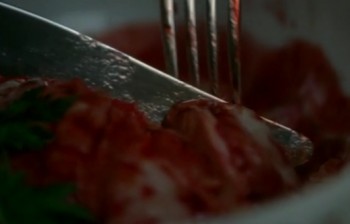


But again, in practice, these scenes of Vivien scarfing down sweet meats and raw brain don't have much weight to them. She doesn't really hesitate before scarfing down some pretty gross stuff, and Moira makes no note of Vivien's alacrity. And because this is American Horror Story, that just makes me think that Vivien's hunger is not an issue when it really should be. Vivien almost doesn't hesitate at all when she starts pecking at the offal and the brains, etc. But again: gross. This should be a thing, shouldn't it, how easily Vivien finds it to eat this stuff even if it is for the sake of enriching her unborn child's life? There is that silly scene in the church with the traumatized nurse babbling about how Vivien's baby is unholy. But for that scene to carry any weight, I'd have to A) believe that the nurse in question was more than just a shrieking loon and B) that between the scenes of offal-eating and of brain-picking, Vivien is seriously wondering whether she's doing the right thing by her kid. Also, if protecting her child is just a major obstacle Vivien must deal deal with before overcoming her bigger problems, does that make her rocky marriage with Ben her bigger problems? I think so, as it's ineptly hinted at in the scene where she tells Ben that "she's disappoint[ed in him] as a man." But I wish there was more meat to that recrimination, if you'll excuse the bad pun...

I wouldn't take as much issue with this subplot if it didn't speak to the greater issue I have with "Piggy Piggy:" there's a lot of good thematic bridge-building here (it is a transitional episode, as you said), but rarely in the right proportions. Which is a letdown after "Halloween, Part 2," which I found to be much more well-balanced in its characterizations.


I also wasn't nuts about Constance's talk with Addy. The seance stuff felt both tacky and tacked-on, and apart from some insta-catharsis and some more pseudo-portentous revelations (Tate's dead, ooohh!), it just felt like a necessary encounter that was botched because the show's runners and episode writer just wanted to make their points and move on. They've got six episodes left, and there's a lot more to get to that they'd rather concern themselves with, so having a meaningful talk with Addy just isn't in the cards. I bristled at characteristically lame lines like, "You're a smart girl. How can you be so arrogant as to think that there's only one reality that you can see?!" This coming from a psychic named Billy, whom Constance met on Craigslist I might add, is too thuddingly obnoxious. 

I mean, ok, maybe I should just accept Billy as a flawed macguffin (at least, as she's used in "Piggy, Piggy;" for all I know, she assumes a greater role later on in season one's events). She does give further credence to my theory about how Derek's story is a thematic clothes-line when she says, "And when you're chosen, you either get with the program, or go crazy." Then again, maybe that line is just vague enough to accommodate most thematic readings of the episode. I mean, how exactly was Derek, "chosen?" Did the Harmons' house choose him? 

But how about when Constance is talking, nay, confessing to Addy that, "It wasn't easy being a single parent and you were such a handful." I hate this line because it tells us how to feel without establishing the mood or taking the time to get to that intended effect. So we sympathize with Constance because she's now saying to Addy things like, "Nobody understood how hard it was to take care of you?" Basically? There's no pathos to this scene, in which a major character whines about her problems at no great length and in such patently prosaic terms. 
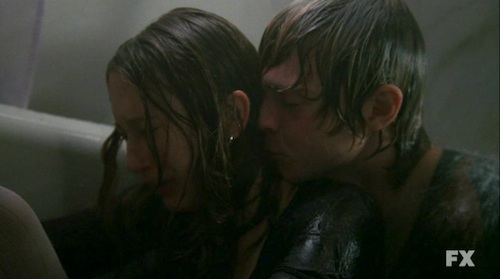


Hrmph. I did however mostly like the way Violet and Tate's joint subplots temporarily resolve. I'm going to get to what I dislike about Tate's flashback in a moment. But I do like that, in spite of the lame re-emergence of a certain former school bully-turned-prophetic teen pill-popper (yeah, I dislike that, too, man), Violet basically has to see what Tate is. He's a ghost and he's a killer. Her uneasy acceptance of this leads to one of my favorite shots in the show thus far. As forced as it was to see Tate cradling Violet in the shower (water=drama!), I did like the bit where he tries to comfort her by saying, "I have you. I have you. I HAVE YOU." It's one of the rare times when I've found the show's typically irruptive style of jump-cut editing to be effective. Vaseline-slathered close-ups quickly ratchet in closer and closer on Violet: ok, that's impressive.

I didn't however think as highly of the Columbine-esque shoot-out flashback thing that you alluded to in your post. I was actually surprised that this didn't set you on edge, too, Dennis. Also, I think it's funny that you think the writers of this show have a continuity editor. Crom laughs at your Four Winds! Ahem.


Anyway, I didn't care for it, mostly because there was something...off about its fetishized version of the past. The squeak of leather on what I can only assume are freshly polished floor boards and the coy cutting away before any violence can be explicitly shown: I don't buy it. Unless you actually mean to tell me that Murphy and Falchuk are building towards a pseudo-thoughtful statement on how we look at the past (ie: some things we see when we remember, some things we only see when we look at the aftermath in the present), then I really just don't buy it. We've seen these kids' faces mutilated, blood gushing out of one of their jawless mouths, just horrible things. Why can't we see them happen in real time? I don't believe it's a matter of respect but rather of ass-covering. Because the events in question are very similar to what happened at Columbine and Murphy and Falchuk don't want to fully admit to themselves that they've crossed that line. I mean, come on, the scene where one soon-to-be victim pisses herself while she's hiding from Tate and a trickle of urine comes out from under her? That's purely exploitative, I don't care how you frame it. 

That egregious shot of the girl peeing is especially cruel when you consider what happens to poor Derek: he faces his fears and gets killed for no discernible reason other than, "Wrong place, wrong time." It's not even one of the Murder House's ghosts that get him, just some random burglars. Which is that much more ugly when you think that the Harmons have a security guard to prevent this kind of thing from happening. Basically, Derek's death is proof that Murphy and Falchuk have no compunctions about viciously stomping on their characters. And I think the piss take in question is definitely crossing over a very gross line. No blood, nor any explicit violence, but yes to piss? Puh-lease. That's like shielding a kid's eyes only to direct his attention to something even more gross that he wouldn't have otherwise seen, just for the sake of...well, who cares, I don't think there's a defensible use of the wee-wee in question, no way.

But you've said offline that you can't wait for round 2, and I've delayed this post long enough. Your turn again, bud.

************************************************


Catch up on the American Horror Story conversation between Simon and me by clicking on the following links:

"PIGGY, PIGGY" POST #1

"HALLOWEEN, PT. 2" POST #1
"HALLOWEEN, PT. 2" POST #2
"HALLOWEEN, PT. 2" POST #3
"HALLOWEEN, PT. 2 POST #4

"HALLOWEEN, PT. 1" POST #1
"HALLOWEEN, PT. 1" POST #2
"HALLOWEEN, PT. 1" POST #3
"HALLOWEEN, PT. 1" POST #4

"MURDER HOUSE" POST #1
"MURDER HOUSE" POST #2

"HOME INVASION" POST #1
"HOME INVASION" POST #2
"HOME INVASION" POST #3
"HOME INVASION" POST #4

PILOT EPISODE POST #1
PILOT EPISODE POST #2
PILOT EPISODE POST #3
PILOT EPISODE POST #4
PILOT EPISODE POST #5
PILOT EPISODE POST #6

*****************************************


Tuesday, October 02, 2012

PROFESSOR ARTHUR CHIPPING’S MADDENINGLY DETAILED, PURPOSEFULLY VAGUE, FITFULLY OUT-OF-FOCUS BACK TO SCHOOL MOVIE QUIZ


Well, that familiar autumn chill is in the air-- except here in Los Angeles, of course, where the only chill you’re likely to get during the current hellish heat wave is from leaving the A/C on all night or from your body’s convulsive internal overcompensation due to excess heat exposure. And here at SLIFR University, where the curriculum has been if not exactly dense, then certainly diverse and controversial in 2012 so far, that chill means that school is back in session, which means it’s time for yet another movie quiz. This semester we've called upon the services of one of the university's most beloved instructors to guide us through the process of learning about our own unique responses to the vagaries and amusements of film culture. He is none other than the esteemed doctor of social sciences Professor Arthur Chipping, affectionately known to the student body and staff, of course, as Mr. Chips. It was a bit of a challenge to get Mr. Chips to assent to heading up this term's quiz, as he has a tendency toward recessive behavior in social situations and was none too confident in his ability to marshal a discussion of film, which he still rather quaintly refers to as "that confounded new toy of technology of which the likes of low comedians such as Mack Sennett and Roscoe Arbuckle seems so enamored." But this shape-shifting teacher, who morphs between alternate physical appearances seemingly at will (the picture seen above, taken in 1969, is of his second incarnation, or as he likes to say, "the husk I prefer these days"), has, despite his own reservations, managed quite a charming and challenging questionnaire for this go-round, and it is our pleasure to present it to you today.

Unlike the last two quizzes, there is no overriding theme, just a series of posers intended to stimulate your thinking and sate your appetite for entertainment. But the learned professor would like to emphasize, by way of the customary preamble to all SLIFR quizzes, that in posting your answers you be as elaborate and loquacious in your responses as possible, all the better for the reader who is ready to indulge in them. But most importantly, please copy and paste the questions into the comments column and provide your answers underneath those questions so that referencing the post above will not be required to remind the reader of what query it is that is being answered.

With those formalities out of the way, it is now time to sharpen your number twos, put all materials unrelated to study underneath your desks, and prepare to undergo your journey through Professor Arthur Chipping's Maddeningly Detailed, Purposefully Vague, Fitfully Out-Of-Focus Back to School Movie Quiz. Ready? Begin!

*******************************************************

            1) What is the biggest issue for you in the digital vs. film debate?

2          2)  Without more than one minute’s consideration, name three great faces from the movies

            3)    The movie you think could be interesting if remade as a movie musical

            4)      The last movie you saw theatrically/on DVD, Blu-ray, streaming

            5)      Favorite movie about work

            6)      The movie you loved as a child that did not hold up when seen through adult eyes

            7)      Favorite “road” movie

            8)      Does Clint Eastwood’s appearance at the Republican National Convention change or confirm your perspective on him as a filmmaker/movie icon? Is that appearance relevant to his legacy as a filmmaker?

            9)      Longest-lasting movie or movie-related obsession

           10)   Favorite artifact of movie exploitation

           11)   Have you ever fallen asleep in a movie theater? If so, when and why?

           12)   Favorite performance by an athlete in a movie

           13)   Second favorite Rainer Werner Fassbinder movie

          14)   Favorite  film of 1931

          15)   Second favorite Raoul Walsh movie

          16)   Favorite film  of 1951

          17)   Second favorite Wong Kar-wai movie
    
          18)   Favorite film of 1971
   
          19)   Second favorite Henri-Georges Clouzot movie
    
          20)   Favorite film of 1991

          21)   Second favorite John Sturges movie

          22)   Favorite celebrity biopic

          23)  Name a good script idea which was let down either by the director or circumstances of production

          24)   Heaven’s Gate-- yes or no?

          25)   Favorite pairing of movie sex symbols
  
          26)   One word that you could say which would instantly evoke images and memories of your favorite movie. (Naming the movie is optional—might be more fun to see if we can guess what it is from the word itself)

          27)   Name one moment which to you demarcates a significant change, for better or worse, on the landscape of the movies over the last 20 years.

          28)   Favorite pre-Code talkie

          29)   Oldest  film in your personal collection (Thanks, Peter Nellhaus)

          30)   Longest film in your personal collection. (Thanks, Brian Darr)
  
          31)   Have your movie collection habits changed in the past 10 years? If so, how?

          32)   Wackiest, most unlikely “directed by” credit you can name

          33)   Best documentary you’ve seen in 2012 (made in 2012 or any other year)

          34)   What’s your favorite “(this star) was almost cast in (this movie)” anecdote?

          35)   Program three nights of double bills at a revival theater that might best illuminate your love of the movies

          36)   You have been granted permission to invite any three people, alive or dead, to your house to watch the Oscars. Who are they?

          37) Favorite Mr. Chips. (Careful...)

****************************************************

Monday, October 01, 2012

AMERICAN HORROR STORY SEASON ONE EP. 5: "PIGGY PIGGY" RECAP


Simon Abrams and I are ready to kick off our discussion of the next chapter of American Horror Story. I'll open up with a recap and some opening thoughts, then it's Simon's turn.

******************************************************

So here we are, Simon, finally arrived at episode five of American Horror Story, entitled "Piggy Piggy," an episode that feels transitional to me. Or perhaps it’s just that it’s an episode given over to emotional repose, gathering up, airing out. It’s also a strange one in that the name of the episode carries weight that doesn’t entirely get resolved, at least not in a satisfactory way, in the episode itself. It may be significant to my half of the discussion (and it also may not be significant) that this is one of two episodes that I had not yet seen myself, so my reactions to it may be a little more raw than my reflections on any of the other chapters so far.

After having just seen finished watching the show, I realized that my preconceptions of just what the porcine imagery of the title was referring to were somewhat off-base. On one level I like that; on another, some dissatisfaction arises from the sense that the imagery, and the element from which it is derived, seems grafted rather inorganically onto the main concerns of the show’s thrust so far.  When I think of “pig” in the context of American Horror Story, my mind races first to the little creatures pickled in Dr. Charles Montgomery’s basement laboratory, and I expect that somehow there might be at least a suggestion of how the presence of those creatures in the visual iconography of the series might be expanded on in some way. Instead, the “Piggy Piggy” of the title refers to an urban legend, the Piggy Man, a Chicago hog butcher who, during the World’s Fair of 1893 made a habit, before entering onto the main floor of the slaughterhouse, of donning a pig mask made from the flesh of a previous kill, and then snorting at and taunting the soon-to-be pork. According to the legend, one day he slipped and fell, the hogs killed him, leaving not a trace of the Piggy Man left behind to be discovered by the authorities. When some of his former customers started turning up gutted and skinned and hung upside-down in the bathtub to expedite draining, the legend of the Piggy Man was born. And they say (“they” always say) that to this day, if you stand in front of the mirror (shades of the Candyman)  and recite the words, “Here, piggy, piggy, piggy, pig” to your reflection, his murderous spirit will be unleashed yet again, the one doing the reciting presumably being the Piggy Man’s first new victim.


All this is revealed to Ben (and to us) by Derek (Modern Family’s Eric Stonestreet), another patient of Ben’s who is incapacitated by an irrational fear of fairytales and urban legends. (Ben is living elsewhere after having been booted to the curb by Vivien, but he still must use the office in the house as a—paltry?-- source of income.) Ben attempts to help Derek deal with this irrational fear, which are getting in the way of Derek’s attempts to pursue normal societal and sexual relations, manifest in insisting that he confront those fears and doing precisely that which most terrifies him—staring into the mirror, reciting the incantation and proving once and for all that the legend is just a harmless story that should hold no sway over a grown man’s life. Of course we know, when Ben invites Derek to step into the bathroom typically designated for use by his patients just down the hall from his office, the one located in the Murder House, to confront his fear that it’s probably not the best idea. And in fact, when Derek finally steels himself and goes through with it, he conjures not the Piggy Man, but a mysterious, ashen, hospital-gown clad ghoulie whom he finds in the shower, and who conveniently disappears by the time Ben comes to take a look. (Since the vision flies by so fast in the editing scheme of AHS, I stopped down and went in for a second stop-frame look just to make sure that I wasn’t mistaken in not recognizing the ghoulie’s identity.)

Insistent that he’s on the right track, Ben pushes Derek to try the experiment again, this time in his own home and away from the security blanket of Ben’s presence, after Derek complains that the anxieties have remained crippling to his potential love life. Ben encourages Derek to think of the problem as a psychological law of physics—the more you fear something, the more power you give it.  Of course there’s an underlying irony that it’s Ben, who has very little power over his own sexual impulses and a much looser grasp on his own moral certainty in the light of his disposal of Hayden and his various betrayals of Vivien, who is dishing out this advice. (The director, Michael Uppendahl, lays Ben’s theory of psychological defense over a series of shots of him looking through windows, unseen, at Vivien as she sits in the kitchen conversing with Luke, the hunky security guy played by Morris Chestnutt.) Heartened by Ben’s rationale, Derek goes home and tries it again, and this time with each recitation resulting in no pig-faced homicidal maniac lurching at him from behind, or even through the mirror, Derek relaxes. “Here, piggy, piggy, pig!” he taunts, to no one in particular, obviously relieved. Except the home invader who turn out to be hiding in the shower (there is just no sanctity of the home in this show) thinks Derek has spotted him and takes exception to being taunted in such a manner. So he shoots and kills Derek, which prompts his pal, who has been ransacking another room down the hall, to burst in and start yelling about how this was just supposed to be a burglary and that no one was supposed to get killed. The last time we see Derek, he’s laying dead on his bathroom floor, perforated with gunshot wounds to the back and bleeding, probably already dead, a victim of Ben’s advice—good advice, on the surface—and a nasty case of unfortunate coincidence.

My problem with the Piggy Man section of the show is that it seems to be unrelated (except in the way that Uppendahl visually insists on making the tangential connection) to the real meat of what’s going on in the show vis-à-vis Ben, Vivien, Violet, Constance and Tate, all of whom have a substantial presence in what amounts to essentially a very mournful episode. The Piggy Man hi-jinks fulfill the show’s jolt quotient, but they don’t seem to add anything either to our understanding of the characters, the situation they are in or, more importantly, the evil mythos of the house itself.


“Piggy Piggy” begins with a harrowing account of the murders at Westfield High, and you’d have to be particularly pinched in the empathy department not to respond with an ache in the gut at the very onset of this scene, which opens the action of the episode in 1994. We see in detail (but, thankfully, given AHS’s tendency to not look away at some rather gruesome events in its past, not too much detail) exactly what happened to the Dead Breakfast Club in that high school library, and how Tate comports himself as a bringer of death. Not that I’m angling for a membership in the Gaffe of the Month Club or anything, but one thing that stuck out to me as glaringly missing from the scene is something that is specifically referred to in “Halloween, Part 2,” the moment when the blond girl expresses anger at Tate for asking her if she believed in God, and her own response to the positive even though she admit, in death, that she didn’t. It remains to be seen if this is somehow significant or just an oversight of editing, but that exchange never happens as the horror unfolds (in what passes for real time on this show) in “Piggy Piggy.” Yes, it could be that we’re supposed to accept that it just happens off-screen, but so much was made of it in the previous episode—it seems central to the girl’s eternal existential wrestling match—that to ignore it so casually here seems like an uncharacteristic storytelling blunder. The recounting of the murders ends with Tate, who lived with Constance in the Murder House in 1994 at the time of the killings, back to his bedroom, where he is followed by a squad of tactical police, who are themselves followed up the stairs by a wailing Constance, crying out for information about what’s happened and, eventually, for the reputation and then the life of her boy. (We revisit this event near the end of the episode and see Tate, who initially puts a finger to his temple in an act of mock suicide, lunge for a gun, which draws the deadly barrage of fire that sends him into his peculiar limbo.)

But that’s not all, folks. Violet Googles (or whatever the name of the fake search engine is that she uses) info on the Westfield High murders and discovers a Web site devoted to the history of the horrific event, but also to its victims, whom she met in the previous episode, and to the perpetrator, her ostensible boyfriend Tate, who she finds out was killed by police in the aftermath of the shooting. He’s dead, something you certainly suspected for a while, Simon, but which comes as quite a shock to Violet, who has the news confirmed, rather matter of factly, by Constance and a medium friend played by Sarah Paulson, who bristles at Violet’s description of her as a Beverly Hills psychic (“A medium, dear. I can’t read your future. That’s a different gift.”)  The two sit Violet down for some serious exposition on the nature of the Murder House ghosts and a heart-to-heart talk about the condition of Tate in particular. It’s a conversation that leaves Violet reeling back to the counsel of former teen queen Leah, whose basement encounter with Tate and the Infantata in the pilot episode has turned her  (somewhat improbably, as far as I can parse) into a completely paranoid expert on the Antichrist mythology of the Book of Revelation.

Leah admits that she only gets about four hours of sleep at night—she can’t stop thinking about the Biblical account of a woman up in heaven in terrible labor pain whose baby is waiting to be eaten by a seven-headed red dragon who is himself /itself then cast out of heaven and spends the rest of the course of human history trying to steal the human race away from God soul by soul. But Violet is really most interested in the “pills” part, and before she leaves Leah has supplied her with a bottle of big-time downers. After visiting the Westfield High library herself and quizzing a wheelchair-bound teacher who was himself a victim of the shooting, Violet returns home and catches a glimpse of who she believes is Tate sliding past a doorway. She follows him down to the basement, where instead of encountering Tate she discovers the redheaded twins, that same undead shower ghoulie that Derek runs into, Dr. Charles Montgomery, who wonders if she’s here for an appointment, and even the three serial killer copycats from the “Home Invasion” episode. Horrified, Violet reaches her breaking point and returns to her upstairs bedroom where she despairingly overdoses on Leah’s pills in order to escape a reality that has warped well beyond her recognition. (My favorite visual moment in the series comes here, when she lies down after gulping the contents of the bottle in a position of deathful repose on the bed, and the camera follows her downward movement onto the mattress, and then continues slowly down, past the edge of the bed and into the blackness of what lies beneath it. Thankfully, Larry has moved on.) A quick cut reveals Tate dragging Violet’s unconscious body down the hall, begging her not to die, and eventually putting her in the tub with himself, where he revives her under the shower. The end of the episode finds Tate confessing his love for Violet out loud (as opposed to the “I Love You” note Violet discovered upon first arriving home) and the two of them, confused and exhausted, spooning together and completely unsure of what to expect next.


But that’s still not all. “Piggy Piggy” also finds Vivien undergoing an excruciating amniocentesis and encountering the radiologist who fainted at the sight of the ultrasound in “Halloween Part 1.” This woman, who insists upon meeting Vivien in a Catholic church one-ups even Leah in terms of flowering religious pathology. (“I saw the unclean thing you carry in your womb, the Plague of Nations, the Beast! I saw the little hooves!”) And with the help of the medium Billie Dean, Constance contacts Addy, who forgives her never being the mother she clearly knew she never was. Addy also tells her that on the other side Addy says really is a pretty girl, thanking Constance for failing to drag her onto the lawn of the Harmon house before she died. (“She doesn’t want to be with Tate,” Billie Dean tells her. “She’s afraid of him now that she knows the truth.”)

As I said earlier, the episode seems to me to be one in which there is some breathing room given to the process of grieving (the true nature of Constance’s tortured relationship with Addy is revealed, at least from the tortured mother’s perspective), but also to dealing with the emotional recoil of Violet’s discovery. It’s a relatively quiet episode in the moments I like best, and it’s most effective violence is something that is centered within wounds that, even a decade after Columbine, and absolutely during the summer of the Colorado/Dark Knight shootings and the Muslim mosque massacre, remain agonizingly fresh. I think this is why I find the Derek subplot unsatisfying—it’s tacky filler compared to the resonance of the Westfield High episode and the weight we’ve invested these characters with so far. (Uppendahl and writer Jessica Scharzer walk the thin line between illumination and ghastly exploitation pretty well, though Scharzer shows her schooling in the Murphy/Falchuk Snarky Dialogue Department all too clearly at times, especially during the Violet/Constance/Billie Dean conversation and any time the strident Vivien shows up.) This episode also gives over an interesting amount of space to textured imagery of a somewhat grisly nature—Violet’s horrific self-mutilation fantasies, that aforementioned amino session, and bloody meats. I haven’t mentioned Constance’s insistence of bringing in some fresh, vitamin-rich offal for Vivien to eat to encourage the healthy growth of the baby, culminating in a particularly gag-inducing dish that we can talk about next time, if you wish. But I’m thinking also of the sliver-thin focal plane in which Derek is often shot which renders his tortured face in a more empathetic, yet strangely disorienting fashion. Too bad there wasn’t the thematic resonance to go along with what is clearly the episode’s showiest visual trope.

Anyway, I have prattled on long enough. The one thing element left dangling in this episode that will (hopefully) be illuminated later is Billie Dean’s very odd projection back to Violet of the vision of an old woman, lying in a hospital bed, hooked up to oxygen and obviously near death. In the vision, Violet leans over the old woman who looks at her with deadened yes and whispers, “I don’t understand you. Never will understand you.” Violet is horrified, and Billie Dean asks her, “What does this mean?” I can’t wait to find out myself.

*******************************************

Catch up on the American Horror Story conversation between Simon and me by clicking on the following links:

"HALLOWEEN, PT. 2" POST #1
"HALLOWEEN, PT. 2" POST #2
"HALLOWEEN, PT. 2" POST #3
"HALLOWEEN, PT. 2 POST #4

"HALLOWEEN, PT. 1" POST #1
"HALLOWEEN, PT. 1" POST #2
"HALLOWEEN, PT. 1" POST #3
"HALLOWEEN, PT. 1" POST #4

"MURDER HOUSE" POST #1
"MURDER HOUSE" POST #2

"HOME INVASION" POST #1
"HOME INVASION" POST #2
"HOME INVASION" POST #3
"HOME INVASION" POST #4

PILOT EPISODE POST #1
PILOT EPISODE POST #2
PILOT EPISODE POST #3
PILOT EPISODE POST #4
PILOT EPISODE POST #5
PILOT EPISODE POST #6

*****************************************

Saturday, September 29, 2012

AMERICAN HORROR STORY SEASON ONE EP. 4: THE WAY THEY DO THE THINGS THEY DO


I'm finally checking in with my last words on the "Halloween Part 2" episode of American Horror Story! Simon Abrams and I will finally be getting to episode five on Monday, in our march toward Halloween (and surely now beyond). But for now, let us return to the Murder House...

*****************************


Simon,


As far as delays to our schedule of analysis and discussion go, you’ve got the Toronto Film Festival (and soon, the NYFF), and I’ve got--- Well, certainly not the Toronto Film Festival or anything like it. But I certainly appreciate your patience and that of Our Dear Readers as we gear down on “Halloween Part 2” and prep for “Piggy Piggy,” one of the episodes in the American Horror Story that I initially missed on my first pass through the Murder House.


I’m intrigued by the thoughts that you stirred re the motivations, or even the emotional state of the ghosts in this show. In most haunted scenarios ghosts are most typically seen as tethered either by revenge or some other portfolio of uncompleted business back on Earth, or perhaps even the unconscious desires of the living to maintain their connection to a past that has been somehow, and unjustly, taken from them. I hadn’t really tumbled on this before seeing this episode again, and considering Nora and the Dead Breakfast Club, it does seem, at least for the moment, that what may be going on is that it is the dead who refuse to give up their claim on the living. The notion that they are free to walk on Halloween, and therefore free to interact, that is, directly change the trajectory and circumstances of the lives of those who are not (yet) dead, is a conceit that I like a lot—it gives weight and meaning to the occasion most Americans think of as a fun, superficial chance to flirt with harmless versions of horrific imagery we don’t have much use for in real life. (Unless we’re watching horror movies and shows like American Horror Story, of course.) 


But within the context of this episode, and even, really, the rest of the episodes, the writers don’t really use it to the end of fleshing out a really novel take on the possible function of ghosts. As we will see again in regard to the character of Hayden, the house and its influences, whatever and wherever their origins might be, permit these kinds of interactions on a daily basis—they just have to occur on the grounds. (We knew this as soon as we saw what happened to Leah in the basement in the pilot episode.) But it seems odd that there would be such emphasis on this walking-among-the-living conceit, and yet the result of it, in terms of what we see as a result of their mingling with the world—Nora’s visit to her mother, Chad and Patrick’s implied relationship shift, and even the DBC’s confrontation with Tate— is that they remain primarily influencers, unable even on this day to actually do much on the physical plane beyond be far less coy about their own presence that they have to be in their less corporeal incarnations. 


As evidenced by certain events I’m thinking of that have yet to occur, their actions certainly can have consequences, but again those consequences are directly tied to the house and its existence as a kind of ghostly fish bowl, the living interlopers buffeted by the swirling currents of the whims and rages of the undead. The dead are far more interested in the living than the reverse—curiosity about what’s behind that door or causing the curtain to move is not something this show much indulges. No, the dead are attracted to what the living have to offer, or perhaps more what is dangled in front of them in that house which they can no longer really have, and that is an upsetting, motivating force. There is one element of this ghost story, yet to be revealed, which complicates this matter a bit, but it remains a story mainly about things unseen, unattainable that the dead desperately want to take with them, things that keep them clutching onto life, even with the knowledge that there really is no going back.


All of which makes me believe with greater conviction as we move through this first season that Murphy and Falchuk have perhaps not considered what compels the ghosts on Halloween, at least the ones with ties to the Murder House, as thoroughly as they might have. (Maybe they got confused, what with all the overlapping, interacting time lines; maybe they just aren’t such clear thinkers to begin with.) The concept of the show is the house’s hold over them, the permission it gives them to be clever, harsh manipulators of those inside it who still draw breath. This is why the conceit behind the Halloween walk, intriguing though it is, doesn’t seem to draw real blood—it doesn’t really amount to much in terms of what the ghosts are able to accomplish on the outside. Even on the inside, Nora seems to be given less to direct action than hushed (subconscious) suggestion, and I think you’re right to presume that her motivations are to hasten her own agenda by couching it in terms that seem to have concerns outside of her own. (The second “failure” she says she will not permit is almost certainly not that of the Harmons’ marriage.) It’s going to take Hayden to really get the ball rolling in terms of testing the waters of just how much physical activity these ghosts can indulge in, if they choose to do so. But none of this does much to quell the growing suspicion that Murphy and Falchuk’s vision of the afterlife, as it applies to the occupants of the Murder House anyway, may be less consistent than previously assumed. (And for a night when the dead can do whatever they want, on the streets or wherever, it’s a much quieter, less chaotic night than I would have guessed!) The mangled and violated DBC are motivated by what usually spurs ghosts on—unfinished business, the desire to draw some sort of revenge on, or at least admission of guilt from a curiously repressed Tate. But for the moment the others remain, as you say, more cryptic in their intent.


One last item on “Halloween Part 2,” which I asked about before and which we discussed off-line, as it were, that I wanted to mention. I raised the question in my last post about who it was that was underneath Violet’s bed that reaches out for (and misses) her foot up in the bedroom, during Larry’s attempt to collect that $1,000 blackmail bill. As I said previously, it’s not Tate-- we see him outside; it’s not the Rubber Man—we see him inside; it’s not the Infantata—he/it is a basement dweller; and it sure isn’t Addy. You pointed out something I didn’t see clearly on my computer monitor—the burned flesh that gives away the identity of the creeper as Larry, and also that the knocking wasn’t heard at the same time as the hand comes reaching out toward Violet’s ankle. You attributed this to a simple lapse of time, and clearly (now) that’s what was intended. It’s the span of time that’s too tight here for me to accept that jump. That's a hell of a scamper from outside on the front porch and up (through a window?) into her bedroom in the amount of real time that separates the last knock we hear from the appearance of that hand. I don't buy it for a second, especially the way the sequence is edited-- her moving toward the stairs after just missing seeing the Rubber Man, and then a quick cut to her opening the door to her room, then the hand coming out from under the bed-- that Larry could reasonably make his way up there that quickly. He ain't dead, after all. And if he did get there that fast, why would he hide under the bed and make one weak grab, then nothing comes of it? And why is he reaching out for her from under the bed anyway? What was he going to do with her if he caught her? Dumb.


Okay, I’m off to watch the “Piggy Piggy” episode. I’ll check in with a recap and some initial thoughts on Monday. And by the way, not to be a shill for Fox Home Video or anything, but the DVD and Blu-ray sets for American Horror Story went on sale this past Tuesday. Halloween’s coming, for real, and so is season two of the show. I have not indulged in any of the teasers or hype for the upcoming season—I’d rather it hit me as cleanly as possible. But I will say that now more than ever, after having gone through the episodes the way we have so far, that I’m happier than ever that the powers that be thought it was a good idea to keep things fresh by starting from scratch on a new idea and new cast for the new season. Flaws and all, this kind of long-form take on the anthology show promises plenty of riches (and the inevitable attendant frustrations) yet to come.

*******************************************


Catch up on the American Horror Story conversation between Simon and I by clicking on the following links:

"HALLOWEEN, PT. 2" POST #1
"HALLOWEEN, PT. 2" POST #2
"HALLOWEEN, PT. 2" POST #3

"HALLOWEEN, PT. 1" POST #1
"HALLOWEEN, PT. 1" POST #2
"HALLOWEEN, PT. 1" POST #3
"HALLOWEEN, PT. 1" POST #4

"MURDER HOUSE" POST #1
"MURDER HOUSE" POST #2

"HOME INVASION" POST #1
"HOME INVASION" POST #2
"HOME INVASION" POST #3
"HOME INVASION" POST #4

PILOT EPISODE POST #1
PILOT EPISODE POST #2
PILOT EPISODE POST #3
PILOT EPISODE POST #4
PILOT EPISODE POST #5
PILOT EPISODE POST #6

*****************************************

Wednesday, September 26, 2012

APOLOGIES FROM THE MANAGEMENT


"It's still the same old story / A fight for love and glory / A case of do or die..."

Once again, I have to apologize for the delay in the posting of my continuing conversation with Simon Abrams and the "Piggy Piggy" episode of American Horror Story. It's a familiar refrain, all right, but it remains true that demands on my schedule in the world of paying work-- that is, the effort to keep a roof over my family's head, food in their stomachs and clothes on their backs-- are making it extremely difficult this week, more so than usual even, to maintain my prescribed writing goals. I'm trying not to moan too much about it, just put my head down and get the obligatory stuff done with so I can spend some time here. But I want to keep those of you who are interested in following this discussion, and anything else I find time to write about here at SLIFR during this taxing year, abreast of the situation and let you know that the project has not been abandoned or anything silly like that.

I remember back in the first three or four years of this blog how it was no big deal to stay up until 3:00, 4:00, 5:00 a.m. if necessary to get things written up and posted. My output then was far more prolific, and lots of people wondered how I managed to do it and maintain a waking, working schedule on top of that. (I was even going to school for two years in there somewhere.) Well, staying up all night was a big part of how I did it, and at 52 years of age, let's jut say that I'm much more of a morning person now than I ever used to be. I have not lessened my commitment to this blog-- I have several pieces in the hopper, awaiting the opportunity to be polished, as well as a new quiz that is near ready to go. (Remember the SLIFR quizzes? You know, the ones I haven't answered myself in a year or so?) It's easy to get swept up in a perhaps misapplied sense of guilt, of obligation regarding posting regularly, and I certainly have allowed that to happen with myself here in the past. I just want to let you (and myself) know that writing here is something I consider crucial, essential to my mental well-being and sense of fulfillment, and a privilege as well. I'm glad there are some people out there who continue to care whether or not there are new posts that pop up here, albeit much more occasionally than used to be the case. I thank you for hanging in there with me.

 The American Horror Story discussion will continue later this week. Look for it.


*************************************