Not unlike
last year’s, my year-end list for 2006 is one that has to be filtered through a lens colored as much by what I didn’t see (the films I missed and those I chose not to see) as by what I was lucky enough to take in. (
Andy, you’ll be happy to note that I was
on this one already!) It’s never been a part of this blog’s mission statement (if this blog indeed has a mission statement) to be all-inclusive regarding the films that are out over a given period of time, or even timely in the way that what full reviews do get published appear while the films are still available in theaters or otherwise “relevant” in some sort of consumer-based, quantifiable measure. Rarely do I ever have a review of a film ready to read on the day of its release, or even a week after, because I don’t get invited to press screenings and am rarely the recipient of DVD screeners. I see most of the films I talk about just like everyone else—during their regular release in theaters, or later on DVD. (My review of
Old Joy was an exception, but only because Laemmle Theatres held a screening for members registered on their Web site two days before they began running the film for the general public; and I was kindly sent a screener for
Iraq In Fragments after I missed the rare press screening that I
was invited to.) I usually depend almost solely on the hope that, if I still find a movie worth writing about in the shards of free time in which I have to do so, then hopefully there will be enough interest in the subject itself, even after studio release schedules and P.R.-mandated windows of exposure have decided it's old news, to warrant the expenditure of my two cents. (Much is also predicated, of course, on whether I’m up to the task of writing about the film
well, which is a subject I leave for others to decide.)
So, with my time (and movie-going money) as limited as it is, I have to be a little choosier than the average critic when it comes to deciding what to see in a theater. Some of my choices are based on the tastes of my daughters, as you will see later, but even then my wife and I like to think we exercise a bit of informed prejudice when it comes to deciding what the girls will see—we skipped
Barnyard outright, based on my aversion to what I’d observed in trailers, and though my six-year-old has decided that
Night at the Museum is just too frightening to consider, I’m looking for more information because my more adventurous four-year-old lights up at the suggestion of seeing it. (I also learned this year that much of their enthusiasm over an upcoming release depends on my own—by not reinforcing the idea of seeing
Barnyard or
Garfield: A Tale of Two Kitties, despite their advertising being on every other billboard along every route we seemed to take this past summer, both girls never uttered a peep over not seeing them, nor have they requested them on DVD. This is not to say that we are impervious to a well-oiled machine like Disney and all its tentacles—they can both sing tunes from
High School Musical, for God’s sake, without the movie or the CD ever once being played or even mentioned in our house—but only that there are methods of resistance.)
As for myself, being connected to such a wealth of critical thinking as is available on the Internet, through largely print-based critics like David Edelstein, J. Hoberman, Armond White, Andrew Sarris, Jonathan Rosenbaum, and including Web-based brethren like Jim Emerson, Matt Zoller Seitz, Ed Gonzalez, Nick Schrager, Keith Uhlich, Kim Morgan and Brian Darr, getting information about upcoming films, those I’m already interested in as well as those with which I’ve yet to become acquainted, has never been easier. Maybe that’s why, when I looked over the list of 72 films released in 2006 that I actually did see (whether in theaters, on DVD, or at work), I was able to note that a disproportionate amount of them were ones that I either admired or outright loved. (Most of the ones I see on the job, not surprisingly, turn out to be along the lower-rated on the scale, and hey, it’s steady income. But when I actually get paid to work on something like William Greaves’ legendary
Symbiopsychotaxiplasm occasionally, it’s kind of hard to complain.) And there is the ever-growing Netflix queue, a wonderful clearinghouse for everything in the year I have yet to catch up with (
The Death of Mr. Lazarescu arrived in that familiar red-and-white envelope on Friday) as well as the less-heralded titles in which there is still a spark of interest (
A Scanner Darkly, Kinky Boots, Scoop, et al).
Despite the fact that I caught as many as 72 releases from the year 2006, the list of titles that evaded my grasp completely is, of course, far longer. It includes, but is most definitely not limited to, the following titles (listed roughly in order of their release):
Movies I Would Have Loved To See In A Theater (And In Some Cases Still Might):
Looking for Comedy in the Muslim World, Tristam Shandy: A Cock and Bull Story, Battle in Heaven, Night Watch, Don’t Come Knocking, Running Scared, L’Enfant, Brick, Army of Shadows, Clean, Lady Vengeance, An Inconvenient Truth, X-Men: The Last Stand, District B13, Wordplay, The Road to Guantanamo, Who Killed the Electric Car?, The Devil Wears Prada, The Great Yokai War, A Scanner Darkly, Excellent Cadavers, Edmond, Lunacy, Half Nelson, The Pusher Trilogy, Idlewild, Invincible, Mutual Appreciation, Riding Alone for Thousands of Miles, Man Push Cart, Jesus Camp, The Last King of Scotland, loudQUIETloud: A Film About the Pixies, Shortbus, 49 Up, Little Children, Deliver Us From Evil, Infamous, Sweet Land, Jonestown: The Life and Death of the Peoples Temple, Marie Antoinette, The Bridge, Climates, Volver, Fast Food Nation, For Your Consideration, 51 Birch Street, The Piano Tuner of Earthquakes, The Fountain, Tenacious D in The Pick Of Destiny, Our Daily Bread, Three Needles, Days of Glory (Indigenes), Inland Empire, Apocalypto, Dreamgirls, The Good German, The Painted Veil, Curse of the Golden Flower, Venus, The Good Shepherd, Miss Potter, Children of Men, Notes On A Scandal, Perfume: The Story of a Murderer, The Dead GirlMovies On Deck For My DVD Player:
Film Geek, Why We Fight, Bubble, Manderlay, Nanny McPhee, Sophie School: The Final Days, Street Fight, Tsotsi, Looking for Comedy in the Muslim World, Tristam Shandy: A Cock and Bull Story, Battle in Heaven, Night Watch, Don’t Come Knocking, Running Scared, L’Enfant, Brick, Army of Shadows, Clean, Lady Vengeance, An Inconvenient Truth, X-Men: The Last Stand, District B13, Wordplay, The Road to Guantanamo, Who Killed the Electric Car?, The Devil Wears Prada, The Great Yokai War, A Scanner Darkly, Edmond, The Pusher Trilogy, Idlewild, Invincible, Mutual Appreciation, loudQUIETloud: A Film About the Pixies, Duck Season, Game 6, Find Me Guilty, The Beauty Academy of Kabul, Lonesome Jim, Awesome: I Fuckin’ Shot That, Basic Instinct 2, The Devil and Daniel Johnston, Friends With Money, I Am A Sex Addict, Hard Candy, Kinky Boots, American Dreamz, Akeelah and the Bee, The Whore’s Son, Down in the Valley, Leonard Cohen: I’m Your Man, Waist Deep, 4, Wassup Rockers, Strangers With Candy, Once in a Lifetime: The Extraordinary Story of the New York Cosmos, Ask the Dust, Mimi’s First Time, Lady in the Water, Brothers of the Head, Scoop, Quinceanera, The House of Sand, How to Eat Fried Worms, Iraq For Sale: The War Profiteers, The Wicker Man, The Puffy Chair, Agnes and His Brothers, Crossing the Bridge: The Sound of Istanbul, Sherrybaby, Al Franken: God Spoke, The U.S. vs. John Lennon, The Science of Sleep, A Guide to Recognizing Your Saints, Tideland, Sleeping Dogs Lie, Death of a President, Fuck, The Aura, Déjà vu, The Nativity Story, Blood Diamond, The Holiday, The Secret Life of Words, Night at the Museum, We Are Marshall, Black Christmas, Factory Girl and (thanks,
Brian, for the recommend)
The Fast and the Furious: Tokyo Drift.
2006 Releases In Which I Have Virtually No Interest:
Tyler Perry’s Madea’s Family Reunion, The Heart is Deceitful Among All Things, Drawing Restraint 9, Art School Confidential, The Da Vinci Code, The Lake House, Click, All the King’s Men, Babel, Bobby, Eragon, The Pursuit of Happyness, Rocky Balboa, The Tiger and the SnowAnd there are about another 200 or so titles that I didn’t include (from
this list) because I either knew not what they were or found them sufficiently below my level of interest that I couldn’t possibly muster enough time or effort to track them down. Whether or not your knowledge of my shortcomings makes any difference to you in terms of how you value knowing about the films that meant something to me in this year is, as it would be if I’d seen all 695 released this year, entirely at your discretion. The list I’ve provided below, which has on it 15 films instead of just 10, is intended merely as a snapshot of
my perspective on the year, which is why providing the list of what I didn’t see seems especially pertinent. It has been suggested that reading a year-end list like this is akin to thumbing through someone’s DVD collection in order to get a glimpse (however profound or superficial) of that person—his/her tastes, interests, biases. I think that’s a much more valuable way of looking at any year-end list, even ones put forth by professionals who have more than likely seen a much broader and more complete range of the year’s films than I have. But even a professional critic is bound by the limits of time, and I doubt there’s any one of them who would make any claims toward a literally or even near-complete view of any given year. That’s one of the exciting things about film and being part of film culture—as much as you know, as much as you’ve experienced, there’s always something new to see, there’s always a film you’ve seen whose rewards can be expanded upon revisiting and re-experiencing it.
So why fret about the things one hadn’t the time to see in 2006? I’d rather celebrate what it was about the year that made me remember, as I love to do, why the movies mean so much to me, as well as hash over how the medium fell short, left me cold, enraged me, left me disappointed yet again. Like any relationship, the one I have (the one I suspect many of us have) with the movies, is never emotionally constant, will (hopefully) demand things of me that I must engage my spirit and my mind to provide and then illuminate, and is almost always in some way rewarding. In looking back at this past year, I also look forward to continuing that relationship in 2007.
THE YEAR'S BEST (in descending order):
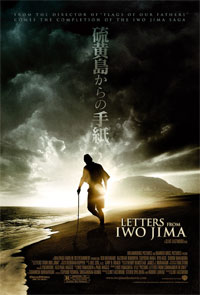
 LETTERS FROM IWO JIMA (Clint Eastwood)
 There’s a moment about halfway through Eastwood’s second recounting of the battle for Iwo Jima, seen this time from the point of view of the Japanese soldiers defending the island from within tunnels dug into the hills, when the degree of empathy this director has mustered for a typically demonized Imperial enemy force crystallizes with a chill of recognition no less remarkable for the offhanded way in which it is presented. The soldiers, led by the stern but humane General Kuribayashi (a galvanizing Ken Watanabe), emerge out of their subterranean caves during a brief respite from the shelling in order to quickly assess their situation. As they glance out over a black beach overrun by American forces, and waters occupied by an imposing flotilla of gunships, there is also visible in the distance, during one brief shot, the sight of an American flag perched on top of an adjacent hill, fluttering in the breeze and the drifting smoke. The Japanese, as far as we can tell, don’t regard it at all, and almost as quickly as we register the significance of the flag, Eastwood has moved on and it is never seen again. In one fleeting instant, the central visual and thematic metaphor of the director’s
Flags of Our Fathers has been reduced to a relatively insignificant blip, a measure of how thoroughly entrenched we’ve become in the story of men whose motives, fears and responses to the horrors of war seem remarkably similar to those of the American warriors, the nature of whose heroism was dealt with powerfully in that flawed but devastating first film. I’m not sure if there’s a precedent among Western directors for what Eastwood achieves in
Letters from Iwo Jima, but the film has such calm confidence, such mastery of mood and tension and sensitivity to behavior, such contemplative expansiveness—I can’t recall another film about war that is, for its first hour, so hauntingly quiet, even its more lighthearted moments, or one so open to the power of moments that lay the foundation for these soldiers’ fates—that a sense of its greatness settles in quickly, with welcome assurance. The actors, to a man, seems to sense that greatness too, yet it’s not a mantle worn by them heavily— the performances all rise to the standard Eastwood has demanded in his filmmaking, and they coalesce with a staggering power. Seen together with
Flags, this may be the definitive portrait of nations and generations at war. It’s the best movie of the year.
(Listmates: Iraq In Fragments, Pan’s Labyrinth) PAN’S LABYRINTH (Guillermo Del Toro)
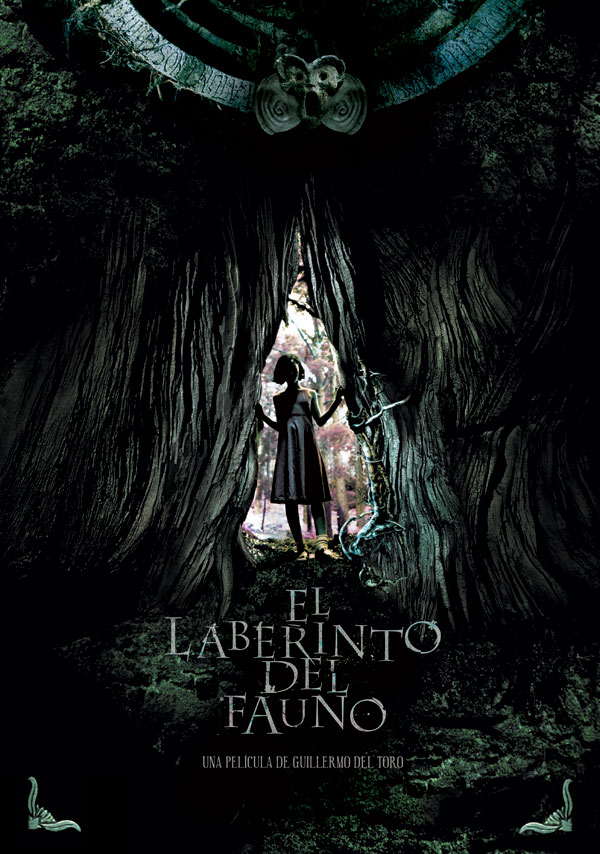
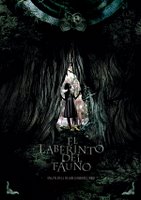
 The subtle ways fantasy reinforces and reflects reality, as well as the way fantasy can actually function as a projection of fears as well as hopes, are subjects at the root of Guillermo Del Toro’s robust, nightmarish vision of the beginnings of Franco’s fascist Spain filtered through the mindscape of a tenacious little girl. Watching this movie, it becomes clear just how shallow is the conception of many of the fantasy worlds Hollywood routinely spends millions, billions to achieve. Del Toro’s imaginative horrors, on the other hand, achieve a rare power not through bottomless infusions of cash, but through their ability to reflect the way a reality like brutal fascism imposes itself on the innocent from within as well as from without. This lyrical pitch-black fantasia is a superbly realized consideration of childhood, as embodied by the lovely, desperate Ofelia (Ivana Baquero), stepdaughter to a sadistic captain (Sergi Lopez) in Franco’s army, yet its unsparing look at the realistic horrors perpetrated by the captain and his forces ensure that it is decidedly
not a film
for children. It is, however, a movie for anyone who longs to be swept away by the inexorable power of a well-told story, illuminated from within by the subtle effectiveness of allegory, a simple fable-like morality infused with overwhelming emotion, and the conviction of a cast and a director that is decidedly sincere and driven by the satisfaction of telling that story well. The last two theatrical experiences I had in 2006 were back-to-back screenings of
Pan’s Labyrinth and
Letters to Iwo Jima, numbers one and two on my list for the entire year. Feeling these two supremely evocative, emotionally powerful, yet tonally dissimilar films resonate and reverberate off of each other was a true and rare treat, the very incarnation of movie heaven on the stage of two very distinct visions of hell. If only every night at the movies could be so rewarding.
(Listmates: The Descent, Letters from Iwo Jima) THREE TIMES
 (Hou Hsiao-hsien) Structured in three segments,
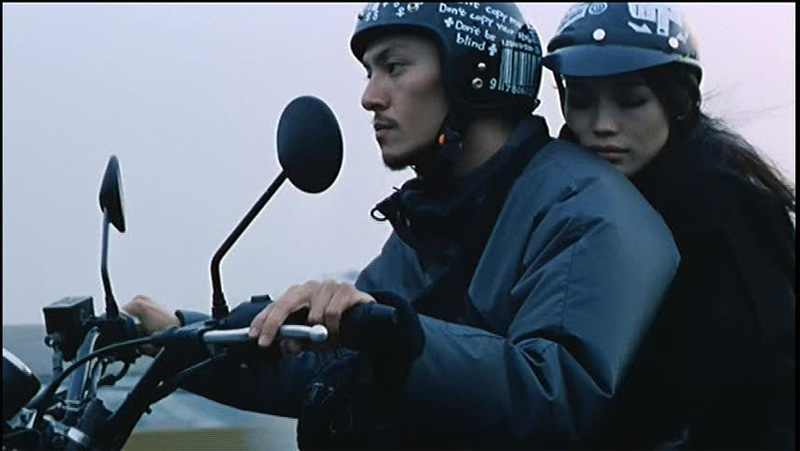
Three Times plays like a greatest hits compilation of Taiwanese director Hou Hsiao-hsien’s favored themes—three love stories set in three different eras, each evoking hazy melancholy filtered through pop culture, political oppression reduced down to an abstract reflection at a fundamental human level, and the ways in which communication is thwarted, through the technology that is meant to enhance it. Hou’s conceit, that the lovers in each segment are played by the same actors—Shu Qi and Chang Chen—is a transporting one, allowing us to luxuriate in their beauty as mere movie presences and to chart their behavior and responses from one segment to the next and our own responses to it. The segments are perhaps most simply and resonantly experienced, however, as tales that reflect the many ways in which people experience falling and being in love, and also that slowed-down sensation of perception that often signals when the hook has been set. Each story is set in a different period in Taiwanese history, and each is tonally and stylistically quite different from the next.

However, each is still imbued with Hou’s probing long takes, the heightened sense that each edit, each shift in perspective,
means something, even if we can’t articulate exactly what while we’re experiencing it, and an alarming sensory sensitivity to the details and pleasures and even slight claustrophobia of the places where the stories unfold. To surrender to the tactile, emotional and observational pleasures of Hou’s worlds is to thrill to being in the hands of a master director, one who knows that some of life’s (and cinema’s) most moving dramas can be charted among the slightest of seismic shifts in mood, in sound, in the positioning of two beautiful actors as they look into each other’s eyes, or as they look away at a crucial moment, the angle of one glance deflecting off of another, another connection missed. (Listmate:
Old Joy)
 THE CONFEDERATE STATES OF AMERICA
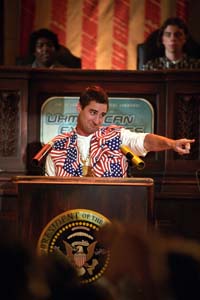
 (Kevin Willmott) The liberating style of the mockumentary format may have finally reached the fraying point of overfamiliarity—even Christopher Guest went another direction for his latest movie. But Kevin Willmott’s brutally funny satiric rumination restakes the mockumentary table by anchoring itself to the mustiest good intentions of the talking-heads format. Staged as a stuffy Ken Burns-style TV special, Willmott’s conceit is a daring and staggeringly well thought-out achievement in speculative fiction, a look back at the history of the United States as it might be told if the Confederacy, not the Union, had won the Civil War. Willmott, like the best social satirists, is not after cheap laughs—the laughs that permeate
CSA are the sort that stick in your throat and make you swallow hard, and they come on the heels of a series of sobering observations about the nature of human relations and how a governmental system rooted in 150 years of institutionalized racism bears some startlingly recognizable features. The faux documentary special is punctuated by a series of hilarious, over-the-top commercials for products and services that more overtly reflect the societal bigotry that has become so entrenched in this “what-if” society. It’s the kind of comedy that uses as well as exposes extreme beliefs and behavior. But if you think the belly laughs are letting you off the hook, Willmott has devised an ingenious twist, the best sucker-punch of 2006. Don’t shut off the DVD until the end credits are over.
(Listmates: Borat: Cultural Learnings of America For Make Benefit Glorious Nation of Kazakhstan, Shut Up and Sing) A PRAIRIE HOME COMPANION
 (Robert Altman) Much has been written about the finality of this movie in the cold light of
the death of Robert Altman, about how appropriate that a movie about the final performance of a fictionalized version of a real-life radio show should be Altman’s last film. Matt Zoller Seitz even gleefully imagined Altman, fully aware of his terminal illness at the onset of shooting, delighting in the opportunity to orchestrate such a deliciously pointed swansong. Yet I wonder if there’s ever been a movie about impending death that has felt as airy, as indulgent in the felicitations, follies and sublimated expressions of its cast of characters, as does this one. After the unexpected passing of one of the show’s stars, a woman in white who turns out to be a literal angel of death comments offhandedly that there’s nothing tragic about the death of an old man. A thematically resonant line that could almost have seemed tossed off when the movie was released last summer, it has now moved front and center, enriching the kind of wistful appreciation of life from the perspective of a director who knew he was at the end of his that infuses the movie’s every privileged moment. Altman goes out soaring on the wings of a zippy cast that gleefully recalls the gloriously alive ensemble milieu at the heart of
Nashville or
Buffalo Bill and the Indians…, celebrating one last time the kind of community that would become a hallmark of his joyous, inclusive style and of some of his very best films. Whether this is one of them or not is an issue for debate among Altman completists (of which I am one), but there’s no doubt that the effortless grace and effervescence of
A Prairie Home Companion made almost everything else in 2006 look clunky and worn by comparison.
(Listmates: Dave Chappelle’s Block Party, Neil Young: Heart of Gold, Shut Up and Sing) THE DESCENT (Neil Marshall)
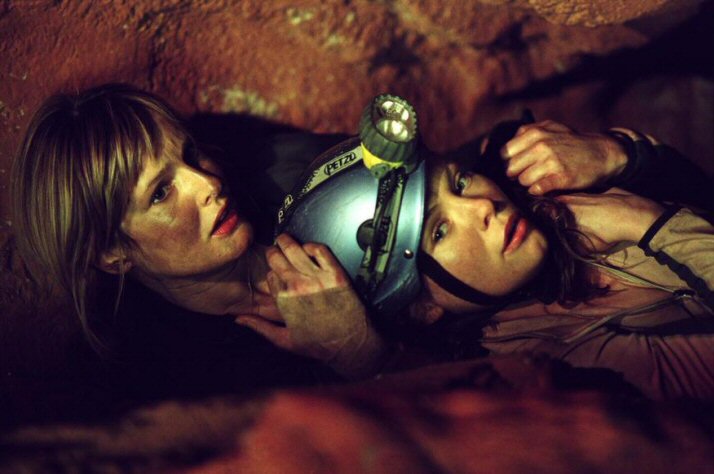
 This is the kind of movie that makes me consider issuing loaded proclamations—Can anyone who claims not to have been terrified by
The Descent really be trusted? (Probably, but you’d better have a good reason for that steely indifference.) Marshall’s achievement, a level of audience identification with escalating claustrophobic fear and confrontation with a terrifying unknown (especially at a time when displays of extreme violence is often confused with, or cynically substituted for, a genuine cinematic cultivation of fear), shouldn’t be underestimated. A group of six women, old friends coming together a year after a horrifying accident leaves one of them without a husband and a daughter, go on an ill-advised spelunking expedition and find themselves lost in a ghastly
underworld hell. Marshall loads the movie with touchstones culled from cinema and art history, but this is no empty spot-the-reference game—each nod to
Deliverance or Hieronymous Bosch deepens the thematic resonance of the movie as well as its power over your imagination. The terror goes subterranean enough that even the return of daylight, and the recurring vision of a lost daughter, provides no solace. As in other great horror movies like
Night of the Living Dead and
The Texas Chainsaw Massacre, at the end of
The Descent it’s clear enough that the horror is just beginning.
(Listmates: Old Joy, Pan’s Labyrinth) IRAQ IN FRAGMENTS (James Longley)
 Eschewing polemics for poetry (achieved through imagery and an intuitive construction of the way those images float and click and sometimes dissolve together), director James Longley manages to shed new light on the current conflict in Iraq through what ought to be an obvious-enough strategy—providing a perspective gained by lending a sensitive ear and eye to three factions of Iraqi citizenry and examining the various realities of life during wartime-- an 11-year-old boy survives in the streets and provides for his family by working for an abusive garage owner who serves as his advisor, his substitute father and his oppressor; Shiites attempting to organize provincial elections submit to using tactics of terrorism in order to enforce adherence to a Koran-based lifestyle; and a Kurdish family expresses gratitude for the American presence even as its members dissipate away from religious practice.
Iraq in Fragments provides viewers a chance to attach faces and names to a nameless, faceless people minimized by the U.S. government’s detached spin on the war and experience a part of the world besieged by conflict, from within and without, with a measure of understanding gained through an associative, poeticized visual approach. A man sits with friends on a Baghdad street and proclaims in conversation, “He who tells history must tell it all, not just for himself.” A disturbing, revealing movie appropriate for viewers as young as the early teens,
Iraq in Fragments is a step in that direction. It should be considered essential viewing.
(Listmates: Letters from Iwo Jima, Shut Up and Sing)  OLD JOY
 (Kelly Reichardt) Mark (Daniel London) is a 40-ish husband, about to become a father, who meditates in order to hold at bay a vague dissatisfaction with his marital relationship and a pointedly less vague dread of the life to come. Kurt (Will Oldham) is the friend with whom Mark has lost touch, as aimless in his constant search of an elusive spiritual bliss as Mark is beholden to what he imagines to be the societal requirements necessary to achieve stability and happiness.
Old Joy is the spare, poetic, blissfully haunted movie about these two men who attempt to recapture a moment of the past, a fleeting shadow of what originally drew them together as friends, and their drift through a weekend together in the woods of the Oregon Cascades. Their two figures constantly, fluidly float past and trespass upon one another within director Kelly Reichardt’s frames, and silently merge with the vast, quiet landscape, where the future hovers, solemnly, forebodingly, in the pines. This is a road movie pitched to the rhythms of gently swaying pine trees, and one of its quietly insistent pleasures is the frequency with which it deflects the trajectory of this fundamentally propulsive subgenre, effectively translating the contemplative ambience and profound economy of a short story through subtle, yet essentially cinematic, use of image and sound. At one point Kurt tells of a dream in which he is comforted by a middle-aged Indian woman who tells him “Sorrow is just worn-out joy,” a suggestion he recounts to Mark, who may or may not be hearing what his old friend is telling him.
Old Joy is a lovely, allusive portrait of the blissful roots of despair, a welcome reminder of how brisk and refreshing the scent of a subtle, original vision can be.
(Listmates: The Descent, Neil Young: Heart of Gold) SHUT UP AND SING
 (Barbara Kopple, Cecilia Peck) As the dawning of the war in Iraq inched ever closer a few years ago, Dixie Chicks lead singer Natalie Maines had the temerity to express her dissatisfaction with the direction the Bush administration was taking the country in the wake of 9/11, and she did it in public, on stage during a concert—she proclaimed that she and the Chicks were ashamed that Bush came from Texas. That one comment sent the Dixie Chicks into a career tailspin. Suddenly abandoned and vilified by country radio and the very fan base that had turned them into superstars, they were now fair game for character assassination, CD burnings and even death threats. Kopple and Peck, veterans of empathetic documentaries like
Harlan County U.S.A. and
America Dream, document that tailspin in this chilling, enraging and ultimately invigorating look at the aftermath of that comment, as Maines and band mates Martie Maguire and Emily Robison attempt to grapple with life and their own image as ex-darlings of country music radio. The movie has a lot of the sass and spirit of Maines herself, and it’s not immune to her occassionally self-righteous swagger either. Yet it’s also a clear-headed look not only at how these women try to right the ship without caving on their convictions, but their own bonds as a sisterhood buffeted by the tides of fear and ruthless public opinion.

Throughout the film Kopple’s nimble filmmaking effortlessly lays down, without a hint of soapboxing, the suggestion that the reaction of country music fans might not have been so vicious or so insistent had it been a man who had made the controversial comment—the swagger of those ill-advised reactionaries we see bearing anti-Chicks placards and burning CDs has a smelly patina of safety-in-numbers goosestepping that looks even more unseemly now that the tide of public opinion has swung decidely away from W and more toward ungrateful insurrectionists like the Dixie Chicks. I was lucky enough to see the Dixie Chicks in concert a mere four days after taking in this film, and seeing them proudly take the stage and perform with such confidence and mastery while continuing to redefine themselves in light of the events this film depicts was a real pleasure. In introducing the band onstage, Maines even found space for a little bit of liberating self-effacement. In noting that Maguire and Robison had surrendered master of ceremonies duties to her for the evening, she demurred, “We decided it as best if Natalie and Martie didn’t talk this time around. See, they shot their mouths off a while back and got us all in a bunch of trouble…”
Shut Up and Sing is a shot in the arm, an appealingly barbed look at a trio of very popular musicians regaining and redefining all three of their voices.
(Listmates: A Prairie Home Companion, Iraq In Fragments, Borat: Cultural Learnings of America For Make Benefit Glorious Nation of Kazakhstan, The Confederate States of America) BORAT: CULTURAL LEARNINGS OF AMERICA FOR MAKE BENEFIT GLORIOUS NATION OF KAZAKHSTAN
 (Larry Charles)
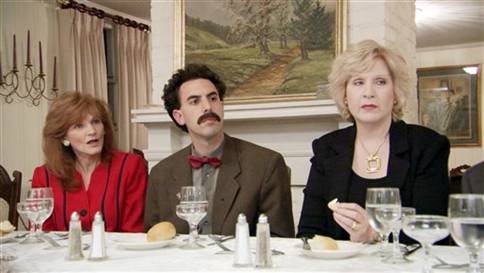
Jagshemash! One of the rare examples of a half year of buzz, hype and advance screening raves actually fulfilling its promise, Sacha Baron Cohen’s disarmingly brilliant comic creation-- the adventures of a cheerfully misogynistic, anti-Semitic self-styled TV interviewer (second best in all Kazakhstan!) bumping uglies with real, mostly unwitting Americans while ostensibly shooting a documentary on the country-- struck a chord with general audiences too. In fact, the response to
Borat, in theaters (and in courtrooms) has been almost as fascinating as the depths to which the movie itself cuts into aspects of the American character. Cohen’s Kazakh journalist is a fountain of cultural faux pas and innocently antisocial behavior, but given the opportunity (and the provocation) the good folks Borat encounters on his journey from New York to California allow a light to be shone on their own homophobia, racism and reactionary politics as well, to chilling comic effect. Is
Borat mean and nasty? Most certainly. Is it entirely fair to those in its satiric sights? Perhaps not. But, as a revered old professor of mine once said to me, ask Jonathan Swift or Mark Twain if it matters whether satire is balanced or sweet-tempered. Then ask to what degree the satire rings true, or how and why the movie creates almost nonstop laughter for 90 straight minutes—three fascinating questions that one viewing of
Borat inspired in me, ones that I will be chewing on right up to the beginning of my second.
(Listmates: The Confederate States of America, Jackass Number Two, Shut Up and Sing) DAVE CHAPPELLE’S BLOCK PARTY
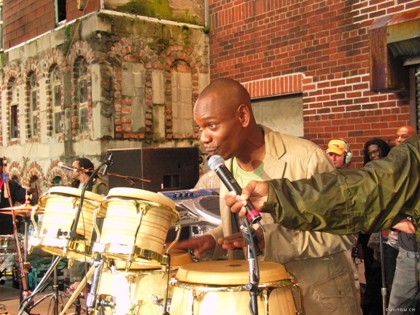
 (Michel Gondry) The most inclusively, infectiously cheerful party of the year, and that’s a proclamation coming from someone whose musical tastes are solidly planted in the hardening cement of classic rock, not this hip-hop stuff that the kids seem to think is all that. Gondry documents both the block party itself—a gathering in the rain on the streets of a Brooklyn neighborhood composed of Chappelle’s who’s-who wish list picked from the hip-hop firmament, including the wonderful, versatile Mos Def, the Roots, Erykah Badu, Kanye West, Jill Scott and a reunited Fugees—and Chappelle’s efforts to organize it and populate the audience with an unlikely assortment of everyday Americans. This movie demonstrates the kind of good will that crosses boundaries of taste and other supposed cultural barriers. The way Chappelle relates to some of his eccentric city neighbors, as well as the Ohio residents, black and white, that he invites to New York for the show, will inspire smiles as broad as Chappelle’s own, and the reaction of the members of the marching band he impulsively invites is likely to inspire tears, just as asses will be set to bouncing by the spectacular array of talent on stage.
Block Party documents a kind of unity that dismantles the divisiveness that politicians are so often quick to exploit. In Mr. Chappelle’s Neighborhood, the beat goes on and it’s all good.
(Listmates: A Prairie Home Companion, Neil Young: Heart of Gold) NEIL YOUNG: HEART OF GOLD (Jonathan Demme)
 A glowing celebration of family, friends, old dogs, tenuous connections and the passage of time, Jonathan Demme films this concert, held at Nashville’s Ryman Auditorium as a coming-out party for Young’s
Prairie Wind album (written at a time when Young was about to undergo surgery for a brain aneurysm), as if he’d never heard of MTV. There’s a texture and an intimacy to Ellen Kuras’ relaxed cinematography that allows us the room to soak up the music’ textures and take in the subtle glances between the performers. And I can think of only a handful (less than five) instances of a shot in this film that lasts less than five seconds or so—Demme’s approach might be mistaken by some as sleepy, but in reality it’s deeply respectful and invigorating, and it provides a proper showcase for Young and his crowded stage of musicians and singers at their most deeply felt, even joyful. I spent New Year’s Eve with this movie, and the first song I heard after the clock chimed midnight and I finished ringing in 2007 with my wife, a kiss, and the expression of hope for a better year in the wings, led off with these haunted, hopeful lyrics:
“Comes a time/When you're driftin'/Comes a time/When you settle down/Comes a light/Feelin's liftin'/Lift that baby/Right up off the ground/Oh, this old world/Keeps spinnin’ round/It's a wonder tall trees/Ain't layin' down/There comes a time/Comes a time…” Amen.
(Listmates: Old Joy, A Prairie Home Companion, Shut Up and Sing) THE PROPOSITION
 (John Hillcoat) The nihilistic grandeur of
The Proposition, a pitiless, grimy, blood-soaked and biblically proportioned Australian western made from a spare and brilliant screenplay by Nick Cave, is truly something to behold. It has the power to bring even the most jaded, weathered viewer to his or her knees through the force of its vision of a bleak outback populated by grizzled, amoral denizens who have no idea that they’re the walking dead, and through the violence barely contained in that vision. Ray Winstone is a constable prone to sadism who reveals a somewhat more upstanding nature in his desire to protect his wife (Emily Watson) from the cruel reality of the world swirling about on the dry winds that buffet the remote outpost where they live. Winstone holds the youngest of three murderous brothers in a cell, using the boy as a whimpering poker chip, and has let the another, played by Guy Pearce (in his skeletal, ravaged
Ravenous mode), go free, promising to spare the younger brother if Pearce finds the oldest brother, their brooding and deadly Kurtzian leader (Danny Huston), and kills him. Cave’s screenplay has primal poetry about it, as does the spare score he has laid down on top of the film’s savagely gorgeous Panavision imagery. But Hillcoat supplies an otherworldly quality to this brutal, relatively unfamiliar frontier that builds on Cave’s narrative concepts and brings a shattering quality to moments of contemplation-- two brothers, united by the blood int heir veins and the blood of others that they’ve spilled, who sit silhouetted against a cruel sun staring down the inevitability of their path-- and to the explosion of horrific violence to which that path inevitably leads.
(Listmate: Casino Royale) CASINO ROYALE
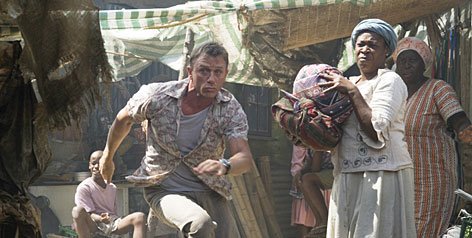
 (Martin Campbell) The most unlikely development in the birthing of James Bond version 6.0 was the one that came most gloriously true: on top of Daniel Craig breathing new, believable, life into the movies’ most durable franchise character, the movie itself, a reimagining of Ian Fleming’s first Bond novel that somehow still remains remarkably faithful to it, turned out to be a smashing piece of action filmmaking. The Bond films, especially in the post-Moore era, have been a notoriously formula-driven lot, yet one of the glories of
Casino Royale is how it acknowledges that formula even while stripping the Bond legend down to its basics, all the better for rebuilding, as well as for acknowledging and incorporating the most recent developments in movie stunt work (like parkour, first seen in the work of Tony Jaa and in the French actioner
District B13) within its own thrilling set pieces. But if all eyes ended up on Craig before the film premiered, they stayed glued on him during the movie too. His is the first Bond, including Connery, who seems completely beholden to the laws of physics, how a man would actually move through space during a chase or a fight—with considerable sweat and effort, as it turns out--and to how the human body ends up bruised and battered because of it. Craig is the first actor to embody Bond to completely approach the role with the instincts of an actor—he’s just as compelling in moments of quiet as he is wheezing and gasping while giving chase up the skeleton of a construction crane. In the past there was Ursula Andress and Halle Berry, and with Eva Green as Bond’s ill-fated love interest there’s no lack of female beauty on display. But in
Casino Royale it’s Daniel Craig who emerges, shirtless, from the surf, giving himself over for the camera’s fetishistic approval. If the Movies for Guys Who Love Movies crowd can still buy
Casino Royale after that, then the Bond franchise may finally be on an interesting new path after all.
(Listmate: The Proposition) JACKASS NUMBER TWO
 (Jeff Tremaine) Life as a no-holds-barred, homoerotic prankster carnival, complete with as much projectile transportation, rectal evacuation, reptilian penile puncture, threat of anal penetration, oral expectoration, and ghastly ingestion of various (and interspecies) bodily fluids as one 90-minute movie submitted for MPAA approval could possibly withstand. (The unrated DVD sits on my desk, unwrapped and awaiting investigation.)
Jackass Number Two spiritedly indulges its own acknowledgment of the guy-on-guy underpinnings of its concept (and paves the way for its comparatively rigid audience to accept them), and in the way its purposefully slack, formless collage of literally hit-and-miss set pieces do lend themselves to a Dadaist notion of body-oriented (and film) art accessed through the back door, by any means but those readily acknowledged by the gatekeepers of taste and achievement. This gut-busting gross-out furthers the idea-- a fairly radical one for a society as basically repressed as ours-- that good-natured, homoerotic bonding between men is just the way it is. A comedy perched purposefully on the taint between art and aimless self-abuse, scored to the sounds of skate punk and bone crunching on concrete,
Jackass Number Two is some sort of twisted masterpiece.
(Listmate: Borat: Cultural Learnings of America For Make Benefit Glorious Nation of Kazakhstan)HONORABLE MENTION:
Beerfest, Calvaire (The Ordeal), Cars, Charlotte’s Web, Curious George, The Departed, Eight Below, Flags of Our Fathers, Flushed Away, Happy Feet, Hoodwinked, Home, Idiocracy, The Illusionist, Inside Man, Jet Li’s Fearless, Keane, Lassie, Little Miss Sunshine, Miami Vice, Monster House, Nacho Libre, The Notorious Bettie Page, Off the Black, The Omen 666, Our Brand is Crisis, Over the Hedge, Poseidon, The Prestige, The Queen, Saw III, 16 Blocks, Slither, Snakes on a Plane, Superman Returns, This Film Is Not Yet Rated, United 93, V for Vendetta and
The Wild Blue Yonder.
MOST PRIZED GENRE OF 2006: I haven’t even seen four of the most acclaimed documentaries as of this writing--
An Inconvenient Truth, 51 Birch Street, Deliver Us from Evil and
The Bridge-- and I’d still say that the documentaries I saw for the first time in 2006, some of which date back to 2004 and 2005, made for some of the most compelling viewing I experienced all year. The insights and compelling human drama found in such disparate titles as
Our Brand is Crisis, Cinemania, Anytown U.S.A., This Film Is Not Yet Rated, Shut Up and Sing, Neil Young: Heart of Gold, Iraq In Fragments, Dave Chappelle’s Block Party and even
Jackass Number Two and
Borat: Cultural Learnings of America For Make Benefit Glorious Nation of Kazakhstan made documentaries the most rewarding for me in 2006. But there was no more pleasure to be had in diving so deeply back into the format than that I found in those made by
Werner Herzog, whose documentaries, as Manohla Dargis once so aptly observed, make everyone else’s look, well, bad. This year I was enthralled by first experiences with Herzog’s radiant and elusive
The White Diamond, the compelling storytelling behind
Little Dieter Needs to Fly and the unhinged brilliance of his “science fiction fantasy”
The Wild Blue Yonder, which interweaves NASA footage of shuttle astronauts in zero gravity and stunning underwater (and under ice floe) footage with a framing device starring Brad Dourif as an ancient alien relating the arrival of his species on Earth, and man’s subsequent attempt to colonize his abandoned planet. It’s as loopy as it sounds, and as wonderful too. And I hear tell Herzog’s audio commentary is great too.
ACADEMY OF THE OVERRATED:
The Departed, followed by
The Beales of Grey Gardens, Little Miss Sunshine, Thank You for Smoking and
This Film Is Not Yet Rated.
ACADEMY OF THE UNDERRATED:
Miami Vice, Nacho Libre, The Omen 666 and
Saw III.
MOST UNDESERVING EASY-TARGET PUNCHING BAGS:
Poseidon, Snakes on a Plane BEST FILM MADE BY SOMEONE I KNOW: Matt Zoller Seitz’s sublime
Home.
THE YEAR’S BIGGEST DISAPPOINTMENT:
The Black DahliaTHE YEAR’S BIGGEST SURPRISES:
Beerfest, The Confederate States of America, Happy Feet, Inside Man, Lassie, The Omen 666, SlitherFAVORITE PERFORMANCES (MALE): Jack Black,
Nacho Libre, Sacha Baron Cohen,
Borat: Cultural Learnings of America For Make Benefit Glorious Nation of Kazakhstan, Ken Watanabe,
Letters from Iwo JimaFAVORITE PERFORMANCES (FEMALE): Helen Mirren,
The Queen, Gretchen Mol,
The Notorious Bettie Page, Shu Qi,
Three TimesBEST MOVIE YOU NEVER SAW:
Idiocracy (But you can remedy this problem-- it’s on DVD January 9)
 KIDS CORNER (My Six-Year-Old Daughter Rates The Year’s Movies That She Saw)
:

1)
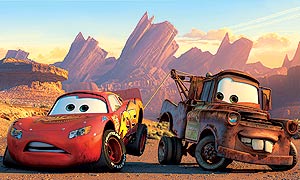
CARS So cute and nice. Each car has different eyes—like, Sally has blue eyes and Lightning McQueen has even bigger ones. But are they blue? I don’t remember. But they’re both big eyes, so the two of them are a perfect combination. I like the music of
Cars (sings “Life Is A Highway”), but my favorite part is when they sing “Sh-Boom” and all the bright signs in radiator Springs get turned back on.

2)
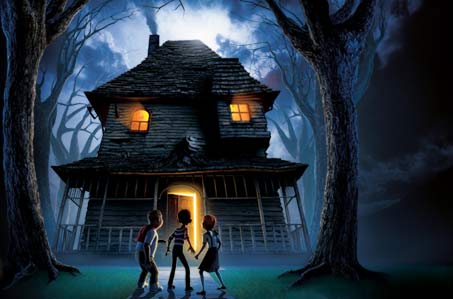
MONSTER HOUSE A little bit scary for little kids. The kids were creeping up toward the house, and suddenly they got up on the porch, rang the doorbell and the door had teeth and the house’s tongue rolled out after them like a red carpet, only sticky and bumpy. My favorite part is when DJ and the girl kissed.

3)
HAPPY FEET Mumble the Penguin is really cute when he does his happy feet dance (She demonstrates). Other kids should see it, but the seals and whales attacking might be too scary. There wasn’t anything in this movie I didn’t like. Favorite character: Mumble’s girlfriend, Gloria.

4)
HOODWINKED It’s all about all the different characters in the story of Little Red Hiding Hood. Red tells her side of the story, then everybody else gets to tell their version of what happened. Granny snowboarding down the mountain with the bad guys was my favorite part.
5)
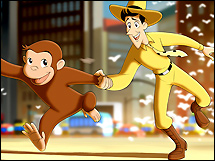
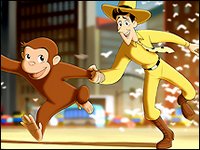
CURIOUS GEORGE He’s really curious and goes everywhere with his buddy, the Man in the Yellow Hat. George always gets in trouble. At the end he shoots off into space and flies over the world. The music is good too.
The rest:
CHARLOTTE’S WEB “Very creative!”
FLUSHED AWAY “Cool!”
THE PINK PANTHER “Funny!”
LASSIE “Exciting!”
OVER THE HEDGE “Hilarious!”
ICE AGE—THE MELTDOWN “Very icy!”
EIGHT BELOW “Sad!”
THE WILD “Silly!”
NACHO LIBRE “Crazy!”
OPEN SEASON “Too many animals!”
SUPERMAN RETURNS “Too scary!”
 WORST OF THE YEAR
: Nudging out
Turistas for Worst of the Year honors is the execrable, painfully unfunny
DATE MOVIE, the nadir (to date) of a trend in stupid American comedies that go for bottom-trolling guffaws at the expense of the grossly obese (be on the lookout for Eddie Murphy’s
Norbit coming this spring) and equate the making of a pop culture reference (Look! It’s Napoleon Dynamite!) with the making of a joke about that reference. The mere fact that you recognize Napoleon Dynamite is itself supposed to be funny, so why bother with any actual humor? Rotten to the core.
RELATED READING: More year-end “Best” lists from
Dana Stevens,
Ed Gonzalez and Nick Schrager,
Jim Emerson, the gang at
MSN Movies,
Filmbrain and the Year-End Critics Poll at
IndieWire.
Elsewhere, Jim Emerson also has a fun article on
The Best Double Bills of 2006, David Poland looks at
Film Critics Version 2006 and a heady roundtable of Jonathan Rosenbaum, Molly Haskell and Brazilian critic Jose Carlos Avellar awaits you as they make their
”Picks from Pedro to Prairie: Discussion on the Films of 2006”.
And finally, our esteemed friend and Internet overseer David Hudson wraps up 2006 in compelling fashion with his
Random Bulletpoint Fire 2006. The number-one development for the year in Web-based film criticism as he sees it: the Blog-a-Thon!
Onward and upward! 2007 awaits! See you there!


 Posts
Posts