Posts
Posts





THE BLACK RHAPSODIES OF BRIAN DE PALMA
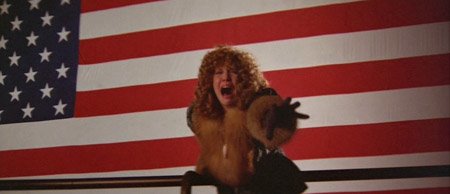
There does seem to be a bit of Brian De Palma blowing in the cinematic winds these days leading up to the release of The Black Dahlia, and it’s taking form in a lot of interesting posts and comments on the director and his films on some very smart blogs. I’ve already mentioned Slant’s Auteur Fatale series, as well as well-considered observations from That Little Round-headed Boy (whose piece on Mission to Mars even gets a mention from the oracle at De Palma a la Mod), Girish and Peter Nellhaus. Now you can add Peet Gelderblom’s two cents to the coffers of fine writers checking on De Palma. Peet muses about paradox in De Palma's work on his blog, Lost In Negative Space, an off-shoot of his excellent film criticism site 24 Lies A Second. (Peet also points to Soundtrack.net where snippets of Mark Isham's score for The Black Dahlia can be heard.)
(If anyone knows of any other good writing on De Palma that could use a link, please let me know!)
There’s so much interesting going on about De Palma that I had been regretting not picking up the ball and running with it myself. But then a message from Peet this afternoon reminded me that, actually, I had. I’d just left everything in the comments column of my recent post, "Brian De Palma: Critical Black Mass." The comments there, from Maya, Tom Sutpen, TLRHB, all add up to an excellent consideration of how this director functions (and sometimes doesn’t function), especially in a critical world that seems to value someone like Sam Mendes more than it does a true soaked-in-cinema provocateur like De Palma. But it was SLIFR reader Cerb Chaos who posed a query that finally got me into the fray:
”I not only dislike (De Palma’s) work, but am confused over the reception he has been given by critics whom I mostly agree with wholeheartedly. True, I have not seen such films as Carrie, Scarface, and Sisters, which are more often cited as his masterpieces, but after my experience I am not so excited to see them. Are they that much better?”
I hope that my own thoughts, intended as a response to Cerb Chaos, can function on their own as a general consideration of why De Palma’s films most often (but sometimes do not) work for me, and therefore might be considered a worthy contribution to the snowballing impromptu blog-a-thon-style discussion of this great director. But I also want to highlight those comments that I received that really serve to illuminate this director, who is so confounding and exasperating to some, and so exhilarating and compelling to others. To start, Maya connects the dots between Antonioni and Blow Out, a connection that goes well past a similarity in titles:
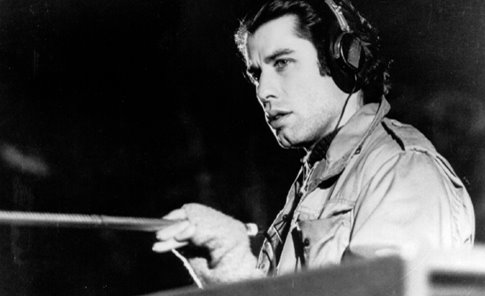
“Blow Out… reminded me of Antonioni, both in its forensic epiphany and the reference to what Girish has already identified as a ‘cinephiliac moment’: when the night wind blows through the trees, replicated almost with tenderness in the scene where Travolta is recording the night wind.”
Then Cerb Chaos checks in, reacting, I’m assuming, to the collection of rhapsodic writing referred and linked to in the “Critical Black Mass” post:
”I have seen three of De Palma's films, and in all likelihood they are not a correct representation. But I don't get the love he's gotten on the film sites I visit. Mission to Mars, which as mentioned has an essay by the always articulate LRHB, is quite simply the worst movie I have ever seen in theaters, and one of the ten worst movies I've seen. Period. This was the first De Palma movie I saw. It did not leave a good impression. I saw The Untouchables, which is entertaining, but nothing that I feel any kind of love for.
 After discussing this with my father, he persuaded me to watch Dressed to Kill, which deemed to devolve into a game of “spot the homage.” De Palma's homages seem to me too obvious and take me out of the movie watching experience. After watching the movie my dad asked me what I thought about it. I admitted that I didn’t like it. He replied that he thought it had aged badly, losing what novelty it had when first released.I not only dislike his work, but am confused over the reception he has been given by critics whom I mostly agree with wholeheartedly. True, I have not seen such films as Carrie, Scarface, and Sisters, which are more often cited as his masterpieces, but after my experience I am not so excited to see them. Are they that much better?”
Then it was Tom’s turn:
”I'm not as great an admirer of DePalma's as some (though what films of his I like I have very high regard for), but I do understand why other cinephiles find much in his work to rhapsodize over.
There are few filmmakers, after all, who evince as complete an affection (albeit a critical one) for Cinema as Brian DePalma; and his engagement with it, as reflected in the films themselves, is never less than fascinating. At worst, yes, there are times . . . I number much of Dressed to Kill among them . . . when he overborrows and the whole thing sinks to the level of empty homage, but far more often he takes this prior material and redeploys it in extremely intriguing ways.
 In Blow Out, for example, DePalma doesn't simply use the Antonioni material to create what Girish righteously calls a 'cinephiliac moment', he fully absorbs it into his own sensibility (a sensibility I think one can find in its purest state in his early comedies) and subtly transforms it in the same breath. He re-claims it in the name of the cinephile, if you will. On these occasions, DePalma's construction of the Thriller becomes as purely cinematic as Jerry Lewis's construction of visual gags; and far more personal. How could a cinephile not go gaga over it?
A brief word on The Black Dahlia: I can think of few artists who could more profitably collide than DePalma and James Ellroy (Ellroy, in his crime novels, applies a technique similar to DePalma's suspense numbers), but personally I would have liked to see what DePalma could do with a dense, maddening, gruesome novel such as Ellroy's The Cold Six Thousand. Black Dahlia seems almost too easy a challenge by comparison.”
And finally, That Little Round-headed Boy, celebrated and eloquent defender of Mission to Mars:

“I'm not blind to DePalma's weaker pictures, but what he creates on film (in his best films, at least) is something akin to a dream state, where you completely lose track of being a viewer engaged with a piece of celluloid and just become one with the experience (That's the same reason I don't dismiss Kubrick's Eyes Wide Shut, which has many clunky passages and a bad performance by Cruise, but also has moments of haunting hypnotic poetry.) Any director who can do that with film simply cannot be dismissed so handily, or thoroughly rated in an up/down thumbs system. I understand consumer criticism that needs to rate the movie on all its elements, but the beauty of what we can do on blogs is explore films for more than that. Basically, it doesn't matter to me if a film is good or bad in sum, but whether it's interesting enough to stay with me, rattle in my head, or make me want to see it again. I think those are equally valid ways to discuss and understand film.”
Thanks, Maya, Tom and TLRHB. And thanks too to Paul C., who is a champion of both Phantom of the Paradise and Raising Cain, and to Peet for encouraging me to go back and make this an “official” unofficial blog-a-thon contribution. (Some might call it shameless recycling. But not you, right? Right?!)
But mostly, thanks to Cerb Chaos for being forthcoming about your disagreement with what seems to be (in this instance anyway) some kind of critical consensus that you're honestly seeking to understand. I’m not saying that the comments, above or below, will necessarily change your mind or anything. But I do appreciate the spirit in which they were put forth, and I’m glad to be able to say that they were, I think, received in the same spirit— one of furthering understanding of all points of view on a figure as complex and controversial as Brian De Palma. It was your comments that finally inspired me to try to briefly (ha!) put into some shape or form what it is about the director that I find so personally transfixing. That attempt is what follows here.
*************************************************************************************
De Palma is one of those filmmakers who seems to inspire either fierce devotion or fierce hatred-- there doesn't seem to be much middle ground when considering his films. (And considering his subject matter and his insinuating, exploratory, personally implicating way with the camera and story structure, should this be so surprising?)
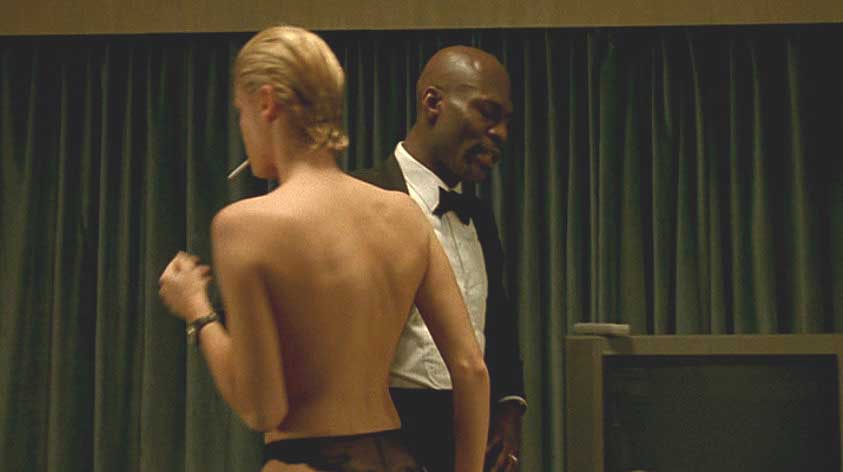
 I've always found De Palma to be a compelling filmmaker, particularly coming, as I do, from the point of view of a cinephile, even when I've found his work off-key or ill-advised. But since the release of Femme Fatale, I've come to realize with just how much esteem I hold this director-- he's surely one of my favorites now, and perhaps one of the two or three best American directors currently working. Yet I've never felt bound to look at his work with a blindly approving eye and, indeed, there are several movies in his oeuvre that, despite their clear thematical relationship to the rest of his work and to the history of cinema he draws upon, seem fundamentally uninspired, tired, atonal.
I'm thinking primarily of movies like Obsession, and also Body Double, which I recently revisited-- I revised my opinion upward slightly, but still don't think much of it-- and the absurdly overestimated Scarface, which Pauline Kael called "a De Palma movie for people who hate De Palma movies."
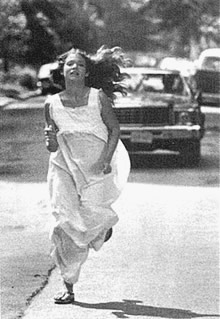 I also think less of The Fury than most De Palma enthusiasts do. To my eye, it's filled with images of sinuous, beautiful rage and the poetry of emotional agony, and it sports some terrific performances-- John Cassavetes, Charles Durning, Carol Rossen, Amy Irving. Yet at the same time it seems rather misshapen at times as a narrative, hurried and choppy in moments where it should be languid and seductive, and I think it fails to build up a true head of black steam by its conclusion, despite the memorable dispatching of Fiona Lewis and, of course, Cassavetes. It's clearly a classic De Palma in its concerns and its approach, and compared to just about any other similar effort from just about anyone else it's clearly technically superior. But compared to some of De Palma's other works from the same period I just don't think it's as perfectly crafted or consistently imagined. All that said, I still enjoy revisiting The Fury every couple of years or so.
But ask me what De Palma films I'm over the moon for, either with the kind of minor reservations I'd have for any filmmaker, or with none at all, and the list is much longer: Hi, Mom!, Sisters, Carrie, Dressed to Kill, Blow Out, Casualties of War, Carlito's Way, Mission: Impossible and Femme Fatale, with a second tier occupied by Phantom of the Paradise, The Untouchables and Raising Cain. Cain, in fact, is on my short list of De Palma titles I'll be revisiting soon, along with Snake Eyes, Mission to Mars, The Bonfire of the Vanities and hopefully even Wise Guys before The Black Dahlia bows.
As Tom says, it's De Palma's engagement (hugely key word) with cinema and cinema history that, plainly enough for me, places him outside and above the class of copycats with whom he's so frequently grouped. He's using key influences (Hitchcock, of course, but Antonioni, Godard, Chabrol and Kubrick as well) not as signposts to clue movie eggheads in as to how smart and crafty he is, but as seedlings for the progression of his vision over the course of his career, as the foundation of a structured, astringently clear-eyed, yet sometimes subtly hallucinatory way of visualizing the world through the cinema. The audiences "sees" the cinema, but De Palma also uses the cinema itself to see, to reflect back on the world, on the audience, in a meaningful and not always comforting fashion.
De Palma's movies, sometimes because of their excessive stylization, can seem uneven, to have not "aged well." There are moments in both Dressed to Kill and Blow Out that seem thin, less well thought out. (Is it coincidence that they seem to be those scenes that feature Dennis Franz and Nancy Allen in one-on-one situations?)
But each movie, even within scenes that may not seem to be "working" for sensibilities that have have moved 20-25 years down the road, relies on relevatory visual strategies and cues that can often help the viewer past the occasional lumpy exposition or weak performance by engaging him or her in the film's structural purpose-- I'm thinking here of how De Palma uses the multilayered framing and levels of sound in the interrogation scene in Dressed to Kill to tickle our imaginations and stimulate our perception during an otherwise banal scene-- Keith Gordon eavesdropping on Franz's questioning of Allen-- seen through layers of windows, and through various and subtle deep focus/split screen techniques.
 I think you're right on the money, Tom, regarding Blow Out as well. De Palma absorbs the Antonioni material, all right, and I'd suggest he goes far beyond what Antonioni was able to achieve, or maybe even what h was interested in achieving, in Blow Up by embracing the crude "plot" elements of the witnessed murder. Where Antonioni abandons this narrative line, for reasons either based in existential malaise, or perhaps a disinterest in exploring the possibilities of mere melodrama, De Palma grounds his film in it and expands the elements Antonioni abandons into a vision of political paranoia and personal responsibility that is far more potent today than are his fellow Italian's mod London mind games.
I cannot imagine sitting through the first 20 minutes of Blow Out and not being completely glued to the screen to see the rest. That's an opening 20 minutes that holds within it the gruesome, salacious comedy and fake-out gimmickry of the movie-within-a-movie; the stunning logo of the movie itself (scored with near-subliminal, prescient use of some of the most integral and agonzing sounds that will be heard later in the film); the enthralling split-screen under the opening credits, which contrasts expository information setting up the importance of the Liberty Bell Parade and the emergence of the Kennedyesque political figure with Jack (Travolta) preparing to record sound out in the field; and of course, that absolutely perfect sequence in which De Palma heightens every sound (the owl, the overheard pedestrians, the faint squeal of tires) in anticipation of the recording of the sounds of the horrific event that will kick the film's primary mystery into gear. You're damn right, Tom-- this cinephile is definitely gaga over it.
And it's impossible for me to see Blow Out and imagine coming away, despite the apparent influences of Antonioni and Hitchcock, thinking of it as anything but a De Palma film, a work of art that couldn't have originated from anyone else. To downgrade an artist because he acknowledges the whole of the history of his art form, and specific avenues of interest that have sparked his creativity in the creation of his work, would be to deny the manner in which artists in every medium have taken previously known works and expanded on them, turned them inside out, filled old wine husks with new wine. De Palma is a polarizing artist whose output has never taken a straight line-- he gets better with age, it seems to me, even if there are disturbing, uneven zags and zigs from film to film. And even his work for hire (Mission: Impossible, Mission to Mars), while sometimes hit and miss, is shot through with this director's fury, deftness with chronology, visual confidence and, in the case of Mars, belief in the lyricism and power of the image to overcome the occasional insufficiency of the spoken word.
I have no idea where The Black Dahlia will land on the scale of Brian De Palma's career, but I'm hard pressed to think of another director in 2006 whose work I'm so much looking forward to seeing.