Monday, November 18, 2024

BURN AFTER READING (2008) REVISITED


When I saw it in its original theatrical release back in 2008, I thought Burn After Reading was brutally hilarious— as far as I could tell, though, the general reaction was less enthusiastic. Yet speaking as a fan who has never warmed to The Hudsucker Proxy (a movie frequently cited when one wants to find a red-headed bastard stepchild among their filmography to champion), it’s one of the Coen Brothers’ movies I think is most underrated and one I find myself regularly returning to. 

I’m watching Burn After Reading again tonight (11/15/24), after the past week and a half of fear and loathing and anxiety and watching a seemingly endless roster of idiots and toadies ponying up to take up space in a clown car careening toward a spectacular crash into the next presidential cabinet, and I suspect that it’s a movie that is just going to seem sharper, more astringent with impending age. As Frank Zappa said in 1981, assessing the population’s predilection for being fleeced by evangelists whose credentials as certifiable con men and women were more than obvious to those not tithing under their sway, “Dumb all over/ Yes, we are/ Dumb all over/ Near and far/ Dumb all over/ Black and white/ People, we is not wrapped tight.” Burn After Reading is nothing if not an accurate reflection, from 16 years ago (when some took it to be overly cynical and even a bit sour), of just how deep, and how dangerous, that dumb goes. 

And really, as an avatar for our age of unenlightenment, Brad Pitt’s inspired turn as an intellectually translucent gym trainer who thinks he’s way brighter than he turns out to be, reveals this as the performance for which he more credibly should have won an Oscar.

Here's the link to my original piece on Burn After Reading, dated September 25, 2008.

***********************************


FROM THE ARCHIVES (11/2021): 1941, FOR JII-JII


We laid my father-in-law to rest three years ago this month, and I am reminded of something that happened just a few months before we lost him. Jii-Jii was a US World War II veteran *and* an internment camp survivor (think on that one for a bit), so I’d always approached showing him one of my favorite movies, 1941, with understandable trepidation. It’s not a movie that denigrates the Japanese, even as it satirizes and depicts some of the ways that the Japanese (the army, anyway) were denigrated by patriotic Americans at the time. Even so, I wasn’t sure how he would respond, or if he’d even be interested in seeing it. Well, a few months ago, when he was still feeling well enough, we had both Mommy and Daddy over to the house and I felt like the time was finally right. So we fired up my 1941 Blu-ray, and darned if they didn’t both love it. On the ride home he just kept saying, “Boy, that was one crazy movie!” and laughing at my stories of the multiple times I’d seen it and how, no matter how low I am at any given moment, it always cheers me up, gives me hope, makes me look at the world a little differently. It’s entirely probable that 1941 was the last movie Jii-Jii ever saw, and given that it made him laugh so much I couldn’t be happier that it was.

**********************************************

FROM THE ARCHIVES (11/15/20): FRANCESCO ROSI'S CHRIST STOPPED AT EBOLI (1979)


I’m currently 64 years old, and though I still have an alarming collection of blind spots in my experience,  I have seen a lot of movies in just over 23,000 spent days. But back in November 2020, on a quiet Saturday night, I erased one of those blind spots and replaced it with a vision of clarity that was, to me, quite unexpected. 

Around 8:45 p.m. I started looking at the new Criterion Blu-ray of the uncut, original four-part, four-hour presentation of Francesco Rosi’s Christ Stopped at Eboli (1979), based on Carlo Levi’s memoir of his political exile in a remote village in pre-WWII Southern Italy, a time defined and scarred by Mussolini and that fascist regime’s  attempt to impose a new colonial presence in Abyssinia, now known as Ethiopia. It had been a long day the day before, and by the evening I was plenty tired— I figured I’d just dip into the disc and take a look at how it looked, with no expectation of actually watching it, and certainly not getting any further than an hour or so before drifting into unconsciousness.

But the alchemy of the movies is a mysterious thing. From the opening images of Gian Maria Volontè as Levi, bearded, solemn, in repose and surrounded by a multitude of paintings of his own creation, to the title card “1935” imposed over a shot of a train which bears Levi to the town of Galiano, in the province of Lucania on Italy’s southern bootheel, to the slow revealing of a culture in the impoverished Galiano, people, traditions, customs and superstitions left behind in the wake of the rest of the country’s economic development and relentless political oppression, the movie’s patient gaze, its nonjudgmental approach to its characters and their environment is established immediately. 

As Levi is introduced to the various people who will expand and enrich his own dissent from the fascist establishment that has made him (and a few others in the town with whom he is not allowed to speak) a political prisoner, I found myself succumbing to its rhythms and knew after 10 or 15 minutes that I was in for the long haul. But it was hardly a chore. It is a rare thing, but that Saturday night in November 2020 I felt myself succumbing to what Rosi wanted to show me, and the way he wanted to show it, in a particular fashion that I can’t recall experiencing often in other films. There was a distinct sensation of my mind and body sinking into the imagery which, on this spectacular new Blu-ray, has a clarity and richness that promises the sort of seduction few movies are capable of fulfilling. 


I spent four hours seeing the world of these Italian peasants, who for Mussolini and his enforcers existed simply as subjects and fodder for war, through Levi’s (and Rosi’s) eyes, feeling my way toward an understanding that would, like it would for Levi, I suspect, remain just out of reach while also changing his life forever. In my own way, I feel like seeing Christ Stopped at Eboli has been a life-changing experience, one that contained within it the possibility of a genuine expansion of perspective, of yielding to a way of seeing the world that already, just 12 hours later, felt like it was in there tinkering with my synapses, becoming an essential part of the blood flowing through my veins. The movie, a giant vision of humanity, began expanding inside my head that night, and four years later I’m beginning to reflect on the ways it had seemingly helped equip me for the new reality America and the world are facing in 2024.

At 60 years old I certainly didn’t expect, sitting by myself on a quiet Saturday night, to discover a relatively less-well-known film that deserves consideration as one of the greatest I’ve ever seen. But that’s what happened. Christ Stopped at Eboli is surely a landmark in this old man’s continuing experience of education about life and the movies, and I cannot wait to see it again. And now, at age 64, that time may be coming again very soon indeed.

**************************************

FROM THE ARCHIVES (11/16/13): IF YOU COULD ONLY COOK and THE LAST ACTION HERO


Woke up feeling kinda crummy this morning-- first inklings of a winter cold to go along with the delightfully gloomy weather outside today (the weatherbots on local news assure me all will be back to sunny normality early this week). All I felt like doing was (surprise!) watching movies, so I wrapped up in a blankie and started in on the DVR queue. First up was If You Could Cook (1935), a charming romantic comedy (it didn't seem screwy enough for the "screwball" label, in my view anyway) starring Herbert Marshall and Jean Arthur as a disgruntled auto magnate and a down-on-her-luck bench warmer who conspire to get jobs as the butler and cook for an Eye-talian mobster (Leo Carillo). The movie was apparently falsely promoted (according to Leonard Maltin's book) as a Frank Capra joint-- right down to bogus credits in some European markets-- to capitalize on the director's popularity at the time. But as directed by William A. Seiter it stands on its own just fine, with plenty of laughs, surprisingly spiky chemistry between the two leads and a cheerfully cranky supporting turn by Lionel Stander as the mob boss's second in command.


I followed up with The Last Action Hero (1993; John McTiernan)-- a 20-year-old relic from a not-all-*that*-different age, which I'd never sat down and watched before. I'll admit I was hoping for a "Misunderstood Masterpiece" sort of revelation, or at least the sort of "Gee-it-ain't-as-bad-as-advertised" moment like the one I experienced with Hudson Hawk a couple of years earlier. Well, forget about "Misunderstood Masterpiece," and it really isn't so bad as to warrant the level of embarrassment it registered for Schwarzenegger and Columbia when it came out-- I remember an awful lot of hand-wringing and pointing of fingers and very impatient reviews (no studio execs flinging themselves from tall buildings, however). But neither is it as clever as it seems to think it is, nor as nimble as a spry, self-aware genre parody should be. Frankly, this deliberately unsubtle picture might have been helped by a better performance by the kid in the lead-- Austin O'Brien isn't exactly Jake Lloyd, but after a while he does make you want to stick him in the back seat with a comic book and threaten to turn the car around and go home if he doesn't shut up. A couple of weirdly prescient winks toward Schwarzenegger's political ambitions gave me the chills too.

The Last Action Hero
 is a big, loud white elephant, but it's not so much the tin-eared mess I was expecting as it is a movie that hums along with considerable energy (it gets better, briefly, when the fictional characters step into the "real" world) and seems, finally, somewhat indifferent to its own wacky premise. There are some funny jokes along the way, and a clever celebrity cameo or two, but I suspect it'll be longer than another 20 years before I ever see this one again.

******************************************************

Sunday, August 04, 2024

MAXXXINE (2024)


With X (2022) and then Pearl (2022), writer-director Ti West (The House of the Devil, The Innkeepers) rather unexpectedly initiated a decades-spanning portrait of evil that allowed him to access distinct movie styles— using the richness of ‘30s Technicolor in Pearl to map the psychological terrain of a character who serves as a rotting vision of what might have happened to Dorothy Gale had she never been swept off the farm to catch a glimpse of Oz, or the sun-bleached, grungy foreboding of Tobe Hooper’s 1974 masterpiece The Texas Chainsaw Massacre as the template for X.

The trilogy comes to a close with MaXXXine, in which the porn star would-be actress Maxine, who  survived a massacre in X perpetuated by the demented murderess Pearl, who somehow retained a degree of sympathetic connection with the audience, if not her victims, has found her way to Hollywood circa 1985 in relentless pursuit of the life she believes she deserves as a mainstream movie star. She lands the lead in a sequel to a ‘80s video nasty that may provide the path to that stardom right about the same time that another murderer, disguising his unfortunate victims as those belonging to real-life Los Angeles serial killer Richard Ramirez, the Night Stalker, begins bringing Maxine’s bloody past back to haunt and perhaps eventually extinguish her.

Since we’re in the middle of the Summer Olympics and in thrall to the far more ambitious and impressive achievements of gymnast Simone Biles, it’s impossible for me to resist saying that MaXXXine fails to stick the landing fans of the previous two films were hoping for. And part of the problem may just be that, being newly beholden to the aesthetics of an era in which neon-lit, relatively style-free, formula-bound splatter films were the order of the day, West ends up recreating not only the look of the sleazier, tourist-unfriendly Hollywood Boulevard of the time, but also the limitations of that particular form of visual and narrative storytelling.

MaXXXine is fun moment to moment, but as it moves toward its sleazy milieu toward the answer to the mystery of just who it is stalking Maxine, the movie starts to get bogged down in attempts to comment on 2024 by evoking images of Moral Majority-esque protests and heavy-handed proclamations about low art usually delivered via the movie’s own directorial stand-in (Elizabeth Debicki), about whom West never really takes a stand as to her status as either self-proclaimed artist-with-a-voice or just another pretentious industry hack. (Debicki’s haughty film director may be modeled at least partially on female horror auteurs like Stephanie Rothman or Amy Holden Jones, whose Slumber Party Massacre was written by Rita Mae Brown.)  And it eventually succumbs to the sort of thinly fleshed-out third act that was part and parcel of the video and theatrical nasties of the day— there’s nothing here to match the chilling, searing endings of either of the previous films. If sleazy ‘80s horror is your thing, there may be plenty here to provide a gristly meal, but merely revisiting that cheapo VHS aesthetic was not enough for me.

And speaking of the previous two, MaXXXine is also hobbled by the fact that it’s the only movie in the series that does not work fully as a stand-alone film. Without particular knowledge of what transpired in X, West’s somehow elliptical, I would say almost cavalier approach to grounding his audience in events that have transpired which directly affect his new film and the character of Maxine Minx is kind of perplexing, and audiences without that foreknowledge might find themselves confused to the point of indifference.

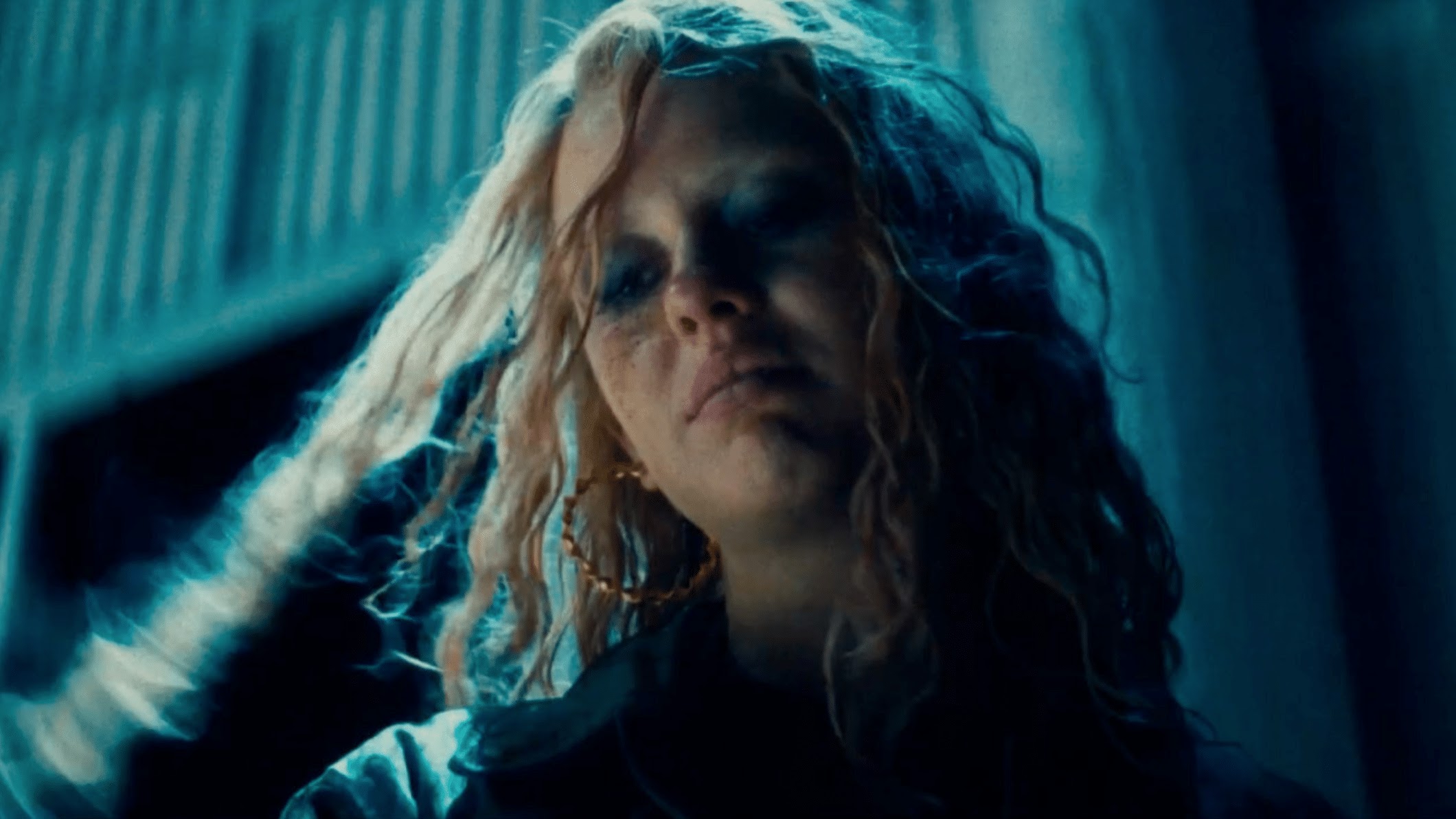
However, MaXXXine does still have Mia Goth, who absolutely makes you believe she is a woman, however mangled by her past and her own violent tendencies, who will not accept anything less than the life she feels she deserves, and if there’s less of the psychological depth she brought to Pearl (and that film’s absolutely soul-shaking final moments), she’s still fully committed to the role and she’s never less than riveting. So much so that the movie never really lives up either to its predecessors or to Goth herself.

MaXXXine is fun in its way, especially if you can see it the way I did, at a drive-in in the middle of a darkened, forested patch, but compared to X and especially Pearl it’s an anticlimactic finish to an otherwise strong series.

***********************

PEARL (2002)


I haven’t said much about Pearl, mainly because I’ve spent the last 24 hours since I saw it processing the unexpected emotional residue it left me with. The difference between this movie and its predecessor, X, is more than just a matter of its faux-Technicolor aesthetic versus X’s ‘70s-inspired low-budget local grunge, or its emphasis on character evolution (or devolution) over transgressive sex and violence (though make no mistake, Pearl does not skimp on sex or transgressive, surprisingly painful gore). The difference, it seems to me, is Pearl's depth of feeling, of emotional resonance.

The movie’s not-so-secret weapon is Mia Goth as Pearl, who sells the character’s constant teetering between levels of reality and desire with horrifying immediacy and surprising shades of empathy, especially given the, um, antisocial behavior we see her indulge on first pitch(fork). In mapping the psychological terrain of a character who could be, given that Technicolor signaling director Ti West indulges with abandon, a rotting vision of what might have happened to Dorothy Gale had she never been swept off the farm to catch a glimpse of Oz, Goth accesses the guileless spirit of a young Shelley Duvall, and the final shot of the movie, which she occupies to devastating effect, made me feel like I was having a Bickle-sized meltdown to match the one on screen. 

 (This post was written in 2022 just after seeing Ti West's Pearl for the first time.)

SHELLEY DUVALL (1949-2024)


A long time ago, in a land far, far away (at least it is now), I saw Shelley Duvall in person. It was February 1982, and she was one of many stars and celebrities gathered at the Plitt Century Plaza Cinemas in Los Angeles to see the opening night screening of Francis Ford Coppola’s One from the Heart—the theater sold tickets to the general public and somehow I snagged one. So there I was, bumping shoulders with Steven Spielberg, Nastassia Kinski, Arnold Schwarzenegger, Teri Garr, Fredric Forrest and, of course, Coppola, to see this movie, and as agog as I was to find myself in this sea of movie star heaven, they all paled in comparison when I set my eyes on Shelley Duvall.

From 1970 on, Duvall had been in some of the most influential movies I ever saw in my life during that period, most of them directed by my favorite filmmaker, Robert Altman— Brewster McCloud, McCabe and Mrs. Miller, Thieves Like Us, Nashville and 3 Women. She was, as my friend Steven Santos has suggested, central to understanding and finding your way to Altman’s wavelength, and the movies he made with her are unimaginable, especially now, without her. In 1982, when I found myself wandering through that theater lobby and eventually spotting Duvall unassumingly standing near the snack bar, engaged in a conversation, she was coming off of the two movies that most people probably associate her with—Altman’s Popeye (1980) and Stanley Kubrick’s The Shining, also 1980)—a moment in her career that would never again be duplicated. (And to those who love to propagate the theory that Kubrick’s punishing methods drove her to eventually crack up, well, there was certainly no evidence of it that I could see—it’s called acting, folks.)  

I stood there for what seemed like a long time, hemming and hawing, hands in pants pockets, trying to get up the courage to go up to her and say something no more prepossessing than “Ms. Duvall, I’m a huge fan. Thank you for your wonderful work.” But I hadn’t yet lived in Los Angeles—I was still only a very green visitor and I had no idea whether I’d be overstepping myself or how she would react to being approached. I have since heard, from people I know who *have* talked to her, that I had nothing to worry about that night 42 years ago. But I didn’t know that then. And so, after a bit more rocking back and forth on my heels and toes, I slunk back to my seat and left her to the movie and to her life.

That’s a decision I’ve regretted ever since, especially today. Because Shelley Duvall, maybe my favorite actress for a good 20 years or so, has died of complications from diabetes. Of course, her ill health and her stepping away from Hollywood were widely known, thanks in part to some callous exploitation of her situation by people who ought to know better but who, in pursuit of dollars and notoriety and clicks, have long lost the crucial compassion of bedrock humanity. But it’s heartening to know that she found love even during this difficult time in her life, and that far more people seemed to surround her and support her in the wake of all that exploitation than wanted to take advantage of her. Up till the end, she had meaningful relationships and fans who would become friends who visited her from all parts, and she seemed genuinely happy, even though her circumstances were far from those that would ever been blessed and anointed by the Hollywood spotlight.

It's hard to underestimate, or even express what she’s given to me since I first saw her-- in Nashville a few years before I ever saw her film debut in Brewster McCloud-- but I remember being immediately taken by her unusual comportment and lack of self-consciousness as a performer, her openness, her vulnerability, and the hint that there was something behind those giant eyes that haunted the untrained approach she brought to almost every role. (Pauline Kael once described her as possessing the appearance of having stepped straight out of a Modigliani painting.) I love her in Brewster McCloud, the hero’s one true tie to the world who inadvertently sets the stage for his downfall; and as Keechie, unsophisticated partner and lover to the gangster Bowie (Keith Carradine, with whom she was paired three times in Altman’s films) in Thieves Like Us; and of course Millie Lamoreaux, the spa worker whose misplaced confidence and desperate longing to insinuate herself into a world she can’t see doesn’t really want her brings about a strange fusion and personality transference with a young woman (Pinky, played by Sissy Spacek) who she ostensibly takes under her wing in Altman’s 3 Women (1977). (Duvall won the Best Actress award at Cannes in 1977 for her work in this movie.)

But I’m not the first to say, and certainly not the only one today, that the role she was born to play, which she embodies so fully as to seem possessed by the spirit of ink and paint that once brought the character to life, is Olive Oyl, and that’s the one I’ll watch tonight. To witness her in Altman’s undervalued family comedy Popeye,  to see her interacting so gracefully in that strangely compressed universe of Sweethaven Village, effortlessly capturing the heart of the spinach-inflated titular character (Robin Williams), to hear her plaintively singing the words to Harry Nillson’s lovely, monosyllabic romantic ballad “He Needs Me,” is to be subject to and swept away by a delightful emotional force that has always hit me sideways and unexpected. She is the cartoon brought to life, but she goes so far beyond that construct that her work here might be the one performance I think most deserving of an Oscar which would never, and never did, come within a mile of actually getting one. Many actors far more classically trained than Duvall will never experience the singular fusion of sweetness and talent and purely graphic glory, the absolute surety that they were born to play a particular role, that Duvall was blessed by, and in turns blesses, as Olive Oyl. That role was a great gift given to her by Altman, her mentor, and no less a great gift to us.

Shelley, I wish I’d been braver that night back in 1982. You were maybe the least intimidating person in the room, smiling that smile that could have only come from you, and I really regret that I passed on the chance to connect with you and let you know how much you meant to me. Your singular personality and style probably mean even more to me now, and I’m sorry that the world was a tougher place for you in your later years than you ever expected it would be, that you ever deserved. In a world where telling cookie-cutter actors apart from each other has become increasingly difficult (and tiresome), no one would ever mistake you for anyone else. I’m sure you knew that, but I would have loved to tell you face to face and let you know about the place in my heart you’ll always have. And it’s there where I’ll visit you tonight, listening to your wonderful voice singing those songs, watching you bouncing through a world that never existed, and I will do my best to say hi this time.


************************************