Sunday, January 06, 2019

OUT ON A WEB: THE MOVIES OF 2018


When is the best not the best? I think the answer to this non-rhetorical question that maybe nobody would ever ask in the first place has to be, when one hasn’t the breadth of experience to really answer with any certainty or credibility. Best cheeseburger in my neighborhood? Well, I haven’t sampled them all. But I know which ones I believe measure up to my standards, which ones transcend simple food, thoughtless product to be inserted with the singular purpose of quashing that gnawing feeling in my belly and, if the creation of a great cheeseburger, one in which the ingredients are complimentary, which integrate to inform the entirety of the experience of each bite can be so loftily considered, which ones approach art.

And so it is with the movies. Despite the protestations of every haughty, angry, insistent film critic (or anyone else, for that matter) whose language abandons the pretense of having not submitted to their own oft-repeated preconceptions, whose manner belies claims that theirs too are just opinions and reveals the judgment delivered upon those who would disagree with their choices for the Best Films of the Year, these sorts of endeavors are (surprise!) hugely subjective. And I have come to understand, after 15 or so years of putting my own thoughts out there for the public to indulge or ignore, that no such claims of “best” anything can really hold much water, simply because to hold forth as if they could would mean I was placing some sort of authority upon myself than I have no business trafficking in. Most intelligent writers and movieheads I know thankfully refrain from indulging in this sort of nonsense. But some continue to bash our heads with proclamations and tirades aimed to end the conversation, not further it. (“X and Y are brilliant. Z is a piece of shit. That is all.”) Those are the ones that I have concluded I can do without.  

The best any film critic can hope for at the end of the year is to try to express some measure of their own experiences with cinema, however far-ranging that experience might be. Of course, the ones who have a greater breadth of knowledge, who have seen more and can make connections between works and eras and sensibilities, are likely to be more interesting than the guy whose top-ten list is comprised entirely of all ten movies he saw in total for the year. These are the writers who can give you a rich snapshot of the film in question and something of their own story, however overtly or covertly, in the process. That’s why discovering Pauline Kael when I was a pup was such an important event in my intellectual and creative life, such as it was and is. She was a master of making writing about film both universal and sublimely personal, and I loved her for it, even if I often found myself at odds with her conclusions.
My own writing, I believe, lands somewhere squarely in the middle of those two poles of experience. One of the great lessons for me when I moved to Los Angeles from Oregon has been that, try as I might, it was impossible to see everything. And over 30 years later, with the accessibility granted by streaming and DVRs and labels like Criterion, Arrow, Warner Archives, Olive Films, TCM, Kino Lorber and an endless chain of other like-minded entities, there’s more available to see right now than there ever has been in my lifetime. And that’s an entirely separate conversation from the movies released in any given year. Therefore,  you won’t catch me trying to proclaim the best of anything any longer, whether we’re talking cheeseburgers or classics of contemporary film. There’s not enough time, literally. 

That said, what follow are the movies I responded to in 2018, with a nod toward all there is left for me to see, an exercise which may add even a little more perspective for any reader who actually cares-- “Well, if he thought so highly of X, maybe he should have seen Y, and it might have affected his thinking about both.” I have also, as become my tradition, included a list of movies made before 1980 that I saw for the first time in the calendar year past, which might also shed some light on what I was doing when I could have been making time for If Beale Street Could Talk or Hearts Beat Loud or Holmes and Watson. And of course, I was doing many other things besides watching movies in 2018, which might provide another sort of clue as to why I can’t be encyclopedically definitive when it comes to the best films of the year. Life will have its way, and as I approach 60 years on the planet I am more than ever okay with that idea. 

As a friend on Facebook pointed out recently, Once Upon a Time in the West, 2001: A Space Odyssey, Rosemary’s Baby, Night of the Living Dead, The Producers, Planet of the Apes, If…, Greetings, they all turned 50 years old last year. Will we be talking about any of the movies on the following list 50 years from now? Stay tuned. 


Here, then, are my favorites, in descending order.


FIRST REFORMED (Paul Schrader)


Writer-director Paul Schrader has made a career out of writing (Raging Bull, The Last Temptation of Christ) and directing (Mishima: A Life in Four Chapters, Patty Hearst, Cat People) challenging movies. But with First Reformed I think he’s finally made one which could be accurately described as exquisite, and without betraying any of the rage and paranoia and unsettled psychological terrain that has earmarked both his finest and most flawed work. That word “exquisite” should in no way imply preciousness, as if anyone describing Schrader’s work could ever make room for that adjective. First Reformed is a tormented consideration of faith (and the lack thereof), the difficult possibility of transcendence, and the seemingly even more difficult act of holding ostensibly opposed impulses of hope and despair in balance without completely losing one's shit. Which, of course, makes it an almost perfect movie for our particular moment. It speaks to the faithful in terms of what even the faithless see directly in front of them. Ethan Hawke’s tortured pastor counsels the husband of a parishioner who is despondent over the dire implications of climate change, and the transference of that burden of responsibility from counseled to counsellor addresses one of the pastor’s central spiritual crises, a profound insecurity over whether God can forgive us for what we’ve done. Schrader has breathed life into a brilliantly sustained act of tension between the spiritual and the corporeal (and the influence of each on the other), building toward an act of desperate release, of a man trying to make a mark on the world, on his own soul. It seems like the fulfillment of a career’s-worth of concerns which, in movies like American Gigolo and Hardcore, have often felt chilly and academic rather than truly embodied, given flesh. Hawke’s pastor, exiled within his own doubt and overseeing a historically significant house of worship made into a sparsely attended tourist trap under the stewardship of a corporate-style megachurch, truly is God's lonely man. Over all of Schrader's most personal work, including Taxi Driver, with which this movie shares more than a few stylistic devices derived from transcendental filmmakers like Robert Bresson, as well as its suffocating sense of isolation, this film seems Schrader’s most piercing, the one that hurts the most, the one that offers the possibility of mortification and the bearable weight of an earthly yoke in equal measure as penance for divine deliverance.


THE BALLAD OF BUSTER SCRUGGS (Joel and Ethan Coen)


A pitiless and awe-inspiring consideration of the myths embodied in our shared story-told history of the western, and perhaps the funniest, loveliest, most empathetic epic about the inevitability of death anyone’s ever attempted. Decorum and a respect for the surprises which lie within this six-tale omnibus, which ranges from the morbidly hilarious to the devastatingly somber to the startlingly elegiac, will keep anyone worth listening to as they wax enthusiastic about this film from giving away too much. But even when one can predict the trajectory of elements within its anthological structure (most apparently in the final chapter), there’s no diminishment in the story’s power because of the abundance of moments that can make you gasp out loud in the telling. You may also find yourself gasping throughout, as I did, in recognition of the audacity of the Coen Brothers, who in making their own way through the trials, beauties, and sundry absurdities of our western legends, reassert here their stature at the top tier of living American filmmakers. And a tip of the cap to Netflix, who gave this movie a theatrical release (however brief) concurrent with its availability streaming, making their contribution to great modern westerns, after last year’s stunning Godless from writer-director Scott Frank, an admirable two for two.

SPIDER-MAN: INTO THE SPIDER-VERSE (Bob Persichetti, Peter Ramsey, Rodney Rothman)


When I was a kid, maybe 9 or 10, I was reading an issue of The Amazing Spider-Man with my usual zeal, and at one point in the action I felt like I just had to share it with someone. Since no one in my immediate family was much on comics (or movies, or monsters, or…), I decided my mom, who also happened to be nearest in the house, might be my most sympathetic victim. I brought the comic to her and opened it up to a particularly impressive section—a moment in a one-on-one fistfight between Spidey and the villain of the month (Kingpin? Green Gobln? Shocker?? I can’t say for sure). The action was divided into four panels, two tall, thin rectangles per page, so you could look at the whole spectacular conception just by laying it open, sitting back and, yes, marveling at the scope of the thing, the dynamism, the movie-ism of it all. She was unimpressed. But the folks who made Spider-Man: Into the Spider-verse get it. My guess is that they’ve been “getting it” ever since they were as old as I was when I tried to share my own enthusiasm for what comics, and particular this comic and its hero, were capable of expressing. Their magnificent, eye-popping, multi-planed epic restores the “amazing” into the Amazing Spider-Man; it’s the first superhero movie of the Marvel era that varies from the tried-and-true template, that colors outside the lines—hell, that explodes the lines into various forms of grace and divisions of space and storytelling energy. There’s just no way of taking it all in in one sitting. It’s also the first superhero movie to successfully understand and relate how reading a really invigorating comic book story happens in the imagination of the reader. At the same time, it absolutely feels and moves and sounds like nothing else of this or any other year, providing an irrefutable lesson in how to make a visually innovative, naturally inclusive and genuinely multicultural movie (in all aspects of that familiar term) without trolling for recognition for having done so. And as Spider-Pig, one of the many wildly entertaining denizens of the Spider-verse might put it, yeah, it’s a cartoon. You got a problem with cartoons?  

LEAVE NO TRACE (Debra Granik)


A story of the familial ties between father and daughter that is a wrenching and rich as its title is intransient and prone to evaporation. A PTSD-afflicted war veteran (Ben Foster) has taken himself and his daughter Tom (newcomer Thomasin Harcourt Mackenzie) off the grid, making for them a quiet, if illegal, existence living off the land in a forested park within Portland, Oregon city limits. Once they’re reined in by social service agents and given a taste of being reintegrated back into society, the father bristles, but the daughter realizes that, though she wants nothing more than to be with her dad, a modest life among modest people carries its own allures. What’s genuinely marvelous about Granik’s approach, especially with Mackenzie, is the way director and actress make clear the dawning difference between parent and child without pressing home the metaphoric significance. Mackenzie’s Tom eases into a world of new experiences with a child’s natural curiosity—sea horses she reads about in books, flag dancers at a local church, 4-H kids raising rabbits, learning about the temperament and tendencies of hive bees—while her dad remains at a measured distance, his mind never far away from the clarion call of an isolated existence to which he longs to return. By the time Tom declares to Will that “the same thing that’s wrong with you isn’t wrong with me,” the movie has fulfilled its unhurried journey toward sublimity, with myriad opportunities for its audience to appreciate the nuanced, rarified air of a soul discovering itself, asserting independence, breathing in the world.


FAHRENHEIT 11/9 (Michael Moore)


A rousing piece of propaganda built precisely for these fearful times. Moore's work primarily addresses those who already accept his premise that the country is in a very, very bad place right now, and not just due to the slimy activities of the man who lost the popular vote yet was still elected president. His purpose it is not so much to confirm their (our) beliefs as to shake them (us) into action, because what’s at stake in Fahrenheit 11/9 is an understanding that Trump is not the end game, he's merely a symptom. Yet what’s perhaps most understandable about the way Fahrenheit 11/9 was perceived by the public, the choir as well as the unbelievers, before they ever saw the film can be found in the apocalyptic tone of its advertising, especially the TV ads showing the image of a newly-elected Trump projected onto the side of the Empire State Building, with Moore’s voiceover intoning ominously, “Ladies and gentlemen, the last president of the United States.” Moore has publicly, and certainly within the framework of this film, largely rejected hope as a fallback position in favor of insistence on activism, but that ad line crosses over into pessimism, and the director apparently recognized as much, because it’s nowhere to be heard in the film itself, pessimism and refusal to rest easy in hope being two quite different stances. Instead, Moore loads the film’s second half with cautious optimism as embodied the likes of Alexandria Ocasio-Cortez, Rashia Tlaib and Michael Hepburn, as well as citizens like Flint mother LeeAnn Walters, Dr. Mona Hanna-Attisha, who heads up the medical effort to address dangerous levels of lead in Flint children as a result of the water crisis, and whistle-blower April Cook-Hawkins, who refused to fudge reports of hazardous lead levels to make them appear to be within an “acceptable” range. If these people embody the incensed willingness to resist the nation’s tilting-toward-Fascism which Moore so effectively argues, then his giving over the film’s final section to the ignited activism of the survivors of the Parkland high school massacre, and their collective eloquence to power, marks the foundation of Moore’s true hope. That hope and the film’s urgency demand and audience. 


WON’T YOU BE MY NEIGHBOR?  (Morgan Neville)


It's possible that society, especially American society, might have continued to undervalue the contribution of Fred Rogers to civil discourse and the general well-being. But Morgan Neville’s fascinating, unexpectedly (and overwhelmingly) emotional documentary is the best of all possible insurances against the man’s ever evaporating from our collective neighborhood. Prior experience with the PBS program which, from 1968 to 2001 provided an oasis for children from the crass relentlessness of most Saturday-morning kid-oriented fare, isn’t required to appreciate this rich overview of Fred Rogers’ achievements as the overseer of a singular corner of television influence. But one’s own memories of spending time in the Neighborhood is likely to make the tears come faster and with more force. And those unfamiliar with Rogers’ work as anything but a Saturday Night Live joke may find themselves surprised by the level to which this articulate advocate for the spirit of childhood (Rogers was an ordained minister whose specific religious views never overtly became part of the program’s content) used his genteel pulpit to help children of the ‘60s and ‘70s deal with some harsh realities, like racism, childhood disease and even political assassination.  Neville’s great achievement, apart from crafting a wonderful, surely enduring film, is to secure Rogers’ reputation as not only a children’s champion in guiding young ones through the process of discovering the world, but one for showing those kids who became adults a way of living in it once their own discoveries had been made.


BLACKKKLANSMAN (Spike Lee)


One does not come to Spike Lee for subtleties. One comes for the expression of indignation, outrage and, yes, the sort of movie experience which couldn’t be further removed from the ones green-lit in executive suites where Hollywood money is doled out, where influence and control are mandated and maintained. The enduring director, once an upstart and now approaching grandmaster status among American filmmakers, thankfully wasn’t discouraged by the level of indifference which greeted the wild high’s and howls of pain of 2016’s Chi-raq, nor has he been much interested in resting on whatever few official laurels he’s received in his 30-plus-year career. If he were, there’d be no BlackKKKlansman, and we’d be the poorer for it. Lee channels a lifetime’s worth of fury into his latest movie, chronicling the tale (based on actual events) of a black detective in the early ‘70s and his infiltration into the Ku Klux Klan by way of a partnership with a white detective, who provides the face which can defuse suspicion and credibly match the black detective’s phone-only persona. Furious, yes, but the director also taps into his movie’s potential for comedy, however cringe-inducing or otherwise wrenching. The result is a blunt, multifaceted movie that manifests its internal conflicts stylistically, juggling the articulation of black rage and disbelief with the racist poison of white supremacy in dramatic and comic terms that manage a startling degree of balance between the warring impulses of caricature and dimensionally fulfilled political commentary, while simultaneously feeling very much of a piece with the pleasures of some of the ‘70s blaxploitation classics he name-checks along the way. By the time Lee leaps 40-some years into the future, the audience is ready to follow the connections which confirm that BlackKKKlansman isn’t just a bell-bottom-and-Afro period piece made to appease the audience’s self-congratulatory impulses. Like Chi-raq, it’s a dispatch from the front lines, and you leave the theater shaken. 


BLACK PANTHER (Ryan Coogler)


Upon walking out of seeing Black Panther on its opening weekend, my daughter proclaimed it “the sexiest movie ever made,” a comment that is itself perhaps one of the more unlikely assessments of a Marvel Cinematic Universe movie ever made. Which doesn’t cast doubt upon the veracity of the claim in the slightest. (See Chadwick Boseman, Lupita Nyong’o, Michael B. Jordan and Danai Gurira if you insist on not believing either me or my daughter.) But it’s also the movie, along with the first two Captain America sagas, that best encapsulates the pleasures of the superhero genre when all the metaphorical pistons are firing, the template-respecting counterpart to Spider-Man: Into the Spider-verse that shows just what can be done by staying within but amplifying and enriching the formula. And any “formula” that can posit a hero and a villain as two poles of an intellectual divide within black experience, the Martin Luther King and Malcolm X of the MCU as it were, while never taking its eyes off its obligation to entertain its massive audience in the manner expected, well, that formula bodes well for richness yet untapped, particularly if the talented writer-director Coogler remains involved. Wakanda forever? Why not?


SCOTTY AND THE SECRET HISTORY OF HOLLYWOOD (Matt Tyrnauer) 


If one of the qualities of a very good documentary can be said to be its ability to turn the viewer’s head around on a topic he or she felt reasonably assured in before, then for a certain nostalgically entrenched audience Scotty and the Secret History of Hollywood may qualify as one of the greatest documentaries ever made. I don’t think it ranks quite that high, but I will say that ever since seeing it, and since dipping liberally into the book on which it was based-- written by self-crafted Hollywood legend Scotty Bowers, for 50-plus years an unparalleled procurer of sexual encounters to the stars, and often a participant in those encounters himself-- I have not been able to watch Turner Classic Movies with quite the same air of an era’s and an industry’s presumed “innocence” as once I was able. Bowers, still going strong at age 95, proves to be as amiable a host down some of Hollywood’s tawdrier paths as one could ever hope for, yet what’s disarming is the guilelessness with which he approaches both his own exploits and the secrets of the stars he for so long played a part in keeping under wraps, stars whose reputations he believes are safe in death. His sunny, jocular disposition isn’t at odds with what we see and hear, it informs it. And the revelations about the secret lives of the stars carry a surprising degree of credibility—Scotty tells a titillating story, and we visit with plenty of people who happily corroborate everything he tells us, about them, about your favorite Hollywood personality (and no one’s favorite is likely to go untouched here), and of course himself. Gasp-inducing, funny, sweet and sorrowful, Scotty Bowers’ secrets speak to the sublimation of personality and appetites in old, closet-bound Hollywood, which ends up extending our sympathies not only to our host but to all those movie stars who seemed to have it all but still had to operate at a subterranean level when it came to their deepest, and sometimes most frivolous desires. 


GAME NIGHT (John Frances Daley, Jonathan Goldstein)


As high concept a comedy as they come—a group of very competitive friends who participate in a weekly game night together find themselves entangled in a kidnapping-smuggling-murder situation which they initially believe is part of an elaborate role-playing extension of their usual easygoing, harmless suburban fun. It’s easy to imagine how in any other hands this could have been just a crass, cookie-cutter Hollywood comedy where style and timing are mere afterthoughts, if they’re thought of at all. But in Game Night every joke, every perfectly timed side glance, is rooted in character, and the movie uses its considerable stylistic confidence to amplify its ideas, which only makes the laughs richer, and harder on your aching sides. A great cast headed  by Jason Bateman and Rachel McAdams and others who may be less familiar, like Billy Magnussen, Kylie Bunbury, Lamorne Harris, is ultimately topped by Jesse Plemons, next-level committed and hilarious as the preternaturally even-keeled but obviously disturbed, freshly divorced next-door neighbor, who keeps angling, in his ominous way, for an invitation to game night and ends up taking things into his own hands. It's a brilliant comic performance within a movie which qualifies, along with Spider-Man: Into the Spider-verse, as the year’s biggest surprise.


Eleven others I thought quite highly of (again, in descending order): 


THE FAVOURITE, THOROUGHBREDS (a great Women Behaving Badly one-two punch if there ever was one), JOHN McENROE—IN THE REALM OF PERFECTION, SEARCHING, ANNIHILATION, BURNING, OF FATHERS AND SONS, BLOCKERS , HEREDITARY, RAMPAGE and LOVE, SIMON.


I Liked These A Lot More Than Y’all Did:


BOHEMIAN RHAPSODY, VENOM, RAMPAGE, I FEEL PRETTY, HOTEL ARTEMIS, DON’T WORRY—HE WON’T GET FAR ON FOOT


Y’all Liked These A Lot More Than I Did:


ROMA, INCREDIBLES 2, CRAZY RICH ASIANS, THREE IDENTICAL STRANGERS, ANT-MAN AND THE WASP, WIDOWS, THE HAPPY PRINCE, AVENGERS: INFINITY WAR, READY PLAYER ONE, ASSASSINATION NATION, MADELINE’S MADELINE


Director(s): Joel and Ethan Coen, The Ballad of Buster Scruggs


Male Performance (Lead): Ethan Hawke, First Reformed


Female Performance (Lead): Olivia Colman, The Favourite


Female Performance (Supporting): Elizabeth Debicki, Widows


Male Performance (Supporting): Jesse Plemons, Game Night


Screenplay: Paul Schrader, First Reformed


Cinematography: Bruno Delbonnel, The Ballad of Buster Scruggs


Editing: Robert Fisher, Jr., Spider-Man: Into the Spider-verse


The Year’s Most Welcome Revival:


2001: A SPACE ODYSSEY

Movie I Most Regret Missing in 2018:


AMAZING GRACE

Silliest but Seemingly Inevitable Development of the Year


The self-righteous reduction in stature of National Lampoon's Animal House from beloved comedy to cultural crime.  


The Bottom of My Barrel (from bad to worst)


MADELINE’S MADELINE (Josephine Decker) 
Is it possible to strangle an entire movie?

THE MEG (Jon Turtletaub)
Winner, Most Egregious Failure to Fulfill the Promise of a Nifty Trailer


LOVING PABLO (Fernando León de Aranoa) As long excuses for averting one’s eyes from bad behavior and taking no responsibility for it go, this is the one of the longest.


DEATH OF A NATION (Dinesh D’Souza) 
With the thoughts you'd be thinkin'/You could be another Lincoln/If you only had a brain


A WRINKLE IN TIME (Ava DuVernay)
The titanically condescending intro which accompanied this disaster theatrically, in which Ava DuVernay set the table for proper consumption of her grand achievement by making sure you understood just how much work went into making it and how it should most properly approached, that alone might qualify A Wrinkle in Time for worst of the year status. But then there’s the practically somnolent, garishly-CGI’d movie itself, as thorough a flattening of beloved source material as I have ever witnessed. It’s enough to make one wonder if Madeleine L’Engle’s novel is, after all these years and now two woeful attempts, essentially unadaptable, its simplicity essentially too modest for the ambitions of filmmakers so bent on inflating every aspect of a tale into a grandiose primer on empowerment that they forget, in their self-important reveries, to wake up and make an actual movie.

**************************************

As if to prove my point about my film consumption shortcomings, these are the movies I’m actually interested in that I have yet to catch up to from 2018, in no particular order (and you will, of course, inform me of any I should see that I may have left out):


PADDINGTON 2, THE 15:17 TO PARIS, DOUBLE LOVER, EARLY MAN, RED SPARROW, FOXTROT, ISLE OF DOGS, CHAPPAQUIDDICK, LEAN ON PETE, YOU WERE NEVER REALLY HERE, TULLY, RBG, FILMWORKER, HEARTS BEAT LOUD, THE FIRST PURGE, SORRY TO BOTHER YOU, EIGHTH GRADE, THE EQUALIZER 2, BLINDSPOTTING, PUZZLE, JULIET, NAKED, SUPPORT THE GIRLS, I AM NOT A WITCH, A SIMPLE FAVOR, LIZZIE, MANDY, THE SISTERS BROTHERS, TEA WITH THE DAMES, THE OLD MAN AND THE GUN, A STAR IS BORN, THE HATE U GIVE, BAD TIMES AT THE EL ROYALE, FIRST MAN, CAN YOU EVER FORGIVE ME?, WILDLIFE, SUSPIRIA, BOY ERASED, THE GIRL IN THE SPIDER’S WEB, OVERLORD, AT ETERNITY’S GATE, GREEN BOOK, CREED II, RALPH BREAKS THE INTERNET, SHOPLIFTERS, BEN IS BACK, THE MULE, CAPERNAUM, THE HOUSE THAT JACK BUILT, IF BEALE STREET COULD TALK, MARY POPPINS RETURNS, AQUAMAN, BUMBLEBEE, BIRD BOX, COLD WAR, HOLMES AND WATSON, VICE, DESTROYER, STAN AND OLLIE

And finally, with a nod to my recliner, my DVR, and the upcoming 10th annual Turner Classic Movies Film Festival, here’s a long list of films made before 1980 that I saw for the first time in 2018:


ANGEL FACE (1953)

BLESSED EVENT (1932)

THE BOWERY BOYS MEET THE MONSTERS (1954)

BOXCAR BERTHA (1972)

BRAINSTORM (1965)

CAUSE FOR ALARM! (1951)

CLEOPATRA JONES (1973)

COLT .45 (1950)

THE CURSE OF QUON GWON (1916)

DAUGHTER OF THE DRAGON (1931)

DEAD MEN WALK (1943)

DIAMONDS OF THE NIGHT (1964)

DIE, MONSTER, DIE! (1965)

DISHONORED (1931)

FINISHING SCHOOL (1934)

THE FROZEN DEAD (1966)

THE GHOST SHIP (1943)

THE GORILLA (1939)

THE HAUNTED CASTLE (1921)
HAVING A WILD WEEKEND (1965)

HAVING WONDERFUL CRIME (1945)

HOMICIDAL (1961)

I MARRIED A WITCH (1942)

I SHOT JESSE JAMES (1949)

THE ICEMAN COMETH (1973)

INTRUDER IN THE DUST (1940)

INVISIBLE STRIPES (1939)

ISLAND OF DOOMED MEN (1940)

KILL THE UMPIRE (1950)

LA CHIENNE (1931)

LADIES’ DAY (1943)

LE BONHEUR (1965)

LEO THE LAST (1970)

LIMELIGHT (1952)

THE LOST CONTINENT (1968)

M (1951)
MACON COUNTY LINE (1974)

MARRIAGE ITALIAN STYLE (1964)

MEXICAN SPITFIRE (1940)

MEXICAN SPITFIRE SEES A GHOST (1942)

MIKEY AND NICKY (1976)

MILLIE (1931)

THE MOONSHINE WAR (1970)

THE MUMMY’S SHROUD (1967)

MURDER IN THE CLOUDS (1934)

MYSTERY STREET (1950)

THE NAKED PREY (1966)

THE NEW CENTURIONS (1972)

THE ONLY GAME IN TOWN (1970)

OUT OF THE FOG (1941)

PANIC IN YEAR ZERO (1962)

THE PETRIFIED FOREST (1936)

PILLOW TALK (1959)

PREHISTORIC WOMEN (1967)

A RAISIN IN THE SUN (1961)

RECORD OF A TENEMENT GENTLEMAN (1947)
RETURN OF THE BAD MEN (1948)

THE RETURN OF FRANK JAMES (1940)

ROUGHSHOD (1949)

THE SEA WOLF (1941)

SCENES FROM A  MARRIAGE (full version) (1973)

STRAIGHT TIME (1978)

THE STRANGER (1946)

THERE GOES MY HEART (1938)

THEY ALL COME OUT (1939)

TISH (1942)

TOKAIDO YOTSUYA KAIDAN (The Ghost of Yotsuya) (1959)

TRAIL STREET (1947)

TROUBLE MAN (1972)
TWO ON A GUILLOTINE (1965)

THE UNSUSPECTED (1947)

UNTAMED (1955)

WAGON MASTER (1950)

WANDA (1970)

WARLOCK (1959)

WATERMELON  MAN (1970)

WHEN YOU READ THIS LETTER (1953)

YIELD TO THE NIGHT (1956)

ZABRISKIE POINT (1970)

*********************************** 
That’s it. Here’s to more good movies in the coming year. And as for the next 12 months, I can only leave you with this thought:

Good luck.
**********************************************

Saturday, December 08, 2018

THE FAVOURITE


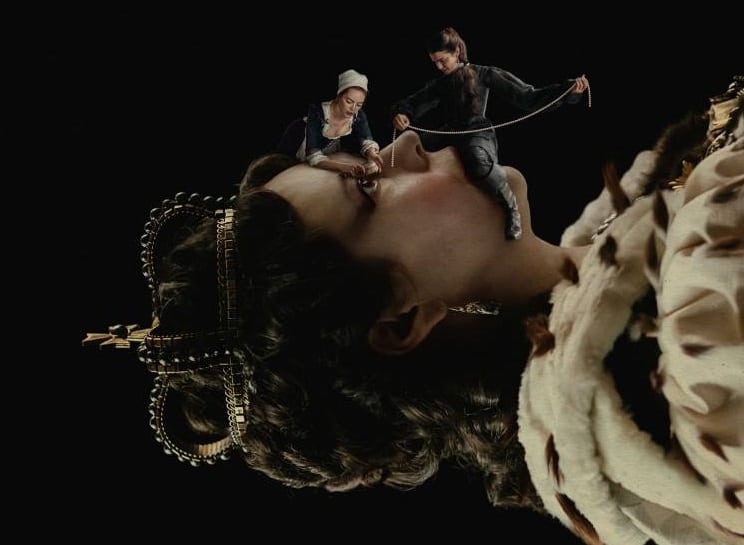
Those who have more than the cursory knowledge of the history of British royalty of which I  possess have made it clear Yorgos Lanthimos’s new movie The Favourite is bollocks as a historical document. This is a claim that is most likely true, and frankly, I don’t have a problem with that-- I doubt the director of Dogtooth and The Lobster, to name two of Lanthimos’s previous warm-hearted crowd-pleasers, does either. I suspect he’d propose that sticking to the facts is a job better suited to schoolteachers than a director possessed with the desire to get to a different sort of truth. And anyway, historical veracity, such as it exists in Hollywood and international cinema, has never been a guarantor of much of anything beyond great cinematography and costumes, and often of a certain stuffiness of attitude which suggests the filmmaker’s concern with nutritional value has supplanted her/his need to tell a good story—the upcoming Mary, Queen of Scots would seem to be in contention to continue this grand tradition, if the humorless trailers are any reliable indicator. But in The Favourite Lanthimos’s own tradition of observing humanity as if it were a series of specimens under glass finds a rich and satisfying expression by embracing the machinations of political power within the court of England’s Queen Anne in the manner in which they have been conceived in the script, written by historian Deborah Davis and UK TV scribe Tony McNamara, as something akin to a reimagining of All About Eve  with powdered wigs and crinoline dressing up all the similarly pretty poisons of interpersonal intrigue.

Anne herself, as embodied by the magnificent Olivia Colman (herself now in waiting to replace Claire Foy as a more mature embodiment of Queen Elizabeth II in The Crown), is in any given moment a figure of immense sympathy, comedy, tragedy and volatility, one for whom her subjects clear as wide a path as their servitude will allow. She’s crippled by gout, insecurity and loss-- the 17 children she’s had to bury are represented in her court by a litter of bunnies on whom most of her sympathies are projected. (Anne's actual husband, Prince George, is a nonfactor here and merits nary a mention.) The one person allowed into the inner chambers of Anne’s vulnerabilities, the one person who sees her both as queen and confidant, as well as someone whose power is there to be constantly measured and influenced, is Sarah Churchill, the Duchess of Marlborough (Rachel Weisz), who uses the access allowed by her long-standing friendship with the queen, which extends back to their childhoods, to act as a sort of shadow empress, manipulating Anne’s confidence to extend an increasingly unpopular war with France headed up by her husband against the complaints of Parliament. Davis and McNamara use hints from historical correspondence between Sarah and Anne to posit that Sarah’s manipulations extended from political and psychological into the sexual, which makes an even more teasingly ambiguous puzzle for the audience as to precisely the quality and temperament of Sarah’s sympathies and her pique, and Weisz occupies those ambiguities with her customary brilliance.


By the time young Abigail (Emma Stone), Sarah’s disgraced young cousin, arrives at court, she’s already been subject to a variety of humiliations. Her father has sold her into servitude to pay off a gambling debt, and she sees her royal connection as a path to betterment, and her cramped coach ride to the castle ends with the young woman face down in a puddle. When Abigail complains of her befouled clothing to a chambermaid-- “This mud stinks”-- the maid assures her that the stench is what passes in the realm for political commentary, and that assessment rather not-so-tidily sums up the movie’s own superficial deferral of political analysis in favor of interpersonal wriggling. (“This Mud Stinks” also provides the title of one of the chapter headings by which the movie has been rather neatly punctuated, all of them bearing similar headings cheekily derived from the movie’s dialogue.) Abigail’s forthrightness with the maid also portends her own ambitions to regain her dignity via a manipulative streak to rival her cousin’s, and soon she supplants Sarah in the queen’s affinity, and in her bed chamber, an act of personal redemption that seals her fate in royal amber.

When one thinks back on the plethora of historical dramas that have been afforded audiences throughout the history of movies, the word “fun” doesn’t come up too often, even given that the definition of the word is necessarily elastic when it comes to what might float your boat in the cinema—The Scarlet Empress and Lawrence of Arabia are both boatloads of fun, if you ask me, and of course your mileage may vary. But The Favourite has to be one of the most purely, devilishly fun movies ever to set itself up in the post-Barry Lyndon era of naturally lit, impeccably detailed dramas of corrupt or corruptible aristocracy, its picaresque qualities doing a gender switch into Abigail’s ambitious and questionable methods of social climbing, then subverted and redistributed into a framework of ostensible male power where the women pull all the strings, nowhere more prominently than amongst themselves. 
The actresses are all exemplary—Stone is the real lead, her wide-eyed countenance always impishly masking, and sometimes unexpectedly revealing, the depth of her personal ambition and her seething anger at the degradations she’s suffered, and she’s rarely been as nimble, as playfully barbed as she is here. But Weisz is easily her match—no one in the movie, or maybe even the movies has a dry stare as penetrating as hers-- and Colman will be even more of a revelation for anyone who stumbles into The Favourite unsure of who she is than she will be for those of us who know her well. (In my book, she entered the realm of greatness by her sarcastic reading of the word “mu-u-urder!” in Edgar Wright’s Hot Fuzz, and she has any number of similarly brilliant moments here.) But those like me who had difficulties with some of his past films, like The Lobster  or The Killing of a Sacred Deer, should be prepared to be surprised by Lanthimos himself too. He pleasurably betrays the conventions of the stately dramatic tradition by ensuring that his movie is constantly on the move, paced at times like a farce and punctuated with duck races and anachronistic dances and spine-tingling outbursts of outrage. The whole enterprise comes decorated with harshly funny language and a recurring dalliance with a fish-eyed visual scheme that suggests this detached, almost scientifically inclined dissector of human nature has not entirely abandoned his penchant for putting his characters under a microscope. Yet The Favourite has a peculiar spirit that his previous films haven’t—one can see the existential prankster of Dogtooth at work here, but this time, yes, he’s having fun, and he’s figured out a way to make sure his audience does too.

********************************

Sunday, November 25, 2018

JOE DANTE'S THE HOLE SCREENS FRIDAY, NOVEMBER 30, 2018


Film fans in the Los Angeles area are getting a special treat this coming Friday evening, when Joe Dante’s marvelous 2010 3D thriller The Hole screens at the TCL Chinese Theaters. 
The event marks the official launch of the new multimedia brand Untold Horror which, according to the project’s press release, “was conceived as a brand dedicated to answering the question that genre fans often ask: ‘Whatever happened to that movie?’ The documentary series will explore the tantalizing projects that were announced but died in development hell, uncover the compelling unannounced projects by our favorite artists that fans have never heard about, and discover just what it would take to bring some of them back to life.” 
All of which makes The Hole a perfect jewel with which to introduce a project with such a trajectory, being itself a movie which was highly anticipated, and then largely beloved by those who were lucky enough to see it on a big screen in 3D, all before it ended up disappearing into the bog of indifferent and inept distribution to which many a good movie has often found itself consigned throughout movie history. 
The screening, which commences Friday night, November 30, at 7:30 pm, will include a special Q&A session with Dante hosted by fellow horror fan and Trailers from Hell guru, director John Landis (An American Werewolf in London, National Lampoon’s Animal House). You can purchase tickets directly from the TCL Chinese Theater website or through Fandango.
The review of The Hole which follows was originally written after I first saw the film in 3D at a screening back in 2010, when the movie’s fate in the marketplace was already being sealed, and it contains some references which most definitely anchor it to a specific period of time. It’s my hope that the review also aptly conveys my enthusiasm for Dante’s achievement and will inspire you to come out Friday night to take advantage of a rare opportunity and see a terrific movie the way it was meant to be seen.

**********************************

Joe Dante’s The Hole (from a script by Mark L. Smith) doesn’t explode off the screen like a Gremlins firecracker or dabble in gory genre-referential antics in the way that made The Howling and Piranha such high-end, low-down fun. And there’s little evidence in this latest film of Dante the satirist who created such tonally disparate films as Small Soldiers, Matinee and The Second Civil War with a spirit of liberal social engagement that makes watching them feel like discovering a really well-spiked punchbowl. It has been observed that Dante, one of the movies’ most naturally, piquantly visual filmmakers (Gremlins 2: The New Batch felt like a great, feature-length Mort Drucker panel), makes movies that already feel as though they’re in 3D. So why bother? Dante answers that question by choosing to use the newly vibrant technology on a small-scaled story (boiled down to its essentials, it’s Three Kids and a Creepy Basement) which allows him to explore 3D not so much as an effects-enhancement tool but one which can be used to expand the boundaries of the story’s emotional pull. (Fans of Dante’s penchant for referencing other films needn’t worry, though; at least one joke involving a certain glove-bound Peter Lorre movie had the audience I saw it with chuckling with appreciation.)
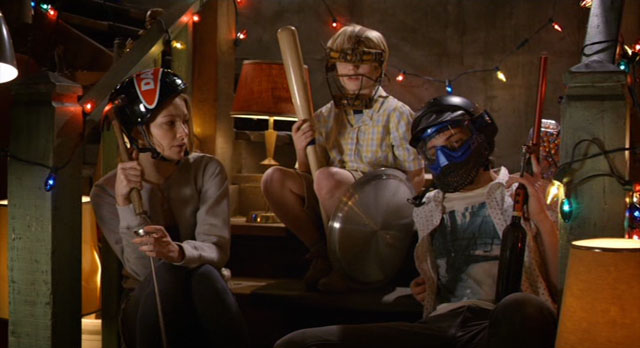
Dante has often spoken of Alfred Hitchcock’s Dial M for Murder as a major influence on how to take what is essentially a chamber piece and artistically enhance it so that the 3D brings out elements of character and emotion that might not have been so direct or accessible otherwise. Here Dante takes a ‘80s horror movie template (the movie The Hole most superficially resembles is the 1987 low-budget hit The Gate) and lends his directorial authority, his mastery of space and pace and the frame, and now what quaintly used to be referred to as "stereovision," to enrich the film’s basic structure. The story involves two young boys and their overworked mother (Chris Massoglia and Nathan Gamble are the boys, Teri Polo is the mom) who have made another in a series of apparently frequent moves, this time into an old house in a small town that the oldest boy (Massoglia) finds unbearably dull. They eventually meet up with a girl from next door (Haley Bennett) and the three of them discover a locked passage which, when opened, reveals an apparently bottomless hole in the basement from which all manner of terrifying things, seemingly directly related to each of the children’s most profound fears, begin to emerge. 
But more so than with the references and inspiration of other directors and films, I was struck by the way the movie beautifully resonates with one of Dante’s own movies-- Explorers. Both share a dark, often cluttered, yet somehow shimmering color palette and a slightly heightened reality--the steps down to that basement never seemed so long as when there’s a ghastly, cackling jester doll at the foot of the stairs, just like the hometown vistas of Explorers, on which a drive-in movie theater seems surrounded by nothing but the most beautiful of night blue. The sullen, introspective Dane, as played by Chris Massoglia, seems a direct descendant of Jason Presson’s troubled Darren, who in Explorers gets involved with a scheme to build a homemade spaceship and send it off in search of the source of a series of strange interstellar signals as a reasonable alternative to spending another night at home with his alcoholic father who, it can reasonably be presumed, indulges in a regular schedule of violent, emotional abuse.
 

There are even images in The Hole that resonate for me with the perversely funny conclusion of Explorers, when our earnest post-Spielbergian heroes realize they been called on their adventure by a couple of alien kids who know nothing of Earth culture other than what they’ve picked up from TV transmissions floating in the void. The party is crashed by a rampaging monster who resembles the alien kids, but who is even bigger than they are. The creature is back-lit, framed by a giant doorway, and he flails his multiple arms in an angry display that confuses everyone but Darren, who recognizes the parental rage right away. “He’s their dad,” he mutters with bemusement, as all remnants of the glowing Spielberg vision of alien visitation delightfully evaporate into space mist. The Hole turns that moment of bittersweet comic recognition into a terrifying tableaux from which Dane must escape with his dignity and his sanity intact.
Leave it to Dante to achieve, with funds approximately equal to that of Avatar’s toilet paper budget, what James Cameron, for all of his movie’s overwhelming immersive grandeur, could not—he takes a story which in other hands could have come off as dangerously thin and imbued it with an impish illusion of depth that comes to mirror that of his characters. And there’s something about the way Dante stages the characters moving around in their environments—that basement full of dark corners and barely illuminated objects which might not be what you think they are, but also the more genial, everyday ones like a kitchen or a bedroom, or simply a small-town street—that allows you to experience those environments not as 3D stunts but as something approaching natural, in the way that the eye experiences objects in three-dimensional space. Cameron achieved this too, but there was always something just a little too dazzling and computer-generated going on to constantly remind you (if those 10-ton glasses didn’t already) that for all of its Z-axis verisimilitude, Avatar was just a movie. The most complimentary thing I can think to say about the stereovision aspect of The Hole is that, in the scenes not designed to showcase the technology, it’s easy to forget that the movie is in 3D. But unlike, say, Wes Craven, whose My Soul to Take betrayed no awareness of how to use 3D to the story’s advantage (or much awareness of anything else, like being scary, for that matter), Dante seduces the viewer into an intimacy with these characters—we really do feel as though we are somehow sharing their space— by using the stereoptic qualities of the image to heighten our response not only to the mounting horror, but also to how the characters live their daily lives.
This sensitivity to the relatively mundane works joyous wonders on making the grand 3D moments even more effective. It also helps that Dante displays astonishing acuity with the 3D image-- The Hole was staged and shot in 3D; no afterthought conversion job, this. And because we haven’t been constantly dodging Ping-Pong balls and other objects flying at us for the first half hour, when a particular 3D image resonates, it does so in a big way. For instance, the moment we stumble upon the lair of Bruce Dern is a real eye-popper. Dern is the requisite town oddball with more knowledge of that hole than one would think safe. He also seems to be haunted by his own hole-inspired fear, that of the dark, which is why he lives in a warehouse surrounded by hundreds of lamps. Our first exposure to this glittering, haunted warehouse has some of the same effect as seeing hundreds of fireflies flitting before your eyes—the lamps seem to go on forever—which just makes it more chilling when they suddenly all turn off.)
 

It seems that gazing into that basement hole leaves one susceptible to one’s emotional closets being cleaned and the fears contained therein being trotted out for a final showdown. At precisely the point where the air usually begins to leak out of similar movie enterprises, Dante manages to invest his movie with the kind of emotional urgency that should be the envy of, but seems quite beyond, most of the current crop of Hollywood shockmeisters. Bennett ends up climbing the tall tower of a dilapidated roller coaster to confront the demon that most plagues her, and the sequence is genuinely unnerving; the imagery has a primal terror to it that is made richer by the use of 3D, and by Dante’s sensitivity to how 3D can be used to accentuate not just depth, but height. Yet the sequence is triply effective because we never lose sight of why that climb is so important to Bennett’s character, a tribute to Dante’s mastery not just of technology but of inspired storytelling. And the movie’s climactic sequence, in which Massoglia faces down his greatest fear—the one that has kept his family on the move from city to city for so long—Dante finds ways to employ dazzling puzzle-logic imagery to make us feel as though we were seeing how a terrified, and newly empowered boy might envision the interior of his own confused mind. 

The Hole belongs in American cinemas—it premiered to acclaim and solid box-office in Britain and all over Europe this past fall. Yet the very 3D technology that assured it would be made has now become a hindrance, not so much in securing a distribution deal (of which it has none as of this writing) as in finding screens on which to play it. In the time between the movie’s conception as a 3D project and its completion, the post-Avatar glut of 3D product (and most of it is truly mere product, not movie magic) hit its zenith, making it difficult for an unassuming horror movie like The Hole to secure a technologically enabled place to spin its tale. One can only hope that with European exposure (including raves at the Venice Film Festival) and occasional screenings like the one where I saw it, as the closing night attraction of a 3D film festival here in Los Angeles last month, word will begin to circulate about the quality of this picture and some executive with as much movie love as business savvy will get it to the marketplace as soon as possible.

The film has been described as “modest,” and compared to many of the bloated movies that do find themselves on a release schedule, I suppose it is. But modesty here has been taken as a signifier, even in some of the movie's most positive notices, of second-tier achievement. The Hole is not a game-changer; it will not redefine cinema. What The Hole is, however, is not only a reminder of how much fun it can be to work up a serious crop of goose pimples; it’s also a reminder, especially for the suits in power, that Joe Dante is still making wonderful movies and that someone who is as talented as this guy shouldn’t have to wait seven years in between projects, only to find his latest afloat in exhibition limbo. The movie is flat-out terrific, capable of sending chills down the spines of youngsters and the not-so-young-as-all-that-anymore—my 10-year-old daughter was as riveted as I was—and it really should be playing this Halloween at a theater near you.


(This piece was originally posted at this blog on October 30, 2010, as "Joe Dante's 3D Ace in The Hole.")

******************************


Saturday, November 17, 2018

THE GREAT MOONSHINE FILM FESTIVAL


Every so often the stars align in such a way as to allow a perfectly inert and “nonproductive” weekend spent in the company of four, or five, or maybe even six movies, the sort of cine-bliss-out designed to decompress the mind and spirit after a particularly insistent week of breadwinning. Back in the salad days, when all thoughts were ostensibly devoted to expanding one’s horizons, this sort of motion picture marathon was known as a typical college weekend. But similar opportunities come far less frequently 40 years later, and when they do, they’re usually accompanied by at least four or five loads of laundry (one per movie, maybe) demanding to be sorted and folded. Thanks to the largely unplumbed depths of my DVR queue, I stumbled into one such marathon last Friday night, and it was a doozy, an entirely unplanned, thematically linked four-picture blast that would have been a honest-to-God B-movie treasure trove if you’d stumbled upon it buried in the movie ads of the local paper. A drive-in all-nighter, perhaps, the likes of which were plenty common back when drive-ins and long theatrical shelf lives were themselves common, when spasms of second-and-third-run programming cropped up every Wednesday or Friday like unkillable weeds. Four big action hits! Show starts at dusk! $5.00 a carload! And I never left my recliner!


It all began innocently enough with a thirst to revisit an old favorite— Burt Reynolds as Gator McCluskey in the 1973 moonshine classic White Lightning. Hal Needham had been a stuntman and stunt coordinator for years before doing this picture—he’d even worked with Reynolds before, as his stunt double on several episodes of Gunsmoke and on his previous outing, The Man Who Loved Cat Dancing, and he did both duties on White Lightning. But this first of two Gator adventures (the second was Gator, from 1976) isn’t a lark like Smokey and the Bandit, the booze-running comedy Needham and Reynolds would make together four years later. Sure, it has banjo-scored car chases, vigilante revenge, and all the rest of the trimmings that helped make it a big hit in theaters and drive-ins 45 years ago. But under the guiding hand of director Joseph Sargent (whose next movie would be the greatest New York City movie ever made, The Taking of Pelham One Two Three) White Lightning emphasizes humid, laconic Southern atmosphere and understated malevolence, beneath the culture and its institutions and often presented at a simmer instead of a boil, that eases the movie right under your skin. Reynolds’ Gator gets himself legally sprung from prison to infiltrate a corn whiskey-running operation when he finds out the fella heading it up, corrupt sheriff J.C. Connors (Ned Beatty), is the bastard who murdered his brother. 


That execution starts the movie, a brutal sequence in which Connors presides over the slow drowning of Gator’s kin. Sargent sets the tone with no comment, observing two canoes and four men gliding through the swamp, the sheriff’s deadpan countenance unmoved behind cheap wire-rimmed glasses as he blasts a hole in the hull of one boat and watches its bound-up occupants slowly sink. The setup and delivery of the scene are truly unnerving for the quiet alone, and Beatty, who with one exception barely raises his voice throughout the movie, is probably the scariest of any in a long and storied line of villainous Southern movie sheriffs because of his good-old-boy reserve—there’s no hospitality beneath the mask, only seething contempt and his conviction that his status within the law gives him the right to express it. White Lightning is a cut above the usual batch of drive-in firewater—it has the burn of excitement you’d expect from that title, but like its namesake, it doesn’t always go down easy.

I followed White Lightning with a movie I’d always wanted to see which had eluded me for decades, The Moonshine War (1970), and that blunt title that pretty much says it all. In 1932, a Northern federal treasury agent (Patrick McGoohan) decides to cash in before the imminent repeal of Prohibition and tries to muscle in on the Kentucky moonshine operation of an old army buddy (Alan Alda). But when his pal won’t cut him in, McGoohan incorporates the influence of another acquaintance, a glad-handing gangster (Richard Widmark) and his psychotic second-in-command (Lee Hazlewood), to press Alda into cooperation. When Alda and his very reluctant neighbors, who are in fact his competition, dig in… well, that title does imply a certain expectation of shoutin’ and shotgun fire on which the movie is happy to deliver. Directed by Richard Quine (whose previous pictures, like Bell, Book and Candle, The World of Suzie Wong and the marquee-strangling Oh, Dad, Poor Dad, Mama’s Hung You in the Closet and I’m Feeling So Sad seemed an unlikely lead-up to a tale of rotgut-fueled intrigue such as this), The Moonshine War goes about its business without a lot of stylish to-do, but it is, however, an adaptation of an Elmore Leonard novel which happens to have been adapted into screenplay form by Leonard himself, and therein lies the potent spirits which provide the perfectly legal pleasures the movie has to offer.
Widmark, in particular, thoroughly enjoys gnashing his choppers on Leonard’s blunt, snappy, occasionally florid turns of phrase. This creepily insinuating psycho is a great mid-to-late-period role for the wonderful actor, and Widmark feeds off the unexpected enthusiasm and facility of Hazlewood, the heralded songwriter and musician whose only significant appearance as an actor this is. The two make a blackly funny pair whose overarchingly friendly demeanor can and will, as Leonard would often have it, take a hard right turn into decidedly less welcoming territory. The Moonshine War is also a haven for earnest actors and their bad Southern accents, but the prime offender is not, as you might guess, Alda as a backwoods Kentucky moonshiner. His casting, given the 20-20 hindsight of his reign as Hawkeye Pierce, seems sublimely odd, though I thought he comported himself surprisingly well on the linguistic front. It’s the Irish, neutrally-accented McGoohan who you gotta watch out for—you haven’t lived until you’ve heard him wrap his Celtic tongue around a mouthful of Yankee R’s.


The next serving in my intoxicating run of movies devoted (at least in part) to the desperate glories of running illegal liquor came from revisiting an old favorite-- Michael Schultz’s Greased Lightning (1977), a high-spirited take on the story of Wendell Scott, the first African-American stock car racer to ever win a NASCAR race, with Richard Pryor in the starring role. If anything, this movie has just gotten better with age (much like Schultz’s previous picture, Car Wash). It captures Pryor just as his status as a full-on movie star was consolidating, before bad choices, in movie projects and certain other lifestyle options, would begin to take their toll—he’s genuinely magnetic. My friend Odie Henderson, film critic for RogerEbert.com, recently marveled to me that in 1974 Warner Brothers wouldn’t insure Pryor to get on a horse for Blazing Saddles, yet here they were four years later sticking him behind all manner of high-speed vehicles, fleeing the police and later in pursuit of glory on the race track—that’s Hollywood. (You can read more of Odie on Greased Lightning and the career of Michael Schultz at his blog, Big Media Vandalism.) 
 
Schultz marks Scott’s achievements with a customary stylistic modesty, but within that modesty he serves the material well, with dignity, spark, good humor, and gravity enough for the audience to register its social significance without being beaten severely with the good-for-you club of history. And though the pendulum has lately swung back toward inclusion and representation in American movies, it’s still kind of thrilling to see a movie given over to a cast populated by the likes of Pryor, Cleavon Little (a de facto Blazing Saddles reunion!), Richie Havens (yet another musician in a supporting role who, unfortunately, doesn’t make the mark here that Hazlewood did in The Moonshine War), Beau Bridges (The Landlord himself!), and memorable, if brief turns from Bill Cobbs, Vincent Gardenia and, in a nod to the politics of the day, SNCC founder and Georgia senator Julian Bond and Atlanta mayor Maynard Jackson. But the movie’s real revelation is Pam Grier, at the tail end of her reign as the queen of blaxploitation and just about to hit the streets of Fort Apache the Bronx. Grier’s role as Scott’s patient, supportive wife Mary, isn’t distinctive on paper, but loosed from the sexy, leather-clad, tough-as-nails Foxy Brown persona Grier positively glows, and the part gives her a brief chance to expand as an actress in ways which she couldn’t be perceived in the movies that made her an icon. In Greased Lightning she allows us a glimpse of the star that would find her way to glory through Elmore Leonard and Quentin Tarantino as Jackie Brown. Of course, she’s still subservient to Wendell Scott’s story, and Pryor’s pleasurable dominance as an actor, but in this delightful movie Grier provides an electrical charge of lightning that’s all her own.

I saw Lolly-Madonna XXX (1973) in a theater when I was about 13 years old, and its harsh view of humanity and the futility of violence really knocked me for a loop. Before last weekend, I hadn’t seen it since, and as the fourth part of my impromptu firewater foursome I approached revisiting it with eager anticipation, but also with a bit of trepidation, wondering whether my perceptions of it as an adult would reveal it to be less than the movie squirreled away in my memory. Turns out Lolly-Madonna XXX is another adaptation of a well-known novelist—Sue Grafton wrote The Lolly-Madonna War (as the movie was known in some markets) in 1969, years before embarking on the Alphabet series of crime novels that would secure her fame and fortune, and like Leonard with The Moonshine War, she also wrote the movie’s screenplay (with Rodney Carr-Smith). 

The X’s in the film’s title don’t refer to the markings on a moonshine jug. In fact, the illegal production of corn liquor is, like in Greased Lightning, only the incidental catalyst to the events the movie is really interested in—the destruction of two mountain families, the Feathers and the Gutshalls, by their own hands. Instead, the alphabetical markings are kisses attached to the signature on a note from a fictitious nymphet, Lolly-Madonna, which is delivered as a prank by the rambunctious Gutshall boys to distract the Feathers from the tending of their still, the better for them to move in and bust it up. But when some of the Feathers run across a young woman at a bus stop, they assume her to be the nonexistent Lolly-Madonna and kidnap her, intending to use her as a bargaining chip in the escalating Feather-Gutshall war over claims to an assuming meadow that sits between their properties. The furious decay in relations between the two clans can’t help but carry echoes of the confusion of conflict in Vietnam, one that was raging full on when the novel was written and when the film was made. But as directed by the significantly underrated Richard C. Sarafian (whose previously film was the inadvertent counterculture touchstone Vanishing Point), Vietnam is never pressed into the foreground, and it certainly doesn’t work as an extended metaphor; yet its presence in Lolly-Madonna XXX feels organic, inevitable, unavoidable, and it lends the film its sense of tragedy without ever becoming an overt ingredient in its dramatic strategy. 
Lolly-Madonna XXX also boasts, like Greased Lightning before it, a dream cast of established veterans and up-and-comers that would, if there were any justice in Hollywood history, warrant placing it in the vicinity of legend—the Feathers are comprised of no less than a remarkably restrained, yet seething Rod Steiger as the doomed Feather patriarch, besotted by tragedy, and the horror that he loved his son’s dead wife maybe even more than his son did; plus Jeff Bridges, Scott Wilson, Katherine Squire, Tim Scott, Ed Lauter and a pre-The Las Detail Randy Quaid. Over on the Gutshall side of the holler, there’s Robert Ryan as the timid father figure, torn by a sense of morals and his ineffectual ability to fulfill them—this was the great actor’s penultimate appearance, followed by his grand embodiment of Larry Slade in John Frankenheimer’s adaptation of The Iceman Cometh, also in 1973, and his Pap Gutshall is a worthy warm-up to that glorious performance. But there’s also Tresa Hughes, Kiel Martin, Paul Koslo and Joan Goodfellow as the rest of Gutshall family, and newcomer Season Hubley as the unfortunate traveler, the would-be Lolly-Madonna, who ends up with a front-row seat to the destruction of two families. 

Critic Michael Atkinson wrote eloquently about the film and its unenviably precarious position in the marketplace of the early ‘70s for TCM.com, and he notes:

“The end product is earnestly doom-laden, and inescapably an artifact of its era, a time when movies were freshly subject to a grungy grain-alcohol cocktail of social protest, youth culture empowerment, international cinephilia, low-culture realism, and prole restlessness. Which is to say, Lolly-Madonna XXX, as with so many films of the Nixon-'Nam days, could never be made today…”
Which might also be why it is so little-known today. But the movie retains the power it had for me when I was a kid, and then some. It is as grungy and mean as Atkinson suggests, but also sensitive to moments of beauty—when one character waxes about how he never wants to leave his mountain home, Sarafian and cinematographer Philp Lathrop provide ample evidence to justify that sentiment, and like that character the movie stays put on the Feather and Gutshall land for the duration because, you sense, it believes this place is the world.
Unfortunately, the movie would never really make its mark, caught as it was in the distribution limbo of an MGM headed by notorious casino builder James Aubrey, who presided over the studio’s erosion in the early ‘70s, and hobbled by a passel of negative reviews. If ever an unheralded early ‘70s film were ripe for rediscovery, Lolly-Madonna XXX would seem to be one, and its availability on disc from the Warner Archives and streaming on Amazon Prime (where I saw it, in it a surprisingly well-preserved wide-screen transfer) is all the encouragement you should need to make it the cornerstone of your very own moonshine-centric film festival. 

*******************************