Friday, October 09, 2015

KILLER COUTURE: THE PLEASURES OF CRITERION'S DRESSED TO KILL ENSEMBLE


July 25, 1980. 

That was the day Dressed to Kill opened in theaters across the country, and it marked the first of countless times I would see the movie projected on a big screen, on a drive-in screen, panned and scanned for home video, even interrupted and cut to ribbons for network TV. But I’ll never forget seeing it that first time, in a cavernous old movie palace in downtown Eugene, Oregon, its lush, complex, violently dynamic and meticulously choreographed images, all set to a Pino Donaggio score which reflected precisely those same qualities, thrilling me to my core. 


I left that theater buzzing, even if at first I wasn’t entirely sure how I felt about the movie-- it took me a few days and another screening or two to decide that the outraged cries of Hitchcock plagiarism coming from some circles were unwarranted. For me, Dressed to Kill is one of those movies which so envelops and overtakes my senses, which zeroes in on my sweet spot of cinematic pleasure to such a degree that it makes every other movie look visually paltry and pedestrian. After seeing it, especially in a theater, I’m under its spell to such a degree I begin to believe, however briefly and/or irrationally, that all movies should be like this one. (I feel the same way when I see a Robert Altman movie, or in musical terms whenever I listen to one of my favorite Frank Zappa albums. It’s that whole unique vision thing.)

The effectiveness of Dressed to Kill has always been diluted by reduction to the scale of home video, even when shown unbowdlerized and in its proper aspect ratio. The 2011 MGM release of Brian De Palma’s unrated version, which restored all the cuts mandated to the movie’s bookending shower sequences and the elevator murder sequence by the MPAA in 1980, was a significant improvement, easily the best showcase Dressed to Kill had ever had on home video up to that time. It even featured a supplement which did an eye-opening, side-by-side visual comparison between De Palma’s version and the one seen in theaters, as well as a look at just how badly those sequences were butchered for the honor of being shown on network television, the sort of censorship which today, in the age of Game of Thrones, The Walking Dead and American Horror Story, seems irredeemably quaint. (These mangled versions of theatrical hits, scrubbed up for presentation on ABC, CBS and NBC, were how fans of my age routinely encountered a lot of movies for the first time, especially if they grew up somewhere outside the big city.)   

Happily, the Criterion Collection’s brand-new Dressed to Kill edition, available on Blu-ray and in a two-disc DVD set, does the movie its ultimate justice. The initial pressings of Criterion’s discs were marred by an incorrect compression of the image that rendered it slightly squeezed. After much righteous hullabaloo from the cinephile community and sites like DVD Beaver, Criterion managed to address the problem before most of the discs had shipped to retailers, and the corrected version, labeled “Second Printing 2015” in fine print on the back cover, hit the streets in early September. Click on that DVD Beaver link to make the comparisons for yourself if you care to, but for my money Dressed to Kill has never been presented with more care and brilliance on home video than in its Criterion incarnation. It’s a four-star package, from the quality of the scope imagery right down to the movie’s original mono soundtrack, which may sound tinny and uneventful to ears trained to require all the bells and whistles of a Dolby 7.1 assault, but which nevertheless reproduces with fidelity and clarity the movie’s sound design, especially as it pertains to showcasing Donaggio’s score, easily his best. This Blu-ray passed the lunatic Cozzalio litmus test with flying colors: for weeks now after seeing it again I still want to know why all movies can’t be Dressed to Kill.

But for as beautiful as Criterion’s presentation of the movie is, the disc shines in the supplements department as well. The 2015 set carries over the 2011 MGM disc’s three terrific featurettes—that segment comparing the unrated, R-rated and network cuts on the movie, in which De Palma admits at being “enraged” at having to submit his movie to the whims of the MPAA; a half-hour piece delineating the movie’s production history, directed by the master of the “making-of” documentary, Laurent Bouzereau; and an appreciation of Dressed to Kill by Keith Gordon, who appears in the movie as Peter, the grief-stricken son of the murdered Kate Miller, and who later became an accomplished director (A Midnight Clear, Mother Night) in his own right.

Bouzereau’s doc takes a step-by-step approach beginning with the movie’s genesis, rooted in De Palma’s early involvement with what eventually became William Friedkin’s film Cruising as well as in a fascination with transgender psychology. De Palma was specifically inspired by the appearance of a transsexual on The Phil Donahue Show, a clip from which appears in the movie. The doc moves through the movie’s shooting-- Angie Dickinson remembers cinematographer Ralf Bode coming to her during the shooting of the sequences involving Dickinson’s body double and asking if she knew what was going on: “We’re doing beaver shots in there!”-- and straight on to the movie’s largely rapturous critical reception and subsequent condemnation from feminist groups on charges of misogyny.

The most surprising and satisfying of these MGM holdovers, however, is Gordon’s brief segment. The actor-director exudes the customary reverence for his director, but instead of the usual puffery and filler designed to contribute to the illusion of Blu-ray and DVD “added value,” Gordon elucidates upon De Palma’s visual method with genuine eloquence, and perhaps even a bit of directorial envy as well. He enthusiastically details the sound design and the use of split diopters in the police station interrogation scene, which De Palma augments aurally with the use of Peter’s homemade surveillance technology and breaks down visually with multiple frames-within-frames and the compression of three different rooms within a single shot. Gordon sharply points out how these directorial flourishes are not just De Palma showing off but instead serving the material and its themes by constantly disorienting and calling into question the audience’s perception of who’s watching who, who’s listening to who, and even just whose point of view is being served at any given moment.


The movie is a tour de force on the subject of split personality, and as Gordon points out De Palma’s technique is unusually well fused to his subject here in his use of devices like split diopters, which allow two subjects on two completely unrelated focal planes to be in focus at the same time, split-screens and multiple frames-within-frames, all of which serve that disorientation but also illuminate the different perspectives at play within the movie and at war within its characters. In fact, one of Gordon’s most cogent observations is in regard to the movie’s clever doubling of the murderer Bobbi, in a leather jacket, blonde wig and sunglasses, with the cop assigned to keep the character of Liz Blake (Nancy Allen) under surveillance. De Palma’s storytelling strategy is so clever, Gordon asserts, that even though the audience doesn’t know as the movie unfolds that Bobbi and the police officer are in fact two separate characters—we don’t know about the presence of the cop— the film is acting as though they are two characters through what De Palma is constantly reinforcing visually. After being initially and masterfully fooled, the viewer, upon reviewing what De Palma reveals in the frame over multiple viewings, can only confirm the truth of Gordon’s claim. 

As good as those old segments are, the new material in the Criterion Dressed to Kill collection is just as good. Anticipating the likely delight of the upcoming feature documentary on the director, there’s a 16-minute segment of a conversation between De Palma and writer-director Noah Baumbach, who co-directed the upcoming doc about De Palma with Jake Paltrow. The segment is not culled from that project but instead a conversation commissioned by Criterion which deals primarily with the position of Dressed to Kill in the director’s career. Baumbach proves to be an enthusiastic, if somewhat hesitant interviewer, but De Palma seems more than game, airing out his lingering disdain with those early criticisms of his merely mimeographing tricks from the Hitchcock repertoire (“I’ve always felt I’ve taken some of his ideas and developed them further”) and offering insight into the way he approaches the choreography of a sequence like the museum visit or the movie’s superb subway chase. 


“The chess game can begin,” he intones in a manner which doesn’t at all suggest that he’s tired of talking about his method, “but you have to know the board and what the pieces can do.” It’s a metaphor which presumably includes the confidence with which sequences such as Kate’s visit to the museum unfolds, an extended flourish which depends almost entirely on what the viewer sees, and what Kate sees, augmented only by the flush emotional clarity of Donaggio’s music. (At one point De Palma considered using Dickinson in a voice-over to illustrate Kate’s random thoughts through the sequence but wisely decided against it.) And despite his own brilliant use of them as part of his own visual repertoire, like any grand old man De Palma bemoans the modern overreliance on close-ups and two-shots, which he lays squarely at the feet of the size of the screens on which many viewers currently use to consume movies and TV. “You’re not going to appreciate too many David Lean long shots on an iPhone 6,” he bemusedly complains at one point, while the viewer winces to imagine the insufficiency of seeing a great De Palma movie in the same way.

The other all-new-for-Criterion interview segments are in their own way just as insightful. There’s a lovely segment devoted to the talents of the movie’s late cinematographer, Ralf Bode, whose chameleon-like ability to use his talents to literally fulfill a director’s vision seems even more remarkable considering the other movies he shot, pictures like Coal Miner’s Daughter, Saturday Night Fever and A Simple Wish, all of whose visual schemes and intentions differ from each other and couldn’t be more separate from Dressed to Kill’s baroque stylization. Nancy Allen, still lovely and vibrant, marvels at her fortune over De Palma, whom she married on a break from shooting 1941 just before production on Dressed to Kill  began, having written the part of Liz Blake with her in mind. She credits familiarity with De Palma as her director and fellow cast members Keith Gordon and Dennis Franz with creating a comfort zone in which risk-taking was the natural response.

In the segment entitled “Pino Donaggio: The Music is an Actor,” the composer who would become synonymous with De Palma during the director’s greatest period, makes the claim for Dressed to Kill as their most fruitful collaboration. Given the room in the museum sequence for his score to truly become another character shadowing Kate Miller’s flight of sexual anxiety, Donaggio claims those nine minutes of screen music as one of his best efforts. “(The music) gets under your skin without you realizing it,” he says, proving his own claim that “a thriller without music will have a hard time thrilling you at all,” and when you think about Donaggio’s scores for De Palma, or Herrmann’s (Sisters, Obsession), or Williams’s (The Fury), the truth of such a claim becomes even harder to refute.


Other figures important to Dressed to Kill also have their moment on the Criterion disc, including producer George Litto, who exudes a genial hustler’s charm (“I thought Brian could be one of the greatest directors of all time”); Dickinson’s body double, Penthouse Pet of the Year Victoria Lynn Johnson, who marvels at “Mr. De Palma’s” professionalism upon having being forced into the necessity of asking her if she would mind dyeing her pubic hair to match the hue of his star’s; and Stephen Sayadian, who began as a graphic artist for Hustler magazine and parlayed his talents into a successful career designing movie one-sheets, describing the evolution of his design for the iconic Dressed to Kill poster (“It’s The Graduate all over again!”) as well as an unlikely porno parody of the movie he directed which De Palma himself trumpeted in a “Guilty Pleasures” article for Film Comment magazine.  Sayadian marvels that De Palma would seize on the opportunity to cast positive light onto a potentially legally troubling project which he found delightful, “as opposed to suing us, which is what I assumed he would do.”

Dressed to Kill seems to me proof of Pauline Kael’s adage that “great movies are rarely perfect movies”— some of the actors, particularly Gordon and Allen, are at sea in isolated moments trying to breathe life into some of De Palma’s more perfunctory dialogue (“I’m just a grief-stricken kid.” “Yeah, but what a kid!”), and comedy of sort that has Allen rising from the back seat of a careening taxicab, adjusting her jaw as if she were in a Keystone Kops comedy, seems misjudged within the moment. But overall it’s one of De Palma’s two or three most perfectly calibrated and composed movies, one in which the director fuses form and thematic intent in a rigorous fashion that is at the same time never labored but instead gleefully, sardonically assured. Those like me, who consider Dressed to Kill a masterpiece and a candidate for king of the De Palma hill, will greet this marvelous Criterion disc with well-earned applause. 

*********************************************  

ON THE 40th ANNIVERSARY OF NASHVILLE: MOVING PICTURES, STILL LIFE REVISITED


NOTE: This post was written two years ago, October 7, 2013, on the occasion of having seen this singular movie on the big screen once again. I'm reposting it today because yesterday it rather lamely occurred to me, one who seems less focused on the anniversaries of movie releases than others I know,  that the movie turned 40 years old this summer, and I've lately been seized with the desire to see it again. (It's been a couple of years now and I still haven't truly taken a dive into the treasures of Criterion's recent Blu-ray). But I'm also putting it back up because I think the piece does some sort of justice to a speck of what Nashville means to me. I enjoyed reading it again, and I thought you might too.

****************************************************

No movie has ever been able to sweep me up, take me outside myself, wrap me in its blinkered, effervescent, caustic, yet somehow forgiving mosaic of American individualism and its narcissistic underbelly more effortlessly than Robert Altman’s Nashville. It’s so alive, so hypnotic in its offhanded and overheard style of observation, so richly humored and casual in its connectedness—between its 24 major characters and all those whirling around them, but also between the world in which it was made and, curiously, the world from which we watch it now—that even its rough edges and contradictions (it’s a marvel of surprising visual beauty despite the fact that its lighting, by Paul Lohmann, is often crude and pedestrian) are crucial to its overall effect—they’re intrinsic to its soaring nature, to its status as an authentic, tempestuous satiric vision of this country, to what in fact makes it American. 

I think Nashville would make an inspired double feature on a program with Steven Spielberg’s 1941. Pairing it with Altman’s equally brilliant California Split might be too much of a bliss-out even for me, but the conversation between Altman and Spielberg's visions-- one microcosmic, one macro-slapstick, both of an America in transition, perhaps in free fall, teetering on the edge where national pride and confidence give way to the cacophony of community and the fear of the unknown, the road yet to be traveled, would be fascinating.

Even after 38 years and God knows how many viewings-- 25? 30?-- the movie catches me off guard and thrills me in new ways every time I see it, and it’s the only movie since the art form began to mean something to me, around 48 years ago, that I’ve loved so much as to feel compelled to sit through it three times in one day, a side benefit of screenings for my University of Oregon film studies program during the fall of 1980. (Thanks, Bill Cadbury!) 

Seeing it Friday night, projected on 35mm for the last time before its premiere on Criterion Blu-ray in December, the movie continued its revelatory spin through the course of my adult life, embracing me with its loose-limbed confidence, its vision of a world where optimism and defeat are mutually exclusive but can often coexist in the same moment, making meaning with each new apprehensive breath. Friday night the New Beverly Cinema was filled with like-minded admirers sitting among those who had never seen it on the big screen or perhaps never before at all. But we all marveled at this 38-year-old film, that it would still be so vital, would still have so much to say about the world in which we’re still struggling and exulting, in which pop culture still serves as an impetus for us to “keep a-goin’,” even as it sometimes provides too many distractions from the profound cares of our lives which insist themselves upon us entirely outside its influence.

During each one of the multiple times I’ve seen it since 1975, it seems like I’ve always latched onto something new in Nashville, or been the recipient of thoughts, impulses, memories and connections that had never occurred to me before, often sparked by specific images or exchanges that I was certainly familiar with but which lead me to a different way of seeing them depending on where I was in my life at the time. There are many things I could say if I had more time. Instead, I'll let the images speak for themselves, with approximations of some of the thoughts that flashed in my head as those images passed by. Let me show you some of the things that stood out to me this past Friday night. 


"Be the first on your block to marvel at the magnificent stars through the magic of stereophonic sound and living-color picture right before your very eyes without commercial interruption!" 

I've often wondered what young people make of this giddy bit of comedy, seeing the movie for the first time and being relatively nonconversant in the sort of TV advertisements being parodied here. It's one of my favorite of the many great opening credit sequences in the career of Robert Altman.

"Featuring the all-time great Dave Peel...!"


Hal Phillip Walker, the down-home Replacement Party candidate, roaming the streets disembodied, echoing against buildings and down streets, a cross between Ross Perot and the Wizard of Oz:

"Fellow taxpayers and stockholders in America. On the first Tuesday in November, we have to make some vital decisions about our management. Let me go directly to the point. I'm for doing some replacing. I've discussed the Replacement Party with people all over this country and I'm often confronted with the statement - 'I don't want to get mixed up in politics,' or 'I'm tired of politics,' or 'I'm not interested.' Almost as often, someone said, 'I can't do anything about it anyway.' Let me point out two things. Number One: All of us are deeply involved with politics whether we know it or not and whether we like it or not. And Number Two: We can do something about it. When you pay more for an automobile than it cost Columbus to make his first voyage to America, that's politics."


The first of many frames within frames: Haven Hamilton, country/western icon, transparent man of the people, immediately set apart from colleagues and admirers, casting disparaging glances from points of isolation and positions of assumed power, looking for Pig and getting Frog.


The traffic jam as block party. Opal from the BBC, Altman and Joan Tewkesbury and Geraldine Chaplin's vicious jab at the very sort of outsider summing up Altman himself would be accused of in some circles, sees it somewhat differently: 

"I wish my cameraman had been here. He's never around when he should be. You see, I need something like this for my documentary. I need  it. It's America. All those cars smashing into each other and all those mangled bodies..."


Linnea, Jimmy, Del Reese and the difference between engagement and the despair of being shut out, even when the separation is self-imposed.


Jim Emerson, from his brilliant essay "String of Pearl: The Lady of Altman's Nashville":

"...There is one, and only one, purple strand running through the Panavision tapestry of Nashville, one character who combines red, white and blue, and that's Lady Pearl, wife of Haven Hamilton and stepmother of Bud Hamilton (who is clothed like an oversized baby in pastel yellow synthetic double-knits). Pearl's hen-on-helium voice, cackling laugh, incandescent red hair and purple-and-white ensembles stand out in Nashville's display of Bicentennial colors, but to follow her thread is to see how tightly she's interwoven with the fabric of the movie as a whole."


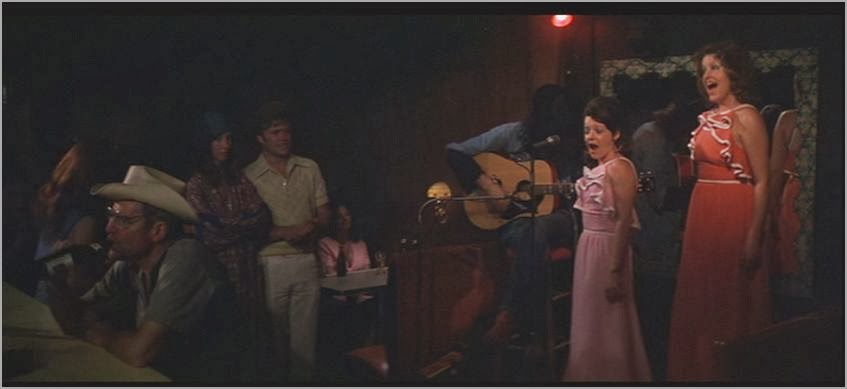
No stage is too small, no talent without its stage. The Smoky Mountain Laurels on open mike night, and Sueleen Gay is next...


Albuquerque is not only indifferent to the chaos she sets in motion-- on some level, conscious or not, she thrives on it, which makes her a perfect drifter through the compressed (and readily unleashed) energy and opportunism floating through Altman's musical city.


As my friend Paul Clark observed, Connie White undoubtedly gets top billing by default, stepping in as Barbara Jean's last-minute replacement at the Ryman Auditorium. One deleted scene I'd love to see is Haven Hamilton's seething indignation at the situation-- he's already repeatedly deferred to Barbara Jean's near-sainted status with the Nashville public, but how could he abide playing second fiddle, even just on a billboard, to a second-tier star like Connie White?


I love Karen Black's evocation of dolled-up singers like Lynn Anderson in her performance here as the catty Connie White, who smiles backstage just long enough to satisfy the photogs before relaxing back into a natural frown. (One of Walker campaigner John Triplette's snotty asides is directed toward her: "Last time I saw a dress like that, I was headed to the junior prom.") And she gets to introduce a real country music legend: "He's the best. It's Vassar!"


"I love you... I love you... I love you." Mary's mantra, delivered to the sleeping Tom while a recording of one of his own songs plays on a reel-to-reel tape deck. If she says it enough times, maybe he'll finally hear it. The song is Keith Carradine's "Honey," one of the movie's best, and perhaps most undervalued tunes, and its sweetly romantic lyrics play in brilliant contrast to the two lovers in bed, one who desperately wants to believe the song is, or could be about her, the other blithely dismissive, even in sleep, of the lyrical sentiments that bear no resemblance to the way he lives his own life. ("Life is short/A precious gift/This thing we have/Please don't let it slip away") Emotional delusion, one of the many recurring threads that bind the men and women of this movie together.


One of my favorites sequences is the one which contrasts the various Sunday worship services attended by some of the characters-- the sober formalism of the Catholic mass attended by Wade (Robert DoQui) and Star (Bert Remsen), and Miss Pearl (Barbara Baxley) with head covering that looks more like a doily-- Sueleen (Gwen Welles) is there too, wearing a fuller mantilla, singing in the choir where she and her musical abilities are finally afforded a modicum of grace; the Presbyterian service where Del (Ned Beatty) brings his kids, a big, ornate Protestant service befitting the mainstream of the Nashville religious community (there's even a sign language interpreter for the benefit of the many deaf worshipers, the Reese children among them) which sees Haven (Henry Gibson) in choral robes, no less pompous in this sacred mode-- like everywhere else, he's there primarily to be seen; Linnea sings with the gospel choir (presumably the one she's seen with at the opening of the film) at a black church-- Tommy Brown (Timothy Brown) is also there-- where the choir provides the background setting for a baptism; and finally, Barbara Jean, seated in a wheelchair at the front of the modest hospital chapel, engaged in a heartrending rendition of "In The Garden" ("Well, He walks with me and He talks with me/And He tells me I am his own...") while her husband Barnett (Allen Garfield), Pvt. Glenn Kelly (Scott Glenn) and Mr. Green (Keenan Wynn) listen intently.


Opal, on the other hand, worships at a different sort of temple, one seemingly ready for any and all metaphorical significance she's willing to dream up at a moment's notice. 


And later Albuquerque sings to a congregation whose lack of receptivity to her message can at least be blamed on the screaming wheels and grinding gears of the culture at large, and not just spiritual vacuity or, perhaps more generously, the potentially hollow habits of worship.


I absolutely adore the way Cristina Raines plays this scene, when Opal begins fumbling around revealing her one-night stand with Tom. She shuts out Opal's faux-modest blathering, the clueless astonishment of the driver, a.k.a. Norman (David Arkin) and her own husband Bill (Allan Nicholls), who suspects Mary's infatuation and passive-aggressively delights in her humiliation, and directs her gaze instead to Tom, on stage, who is about to call her and Bill up for a chance to sing and, of course, for a few more jabs.


On stage together for what will undoubtedly be the last time, Tom, Bill and Mary tear through another of Nashville's two or three best tunes, "Since You've Gone," written by Gary Busey, who was originally slated to play Tom before Keith Carradine became involved. One of the charges most often leveled at Nashville is its inauthentic representation of country music and the country music scene that was prevalent in the early to mid '70s. (Take a listen to Johnny Wright's "Hello, Vietnam" and then ask yourself how exaggerated satiric anthems like "200 Years" or "For the Sake of the Children" sound.) Given the leeway that is not unusual to grant works of satire, this seems like a ridiculous charge, made mostly, I'm guessing, by those who demand , because of its deceptively documentarian style, that the film display some sort of stricter fealty to "reality." Ironically, I've also heard complaints about the film having a slapdash, pieced-together quality, as if Altman were just out there filming what he saw, that creative choreography and dramatic convention were entirely beyond his concern. From Ronee Blakely's gorgeous "Dues" to Karen Black's "Rolling Stone" and straight through to Keith Carradine's "It Don't Worry Me" and the Oscar-winning "I'm Easy," the music of Nashville,  presented with the typical adornments of the day and often by actors who approached their roles as singers with honesty and purpose, remains one of the movie's most consistently pleasurable elements.


Facing the fans at Opryland, deadpan and respectful, and eventually hostile, Barbara Jean melts down, while Barnett, John Triplette and Del Reese look on, helpless, stunned. Many such scenes have shown up in dramatic music biographies, but none, not even the one in Coal Miner's Daughter, in which Sissy Spacek enacts the life of Loretta Lynn, on whom the character of Barbara Jean was partially based, can match the sheer empathy, laced with comedy and even more wonderful singing, that Ronee Blakely generates in this scene. Every time I see the movie, I'm always surprised, during her performance of "Dues," that she doesn't just float away from excess grace.


And at Opryland, Kenny Fraiser (David Hayward) listens in as Opal presses Pvt. Kelly on his Vietnam experience. One of the most satisfying things about Nashville is that it feels no obligation to provide a "satisfying" answer to who Kenny is and why he does what he does. We can listen to him interact with veiled hostility when Del tells him to move his car during the traffic jam, or observe his agonized phone call with his smothering mother, or watch here as he considers, with confusion and apparent rage, the curt, indifferent answers Kelly provides to Opal's insistent questions. But having done so, we are no more equipped to "understand," in a strictly behavioral, psychological fashion, what he imagines he's doing at the Parthenon. We aren't privy to Kenny's version of Arthur Bremer's diaries or the ramblings of Mark David Chapman. We cannot even say "he was a quiet fella who kept to himself; you'd never expect him to do something like this." He is an enigmatic figure from start to finish, whose behavior demonstrates the ultimate unknowability of a person marginalized, set adrift, who finds the brightly lit world of Nashville entirely suitable as he moves through its crevices and cracks in search of... 


"Little more than a year ago, a man named Hal Phillip Walker excited a group of college students with some questions-- "Have you stood on a high and windy hill and heard the acorns drop and roll? Have you walked in the valley beside the brook, walked alone and remembered? Does Christmas smell like oranges to you?" Within a commencement speech, such questions were fitting, perhaps, but hardly the material with which to launch a presidential campaign. Even those who pay close attention to politics probably saw Hal Phillip Walker and his Replacement Party as a bit of frost on the hillside. Summer, if not late spring, would surely do away with all that. Well, now that summer, along with presidential primaries, is heavy upon us and the frost is still there, perhaps we should take a closer look. Hal Phillip Walker is, in a way, a mystery man. Out of nowhere with a handful of students and scarcely any pros, he's managed to win three presidential primaries and is given a fighting chance to take a fourth-- Tennessee. A win in that state would take on added significance, for only once in the last 50 years has Tennessee failed to vote for the winning presidential candidate. No doubt many Americans, especially party-liners, wish that Hal Phillip Walker would go away, disappear like the natural frost and come again at some more convenient season. But wherever he may be going, it seems sure that Hal Phillip Walker is not going away. For there is genuine appeal, and it must be related to the raw courage of this man. Running for President, willing to battle vast oil companies, eliminate subsidies to farmers, tax churches, abolish the Electoral College, change the National Anthem and remove lawyers from government-- especially from Congress. Well, at this point, it would be wise to say most of us don't know the answer to Hal Phillip Walker. But to answer one of his questions, as a matter of fact, Christmas has always smelled like oranges to me."


Hal Phillip Walker and his motorcade approach the Parthenon. Not for nothing does it resemble, in this shot, a funeral procession...


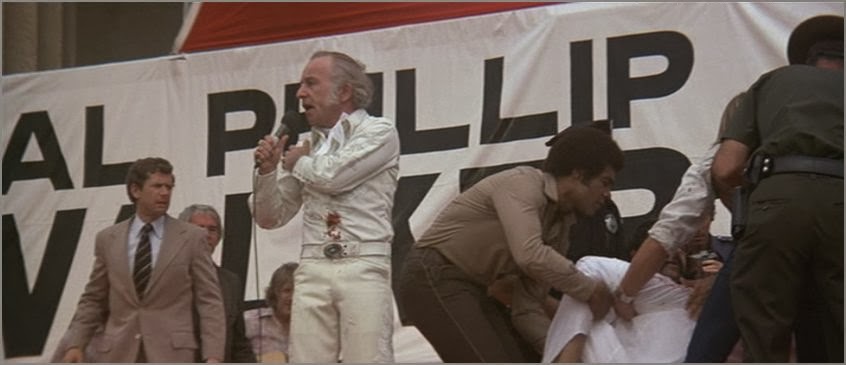
Among all those gathered at the Parthenon on stage for the Hal Phillip Walker rally, only Albuquerque seems natural, relaxed, in her element...


The moments just before and just after an unfurling national nightmare comes home to roost. "They can't do this to us here in Nashville!" shouts Haven Hamilton to a stunned, perhaps even slightly oblivious crowd. But "they" have surely done it. Sueleen knows it, the air of her own self-deluded dreams of stardom flying permanently away on a chorus of gunshot and scarlet sprays of blood.


Albuquerque seizes the moment...


the gathered crowd responds...


and the movie ends on the most exhilarating, cynical, ambiguous refrain of blinkered optimism American movies have perhaps ever produced. Tell me it doesn't resonate still today:

They say this train don’t give out rides, it don’t worry me
And all the world, is taking sides, it don’t worry me
Because in my empire life is sweet, just ask any bum you meet
And you may say that I ain’t free, but it don’t worry me
It Don’t Worry Me, It Don’t Worry Me
You may say that I ain’t free, but it don’t worry me. 
The price of bread may worry some, it don’t worry me
Tax relief may never come, it don’t worry me
Economy’s depressed not me, my spirit’s high as they can be
And you may say that I ain’t free, but it don’t worry me...


******************************************************

************

Saturday, October 03, 2015

MR. DADIER’S JUVIE-READY, TOUGH-AS-NAILS BLACKBOARD-BUSTIN’ FALL TERM MOVIE QUIZ


Back-to-school season is now well under way (although my kids have been back in school since August 10—go figure), so it couldn’t be a better time to introduce a new curriculum and a new teacher to the SLIFR University staff, the newest addition to our English department, Mr. Richard Dadier.

Mr. Dadier is a veteran of a school from what some might call the wrong side of the tracks, a tough urban location where the kids brandish switchblades with which to spread their peanut butter and jelly sandwiches during lunch break and think nothing of rockin’ around the clock, all the while ignoring their studies and taking time out from gyrating to the devil’s music only to intimidate the occasional square who wanders into their field of vision. We hear at SLIFR U have assured Mr. Dadier that he can expect a full 180-degree turnaround from that sort of behavior in our student body. Nonetheless, he has asked that we convey to you ahead of time that he will “take no shit from any of you lunkheads” and is prepared to “scramble the brains of any young punk who thinks he can put one over on me, especially during a test.”

Well, we just happen to have a test coming up, one to which we think our student body will rise to with honor and academic brilliance, one for which we feel confident our new teacher will not have to break out the brass knuckles in order to get a positive and encouraging response. It’s Mr. Dadier’s Juvie-Ready, Tough-As-Nails Blackboard-Bustin’ Back to School Movie Quiz, and we expect you will find it as intellectually invigorating as any of our SLIFR U movie quizzes. There are a couple of rules with which Mr. Dadier asks you to comply in order to avoid the stinging taste of his polished Florsheims in your ass. First, please copy and paste the questions into the comments column below along with your answers so that readers may more easily discern what questions your answers apply to. Second, please feel free to be as wordy as the spirit moves you. Longer, more elaborate answers are almost always (but not always) more interesting to read than the short, clipped ones, even though Mr. Dadier admits the non-nonsense approach is more to his personal style.

So there you have it, the latest SLIFR U quiz spread out before you, ready to go. Please shut your traps, keep your eyes on your own paper, shut that goddamn noisy radio off, open your blue books, and get going!

********************************************

1        1 )      Favorite moment from a Coen Brothers movie

2        2)    Scratching The Ladykillers, Intolerable Cruelty and The Hudsucker Proxy from                              consideration, what would now rate as your least-favorite Coen Brothers movie?

3        3)      Name the most underrated blockbuster of all time

         4)      Ida Lupino or Sylvia Sidney?

5       5)      Edwards Scissorhands—yes or no?

         6) The movie you think most bastardizes, misinterprets or does a disservice to 
              the history or historical event it tires to represent

7       7)      Favorite Aardman animation

         8)      Second-favorite Olivier Assayas movie

         9)      Neville Brand or Mike Mazurki?

         10) Name the movie you would cite to a nonbeliever as the best evidence toward
               convincing them of the potential greatness of a favorite genre

          11) Name any director and one aspect of his/her style or career, for good or bad,
                that sets her/him apart from any other director

          12)   Best car chase

1        13)   Favorite moment directed by Robert Aldrich

1        14)   The last movie you saw in a theater? On home video?

1        15)   Jane Greer or Joan Bennett?

1        16)   Second-favorite Paul Verhoeven movie

1        17)   Your nominee for best/most important political or social documentary you’ve seen

          18)   Favorite movie twins

1        19)   Best movie or movie moment about or involving radio

2        20)   Eugene Pallette or William Demarest?

2        21)   Favorite moment directed by Ken Russell

           22)   All-time best movie cat

           23)   Your nominee for best movie about teaching and learning, followed by the worst

1         24) Name an actor/actress currently associated primarily with TV who you'd like
                  to see on the big screen

           25)   Stanley Baker or David Farrar

   26) Critic Manny Farber once said of Frank Capra that he was "an old-time
                  movie craftsman, the master of every trick in the bag, and in many ways
                  he is more at home with the medium than any other Hollywood director,
                  but all the details give the impression of a contrived effect."

                  What is the Capra movie that best proves or disproves Farber's assertion?

                  And who else in Hollywood history might just as easily fit his description?


*************************************************

FLIES AND FASHION: KISS THE WATER & IRIS


A look at the list of my favorite films from 2014 reveals the presence of six extraordinary nonfiction films, and that’s just a taste of the seeming hundreds of docs released last year-- not all of them extraordinary, of course, but all of them indicative of a trend toward the making of the availability of more nonfiction filmmaking than it seems we’ve likely ever seen in this country. And speaking of availability, the six I listed—Ron Mann’s Altman, Joey Figueroa and Zak Knutson’s Milius, Orlando von Einsidel’s Virunga, Chaplain and Maclain Way’s The Battered Bastards of Baseball, Stephanie Spray and Pancho Velez’s Manakamana and Errol Morris’s The Unknown Known— were all pictures I caught courtesy of Netflix Streaming. (Virunga was actually produced under the company’s auspices.)

I have a special place in my cinematic heart for nonfiction, both bound between covers and on the screen, big or small. And it seems that in my old age documentary film is the one form that can hold me riveted no matter how tired I may think I am when I start watching. (I was exhausted when I impulsively switched on Manakamana, only wanting a taste and never expecting that I’d find its unblinking gaze energizing, and I ended up watching the entire thing.) There’s something about the knowledge, or at the least the presumption that what I’m seeing in a nonfiction film is in some way, shape or form in pursuit of the preservation of actual human experience, as opposed to its artful restaging in a fictional form, that heightens my senses, my expectations. And when a documentary is really good, when it finds a way to jigger and reshape the form to new and surprising ends, it can be genuinely transporting, a mainline epiphany of the subject’s wonder, confusion, anguish and/or beguilingly original perspective on life.

Of course, just like any other classification of movie available on that streaming service, there’s an incredible load of forgettable filler clogging up the bandwidth—not every movie telling the story of Hitler’s last days, or the Stonewall riots, or the secrets of Nostradamus, or the 10 gnarliest shark attacks of 2015 is going to be a winner. But if you’re willing to keep an eye open for the possibility of a good catch, it’s possible to hook some vital filmmaking by casting a line in the Netflix stream.

Just this past week I caught up with two absorbing documentaries, both of which, by no design of my own, just happen to spin portraits of creative women and the environments in which they and their art flourished and sometimes struggled. These movies stand a good chance of ending up on my list of the best of 2015; they honor their subjects by approaching them with clarity, honesty and a formal vitality that seeks an original cinematic voice to match that of the subject and challenge the preconceived notions of the viewer.


Kiss the Water (2014) examines the life and art of the eccentric, world-renowned fly-tier Megan Boyd, but director Eric Steel (who in 2006 made the gripping and horrifying documentary The Bridge, about the strange beauty of the Golden Gate Bridge and its attraction for suicide jumpers) feels his way into Boyd’s story intuitively, lyrically, with the deceptive lightness that feels almost ghostly. Steel’s unhurried way with the expected anecdotal interview segments help to set the table for Boyd’s upbringing and her obsessive lifestyle. After having moved to Scotland when she was three, Boyd began taking fly tying lessons at age 12 tying flies and got her first paying work at the craft when she was 15. At 20 she moved to a cottage in a small Scottish village and, dressed in her favored style of a man’s shirt and tie, a sport jacket and heavy boots, began a life of 14-hour days creating tiny works of art for the local fishermen to use in their pursuit of North Atlantic salmon.

But it’s the movie’s unusual combination of testimony, animation (much of it based on the sort of water-color painting style one could imagine adorning the walls of a fisherman’s home) and macro-focused observation of actual fly tying, based on the meticulous patterns of Boyd’s own design (and accompanied by spectral narration detailing each turn of thread and the significance of the placement of each feather) that catches the glint of obsessive beauty that one could easily imagine might have inspired Boyd’s internal journey toward perfecting this demanding, specific craft. It also allows Steel access to some of the movie’s other concerns, among them the contradiction of fashioning flies which may in the end be more effective in catching the eye of the fisherman than the fish (Boyd herself was concerned that she was devoted to a practice that encouraged the killing of fish, the thought of which she abhorred), as well as the strange and unknowable nature of the salmon’s own breeding and feeding habits-- the mysteries of why a fish might take one fly in its mouth while completely ignoring another and how an expert fly-tier could possibly design a fly that could consistently attract a salmon’s attention are evoked but go thankfully unanswered here.


All the while, the movie’s keeps its own attention, peripherally and centrally on its own essentially unknowable mystery—Megan Boyd herself, who died in 2001 and is never seen, in still or moving image, until the film’s final shot. In its atmospheric, ethereal approach to the motivation and apparatus of the creative impulse, and that of the solitary internal pleasures of angling, Kiss the Water at times feels like the movie that might have been made of Norman MacLean’s A River Runs Through It, a blissful, haunted evocation of a life which itself feels as elusive and mystical as the ripples caused by a fly dancing and flitting across a stream on its way toward the fulfillment of its purpose.


Perhaps less stylistically arresting (in cinematic terms only, of course) is Iris, the film the great documentarian Albert Maysles completed just before his death, a fleet, insouciant and altogether charming portrait of style maven and fashion iconoclast Iris Apfel. Apfel, a nonagenarian maverick who cast off conventional notions of being “well-dressed” in favor of improvised and outrageous fashion combinations, many culled from flea markets and other low-end sources, favors her own personal, indefinable style, one without apparent parameters, which speaks to individual expression of taste and effect while simultaneously tweaking at the edges of absurdity and accepted notions of the impractical outer limits of high fashion.

For Apfel, it is in the pursuit of the individual pieces that will come together to form her view of the way fashion can function, as well as the assembly of all the detritus into a flamboyant yet coherent way of dressing, where the pleasure of fashion lies. It’s one of the movie’s purest joys to see the degree to which she not only thrives in this personalized magnificence, but how it genuinely does seem to express the inquisitive and colorful nature of her own personality, as well as her own resistance to the homogeneity of style in fashion. With her husband, Apfel founded a factory dedicated to reproducing fabrics and designs unique to the 17th, 18th and 19th centuries, and enjoyed a career as an interior designer whose clients included several inhabitants of the White House, including Jackie Kennedy, with whom she apparently had disagreements, upon the nature of which neither Apfel nor Maysles seem too interested in elaborating.


Other than Apfel’s undeniable energy and infectious enthusiasm, what makes the movie illuminating and fun is the spryness his subject seems to inspire in Maysles himself, who seems to see Apfel as a sort of elderly kindred spirit, a true collaborator in tone and voice, and she has inspired him to make what turned out to be his final film one of his best, certainly in terms of sheer engagement with the audience. The perverse fascination of Grey Gardens, directed by Maysles and his brother David, would seem to be an obvious touchstone here, but with a significant difference—Iris has the luxury of having no delusions, as well as a surfeit of confidence about the way she moves about in the world, and a delightful rapport with younger fashionistas to whom she relates her philosophy of creative foraging and fashion collage. She thrives in the world, and Maysles thrives in following her about on her adventures.

In Grey Gardens, there was a major and troubling disconnect between how Edie Bouvier Beale, another fashionista who ended up losing her way, saw the world and the way the Maysles’ camera unflinchingly captured her actual surroundings.  On the other hand, Iris Apfel, rather than being examined and refuted, is a camera subject who is fulfilled by the presence of Maysles’ gaze and all its attendant editorial and compositional choices. The confidence of this pioneering documentarian’s final film allows what we might reasonably suppose to be the essence of Iris’s bold eccentricity and her satisfactions, surrounded by warehouses full of a life made in collections of the world’s most unique, ridiculous and wonderfully kitschy accessories, as well as the undercurrent of sadness we can’t help but feel, from subject and filmmaker alike, at the prospect of such a long and vital life forced to consider its own end. In the final scene of Iris, Apfel throws a bash for her husband and business partner, Carl, on his 100th birthday*, a tribute to his longevity and an acknowledgement of mortality, and through the lenses of her gigantic eyeglasses it’s not hard to read Iris’s own sadness and ambivalence, as well as her satisfaction in considering a life well-lived and on her own terms. Albert Maysles’ Iris is that kind of party.

*****************************************

* Sadly, Carl Apfel died on August 1, 2015, just a few days before his 101st birthday.

*****************************************