Saturday, July 30, 2011

G.D. SPRADLIN: 1920 - 2011


It never really occurred to me, until his death last week at the age of 90 in San Luis Obispo, that I never knew, nor did I ever feel compelled to look up, what the initials in G.D. Spradlin’s name stood for. I guess it seemed to me that a man who could simultaneously project rectitude, disgust, corruption and a sense that he could size you up with one withering glance deserved a little mystery. And the letters' slight nod toward blasphemy seemed right too. Spradlin was independently wealthy, perhaps another source for that strident authority he accessed so well on screen; he got rich during the oil boom of the 1950s and became involved in politics, running for mayor of Oklahoma City, Oklahoma in 1965, and serving as John F. Kennedy’s Oklahoma campaign adviser during the lead-up to the 1960 election. Legend has it that upon delivering his daughter to a casting session for a play he was cast himself, thus launching a second act as a soon-to-be-renowned character actor. Spradlin toiled in television, appearing on everything from The Iron Horse (1966) to Gomer Pyle USMC, The Big Valley, The Cimarron Strip, Mannix, Dragnet, The Virginian, Bonanza, Alias Smith and Jones, Kung Fu and Adam-12, and he didn’t make a movie until director Tom Gries hired him for a small role in Will Penny. Not unlike Roberts Blossom, another signature face from the movies of the ‘70s who passed away recently, Spradlin’s power as a presence was such that it seemed like he was everywhere, in everything, when in fact he only made something like 25 appearances in feature films, and many more TV appearances than that, before he retired in 1999. But also like Blossom, the movies that he did show up in tended to be the ones that made an indelible impression on audiences, no matter how big his actual role.

As Senator Pat Geary, who wildly overestimates his political cleverness and connections when initially playing hardball with Michael Corleone at the beginning of The Godfather Part II, Spradlin oozed the kind of oily patrician condescension that could only assure that he would end up dangling on the family’s puppet strings, if he was lucky. His contempt for the “Eye-talians” he ends paying tribute to at Anthony Corleone’s confirmation, after having just handed Michael his ass (or so his advisors would have him think), is a petite marvel of unctuous political corruption funneled through the movie’s ambivalent Watergate-fueled gaze. (How perfectly fitting then that Spradlin would end his career portraying Ben Bradlee, editor of the Washington Post who headed up the Watergate investigation, in Andrew Fleming’s crackpot comedy Dick.) Spradlin’s other appearance for Coppola was just as indelible—as the army officer who details Martin Sheen’s mission during the opening minutes of Apocalypse Now, Spradlin seems mired in the malaise of Vietnam (as it is reinforced by Coppola and Vittorio Storaro’s razor-thin depth of field), his disgust for Kurtz barely held at bay, fighting for face time with a slight sense that he wishes he were anywhere, even on the boat with Willard, rather than trapped in this humid hell behind a desk.


Around the same time Spradlin appeared as Robby Benson’s martinet basketball coach in One on One, a movie I thought was decent at the time, though I remember nothing about it, not even Spradlin, except for how lovely Annette O’Toole was in it. But One on One provided Spradlin with a nice warm-up exercise for what I think is his finest hour on screen, standing in for Dallas Cowboys coach Tom Landry in the movie adaptation of Peter Gent’s rollicking football expose North Dallas Forty (1979). In this profanely funny picture Spradlin’s initials undoubtedly would have stood for the kind of blaspheme his Bible-quoting head coach would certainly have eschewed. His character, however, adopts another set of intimidating initials; here he’s known as B.A. Strothers (Bad-Ass?), a coach prone to homilies and platitudes, as well as the occasional fiery jeremiad when one of his players gets really out of line. (The real yelling is left up to assistant coach Charles Durning, whose vocal cords, to say nothing of his blood vessels, are in constant danger of exploding.) This is the quintessential G.D. Spradlin performance in that it nails the patriarchal aloofness and condescension he was so good at delineating, the moral righteousness in which that condescension (or was it really contempt?) was cloaked, and the pinched disgust landing on his face like a death mask when sour defeat is finally tasted. I will never ever forget the look on his face, like the look of a severely dejected and disappointed father, when a kicker misses a crucial field goal that prevents the North Dallas Bulls a shot at the championship. If G.D. Spradlin never made another movie, this performance would be justification enough.

He did make other movies, and lots of TV too, including portrayals of two presidents—Andrew Jackson and Lyndon Johnson. He matched perfectly Hollywood’s way of looking back on this country’s authoritarian figures with a mixture of salutary respect and mistrust. And I always remember him as the befuddled minister presiding over the baptism of a gaggle of Hollywood fringe folk in Tim Burton’s sublime Ed Wood. As for those initials, seems they stood for Gervase Duan. Gervase Duan Spradlin. Might be easy to imagine a schoolyard full of punks who’d think a name like that was worthy of some jeering and physical abuse. But somehow, if the man G.D. Spradlin projected through his characters was anything like the real person, I might also imagine that he was able to take care of himself well enough to dissuade a whole lot of name-calling. He could be Gervase Duan at home with his family; he is survived by his second wife, Frances Hendrickson, his daughters, Tamara Kelly and Wendy Spradlin, and five grandchildren. But to us G.D. is goddamn good enough, the letters themselves lending credence to his ability to access the tough, laconic, partially hidden men he so excelled at portraying.

*********************************************

Saturday, July 23, 2011

THREE PLASTIC CHICKS SITTIN' AND TALKIN': AN INTERVIEW WITH CLAIRE-DEE LIM, CREATOR OF THE POWER OBJECT


In the previous post I took a look at a terrific new Web series from creator Claire-Dee Lim called The Power Object, which chronicles the adventures of three young female professionals who stumble upon a magical vibrator with wish-granting capabilities. I got a chance to sit down and speak with Lim about her series, how it came about, why she decided to stage the entire thing with dolls, and lots of other interesting stuff about the ways of Hollywood. What follows is our conversation, two live-action adults talking about the power and the objectivity of dealing with low-tech puppetry. All wine glasses and other utensils employed during this interview were full-size and to scale.

***************************************************

DC: So you must be feeling pretty good about The Power Object right about now.

CDL: Out of everything I’ve done in the last few years, The Power Object is the thing I feel best about. I didn’t feel like I had to compromise. I had an idea about what I wanted to do, and the best part was that no one told me I couldn’t do it. It’s been a relief in that regard, and the way that people are responding, I couldn’t be more thrilled that somebody noticed.

DC: It’s really fun and it announces itself in a unique way, even the tag: “Finally, a Web series about vibrators.” Hard to resist, or at least resist the temptation to check it out and satisfy your curiosity.

CDL: It’s a wish fulfillment story, and those are interesting to me, because when we’re making wishes we never cover all the bases. Ever.

DC: And as a viewer you don’t want the bases covered. You want to see where the chips fall. It’s a version of “The Monkey’s Paw,” only this monkey’s paw has batteries. How did the series come about?

CDL: The Web series is an interesting format. I started on The Power Object years ago, during the Writers Guild strike. I was getting a sense that this was not going to turn out well for the majority of writers in the middle of the pack.

DC: So the project originated because you were trying to create opportunities for yourself rather than wait for them to come to you.

CDL: Yes. Absolutely. That particular script was written way before Firehouse Dog. Mike Werb and Mike Colleary were producers on this, and we’d known each other from way back. They approached me and said, “We wanna work together. Come up with something you want to write and we’ll move forward and see if we can set it up.” So I wrote the screenplay on which the eventual Web series was based and got a lot of meetings on it, but no one wanted to pull the trigger on it.


DC: Was the screenplay conceived as something done with dolls, or was it written as more conventional live action?

CDL: It was live action, and at the time there was no Bridesmaids to lead the way. Movies that had come out around the time the script went out and started circulating in the system were movies like The Sweetest Thing with Cameron Diaz and Selma Blair, and The Sweetest Thing didn’t do very well at all. Now, with Bridesmaids and with Bad Teacher, everybody’s going, “Yay! Girl comedies! Men and women are going to see it!” But at the time women doing raunchy was still kind of unproven as an audience draw. I did get the Firehouse Dog job out of it, though. New Regency responded well to the screenplay, but I think the vibrator scared them! (Laughs) I had so many meetings where the reaction was, “Can’t you get rid of the vibrator?” Fast-forward to the strike, and the whole atmosphere there was, “Create your own stuff for TV! Writers have to be creators, blah, blah, blah.” And it was inspiring, in that I wanted to try to figure out what the script really was.

DC: Has doing it in this Web series format, with dolls instead of live actors, freed up your creativity in any way or made you more open to taking chances?

CDL: Well, once you say yes to puppets, you say yes to everything else. (Laughs) And even before landing on the concept of dolls, The Power Object was conceived as a flash cartoon. In 2000, I had made a very rudimentary flash cartoon called Game Girl, about a girl gamer. I had four episodes, and it’s still online—I won’t tell you where. So I was initially going to do The Power Object as a flash cartoon, but a little more polished, a little more animation, but the drawings just weren’t up to the task. So I thought, where could we go from there? I met with this really talented artist, Jean Kang, and she worked over the scripts. I had 45 minutes of material and it was nine episodes, and she said “This is gonna take forever to finish this thing.” So we started spitballing and I thought of that MTV series The Sifl and Olly Show-- sock puppets! So from there I said, “What if we just do puppets?” Or what if it was this, or what if it was that? All of which led to the idea of dolls. This was all just in the last year.

DC: The whole design of the show tickles me. As a kid, one of the things you do—or at least what I did—was restage my favorite TV shows using dolls and other toys or, when high tech really came to town, doing radio play versions on my keen new cassette tape recorder. And your series reminds me a lot of that kind of approach. The absurdity is heightened, yet what’s notable about what you’ve done is in hanging onto a kind of seriousness in regard to the aspirations these three characters have for themselves.

CDL: Another friend of mine says, “At a certain point I forget they’re dolls.” That’s what I want to have happen, for you to get into the story.


DC: I actually felt bad for Jessie when her date with Rollo goes so badly.

CDL: You get the emotions, which border on the realistic, or at least the recognizable, and then you get plastic hamburgers and rubber sushi.

DC: One of the funniest ongoing gags is the mixture of props that are the proper scale for the dolls with full-sized found objects, like the martini glass the rocker is sleeping in, or a pair of gigantic nail clippers that Glenda uses on herself. And in one of the episodes we even get a Power Object-world close-up look at pubic lice which, thank God, is the furthest thing from realistic!

CDL: (Laughing) One thing that Firehouse Dog was really criticized for was all the fart jokes. And those were my fart jokes. I wrote most of them. And Hannah’s troll babies do some farting. Again, it’s probably seen as inappropriate to some degree.

DC: But seriously, if you’re watching the first Web series about a vibrator, are you really looking for decorum? Probably not.

CDL: You won’t get it from me! (Laughing)

DC: Jean Kang designed the dolls. How did you and she settle on what you wanted to do with them?

CDL: We found the most generic dolls we could get from the L.A. toy district. All of the dolls were then chemically stripped and Jean painted the faces. She modeled Jessie on Halle Berry, Glenda was Reese Witherspoon and Hannah was Lucy Liu. But the thing is, with real actors this series would play completely differently. Because somebody’s head stuck in a gigantic wine glass is funny. The physical comedy that we’ve got now just wouldn’t translate. We’d have to be much more literal, and all that physical stuff would be completely missing. And there’s the budget issue too. With Web series you can’t compete with television. Television has lots of money to devote to making things look a certain way and actors to be a certain way. Take away the shoestring that I’m working with, and I think you take away a certain creative impetus.


Art Director Jean Kang paints a doll's face (top), while creator-writer-director Claire-Dee Lim tends to hairdressing duties.

DC: It’s almost as if your very lack of resources causes you to find creative, sometimes odd solutions, and inspires a spirit of comedy that would be harder to access with a more visually conventional style. It’ll be interesting to see, when the script begins to emerge as a live-action project again, how the making of The Power Object as we know it now will affect the project as it is reconceived for flesh-and-blood actors moving about in real space. It’d certainly be an interesting creative process for you.

CDL: I would welcome that. I’m sure I’d find myself saying, why can’t we just have two-story-high wine bottles, and add this whole other surreal element to it? But what the full script has is 45 more minutes of various subplots that got knocked out. And we’d be able to dig deeper into the characters and work with strong actresses who have all that great comedic timing that would be necessary.

DC: Is the series completely produced now and being released in chapters now, or are you still working on it?

CDL: I am all done, and part of the reason for doing it that way is that just the releasing it and the working the Internet and the social networking, and the real networking— going out and doing various things for the project-- that’s another job. So it was my goal to just get it all done, because I don’t know how I could have done the creative work and the promotion of it at the same time.

DC: Do you see this as the end project, or will you try to use the Web series as a sort of springboard to get the live-action script going again?

CDL: To take the script further, that would be fantastic. You wouldn’t have to read the screenplay. You could just watch the show! I have ideas for sequels and further development of these characters, and the dolls are camera-ready. So at this point it’s about gauging the reception of the series itself, and taking a longer look at where I think Web series in general are going to go. I’ve noticed that in the last year audiences are having a hard time finding them. It couldn’t be a more convenient format for audiences, but there’s not exactly a TV Guide out there for the kind of choices you have on the Internet. The doing of it has to be, to some degree, its own reward. One of my friends told me, “I’m getting a window into your brain, and it scares me.” The fact that my friends like it and are laughing, to me that’s it.


*************************************************

Thursday, July 21, 2011

THE POWER OBJECT: STRAP IT ON!


Claire-Dee Lim, creator-writer-director of The Power Object, and her stars-- from left, Glenda, Hannah and Jessie

Over the course of six seasons (lots of Emmys) and two movies (lots of money, um, no awards to speak of), Sex and the City tapped the zeitgeist by following the exploits of a quartet of post-feminist, moneyed, Manhattan-based, me-first ladies, and not just the female audience found the raucous comedy, not to mention the self-indulgent fantasy, extremely appealing. But by the time the movies rolled around—and for some of us even earlier than that— many began to wonder at what point Carrie, Samantha, Charlotte and Miranda had jumped the shark from recognizable social types to cartoon representations of that indulgent fantasy, to the exclusion of almost everything else that had once grounded the show’s appeal. Of course, by the time the second movie arrived the real world had left this gang and their materialistic agenda of entitlement in its rearview mirror, not that anyone who had a hand in creating the movie seemed to notice. What was left behind was a grotesque spectacle where once resided at least a kernel of potent social observation regarding how these women viewed sex and relationships, and an awareness of the gulf between that worldview and that of its viewers.

The wit of Claire-Dee Lim’s The Power Object, a nine-episode Web series based on an original screenplay of the same name (written in collaboration with Mike Werb and Mike Colleary-- the three of them scripted the underrated family comedy Firehouse Dog), is that it makes that jump into fantastical representation and accesses a similar kind of satiric spirit regarding the bonds of female friendship while roasting the beating heart of the Sex and the City archetype like a holiday chestnut. But no one is likely to mistake The Power Object as mere homage, and that’s because Lim has recognized the essential fantasy at the heart of SATC-- girls dressing up and acting out—and realized it in its most potent distillation: it’s a comedy acted out in front of absurdly out-of-scale cut-out backdrops of varying detail by a charming cast of character-customized Barbie dolls. (The wildly creative work on the dolls is credited to art director Jean Kang.) The Power Object has been described as SATC crossed with Team America: World Police, and that’s apt as far as the allusion to puppetry is concerned—Parker and Stone’s absurdist political fantasia was grounded in a similarly spectacular low-tech mise-en-scene, but its thematic ambitions have little to do with what Lim is up to here. A more apt nutshell description of The Power Object might be Sex and the City meets “The Monkey’s Paw” as seen through the darker prism of something like Todd Haynes’ Superstar: The Karen Carpenter Story.

Haynes’ use of Barbie dolls was a politically pointed way of accessing the disturbing reality of the way Karen Carpenter was forced to look at the world. It made us realize that rich and honest character could be accessed through such a stylized and detached approach, but though his efforts were sincere Haynes was mistaken in some circles for being callous and coldly ironic. Lim’s intent is far breezier and more irreverent than was Haynes’, but the point is still made that using dolls to represent an essential truth about characters—in this case, all things being on the surface, their shallowness, duplicity and skewed self-images—can be an effective way of dealing with the subject of the way young urban professional women move about in the world, dodging one absurd crisis after another while dodging one absurd advance by the male population after another as well.

The Power Object tells the serialized story (each episode runs about six minutes) of three women—Glenda, age 30, who aspires to become an investigative journalist for one of the major TV networks but who is currently mired in a low-level research job for a crass local morning show; Jessie, an A&R music executive whose dream of producing albums is constantly stunted by the reality of her role as baby-sitter for an ongoing series of spoiled, reckless rock stars; and Hannah, a sculptress who specializes in dildoes and vibrators for a social set far wilder than the one in which she travels. Each woman has secret longings, and those longings are soon exposed when the trio stumbles upon a super vibrator with magical powers-- the totem of modern female sexual independence imbued with wish-granting capabilities which Glenda, acting on behalf of them all, takes advantage of, with predictably unexpected results.

What is unpredictable about The Power Object (the title makes a keen play on the traditional way these women might be viewed, as well as their real desires) is how addicting it becomes over the course of its run, and how frequently hilarious it is. Lim has posted seven of the nine episodes so far, and each one has successfully built on the series’ recurring stable of characters—my favorites include Jessie’s psychotically possessive hockey player boyfriend Rollo, who by episode six is attempting to shift his status from stalker to full-fledged groom, with no encouragement from his ostensible girlfriend, and Glenda’s ineffectual boss Mr. Hamel, who is, riotously, about two-thirds the size of his staff of employees. Even the pop culture references are a bit sharper than one might expect—the girls share a bong they have dubbed Mudshark, which ought to give you a clue as to Lim’s taste in music as well as her sense of humor. But perhaps my favorite element of The Power Object is its sense of the absurd in the prop department. Full-sized cell phones are often seen glued to the heads of the characters as they speak; Jessie massages the shoulders of one of her hopelessly inebriated clients, whose head is stuck inside a full-sized martini glass; a vanity mirror in which Glenda stares at herself is a ladies’ compact flipped open , mirror up, make-up pad fully exposed. The way Lim surrounds these women (after seven episodes it seems rude and reductionist to think of them simply as dolls) with the objects of their daily lives inspires lots of comedic mileage, but the juxtaposition has a second function. It serves to skewer how the material world tends to overwhelm, by volume and here by sheer size, the thinking, the movement and even the passions of professional ladder climbers like Glenda, Jessie and Hannah, and of course, by extension, Carrie, Samantha, Charlotte and Miranda.

The Power Object is pure proof that social satire and good comedy need not come packaged in multimillion-dollar budgets or long-term cable TV contracts. Episode #7, titled “This Chick’s a Psycho,” is online now-- episode 8 will be unveiled next Monday, July 25, with the finale scheduled for August 1. There’s plenty of time for you to strap on The Power Object and get up to speed. The lead-up has been tingling good; no reason not to expect a shattering, and hilarious, climax.

Next: An interview with The Power Object’s creator, Claire-Dee Lim.

***********************************************

Thursday, July 14, 2011

ROBERTS BLOSSOM 1924 - 2011: BALLADS OF SLIGHT, SAD MEN


An entire generation of moviegoers who came of age in the late ‘80s and early ‘90s will probably only remember Roberts Blossom, if they remember him at all, as the mysterious old man Marley who lived across the street from Macaulay Culkin in Chris Columbus and John Hughes’ Home Alone (1990). Marley was, for better and worse, Boo Radley grown old and writ in the broadest possible strokes, the possibly foul stranger who is revealed to be simply lonely and misunderstood, less a character than a receptacle for the kind of misplaced sentimentality that would often serve as a sweet cherry on top of the smoking pile of wreckage and bad taste that often characterized late-period John Hughes family comedies. There was true sweetness, however, in discovering how Blossom could temper the synthetic pleasures of a movie like Home Alone by the simplest shift of those piercing blue eyes, which could cut through the crass maneuverings of scripted plot or insensitive direction and anchor his own moments, if often not much else surrounding him, in a kind of simple, serendipitous and often slightly uncomfortable reality.


However, those of us who grew up on the movies of the ‘70s will remember Roberts Blossom, who died this past Friday, July 8, at the age of 87, as something more than an afterthought to a hugely commercial and iconic Hollywood hit. Blossom, who had a distinctively weathered, poker-faced countenance, spent a long career in the theater, dabbling in TV projects in the ‘50s and ‘60s on the side. But he really hit his stride as a character actor of few words in the movies, where during the ‘70s he had the good luck of appearing, however briefly, in some of the most beloved films of this movie-bred generation. In looking over Blossom’s résumé what’s immediately surprising is how few movies he was actually in—a mere 20, from his debut in Arthur Hiller’s adaptation of Paddy Chayefsky’s The Hospital (1972), where he played a man doomed to be victimized by a heartless medical administration, through to his last movie, Sam Raimi’s The Quick and the Dead (1995). He worked a lot in television, especially from the ‘80s on, but for those of us who haunted cinemas in the ‘70s it seemed like Roberts Blossom was in everything. The truth of it was much closer to the fact that Roberts Blossom was so good at what he did that it just seemed like he was everywhere. He had the good luck of being in films that mattered, films that made an emotional impression, and even some not-so-good films which are remembered to this day simply on the strength of his participation.

In his '70s films, Blossom personified the mysterious, cranky, perhaps possessed spirit of middle-aged and senior citizens who floated out on the fringes of society, the kind of characters for whom immediate assessment and snap judgments do not apply but are so often offered by us self-satisfied “normal” folk anyway. Blossom’s characters had a way of staring at, down and through the people with whom he shared the screen, and often the members of the audience too who were so often incorrect in trying to figure out the direction, purpose and sometimes level of his characters’ intellect. He has only two lines in Close Encounters of the Third Kind (1977), and this is the one that most will remember: “I saw Bigfoot once. 1951. Back in Sequoia National Park. Had a foot on him 37 inches heel to toe. It made a sound I would not want to hear twice in my life.” (Reader and pal Robert Hubbard supplies the other line in the comments section following. Thanks, Robert!) But no one who ever saw Close Encounters will forget the piercing look in Blossom’s eyes as he leaned forward to offer his testimony, a wild blue yonder flaring in his irises that spoke to his utter conviction and, perhaps, a benign madness.

In Don Siegel’s Escape from Alcatraz (1979) Blossom was Doc, a beaten-down prisoner whose tenuous grip on reality is severed when sadistic warden Patrick McGoohan robs him of the means of his only expression— painting. In what could have been a stock role, Blossom revealed the tenderness of spirit, and the self-destructive impulses, of a man whose criminal past is left largely unsketched. The actor had become, in a few short years, an adept, eloquent poet of the souls hidden beneath the masks of character of a score of beady, inarticulate men. Many character actors thrive on artistic bravado, the meat of the big, showy scene, the energy derived from clever writing and crafty direction which will lead them to stand out in smaller roles even up against the magnetism of the lead actors. But Blossom’s game was always precisely the opposite of this tack. In movies like Escape from Alcatraz, or with his other great, imploded senior citizen, Papa Thermodyne, in Jonathan Demme’s magnificent Handle With Care (1977), Blossom retreats, hunches his shoulders, and stares. In Alcatraz the stare is averted, to preserve his thoughts, but also to preserve his dignity. Papa Thermodyne, however, stares with a mixture of faraway wistfulness, perverse refusal of emotional directness, and simple defiance. Papa Thermodyne is a retired trucker, a lonely patriarch of a broken-down family unit that consists now only of two brothers (Paul LeMat and Bruce McGill) who cannot bear the presence of each other, and his trusty dog whose company he both enjoys and endures. He sits at the head of an often-empty dining table in a ramshackle house, surrounded by the detritus of his past and only coming to life when he hears the crackle of the road and the voices of other truckers, those still engaged in life and work, on his CB radio. Blossom’s brilliance really shines in Demme’s hands, a director who would make a career out of guiding actors to bravely court an audience’s misunderstanding. Papa Thermodyne is, to the casual eye, a cantankerous and unbearable coot, but it takes the mischievous kaleidoscope that Blossom manages to turn on and off in his peepers at will to clue the audience in to his true spirit, glimpsed briefly through the curtain of antisocial indifference which he’s drawn around himself.


Blossom could fix that stare and use it for insinuating evil too. He personified the decrepit and antagonistic George LeBay, for whom all the rest of the world with their prying eyes were lousy “shitters,” the old bastard who palms off a 1958 red and white Plymouth Fury on the mousy and as-yet-undefined Dennis Guilder (Keith Gordon) in John Carpenter’s streamlined and terrifying Stephen King adaptation Christine (1983). And in 1974 this great character actor had the lead in a film for the first and only time in a lesser-known drive-in exploitation classic called Deranged: Confessions of a Necrophile. Written by Alan Ormsby and directed by Ormsby and Jeff Gillen, Deranged takes off, as did great seminal horror films like Psycho and The Texas Chainsaw Massacre, from the legend, as it were, of real-life serial killer Ed Gein. Like Tobe Hooper’s film, Deranged is largely unadorned with the trappings of art, and it may even hew closer to the fine line separating quality and queasiness than does The Texas Chainsaw Massacre. But where that nasty classic of nightmarish brutality had Hooper’s relentless and fearless intent (and a genuinely fearsome savage at its center), Blossom is the key to appreciating, or enduring, the ghastly inevitability of Deranged. Never before or since would Blossom have the opportunity to stir the pot of sociopathic impulses, sympathy and grotesque character traits-- his Ezra Cobb, like Gein, is a taxidermist and grave robber who keeps the corpse of his recently deceased mother strung up in a farmhouse, along with those of his ever-increasing number of victims. As the embodiment of pure evil, Blossom never draws us in with those haunted blue eyes the way he might have with Demme or Siegel or Spielberg. Here that stare is a storm warning, a glassy projection of the unsettled weather brewing just behind the eyes. His shuffling, recessive demeanor is a dodge to lure the sympathies of unsuspecting neighbors and potential victims, and if the movie never explains convincingly how such a fundamentally creepy individual might engender enough social reaction to gather victims to his slaughterhouse, it’s not for Blossom’s lack of trying. Ezra Cobb is sealed off, pickled, delivered to the devil, unresponsive to the pleas of the rational or of sickening fright, but it’s the singular blessing of Deranged that Roberts Blossom, the actor, is not. He allows just enough humanity to creep across Cobb’s unblinking death mask of a face to make us wonder at what point this man was lost, to tacitly acknowledge that he is, despite his ghastly deeds, human after all. The movie isn’t sharp enough to follow through on the implications of those realizations, but thanks to the artistry of Roberts Blossom they spark nonetheless.

Blossom, through his characters, even ones as vile as Ezra Cobb, seemed like so many men I knew growing up—cranky, arrogant, defensive, deluded, yet proud and certain about aspects of life, their own and others’—that I could never take my eyes off him when he was on screen for fear of missing some crucial illumination about men for whom self-revelation was never a priority, often a sin of vanity. His were men lost among the echoes of what might have been and the laughter of a society that has already closed them out.

**********************************************

Roberts Blossom was born in 1924 in New Haven, Connecticut and grew up in Cleveland. In 1941 he enrolled in Harvard but joined the army a year later. Upon returning from Europe during World War II he trained as a therapist but was soon acting in productions based in Cleveland, and eventually New York, where he made his off-Broadway debut in Shaw’s Village Wooing, for which he won the first of three Obie Awards. He also appeared on Broadway in Edward Albee’s adaptation of Carson McCullers' The Ballad of the Sad Café and Sam Shepard’s Operation Sidewinder. He retired from acting in 1999 to pursue writing poetry. Blossom is preceded in death by his second wife, Beverly Schmidt Blossom, and is survived by his daughter Debbie and son Michael.

**********************************************

Tuesday, July 12, 2011

IN LIEU OF ACTUAL CONTENT...


"Goddamn it! When is somebody gonna post some actual writing on this blog?!"

Brothers and sisters, when it rains it pours.

Seems like there's always something to write about, or post about (and there is a difference, as this post ought to make abundantly clear). But right now I have got a back burner full of thoughts, ideas, projects burning to be written, and one gigantic project that lies half-written and begging to be finished. Good news for readers, right? Well, what happens when this burst of creative energy collides with an avalanche of work, the paying kind, the what-puts-bread-on-the-table-and-shoes-on-my-kids'-feet kind? Well, I'm sure you can guess.

The line of work which has funded my meteoric rise to the uppermost heights of the lower middle class is not exactly seasonal; would that the volume and consistency of it were as predictable as that. No, the amount of work I have to do at any given time is even more fickle and unreliable than one of Dallas Raines' Live Mega Doppler 7000 Extreme weathercasts. It ebbs and flows like a meandering summer breeze-- one or two or three months of more work than it seems possible to do and meet every deadline might be followed by a fallow period of the same length or longer, with jobs trickling in slow enough to make one wonder from where one's next stack of bills will be appeased. It's more or less freelance work, only with a single roof over one's working head, and as meager security goes it's pretty good. That ebb and flow is so extreme that after almost 20 years at the same grind I've learned (and so have most who work with me) to try not to complain too much when the work weeks crack the 60-hour mark, the way they have the last few weeks, because one never knows when the well will once again start to go dry.

And that's why this blog has looked so dry of late too. I have literally so much work to do outside of the pleasures of this site that if I want to keep from drowning in laundry and make sure my kids don't get Top Ramen for dinner seven days a week, then it seems I can find scant few minutes to actually write when I might otherwise sleep. The drive and desire is there, and I have crafted myself a list of at least nine or 10 projects, including an interview and a whack at some of those professorial questions from last month, which I want to finish before taking an upcoming week in August off to bike the Oregon Coast with my good pal Katie. So that's my goal. I am grateful, grateful, grateful for my paycheck and that it looks like it might be a big(ish) one this time around. But I am also fired up and re-energized to take on some of the worthy work I have given to myself here, and I think some of it might actually start showing up in the next day or so.

Until then, here's a great shot from days long past of the interior of the Egyptian Theater in Hollywood, where the American Cinematheque is currently situated. (This shot courtesy of Archi/Maps.)


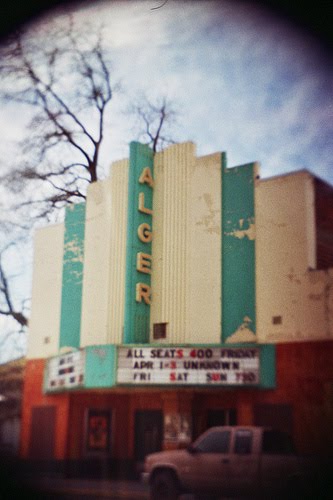
And not to be outdone, here's one of the outside of my hometown art deco movie palace, the Alger Theater, circa 1941, guessing from the release dates of Sierra Sue and All-American Coed, followed by a couple of shots of what it still looks like today.


Okay, back to work...

************************************************

Sunday, July 03, 2011

TONIGHT: A LIVE ONLINE Q&A WITH FILMMAKER LUCAS McNELLY


It’s my fault that this is so last minute, but I wanted my friends in Los Angeles, and around the blogosphere, to know that there’s a unique opportunity to see and support the work of a talented and ambitious independent filmmaker coming up. You can listen to him talk about his movie and participate in a cutting-edge online film distribution experiment at the same time, and it’s all happening tonight.

Writer-director and indie film distribution pioneer Lucas McNelly (gravida, Blanc de Blanc) is in Los Angeles to screen his film Blanc de Blanc at the Hot Pixel, Inc. production house in North Hollywood. Seating is very limited, but you need not worry about that. Lucas will be screening the movie live in L.A. at 5:00 p.m., but he has arranged for you to be able to see the movie by clicking here, where you can become an affiliate of the film (more details here). Then, after the film is finished, you can participate in a live online Q&A with Lucas and a panel on independent film production and distribution and the state of independent film.
It’s a chance to participate in a new distribution model which Lucas hopes will become the future of online film distribution.

So watch Blanc de Blanc tonight at 5:00 p.m. and then join Lucas and other independent filmmakers online at 7:00 p.m. for what promises to be a lively discussion of the film and other matters that anyone whose interested in independent film should be talking about.

For more reading on Lucas’s films and his filmmaking philosophy, check out my 2007 conversation with Lucas about gravida and look for another conversation with him on this blog about his latest groundbreaking project coming in the near future.

**************************************

Saturday, July 02, 2011

MADE IN OREGON


The world is a big, sometimes wonderful, sometimes terrifying and fatally screwed-up system, and as we get older we often find, if we hark from someplace other than the major hubs of the Left and Right Coasts, that the places we come from, those places we sometimes sought so desperately to leave behind, were far richer, more interesting places than our grass-is-always-greener state of mind would ever have allowed us to believe. (This basic knowledge is an integral part of that inevitable process known to independent filmmakers and the audiences that flock to them-- or at least shower them with awards at film festivals-- as the coming-of-age story.) I grew up in the sparsely populated desert of Southeastern Oregon, where at the time lumber and ranching were king, in the governmental seat of Oregon’s Lake County, a small town called Lakeview. My hometown, population approximately 2,000 (the accuracy of which fluctuated depending on whether you were looking at the sign on the north or the south end of town) comprised 2/5 of the population of the entire geographically vast county, which takes up a giant chunk of the corner of the state bordering Idaho and Nevada. Throw a rock in any direction and you were liable to hit a cow or a big guy in a cowboy hat, at which point, especially if you were of slight build like I was growing up, the benign image of Roy Rogers and all those singing cowpokes morphed into one more like that giant son of a bitch Nasty Canasta. If you were a young kid, there were plenty of outdoor activity options to keep you occupied. But if your interests extended much beyond sports (including rodeo riding), cars and or the burgeoning drug culture (I was a teenager in 1973, just about the time the freewheeling ‘60s finally arrived in Eastern Oregon), there weren’t too many choices in the amusement department. Of course I always had the option to retreat into my drawing and writing hobbies, and eventually I would discover like-minded pals who were fascinated with movies and monsters and monster movies.


And fortunately for us, we also had a local movie theater, a wonderful if slightly run-down art deco movie palace called the Alger, named after the father of the theater’s owner, local entertainment impresario (and eventual mayor of Lakeview) Donald R. “Bob” Alger. The Alger operated during the fall, winter and spring months, when weather in Lakeview was dependably bad. And during the summer, when weather was not-so-dependently seasonable, Donald R. “Bob” ran the Circle JM Drive-in, which might have been one of the single worst places to actually see a movie—those carbon-arc projectors could be counted on to start out dim and gradually fade completely to black at least once per showing, and it didn’t help that Donald R. “Bob” and his wife Norene (whose deadpan dry demeanor perfectly matched that of her husband’s, blink for slow, nonplussed blink) liked to get home before 11:00 on those summer nights, so they would often instruct the projectionist to crank up the picture long before the last of the evening pink had disappeared from the sky. But despite their technical shortcomings, both the Circle JM and the Alger were beloved mainstays of growing up in my hometown, even though it wasn’t unusual back in those pre-home entertainment days to have to wait as much as a year before movies made it to our part of the Oregon outback. If you actually wanted to see Jaws during the summer of 1975, you had to head out of town to do so, and the first movie theater in any direction was at least 100 miles away.

(I saw Jaws a week after it opened in Reno. When it finally arrived in Lakeview the following summer anticipation among the cowpoke cognoscenti, who wanted to see it but who obviously didn’t want to see it that badly, was still running high enough that Donald R. “Bob” jacked the regular admission price up to an astronomical $3.50 per adult. This fleecing of his captive audience was a hot topic around town the week the movie played, and nowhere hotter than in the literally half-mile-long line of cars backed up on Highway 395 waiting to get inside the drive-in to see that 25-foot shark chow down on Amity Island swimmers for themselves.)

Life in Lakeview, for kids growing up and, I suspect, the adults who lived their entire lives there, was nothing if not insular. I grew up thinking that the outside world was a place that existed and operated quite separate from the experiences that defined my formative existence. (I had all the monster and movie mags I needed to prove that point, at least to myself.) So it was a very welcome eye-opener to discover, as I did when I got a little taller, came of college age, and even after I’d settled into my roly-poly adulthood, that Oregon, including the desert surrounding my own hometown, had indeed been touched by the dream factory. The Beaver State had, in fact, not only played an integral part in a goodly portion of the American film industry, it had also given birth to some genuinely great films.


One of the best places to head in order to dig up information on the classics and the clunkers of Oregon film history, as well as any and all research into past and current Oregon film production, is the Web site for the Oregon Film Office. Within that voluminous site is located Oregon Confluence, a terrific multi-author blog dedicated to “bringing together the creative streams of film, television, and media in Oregon.” Casting director, film producer and ambassador of Oregon film extraordinaire Katherine Wilson is a frequent contributor to the Confluence-- she recently wrote a couple of lovely pieces about Jack Nicholson’s legacy to Oregon filmmaking and a tribute to Michael Douglas, both of which touch on Oregon’s strong connection to Hollywood and provide fascinating insights into the production of One Flew Over the Cuckoo’s Nest, on which Katherine served as local casting director. (The Oscar-winning movie was filmed primarily at the Oregon State Hospital in Salem.)

It was Katherine who gave me my first job in the film industry (not that there have been many others) as well as my personal entry into film history when she and casting director Michael Chinich hired me as one of a handful of pledges to the Delta Tau Chi fraternity, surely on the strength of the outdated wardrobe that I wore (which came straight out of my closet) to a cattle call casting session at the University of Oregon during the autumn of 1977. She was also a part of the team that operated the Cinema 7, Eugene’s premier outlet for art-house and repertory cinema when I was a student there. Katherine tirelessly advocates for Oregon film and filmmakers and is currently putting together the Oregon Film Factory Film Museum, which will unveil its first formal exhibit in September. She has also written Blanket of the Sun, a screenplay about Chief Joseph’s nephew Jackson Sundown, which has attracted the attention and enthusiasm of writer-director John Milius, and has a new documentary premiering in the fall entitled Animal House of Blues.

My other go-to source for information on what’s happening, and what has happened, in Oregon’s film history is Anne Richardson, who lives in Portland and documents the Oregon film scene for her blog Oregon Films A to Z. A quick click to her home page will get you up to date on The Mel Blanc Project, Stan Hall and the local film project MIMBY (Made in My Back Yard) and even George Cosmatos’s hit western Tombstone, which Anne, in a signature move, “claims” as an Oregon film “on the basis of Sam Elliott’s performance as Virgil Earp.” (Elliot graduated from a Portland high school and attended college in Vancouver, Washington, so there’s your qualification. In 1972 Elliot had a small role opposite Ray Milland in the nature-gone-berserk opus Frogs (1972), and when the movie opened in Portland the ad in The Oregonian’s movie section was topped by a cut-and-paste banner which trumpeted: “Starring Portland’s own Sam Elliot!”) Anne has her finger on the pulse of all things Oregon in film history and along with the Oregon Film site she provides terrific and valuable insight into what’s happening now, especially on the streets of Portland. With these resources and the insights of these people at their fingertips, those investigating the history of the motion picture as it applies to Oregon will be well armed.

A perfunctory glance at a list of movies made in Oregon compiled by the Oregon Film Office, with important contributions from The Northwest Film Center, The Oregon Historical Society, The Oregonian, The American Film Institute and Leonard Maltin, confirms however that, no, they were not all classics. And a quick e-mail to the Oregon Film Office (one which I was not quick enough to send before writing this piece) would put anyone interested on the trail of which of the earliest of the films on this list, dating from 1908, are readily available to see. According to Oregon Film, the first documented film made in Oregon is a movie called The Fisherman’s Bride, which was made in 1908 in Astoria and eventually released in November 1909. Little seems to be known about The Fisherman’s Bride (and if someone knows anything about it, I’d love to be enlightened) other than its historical significance as the starting point of Oregon’s dalliance with film history, and it may well be that the movie is of little interest other than historical. In fact, the list of movies made in the state over the next 20 years or so is littered with titles like Where Cowboy is King (1915), an early document of the still-popular Pendleton rodeo, a Jackson County travelogue entitled Grace’s Visit to the Rogue Valley (1915; left), The Underground Trail (1922), The Vow of Vengeance (1923), Shackles of Fear (1924) and Youth’s Highway (1925), all of which individually are undoubtedly fascinating historical artifacts that may have fallen victim to neglect and joined the ranks of the thousands of movies made in this era that have been lost forever.


One Oregon-made film of that period which has definitely not been lost is Buster Keaton’s The General (1925), certainly the first film of major historical significance in the history of Oregon-based filmmaking. The movie, which ranks high on most every list of the greatest movies ever made, was a flop and a critical bomb upon its initial release (so much for the value of breathless first-out-of-the-gate reviews). Keaton filmed the movie’s spectacular locomotive bridge collapse just outside Cottage Grove, Oregon, and the wreckage was left intact as a tourist attraction for 20-some years after the production wrapped.

If The General marked Oregon’s big-time calling card introduction to Hollywood, the invitation was most certainly accepted. The next few years, as the silent era came to a close and sound was being ushered in, Oregon saw two more major movies produced within its borders. The first production was filmed in Pendleton and in the small town of Athena, both of which stood in for rural Minnesota in a film with the working title Our Daily Bread (1928). It is under this title, with the production date of 1928, that the movie is listed on the Oregon Film list, which unfortunately might contribute to a bit of confusion regarding that title. King Vidor directed a well-known film called Our Daily Bread, but that one was released in 1934, filmed in Tarzana, California, and has absolutely no relation to the film made in Oregon.


To use Anne Richardson’s phrase, the movie with the working title Our Daily Bread that Oregon can lay claim to is in fact F. W. Murnau’s City Girl, the great director’s altogether stunning, penultimate film of ill-fated romance, a spectacularly moving visual essay of urban/rural conflict. The movie’s production is dated 1928, but its release date is 1930. The inclusion of this indisputable film classic under the title Our Daily Bread on Oregon Film’s list is, unfortunately, misleading, especially since the title City Girl, by which it was released and is exclusively known, is nowhere to be found on that list. The second major movie produced in Oregon up through 1930 was Raoul Walsh’s influential western The Big Trail (1930); its locales, of which Oregon is but one, are listed by Oregon Film and the Internet Movie Database as being “statewide,” certainly an appropriate designation given the movie’s scope and grandeur.


Another curious glitch on the presumably comprehensive Oregon Film site is the absence of one remarkable historical footnote that can be credited to nascent Oregon filmmaking chutzpah of the period. In 1928 two students at the University of Oregon, James Raley and Carvel Nelson, returned to school from summer jobs as extras on the set of Murnau’s City Girl fired up by their experience and eager to undertake the ambitious task of making their own film. They rallied fellow students, planned the production and eventually filmed a movie that is widely presumed to be the first independent student film ever made in this country. It’s called Ed’s Coed (1929) and is available to view at the University of Oregon’s online archives, where it is mistakenly dated (due to a typo, no doubt) 1919. I have included the link to those archives even though, try as I might, I have not been able to get the movie to stream from that source. Fortunately, I was able to find it on YouTube and have cut out the middle man altogether. Here’s is Ed’s Coed, in its entirety, for you to enjoy:


There is another chapter in the Ed’s Coed story as well. Fascinated by this near-forgotten milestone of film history, University of Oregon journalism students John Rosman and Eric Rutledge are trying to revive interest and inspire awareness of Ed’s Coed with a film that tells the behind the scenes story of this groundbreaking movie created over 80 years ago. The documentary is entitled Reinventing Ed’s Coed and you can watch it right now below.


As that Oregon film history list surely attests, the following 40 years certainly saw film production in Oregon ramp up considerably. The ratio of shit-to-sapphires is as out of balance as it is when talking about Oregon-produced movies as when Hollywood is the subject, so you do have to do a little sifting to get to the jewels. Even many of the notables titles aren’t necessarily classics-- The Way West (1967, filmed in Crooked River, Lane County and also in my backyard, Christmas Valley, in northern Lake County) and Paint Your Wagon (1969, filmed in Baker) aren’t entirely charmless, but few would rate them at the top of the class in their respective genres, the western and the musical. But Anthony Mann’s Bend of the River (1952), filmed near Mount Hood and Palmer Glacier, most certainly is, and movies like Abe Lincoln in Illinois (1940; Eugene, Mackenzie River), Thunderhead, Son of Flicka (1945; Gresham), The Great Race (1965; Gearhart) and Shenandoah (1965; Marcola) ain’t half bad either.

And just like Hollywood, Oregon saw its own golden age of filmmaking emerge in the 1970s. The relatively high-profile collegiate affiliation of Eugene attracted the attention of a lot of filmmakers and studios eager to capitalize on the unexpected success of Easy Rider and tap into what was perceived as a large, previously dormant demographic. And the fact that the University of Oregon campus, with its heavy foliage, storied architecture and dependable rainfall, could easily pass for a location situated somewhere east of the Mississippi made it a desirable location for studios looking for campus verite without traveling far from Los Angeles. The counterculture vibe in American filmmaking was perpetuated, with various degrees of artistic and box-office success, through such Oregon-centric productions as Getting Straight (1970; Eugene), Five Easy Pieces (1970; Eugene) and Drive, He Said (1971; Eugene).

At work in the culture at the same time was the continuing presence of Oregon writer Ken Kesey, whose novels One Flew Over the Cuckoo’s Nest (1962) and Sometimes a Great Notion (1964) were still reverberating through the sensibilities of the disaffected children of Vietnam and American civil unrest even as Kesey himself and his band of Merry Pranksters held court at the center of a national counterculture conversation/shouting match.


Paul Newman, as actor and director. eventually tackled the daunting task of adapting Notion into a movie (known both by the novel’s title and also Never Give an Inch), one which was met at the time largely with indifference everywhere except Oregon, where its literary cachet in urban areas like Eugene and Portland, and its subject matter for rural Oregonians—the story of a defiant family of loggers— assured its must-see status. But the next Kesey adaptation was more successful, even if Kesey himself publicly grumbled. Jack Nicholson, who starred in Five Easy Pieces and directed Drive, He Said, returned to Oregon and eventual triumph in Milos Forman’s film of One Flew Over the Cuckoo’s Nest, which managed the unlikely feat of translating much of the desperate comedy, anguish and even some of the poetry of Kesey’s book to the screen, with Nicholson himself becoming the recipient of one of the film’s five Oscars.


By 1977, the anti-establishment vibe of Randall P. McMurphy’s institutionalized resistance had morphed into something equally defiant but much more heavily reliant on at least the literalized spirit inherent in the name “Merry Pranksters.” When National Lampoon’s Animal House was filmed on the campus of the University of Oregon in the autumn of that year there was heavy resistance from the campus Greek community, who mounted a campaign against the movie which they thought surely would bring further stress upon a fraternity/sorority system already experiencing a downswing in popularity. The film was released at the end of July in 1978, and by the time classes reconvened for the fall fraternities and sororities at the university, to say nothing of those all around the country, had fully embraced the movie’s no-holds-barred hedonism and disdain for authority, which had its roots in the kind of experimentation and nascent political awareness that informed the generation of its characters, many of whom might have been reading Kesey, if they bothered to read at all, on the Faber College campus.

But anti-establishment attitudes tend to become establishment very quickly, especially in Hollywood. The scent of money assured umpteen Animal House clones, some of which were terrific-- Stripes (1981), parts of Caddyshack (1980)-- most of which-- Meatballs (1979), Up the Creek (1984; filmed in Bend)—um, weren’t. Only a year later Steven Spielberg’s Animal House-influenced 1941 (1979; some sequences filmed in Cannon Beach and Gold Beach) debuted to decent box-office and some of most derisive reviews of Spielberg’s career to date, but by then the antiauthoritarian vibe of Kesey and Animal House had already begun to fade into a future so bright that Tom Cruise was forced to wear Raybans.

Fittingly, that counterculture street cred has been reclaimed somewhat in the ‘90s and ‘00s by Oregon-based filmmakers like Gus Van Sant (Mala Noche, Drugstore Cowboy, My Own Private Idaho, Even Cowgirls Get the Blues, Elephant, Paranoid Park, all filmed in his native Portland), Mike Mills (Thumbsucker) and mumblecore survivor Aaron Katz (Dance Party USA, Quiet City, Cold Weather), all of whom have helped to redefine Oregon, and in particular Portland, as a center of culture for a new generation of convenienced young people who have technological advantages but also some of the same confusion and troubles as their precursors when it comes to uncluttered communication and personal expression.


And director-writer Kelly Reichardt, along with her regular collaborator Jon Raymond, has established herself as an Oregon filmmaker in spirit, if not in genealogy (she’s a Florida native who was educated on the East Coast), with a distinctive, arresting and seductive trilogy of films that capture specific aspects of life, history and experience that will be familiar to many Oregonians even as they speak to viewers all over the world. Old Joy (2006) and Wendy and Lucy (2008) were among the five best movies of their years, and this year’s beautiful, ghostly Meek’s Cutoff already sits high atop the pile of 2011 releases you’ve already forgotten as the movie to beat (at least in my book) for year-end honors. Reichardt’s movies whisper to the viewer, gently suggesting, alluding, never insisting, yet they contain the sometimes exhilarating, sometimes awful power of regret, destiny and revelation in their genes. They make me look at the world differently, the same way that I began to look at the world differently, with more eagerness and fascination and even hope, when I began to understand how my Oregon life was connected to the world at large, that there was something beside the everyday, or at least a way of illuminating it, that was accessible in the place that I came from. These are the movies that are made in Oregon that continue to make and remake the state in my mind. It is, after all, a wonderful place to be and to be from, as all the contributions to film history that have originated or produced in Oregon tend to make clear, clear as one of its rivers, teeming with hidden treasures and fascinations and other worthy aspects of life.

A BRIEF AND INCOMPLETE CHRONOLOGICAL GUIDE TO SOME OTHER NOTABLE MOVIES MADE IN OREGON


Call of the Wild (1935; Mt. Baker Lodge)
Lost Horizon (1937; Mt. Hood)
Canyon passage (1946)
Rachel and the Stranger (1949; Eugene)
The Great Sioux Uprising (1953; Pendleton)
Ring of Fire (1961; Vernonia)
The Great Northfield Minnesota Raid (1972; Jacksonville)
Kansas City Bomber (1972; Portland)
Lost Horizon (1972; Mt. Hood)
Napoleon and Samantha (1972; John Day)
Emperor of the North Pole (1973; Cottage Grove
Closed Mondays (1974; Portland)
The Apple Dumpling Gang (1975; Bend)
Rooster Cogburn (1975; Bend, Grants Pass)
How to Beat the High Cost of Living (1980; Eugene)
The Lathe of Heaven (1980; Agate Beach)
The Shining (1980; Timberline Lodge)
Personal Best (1982; Eugene)
The Adventures of Mark Twain (1985; Portland)
The Goonies (1985; Astoria, Cannon Beach)
Short Circuit (1986; Astoria, Portland, Columbia River Gorge)
Stand By Me (1986; Eugene, Cottage Grove, Brownsville)
Come See the Paradise (1989; Portland, Astoria, Willamette Valley)
Kindergarten Cop (1990; Astoria)
Point Break (1991; Wheeler, Ecola State Park)
Body of Evidence (1992; Portland)
Dr. Giggles (1992; Portland)
The Temp (1992; Portland, North Coast)
Free Willy (1993; Portland, Astoria)
Maverick (1993; Columbia River Gorge)
The River Wild (1993; Grants Pass)
Teenage Mutant Ninja Turtles III (1993; Astoria)
Dead Man (1994; Grants Pass)
8 Seconds (1994; Pendleton)
Free Willy 2 (1994; Astoria)
Mr. Holland’s Opus (1994; Portland)
The Postman (1997; Central Oregon)
Zero Effect (1997; Portland)
Double Jeopardy (1998; Salem)
Without Limits (1998; Eugene)
A.I.: Artificial Intelligence (2000; Gresham)
Pay It Forward (2000; Portland)
The Hunted (2001; Portland, Oregon City, Salem)
The Ring (2002; Newport, Columbia River Gorge)
Mean Creek (2003; Estacada, Troutdale)
The Ring 2 (2004; Astoria)
Into the Wild (2006; Astoria, Cascade Mountains)
Coraline (2008; Hillsboro)
Twilight (2008; Portland, Estacada, North Coast, St. Helens)
The Road (2008; Portland)
How to Die in Oregon (2010; Statewide)

************************************