Artist
Robert McGinnis imagines life as Sean Connery's James Bond in
You Only Live Twice.
*************************************************************************************
The reviews for
Casino Royale, the reboot of the long-running James Bond series starring Daniel Craig as 007, are finally starting to trickle in, and the word, at least initially, looks pretty encouraging. For
Anthony Lane, the quip is always paramount, but there’s seems to be a bit of Brit provincialism peeking out from underneath the wisecracks in his review—Lane wants the lustre restored to Her Majesty’s super-spy franchise and it seems he thinks he’s gotten his wish: “
Casino Royale, though half an hour too long, is the first semi-serious stab at (Ian) Fleming, and at the treacherous terrain that he marked out, since
On Her Majesty’s Secret Service, in 1969.”
Kim Newman in
Empire magazine, may be even more enthusiastic: “(
Casino Royale) has almost everything you could want from a Bond movie, plus qualities you didn’t expect they’d even try for. It does all the location-hopping, eye-opening stunt stuff and lavish glamour expected of every big-screen Bond, but also delivers a surprisingly faithful adaptation of Fleming’s short, sharp, cynical book with the post-WWII East-vs.-West backdrop persuasively upgraded to a post 9/11 War on Terror.” And as for the controversy regarding the casting of Craig, Newman says relax: “Contrary to pre-release nay-sayers, Daniel Craig has done more with James Bond in one film than some previous stars have in multiple reprises. This is terrific stuff, again positioning 007 as the action franchise to beat.”
All right, but what does the American have to say?
David Edelstein writes in
New York magazine: “After serving up a sleek male mannequin in four so-so films, the corporate executives of the James Bond franchise have opted for his opposite in
Casino Royale-- Bond as a bit of rough trade. And he’s good! Better than that, he’s what Bond hasn’t been in a quarter-century, since a certain rugged Scot said, ‘Never again.’ He’s fascinating.” And Edelstein gives us a little perspective on director Martin Campbell: “Campbell… also made Pierce Brosnan’s generally flaccid debut,
GoldenEye. He doesn’t screw up this time. Working with the crack editor Stuart Baird, Campbell propels Bond (and his quarries) onto impossible precipices and stands back while the world’s highest-paid stuntpeople earn their paychecks. In the early Bond movies, the violence was both brutal and stylish, with witty curlicues; here, it’s mostly brutal, but at least the director has a Hong Kong-style awe for the poetry of human bodies doing things that, evolutionarily speaking, they haven’t needed to do since the saber-toothed tiger died off.”
I’ll be there Sunday morning at 10:00 a.m. at the AMC Burbank 16, escorting my 80-year-old mother-in-law, she of the very small frame, quiet Japanese comportment and voracious appetite bordering on bloodlust for all kinds of extreme violence and Hollywood action fare. The first movie we ever saw together was
The Last Boy Scout, for God’s sake, which was released in 1991, and set the tone for our cinematic investigations to come. We saw virtually every big, bloody explosion-fest that came out all the way up through the summer of 2004—you name it, and I’ll virtually guarantee we munched popcorn together through it. Though her various infirmities have curtailed our movie outings since then (she even skipped
Die Another Day and waited for the DVD), the excitement of this new Bond was just too much catnip for her to resist. It might take her a while to climb the stairs of the stadium auditorium, but with me there backing her up I foresee nothing but blue skies and Daniel Craig’s blue eyes for her to get lost in, that is when she’s not grooving on the big action set pieces that sound like a sure thing on this movie’s menu. I always hope the movie we see together will be fun for her sake, but it sounds like
Casino Royale might be fun for both of us.
*************************************************************************************
And speaking of fun good enough to carry you and I up to opening night, my pal Sal alerted me earlier today that some giddy, crazy person has done us all a favor and posted YouTube clips of the opening title sequences for
all the official 007 movies on one single page. So take
a look and a listen and then drop back by the comments column and let me know:
What are your five favorite Bond theme songs? I’ll get it started:

5)
“The Living Daylights”: If this one had been graced with stronger vocals than the wispy boys of Aha could provide, I think it’d be recognized as a classic.

4)
“The Man with the Golden Gun”: On one level, I know it’s god-awful. But Lulu belting out lines like "Love is required/Whenever he's hired/It comes just before the kill" and “One golden shot means another poor victim/Has come to a glittering end” is just too much for me to resist.

3)
“On Her Majesty’s Secret Service”: The best of the instrumental opening titles of the Bond series is a theme almost as good as the one Monty Norman wrote for 007 himself. (Thanks, Flickhead!)

2)
“Goldfinger”: Probably the greatest Bond song of them all. Everything that’s good about the Bond series, and
Goldfinger itself, is encapsulated in this tune and in Shirley Bassey’s spine-rattlingly sexy vocal.

1)
“You Only Live Twice”: It’s my favorite Bond and my favorite theme song-- the seductive strings of the orchestration undulate past delicious Japanese instrumentation and underneath the slightly dazed emotionalism of Nancy Sinatra’s purring vocal.
Honorable mention goes to Paul McCartney’s “Live and Let Die,” Gladys Knight’s “License to Kill” (for her vocal only) and, at the risk of losing all my Bond credibility, Sheryl Crow’s “Tomorrow Never Dies.”
*************************************************************************************
And one last tidbit before Version 6.0 takes off on Friday-- the projectionist at my hometown movie theater in Lakeview, Oregon was a kindly old gentleman by the name of Mr. Tatro, who also got up every Monday morning at 5:00 a.m. to change the marquee so that it would reflect the new program upcoming for the week. It so happened that I was a close friend of the son of the owner of the theater, so I would always take great enjoyment in pointing out the various misspellings that would occasionally appear on the marquee, due undoubtedly to a mix of the bleary time of morning and Mr. Tatro's natural, old-fashioned dottiness. For example, I knew that every time a picture starring that blue-eyed guy who liked to drink beer and race cars came to town, his name would inevitably be posted as "Pual Newman." And imagine my surprise when I found out that
Duck You Sucker! starred
Charles Coburn. (I'll give him credit for this, though-- Mr. Tatro sent me scrambling for my early edition of Leonard Maltin's book to find out who this mysterious Charles Coburn was!)
But no marquee Mr. Tatro ever assembled ever matched the one that greeted early risers on their way to work and school on a Monday morning sometime in 1971. I was excited about the movie's arrival and couldn't wait to catch a glimpse of the one-sheet and the official announcement on the Alger Theater marquee. But if Charles Coburn confused me, imagine the head-scratching that went on when I read this, laid out above South "F" Street in giant black-and-red letters:
SEAN CONNERY is WARD BOND 007
in DIAMONDS ARE FOREVERMr. Tatro, ever the film historian, had inadvertently expanded the world of John Ford and Frank Capra for me and at the same time gave me the single biggest gut-busting laugh I ever had reading the marquee at the Alger Theater. I couldn't wait to tell my buddy what was screaming out off the front of his dad's theater, and after I did I immediately regretted it-- when I walked past the theater again later that day, the delightful mistake had been corrected and Bond was James once again.
*************************************************************************************
(If you like that painting from
You Only Live Twice seen above, please do avail yourself of the Web site of artist
Robert McGinnis and check out his great
movie posters gallery. He’s done a lot of the Bond films, and some of his other work will be instantly recognizable as well-- thanks, Mr. McGinnis, for
Barbarella!)
*************************************************************************************
UPDATE 11/15/06 5:35 p.m. Wow! After commenting below that he was worried that the new Bond might be chasing after a
Bourne-style realism, That Little Round-Headed Boy checks in on his eponymous site with a real treat aimed straight at the heart of those who love the Bond films (especially the Connery entries) for the oversized grandeur, spectacle and wit that came largely courtesy of production designer extraordinaire Ken Adam. Hear TLRHB sigh:
"Realism, realism, what's so great about realism? Anybody can do realism. Give me imagination! (Adam) was a man not pinned down by rule-bound notions of architecture or set design. He blended the "hip" jet-age look with heavy concrete and steel spaces that interlocked like mechanical puzzle pieces. When you see his sets on film, it's like watching the Great Pyramids move on a hinge."
That LRHBoy can write! As one who can't imagine an action cinema without the great volcano Adam designed for
You Only Live Twice, the one that opens up to reveal a giant missile silo complex hidden beneath, I really appreciate TLRHB taking the time to throw the spotlight on Adam's brilliant work. He bowed out of the Bond series with
Moonraker (perhaps one movie too late, eh?), but 007 was only part of his story-- he was the man who made Kubrick's War Room in
Dr. Strangelove... and-- Well, enough of me. Get yourself on over to That Little Round-Headed Boy's excellent piece entitled
"The Man Who Designed the 20th Century" and realize how familiar you already are with the wonderful world of Ken Adam.
And while we're clicking, a friend of mine just sent me a link to a gallery of
Bond girls that is somewhat pleasing to the eye, courtesy of
James Bond Multimedia. Thanks, Mike.


 Posts


 Boys and ghouls, Forrest J. Ackerman, founder and publisher of Famous Monsters of Filmland and hero to a generation of monster movie geeks, the ranks of which include Steven Spielberg, Stephen King, Joe Dante, John Landis and many others, turns 90 years old next Friday, November 24. As a way of saying happy birthday to Forry, number-one resident of Horrorwood, Karloffornia, Flickhead will be hosting a blog-a-thon that day from his eponymous blog to celebrate this milestone.
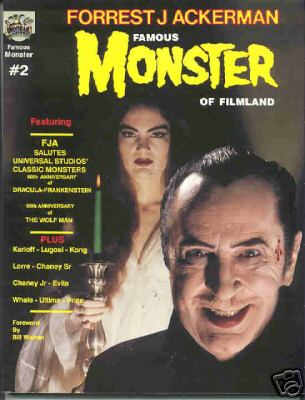 I know Flickhead would love to see testimony and tribute from everybody for whom Forry was a major childhood influence, in the hope that we can help make it a special birthday indeed and somehow get word of our endeavor to Mr. Ackerman himself. (Speaking of hopes, maybe Tim Lucas can get word to some of those notables that he knows and give them a chance to chime in too!) And as always, if you are blogless but would still like to write something in tribute to the curator of the Ackermuseum, please feel free to contact me by e-mail and I will be glad to post your contribution alongside my own next Friday. Flickhead will undoubtedly be posting links to all the contributors on his Forrest J. Ackerman Blog-a-Thon home page on Friday as well..