Thursday, February 16, 2006

LOGJAMMIN' AT LEBOWSKI FEST WEST 2006


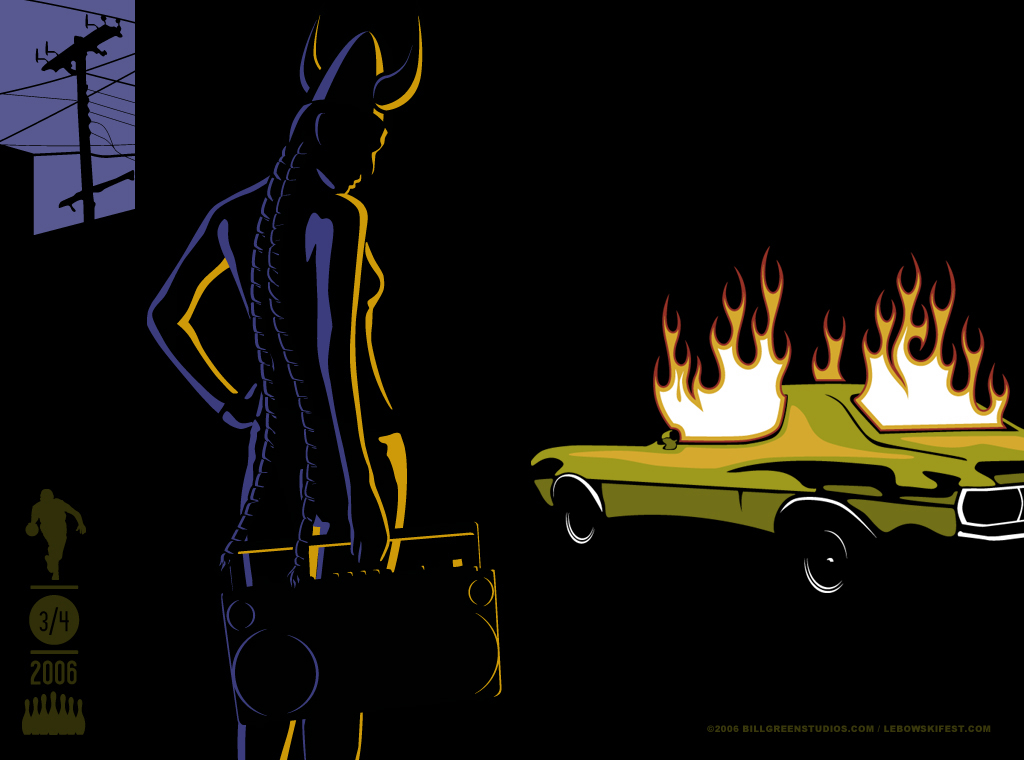
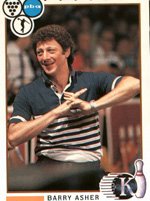
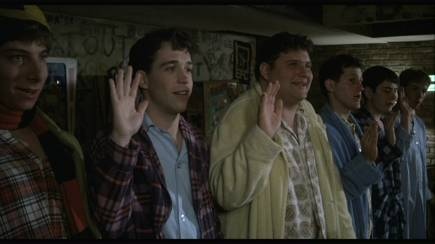
Well, I don't know about anyone else, but I know where I'm going to be on Saturday, March 4-- in Lakewood, California, that's where, sipping white Russians and deconstructing the screenwriting style of one Arthur Digby Sellers (You know... Branded? "All but one man died there at Bitter Creek"?) with as many no-accounts and Coen-heads as can fit into the Cal Bowl in Lakewood for the 7th Annual Lebowski Fest West, celebrating all things substantial and tangential to the Coen Brothers brilliant 1998 comedy The Big Lebowski. (Yes, even this.) There's a pre-party at the Knitting Factory in Hollywood the night before, but clearly the place to be is gonna be the Cal Bowl on Saturday night. Of course, there are always rumors about celebrities from the movie attending, and this year is no different, but if you're gonna get all excited about maybe tipping a sarsaparilla with Sam Elliot, trading photography stories with Jeff Bridges, pitching a script to Philip Seymour Hoffman, or getting your toenails painted by Tara Reid, you'd best scale your expectations down a bit. Jeff "the Dude" Dowd and Peter Exline, the real-life inspirations for the Dude and Walter, will be appearing at the Knitting Factory, and it's reasonable to think they might find their way down to Lakewood as well (although I'm not sure I could handle sharing a lane with the real Walter Sobchak.) And the good folks at Lebowski Fest 2006 have confirmed appearances by Jim Hoosier (Liam, the Jesus's teammate), Robin Jones (sullen Ralph's checkout girl), bowling technical consultant Barry Asher and even Edie McClurg, who had not one thing to do with The Big Lebowski, but who is a tremendously good sport and loads of fun and who has given up her Saturday evening to spend it with a bunch of drunken film fans who may or may not even know who she is.
(Maybe I'll throw her a curve and ask her about Brian De Palma and Carrie-- "Edie, do you ever lay awake at night regretting having treated Sissy Spacek so badly?")


This event sold out faster than you could toss a marmot into a bathtub last year, so if you're a fan of the film, or perhaps just a very interested, very brave sociologist who can't get a date for March 4, you might want to consider getting your tickets now. I'll be there dressed as Walter (if I can find my hunting vest) to my pal Stoogeking's Dude, and we're hoping to drag a few likeminded travelers to tumble with the tumblin' tumbleweeds right alongside us that night. Remember, you can say what you like about the tenets of Lebowski Fest 2006, but at least it's an ethos. Come see the ethos get tipsy, drop 15-pound bowling balls on their tender feet, and luxuriate in a bowling alley full of fellow Lebowski-heads on that very special night in Lakewood March 4.

Yet another bit of Lebowskiana: Here's some tomfoolery by way of GreenCine Daily called Sizing Up Lebowski, a peek inside the LebowskiFest phenomenon. You may want to take a look at this before buying your tickets, especially if your favorite Coen Brothers movie is The Ladykillers...

O DEATH, O DEATH: FINAL DESTINATION 3


(Original post Thursday 2/16 10:51 p.m. UPDATED 2/19/2006 9:05 p.m.)

I doubt it'll come as a surprise to any regular readers of SLIFR that I have a jones to see Final Destination 3. I was pretty enthusiastic about the first installment, directed by James Wong, from a script by Wong and Glen Morgan (both veterans of The X-Files). But I absolutely flipped for the even more convoluted and gleefully gory Final Destination 2, which was my first exposure to the superb action director David R. Ellis, who has since gone on to direct Cellular, from Larry Cohen's exceedingly clever script, and the upcoming Snakes on a Plane, perhaps the highest must-see high concept movie I can recall since the dawning of the new century. Wong and Morgan return for part 3, and the absolutely venomous reviews the movie has drawn hold almost deterrence value to me at all. However, Ed Gonzalez, film critic for Slant magazine, has posted a very well written dismissal of the new film, and within it he discusses, and links to, one of the most intelligent write-ups in favor of Final Destination 3, submitted by one of my favorite critics to read these days, Walter Chaw of Film Freak Central (which, by the way, sports a blog well worth checking out). As I try to find room this weekend in between screenings of Brokeback Mountain and The New World to get myself to a late show of FD3, I'll read Gonzalez and Chaw again, two fine writers who are probably the only ones so far who have written anything worth reading about the Final Destination movies and their place among the imagery in the cracked mirror that America uses to look at itself.

UPDATED 2/19/2006 9:05 p.m.


WHOOPS, YOU MISSED ME: FD3's scattershot approach

Well, I wish I could report that the enthusiasm I had for the first two installments of the Final Destination series has carried over into the third installment, but, alas, Final Destination 3 is just not the well-oiled Rube Goldberg deathtrap part 1, and especially part 2, led me to expect. The problem I had with the film didn't derive entirely from its failure as a portrait of or a treatise on post 9/11 fear experienced as a mass loss of control, even though I do think its attempt to engage this theme was half-baked. And the movie's attempt to bolster this theme by utilizing a photograph of a plane's shadow crossing the face of the World Trade Center as part of our heroine's evidence that Death often provides clever clues to its plans before carrying them out is not only "extraordinarily inappropriate" (Walter Chaw) but also grossly insensitive, especially in this context. Whether its understood to be a picture taken days before 9/11, or a chance shot of the shadow appearing just before the actual crash, the picture doesn't lend itself to the movie's logic as to Death's methods, and it's harshly gratuitous considering director-writer James Wong (and cowriter-producer Glen Morgan) uses it only to goose the cheap thrill factor and not to expand the theme meaningfully (see Ed Gonzalez for a solid and reasonable theory as to why this attachment to 9/11 doesn't make any sense for this series). Chaw also mentions the movie's flirtation with another interesting theme, the value of ignorance when discussing matters of mortality and impending death, and makes reference to similar concerns in Saw II, where I think the idea is more interestingly and fully played out.

My biggest disappointment with Final Destination 3, however, derives from its near incompetence when it comes to diagramming the set-ups and the pinballing machinations of Death's ever-elaborate contrivances for taking out the various straw boys and girls of the cast (unlike the first two parts, adults, either as authority figures or potential victims, are virtually nonexistent here.) Final Destination 2 distinguished itself in this regard-- David R. Ellis' lean directorial style made the movie seem almost more an action thriller at times than a horror film, but there was always a precise understanding of how each piece of the fatal puzzle, however outlandishly contrived, was falling into place, which made the outrageously gruesome "payoffs" that much more ghastly and funny. I still have a vivid picture in my mind of the spectacular auto accident that sets FD2 in motion, and the intricate (and patient) set-up for the sequence in that same film when the doper kid is trisected by a flying section of barbed-wire fence-- the ingenious use of CGI allows us to see the result, a Warner Bros. cartoon death joke staged with spraying blood and sliding entrails, and puts the "ping!" in this particularly crystalline bit of action choreography. None of the fatally convoluted machinations in Final Destination 3 have this kind of clarity. They're all indifferently staged, with a scattershot logic and visual clutter and, surprisingly, a lack of concern for simple follow-the-bouncing-ball purposefulness-- the way these scenes are edited together suggests to me impatience on the part of the filmmakers, as if they just wanted to press on to the big red spray of viscera at the end and didn't really much care how they got us there (Wong's staging of the signature sequences in the first film were much more alive, crackling, often literally, with electricity and dread-- was he just bored this time around?) One sequence, at a fast-food drive-thru, depends entirely on a garbage truck backing up perpendicular across a busy street, pinning our hapless victims from all sides-- there are cars in front of and behind them-- and there is absolutely no explanation offered why this truck is suddenly performing this irrational driving maneuver. (My theory: lazy screenwriting.) Chaw finds value in the movie roasting (again, in one instance, literally) the Breakfast Club stereotypes that populate its cast, but these familiar teen-movie characters seem like a pretty tired satirical target and lend the movie a generic quality that FD2, with its mixture of ages and races and backgrounds that made up the roster on Death's scorecard, avoids (FD2's coarse teen stereotypes don't make it through the initial disaster.) Despite a winning performance by Mary Elizabeth Winstead as the control freak yearbook photographer who spends the movie looking for that big loophole in Death's design, Final Destination 3 ends up feeling too disengaged and indifferent, not only to our capacity for on-screen violence (which it engages, with unmemorable results), but also with the legacy of its own cleverly jerry-rigged conceits.

Monday, February 13, 2006

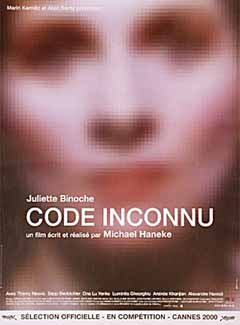
CODE UNKNOWN and CRASH: COLLISIONS, CONNECTIONS AND CATHARSIS


The last encounter I had with anyone here in Los Angeles involving race or cultural diversity came while helping out in my daughter’s kindergarten class last week. I called her name and attached to it the appellative “-chan,” a familiar term of endearment in the Japanese language (my daughter is half Japanese). My daughter’s teacher looked up at me and asked me what I said. I repeated it, and she told me, with some delight, that in Armenian there is a similar appellative, used in exactly the same way, pronounced “-jan.” It was a pleasant exchange, an unexpected connection between two cultures and peoples I’d always assumed were about as far apart as two cultures and peoples could get. There was no tension, no unease, no anger bubbling just under the surface that eventually exploded in ugly epithets and violence. It was a simple, everyday occurrence, the sort for which there is simply no room in Paul Haggis’ widely admired, overwrought, fatally didactic and schematic, frequently absurd after-school special entitled Crash.
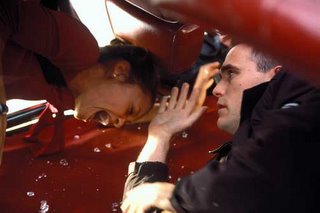
I’m not naïve enough to suggest that racial tension in the most segregated city in America is outside of my experience—if it ever was before (and it wasn’t), in the post Rodney King-O.J. Simpson era it is impossible to live in Los Angeles and not be aware of the kind of cultural divisions that often seem to be tearing the city apart from the inside out. But it’s just as naïve, self-serving and dramatically shortsighted to set up an entire movie populated by people who function only to embody all the various elements of bigotry and prejudice and intolerance which make up Haggis’ cobbled-together thesis, the bottom line of which seems to be, “Racism is wrong, and we are all capable of it.” A radical idea on which to construct a big, important social melodrama, or a safe platitude around which to twist and turn a convoluted narrative based on a specious metaphor designed to ensure everyone who leaves the theater will be convinced they’ve seen something significant and soul-changing? When a morose detective played by Don Cheadle opines, not five minutes into the film, about Los Angelenos, “We’re always behind this metal and glass. It’s the sense of touch. I think we miss that sense of touch so much that we crash into each other just so we can feel something”—and, yes, he’s just gotten into a fender-bender—I felt like shutting the film down, because I could feel Haggis already clobbering me on the head, insisting that I understand that he’s serious, dammit.

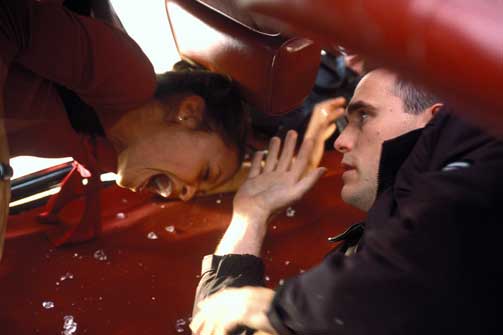
Haggis’ strategy is to alternate between the stories of 15 or 20 different characters as they literally and figuratively crash into each other over the course of the movie, and since none of them have any inner lives, all any of them ever talks about are hot-button issues of race and intolerance. Haggis writes scene after scene of position-paper dialogue masking as conversation, and after a very short while you begin to realize that these 15-20 characters must be the only citizenry in Los Angeles, because they keep stumbling over—I’m sorry, crashing into each other in ridiculous coincidence after ridiculous coincidence. The racist cop (Matt Dillon) who feels up the wife (Thandie Newton) of a black TV director (Terrence Howard) at a traffic stop saves her from a fiery car accident the next day. The same black carjackers (Larenz Tate and the representatively named rapper-actor Ludacris, who likes to argue about hip-hop culture and black-on-black crime and being stereotyped by whites between jobs) who steal an SUV belonging to the district attorney (Brendan Fraser) and his shrew of a wife (Sandra Bullock) later jack the SUV of the above-mentioned TV director, leading to a patently absurd scene in a which the ex-partner of the racist cop (Ryan Phillippe), after a lengthy chase down residential streets, convinces the rest of the pursuing officers to let him off with a warning. The cops have mistakenly assumed that the director, because he’s black, has done something wrong-- he’s really been trying to wrest control of the vehicle from Ludacris, who hides in the front seat, undiscovered, while Phillippe engineers Howard’s release. Later, Phillippe, a good liberal, will gun down one of these same carjackers due to a knee-jerk response based on the man’s race. The dead car thief turns out to be the brother of another major character, and on and on and on.
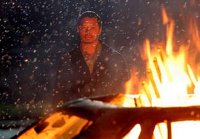
Those who would defend Crash might dismiss these constant coincidental meetings as thematically relevant, and the interlocking stories as parables. This might be a way of suggesting that even though they are filmed “realistically” and we are meant to take Crash as a portrait ripped fresh and bleeding from the streets-- The Way We Live Now!-- they don’t really have to be believable in a dramatic sense because they exist primarily to teach us something. (That “whooshing” sound is the wind going right out of my sails.) Unfortunately, those stories don’t really interlock so much as, yes, crash together, due largely to Haggis’ ham-fisted mise-en-scene, his tin ear and the movie’s flaccid, predictable editorial rhythms (You may ask yourself, for example, why we're not allowed to see a scene between Newton and Howard where he expresses his concern that she almost lost her life in a car accident. It’s not there because Haggis isn’t interested in these people as people, only in terms of how they flesh out his thesis—much more important to see the scene where Howard stands up to the Man and regains his dignity, even if it is one of the most unbelievable scenes in the entire movie.) The film is rigged to produce a response to premises-- racism is wrong, all of us have the capacity to change-- with which most of the film’s viewers probably already agree, and the zeal with which people have taken to this movie might make others who end up less impressed think that to reject the movie’s clunky drama-turgid-cal arguments is tantamount to siding with the devil of intolerance. I’d call it standing up for cogent, clearheaded analysis and vivid storytelling.
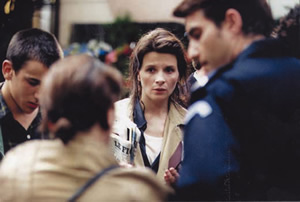
Haggis’ movie has drawn comparison with other life-in-L.A. mosaics like Alan Rudolph’s fuzzy, unfocused Welcome to L.A., Robert Altman’s misguided and condescending Short Cuts and, the cream of the crop, Paul Thomas Anderson’s Magnolia, which found ever more interesting ways to spin characters that resembled real human beings through a visually arresting narrative that hit on its own concerns in a fluidly charged way quite the opposite of how Crash throttles its big issues to the ground. Anderson, in Magnolia recognizes that one aspect of an issue or a person does not constitute that whole person, and he creates a visual/aural tapestry that, seen whole, is reflective of a sensibility based on dramatic and emotional truth, of searching for the connections that people make and following them in order to find out where they go, not because you’ve already decided where they’re headed and what they mean (if anything). At the top of this particular hill must be Michael Haneke’s Code Unknown, probably the best example of this kind of mapping of the ways in which people touch and influence and enhance and destroy each other’s lives, often without ever knowing it, all as a condition, a symptom, of living life in modern, racially and culturally integrated cities. What’s intriguing, as a matter of comparison not only with Crash but with the other films as well, is how Haneke charts the movement of his characters. Where Altman or Rudolph or Anderson or Haggis might insist that the constant bumping up against each other within the framework of the urban world they portray is where their films derive, or at least begin to extrapolate their meaning, Haneke sees it in precisely the opposite terms.

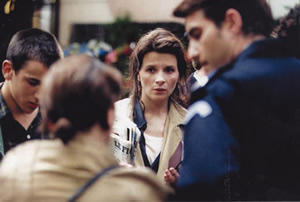
Code Unknown, well described in the opening credits as “a collection of incomplete tales of several journeys,” begins with a brief episode in which a group of deaf children attempt to interpret a visual representation of an emotion (“Alone,” “Hiding Place,” “Sad”). This sequence is followed immediately with a single long take that will handily encompass the characters who will, in varying degrees, inform the rest of the film. The camera glides laterally along a Parisian street as we observe a young man, Jean (Alexandre Hamidi), catch up to a young woman, an actress named Anne (Juliette Binoche) who is his older brother’s girlfriend. Jean expresses frustration about having to live with his father on their farm, for which his father expects him to eventually assume responsibility. Anne discourages the idea of Jean moving into the apartment she shares with Jean’s brother, but offers to let him rest there for the afternoon while she is out and gives him the pass code so that he can enter the building. (This is the film’s only explicit reference to a code, unknown or otherwise, and it’s enough to set up a fertile metaphor that the movie will bring to fruition in various incidental ways.) After parting with Anne, Jean walks the street, unsure of where to go, and in a burst of frustration hurls a crumpled sandwich bag into the lap of a woman (who we will later know as Maria, played by Luminata Gheorghiu) who sits begging for change near a storefront. The act is witnessed by Amadou (Ona Lu Yenke), a teacher of deaf students, who confronts Jean and demands he return and apologize to the woman. The police are quickly called, Anne reappears on the scene, and it’s not long before the police have (inaccurately) assessed the situation and Amadou has been arrested for attacking Jean. As a result of this one encounter, Amadou will spend time in jail (where, we find out later, he was beaten), Jean will sullenly retreat to his father’s farm, Maria will be deported to Romania when it is discovered she is in France illegally, and Anne proceeds on to a series of film auditions.
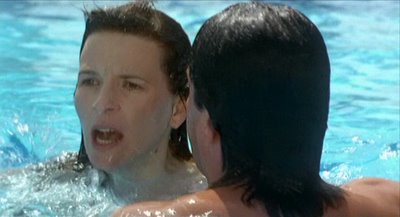
Rather than tracing his characters in a pattern like an interconnected web, taking them from the outside in toward an all-encompassing event or series of events that will tend to define them, Haneke, in Code Unknown approaches this central narrative event as if it were the point of impact on a shattered windshield, a center of pulverized glass, and follows the myriad ways in which these people fan out along the cracks toward experiences and destinations that may have been set in motion by that event but may also bear no real relationship to it. It is down these fractured, unpredictable paths that Haneke sets his characters, a strategy which sets the film itself up as a series of fragments, individual scenes not connected by conventional film grammar (dissolves, shock cutting, graphic continuity, etc.) that often begin and end abruptly, either just a moment or two into the significant action, or just a beat or two behind the completion of a thought or an action, separated by a brief moment of darkness. The director often refuses to make the connections between emerging characters and those we’ve already met clear—it may be a minute or two, or more, before we can adequately suss out who this new person is in relation to Jean, or Anne, or Amadou, or other more tangential characters. (At one point Anne is seen attending a funeral, and the moment when the realization hits as to who is being buried is devastating, in large part due to the offhanded way we’ve been made aware of this character’s presence earlier in the film.) Within that period of time when we’re assessing these connections, we’ve been taking in information about the environment and the different ways we’re allowed to see those characters that accrue and augment our understanding. There’s a striking scene, reminiscent of similar visual strategies Haneke uses in Cache, in which Anne is seen addressing an unseen man on a videotape—she becomes increasingly distraught, as it is becomes clear she’s been trapped in a room where she will be killed for the man’s entertainment, and only gradually, while watching Binoche’s magnificent face register an agonizing array of emotion, do we realize she’s auditioning for a suspense thriller.

Race is significant in Code Unknown, too, but the way Haneke integrates the reality of social relations into the mosaic of the film’s “narrative” boldly suggests, as Crash does not, that the viewer may have actually done some independent thinking on the subject before coming upon this film, and thus may be capable of filling in the spaces between glances and body language and intonation, allowing the story to tell itself so much more eloquently. When the police arrive on the scene and begin questioning Jean and Amadou, there’s an immediate resignation on Amadou’s part, a slight recessive quality in his body language, even as he remains confrontational, which says, “I know what’s coming, but I need you to hear me anyway.” Paul Haggis might have had Amadou begin haranguing the officers, Ludacris-style, about how a nigga always gets treated this way, immediately curdling the subtleties at work in the scene into hopeless grandstanding. It’s there in the eyes of the officers too, who must assert their authority while holding their physicality, and their disdain for Amadou as an assertive black man, in check for fear of creating a potentially more volatile situation. Haggis would have made sure Amadou’s girlfriend (who turns out to be white) was also present, so one of the officers could grope her in front of him, thus adding another series of humiliations onto the already loaded scenario.

But what may be even more important about the way Haneke plays the race card is the way that, when the matter of race does shift to the foreground, it may still not be the most significant element being discussed in the scene. Haneke doesn’t dilute the power of any scene by overemphasis, and certainly the one scene in Code Unknown that could be read as an explicit statement on race relations in an integrated city like Paris could just as easily be read, minute to minute, as a bitter comment on class, economics, sexual aggression, sex-based power or simple urban stress. On a Metro ride after a day of looping dialogue for an upcoming film, Anne is confronted by two young men, one of whom, unprovoked, zeroes in on her and begins haranguing her, accusing Anne of disregarding him based on his “common” status (he reveals after a few moments that he is an Arab). Anne quietly endures his increasingly aggressive and suggestive comments, but at the first opportunity she moves down to the end of the car to an empty seat. The young man follows her, sits next to her and continues his campaign of rage, while an older man sitting directly across the row stares straight ahead, clearly disgusted by the young man’s actions but unwilling to get in the middle of the confrontation. Finally, the young man spits in Anne’s face and begins to walk away, and the older man blocks his way and tells him, in Arabic, that he considers the young man an embarrassment. The hostility leaches out of the young man’s posture as he stands staring at the older man for an uncomfortable moment. He then passes out of the frame and presumably heads for the exit. Haneke’s camera holds on the older man, who has returned to his seat, and Anne, who is wiping her face with a handkerchief and trying to maintain her composure. The scene has been quiet just long enough that when the young man, from out of frame, makes a shocking, loud noise before leaving the train car meant only to unnerve both of them, it succeeds all too well. Anne’s reserve has been shattered, and she explodes in tearful sobs, through which she thanks the older man, who, we might guess, has been witness to this kind of behavior before.
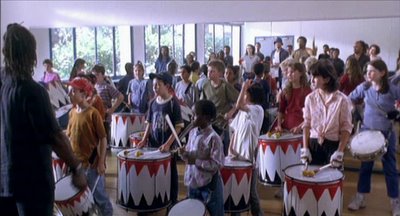
The scene is a brilliant tour de force from Binoche, who creates high point after high point like this throughout the film. In a career full of exceptional performances, this is the very best work I’ve ever seen from her. But it’s Haneke’s triumph as well, as the scene turns out to be the emotional climax of the film, and a more powerful, elliptical way of summing up and addressing the concerns of the entire picture I couldn't imagine— the way the electricity of all these interwoven connections fires on the nerve endings of these characters to create meaning through experience, shared or isolated-- without breaking the code the picture has established for itself and allowing it to slop over into purplish melodrama (like another film I could name). The only thing that keeps me from unreservedly declaring Code Unknown a masterpiece is that it is the first encounter I’ve had with the work of Michael Haneke, and I like to have a little more familiarity, a little more context to drawn upon before bestowing such a judgment. But whether I can declare it a masterpiece or not, it certainly does seem to me the apex of this kind of investigation into the way that people cross amongst each other, how cultures seep into one another, are informed by one another, and how people live and exist and flail and love and create a sense of responsibility, of community, and how some (like Maria) are left out of that picture altogether even as they drift among its signposts. Haneke avoids the kind of haughty disregard for his own characters that crippled Robert Altman’s Short Cuts. (The disastrous decision to excise the Northwest from the stories of Raymond Carver from which Altman stitched his film together, as if to say what was most important about Carver was not his poetry but his plots, did the director no favors either.) And he eschews P.T. Anderson’s penchant for visual overstatement (which I tend not to mind, if it results in a sequence as brilliantly inexplicable and unsettling as Magnolia’s rain of frogs). Haneke can, however, tie an entire disparate bundle of feelings, experiences and implications together with a touch as glancing and moving as the way he ends Code Unknown. A simple shot of a multiracial group of children and adults playing African drums at an outdoor festival, the sound of which carries over and accompanies a kind of visual coda-- Maria, who has returned to Paris, only to find herself homeless and without work again, attempts to land on the same storefront step she was on when we first met her, but is chased off; Anne emerges from the subway and makes her way to the front door of her apartment; her boyfriend, a war photographer, who disappeared without notice to Kabul, reappears, attempts to enter the apartment building but finds the pass code has changed and, upon attempting a phone call, that her phone number has as well; and a final return to a deaf child perhaps interpreting a series of events or other emotions like the ones considered at the beginning of the film, all in body and sign language, for some of us yet another code unknown.

*************************************************************************************

The Code Unknown Blog-a-Thon continues with great pieces on the movie available at the following links:

Aaron at Cinephiliac
David at Drifting
Dipanjan at Dipanjan's Random Muses
Eric at When Canses Were Classeled
Filmbrain at Like Anna Karina's Sweater
Flickhead
Girish
Matt at Esoteric Rabbit
Michael at CultureSpace
Michael Guillen at The Evening Class
Zach at Elusive Lucidity

Girish may have a more recently updated list of participating bloggers available on his post, but I will try to keep this list as current as possible.

*************************************************************************************

(A final note: the domestic Kino Video DVD release of Code Unknown may be one of the worst-looking DVDs of a major film I've ever encountered. For a side-by-side comparison of the Kino region 1 disc and the Artificial Eye region 2 disc-- the difference is shocking-- as well as a detailed explanation as to why the Kino disc looks the way it does, visit our friends at DVD Beaver and see for yourself. It's the best argument for purchasing an all-region DVD player-- which I recently did-- I've seen yet.)

Friday, February 10, 2006

THE MYSTERY OF BIRTH


Jonathan Glazer’s Birth opens with one of the most potent tracking shots in the history of the Steadicam shot. From beyond a darkened screen, we hear a self-described man of science who holds the supernatural in disregard proclaim (to, it will soon become clear, an audience), “If I lost my wife and the next day a little bird appeared on the windowsill, looked me right in the eye and in plain English said, “Sean, it’s me, Anna. I’m back”—What can I say? I guess I’d believe her. Or I’d want to. That’ll have to be the last question. I need to go running before I head home.” Before we can even ask ourselves why it’s important to know about this man’s athletic inclination, the frame fades up out of black, the camera elevated about seven feet above ground and tracking behind a figure in a dark running suit, who we assume to be this same man, contrasted sharply against his surroundings as he jogs across down a snowy path through Central Park. Held aloft by the deceptively light, shimmering flutes expressing the first few passages of Alexandre Desplat’s score, which moves during the film from delight to subliminal disquiet with the ease of a casual brushstroke, the camera, following the runner (and directed by Gus Van Sant’s brilliant cinematographer, Harris Savides), glides along with a forward thrust that will soon come to illustrate, in foreboding comic-sexual visual terms worthy of the finale of North by Northwest, the groundwork on which the rest of the film is built.

The runner, himself cutting a rather phallic figure against the recessive, snow-covered park, moves along a somewhat equally suggestive rock and tree-lined course. His path is soon crossed by a pack of roving dogs that disrupt the continuity and solitude of his run, but his trajectory is never disrupted, and with each moment that the Steadicam take extends in real time the path along which the runner moves from suggestiveness to a more emphatically vaginal quality which complements the consistent (and, as visually imagined, sexually insistent) strength of the jogger. Only a few more seconds pass before the jackpot in this visual strategy is revealed—the upcoming underpass of a small foot bridge, cloaked in shadow and looming in front of the jogger like a waiting lover. The runner (and the camera) pass into the dark recesses of the underpass, and before he emerges out from the other side comes the first cut in the sequence, to a static long shot suddenly from much further down the path. The film’s title card, in that familiarly florid cursive font, appears over the shot, and as it disappears we reestablish the connection with the runner, who now proceeds down the path toward a now-slowly receding Steadicam, the runner’s phallic insistence threatening to assert itself now upon the camera, and the audience, itself. But this time the camera moves only a few feet before it becomes apparent that we are inside another underpass, now awaiting the arrival of the runner. If the first underpass held some visual suggestion of a vaginal destination for the jogger, this new area of darkness along the path, as seen from within, the arch of the bridge fully visible, is far more suggestive of a destination even beyond the immediate pleasures of the vagina—that is, the womblike darkness of the uterine canal. The camera continues to recede into the darkness, the port of light on the other side growing smaller even as the runner re-enters the frame and moves into that darkness, continually silhouetted against the small patch of light at the center of the frame. Suddenly, the runner’s trajectory hitches slightly. He staggers equally slightly, then slows, turns to his right and bends over, obviously stricken and gasping. But it quickly becomes clear that this runner’s condition is far more serious than mere sudden exhaustion. He falls to his knees, becoming lost in the darkness that is so dominant in the frame, and the camera, which has stopped to observe this strange new series of his movements, resumes receding back through the dark. As it begins to finally find its way out the other side, there is a quick lap dissolve back to the inside of this womb—or is it now a tomb—to a close-up of the runner, laying face-down on the ground, dead or dying. Cut to a shot from outside the underpass. The camera has now stopped tracking and instead pulls back in a conventional zoom diagonally across the jogging path, drinking in, even as it pulls away from it, the ominous sight of the bridge and the entrance to the underpass. As yet unbeknownst to anyone, this representation of the womb, a place where life begins, has become the last resting place of the character of Sean, whom we will never see again in this form, but who will propel the rest of the film not through his physical presence, so dominant a factor in the film’s first four minutes, but through his (reincarnated?) spirit. We’re left to recall and ruminate upon the only words we’ve heard Sean speak in the film, and to wonder about what they mean in regard to the shot that finally ends the opening sequence—a cut to the diaphanously rendered image of a newborn baby, as seen through water (are we under water, or is the baby?), perhaps as it is just emerging from its mother into the world. It stretches, gasps for air, and then we realize it is being birthed underwater, and being slowly borne to the surface by the hands of a person (a doctor? a nurse? a father?) whom we will never see. Fade to black, and then to the title card: “Ten Years Later.”

The wonder, the brilliance of Birth is that it completely and satisfyingly, through many virtuoso stylistic sequences to match the one described above, explores a genuinely provocative narrative question. In an inverse of the scenario described by Sean in the otherworldly black of the opening few seconds of the film, is the little boy who presents himself at the doorstep of the soon-to-be-remarried Anna (Nicole Kidman) 10 years after the death of Sean, her first husband, actually who he claims to be— Sean, reincarnated? Or is he merely an incarnation of the real love Anna had for Sean amidst the looming shadow of an upcoming marriage that she seems to think may threaten her memories of what she had with her first husband? Whatever the answer, Birth is hardly, as some of the reviews that turned me off of seeing the film in theaters a year and a half ago suggested, an empty exercise in style— as if style were simply ornamentation to drape over the skeleton of a story, as if style could not, in the right hands, in the hands of an artist, be itself a doorway unto meaning and understanding of the deeper realms in which the story operates. Neither is it a “supernatural thriller,” though it walks the line between representational, logical understanding of its premise and the possibility of supernatural underpinnings far more successfully than did one of its obvious inspirations, Stanley Kubrick’s adaptation of Stephen King’s The Shining.


What Birth is, beside being one of the most unjustly overlooked movies of the new decade, is an exceptional flowering of theme and artistic purpose, from the perspective of its director, Jonathan Glazer (whose only previous film was Sexy Beast, but who has had a major career in music video), and a high point in the acting careers of almost everyone involved, from Danny Huston, to Arliss Howard, to Anne Heche (whose appearance here makes you remember why she was once considered to have such potential), and of course, to Nicole Kidman, who I believe has never been better than she is here, subtly modulating the narrow, self-restricted emotional range of a fragile woman who struggles to maintain disbelief at the same time that she so desperately wants to give over to absolute acceptance of the boy’s outlandish, yet eerily believable claims. (There is a sequence here, an unbroken take focusing on her face as she watches an opera with her fiancé, in which all the building conflict and emotion in her character flits across her face, choreographed to the crescendos and lulls in the dramatic music she’s there to hear, that is as much evidence of Kidman’s talent, so infrequently put to full advantage, as anyone need ever see.) The movie gains strength with each sequence, lending power and emotion to scenes that are staged with absolute clarity of purpose and none of the grandstanding sentimentality that might turn it into, as one writer thoughtlessly claimed, Ghost with pretensions to art and intellect. It’s much easier to write off a movie like Birth with glib, snarky pronouncements like that than it is to engage with the movie on its level and explore some of the questions it asks: What constitutes identity? Is it something innate in us, or is it something projected onto us by others to which we acclimate ourselves, becoming versions of a vision others have of us? The movie is startlingly intelligent; it leaves available enough pieces of the puzzle to satisfy the most literal-minded viewer, yet retains a potent ambiguity that calls into question the rational explanation as well as the fanciful. And even though it’s not backloaded with a Shamaylanian revelation that causes you to back-track and reevaluate all that you’ve seen before, you may find yourself reacting as I did—I was so seduced by the spell the movie cast that I simply did not want the sensation of that spell to go away, so I took a walk around the room, returned to my DVD player, pressed “play” and indulged in the entire movie all over again.

I’ve tried to give a sense here of what kind of visual intelligence is at work in Birth, as well as a hint of the philosophical and cinematic sensibility that makes engaging with its narrative such a rewarding experience, without turning this piece into an exegesis of the questions and strategies of the film that will mean little to anyone who hasn’t seen it. My suggestion, if you haven’t already seen Birth, is this: rent it immediately, and if you find yourself similarly moved, follow my example and head over to 24 Lies A Second, where you can read Robert Cumbow’s extensive analysis of the film. That’s where I’m headed now—I wanted to get some of my own fleeting thoughts down before I allowed Cumbow’s much more detailed consideration to wash over me, giving me food for thought, new ideas, perhaps confirming some of my own, and perhaps even giving me cause for argument, just like all good writing should. (I’m assuming it’s good based on the evidence of Cumbow’s book about Sergio Leone, entitled Once Upon a Time, as well as his excellent piece on Altman and Coppola, also available at 24 Lies. If “Why is This Film Called Birth?” is even half as good as those other two works, those who love Jonathan Glazer’s movie are in for a very good bit of reading indeed.)

2005 CATCH-UP: THREE TWISTS OF THE BIOPIC


LAST DAYS Directed by Gus Van Sant


Gus Van Sant’s Gerry set two characters (both referred to as Gerry, played by Matt Damon and Casey Affleck) on a hypnotically minimalist road to discovery, the thing discovered being their ultimate existential (and physical) dead-end. The troubled, troubling Elephant followed in Gerry’s path, revealing the former to be not a warm-up for the latter Cannes prizewinner, but a stylistically important piece in its own right, and one free of the societal baggage of Elephant’s hot-button subject matter—the murderous impulses lying just below the placid surface of a Portland, Oregon high school-- that ultimately informed and effected that film’s similarly unblinking, long-take style.

In the final piece in Van Sant’s triptych of death, Last Days, shot, as were the other two, by brilliant cinematographer Harris Savides (who is also responsible for the cinematography on display in Birth), there is no movement toward death (Gerry) or examining the environments in which it dwells, sleeping (Elephant). Instead, in chronicling the last days of an irredeemably disconnected rock star (based, obviously enough, on Kurt Cobain), Van Sant makes it clear from the beginning that death’s blanket has already been tossed over the head of his muttering protagonist (Michael Witt), suffocation being not a matter of if but of when. It’s a strategy that at times seems heartbreakingly honest—there is some strange, cold comfort to be had in seeing the musician shuffling about his wooded mansion environs with no appreciable place to go, as if he were swimming freely, and for the first time in his life with some perverse satisfaction, in the churning waters of his own disorientation and muffled sensory perception.

But for all of Van Sant’s haunted tableaux and penetratingly askew sound design (mirroring and mutating the creative impulses soon to be tamped into submission inside the musician’s soul), Last Days ultimately seems the least satisfying of the three aurally-visually experimental features. It substitutes the forward thrust (is “thrust” too strong a word for the languid movement of these films?) of Elephant and Gerry, and Gerry’s openness to the texture and beauty and terror of environment, and to a streak of very dry gallows humor as well, for a very restricted sense of movement—there is no wandering the desert or the halls of a high school here and despite a very tactile and satisfying dive into a nearby creek to lead off the film, Van Sant’s Cobain stand-in has, before the film’s first frame, already been closed off to natural joy or outside influence. He’s incapable of meaningful, or even meaningless connection with other human beings-- there’s a shiveringly funny sequence in which he engages in-- or rather submits to—a presentation by a phone book ad salesman who seems either unaware of unconcerned with just how gone his potential customer really is. He sits across from the salesman in a silk nightgown and tattered fur housecoat, muttering rote responses, not even nodding, until the salesman lets himself out, finally convinced there’s nothing to be gained by continuing the pitch.

But rather than lend sorrow or depth to his last days, the film comes to resemble watching a dying rat as it meanders about in its cage, waiting for it to draw its last breath. There’s perverse interest in that, to be sure, but just as perversely Van Sant has ensured that it does not resonate meaningfully. The director has surrendered to this deadpan observation much of what made the far richer Gerry (a masterpiece) and the flawed, fascinating Elephant interesting, even if taken only as a simple stylistic exercises—the recognizably human element. Last Days is a spectacle of waiting death, with a chipmunk wrapped in night clothes and a furry shroud at its ethereal, hushed center.

CAPOTE Directed by Bennett Miller


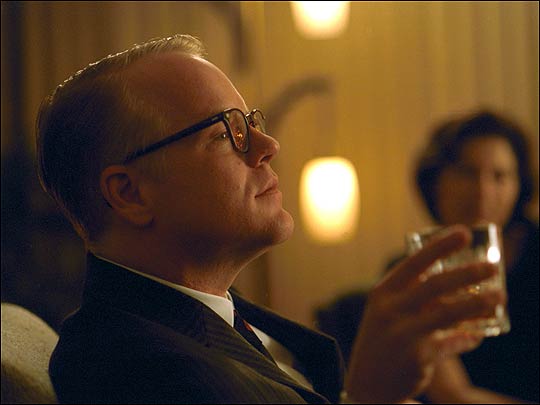
Philip Seymour Hoffman embodies the tic-ridden, ready for TV-panel personality of journalist-author Truman Capote probably better than could ever be expected, and the performance, more successful even than Jamie Foxx’s much lauded embodiment of Ray Charles, moves beyond mere impersonation because Capote isn’t yoked to the first act (humble beginnings)-second act (rise to fame)-third act (crumbling life)-epilogue (set back on the road to redemption) structure of the more routine and typical Ray or this year’s Johnny Cash biopic Walk the Line. In fact, though it has been characterized as one by a press looking for readily acceptable generalizations which with to fuel endless Sunday think pieces, Capote isn’t really a biopic at all. When it begins, Capote, fresh off Breakfast at Tiffany’s, is already enjoying and exploiting his celebrity, holding captive audiences at cocktail parties in sway to his seductively funny, culturally condescending raconteur act. The greatest success of Hoffman’s performance may be that the actor eventually transcends the severe self-consciousness of having to affect that voice and those exaggerated mannerisms, that after a span of about 10 minutes, after only one round of alcohol-spiked anecdotes and wry observations, he forces us to get beyond our own discomfort with that voice and those mannerisms, to fight our natural inclination, so many years after the author’s enshrinement on the talk-show circuit and his death, to look at Capote as anything but a cartoon, a David Frye sketch-in-waiting.

The use to which Capote puts its titular subject, however, is, in its own way, just as routine as those of a biopic’s. The film chronicles Capote’s growing interest (with the help of voice-of-conscience Harper Lee, essayed with equal, far less showy brilliance, by Catherine Keener) in the murders of a Kansas family, the Clutters, and, eventually, in the two drifters, Richard Hickock and Perry Smith, who come to be held, tried and put on death row for those murders. As Capote begins to befriend (and perhaps fall in love with) Smith (subtly, powerfully played by Cliftons Collins), he also initiates writing the “nonfiction novel” account of the case and the killers’ fates which becomes In Cold Blood. He quickly realizes that in order for his book to be completed, Smith and his partner must die. But Capote’s celebrity status and closeness to his subjects may also be contributing to the killers’ repeated stays of execution. Left with a choice of supporting Smith or painfully distancing himself from the killer and (tacitly) refusing to help him with outside legal representation, Capote, with much gnashing of teeth and inner turmoil made readily visible for the art house audience, chooses what’s good for his art and (it is implied) pays with his soul—we’re informed that after finishing In Cold Blood, Capote would never finish another book. Capote is well-written and constructed (by Dan Futterman) and tastefully, if none-too-imaginatively directed (by Bennett Miller), but never with enough of Capote’s true tartness or bitchiness as a personality, or his relentless probing intelligence as a writer to truly elevate the proceedings. We’re left with an entertaining, somewhat overly modulated “true-life” wrinkle on the same kinds of journalistic ethical questions covered many times before, sometimes with much more savvy and sharpness (The Front Page and, especially, His Girl Friday), sometimes with much less (Absence of Malice). I ended up looking at Capote in much the same way I ended up looking at Hoffman’s Capote—with much respect and appreciation, but little enduring spark of interest and investigation, and with few of the kinds of questions that might be inspired by a work of genuine, lasting depth.

GOOD NIGHT, AND GOOD LUCK Directed by George Clooney


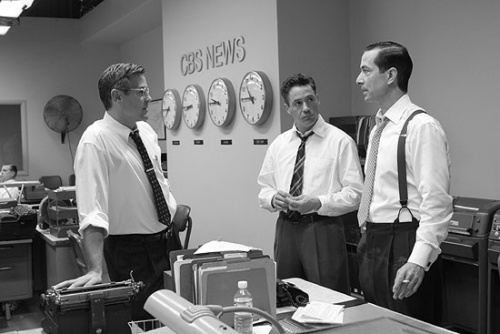
Another historical drama, George Clooney and Grant Heslov’s Good Night, and Good Luck, chronicling the clash between seminal television journalist Edward R. Murrow (David Strathairn) and anti-communist zealot Senator Joseph McCarthy (himself, courtesy of kinescope recordings), is a far more satisfying film, visually and narratively. The screenplay (written by Clooney and Heslov, and directed by Clooney, who also plays CBS News head honcho Fred Friendly) chronicles a chapter in American journalism which has been widely documented, its heroes (Murrow and many others) widely celebrated, its villains (McCarthy, crony Roy Cohn and others) duly vilified. And, strangely, the movie itself is being celebrated in some circles (perhaps the Academy of Motion Picture Arts and Sciences is one of them) for its bravery in “taking on” McCarthyism, as if it were some virulent new political phenomenon. Actually, while dramatically compelling, if the movie were only “about” Murrow and McCarthy, or about the legacy of a broadcasting system that has fallen far from anything resembling the high-mindedness of Murrow’s concerns, it would, at least to me, be still satisfying, simply less so.

Clooney’s facility with the camera (assisted by ace director of photography Robert Elswit, who has rendered the movie all silken black and white and the infinity of shades in between, through a constant haze of cigarette smoke and fluorescent light) and with staging that sometimes approach the Altmanesque is something to be reckoned with-- the nuts and bolts of what happened to lay the groundwork for these two towering figures of recent American history coming to figurative blows is, after all, riveting stuff and Clooney's craft is well applied to it. But on the surface the movie might be just a little too self-contained; while it never really indulges in it to a degree approaching irritation, there is a whiff of self-satisfaction about this group of filmmakers who would seek cultural applause for “taking on” the House Un-American Activities Committee. What really makes Clooney’s movie fly, however, is his admirable insistence on the parallels between McCarthy’s government of political suppression, of guilt by association, of bulldozing machismo aggression, all gilded by a “If you’re not with us, you’re against us” sensibility, and the current administration’s swaggering truck with all of the above. It is one thing for a history lesson to ultimately say that, without vigilance, history may end up repeating itself. Clooney girds his fascinating dramatic entertainment by asserting that history has repeated itself, and wondering aloud whether there’s anyone, in broadcasting or in the general citizenry, willing to try to shake the foundations of an administration ostensibly constructed on moral certitude that has since revealed its own self-righteous belligerence and disregard for simple truth. The hopefulness, and the weariness, of Murrow’s signature “Good night, and good luck” thus becomes a haunting refrain indeed.

Friday, February 03, 2006

THE OFFICIAL SLIFR WEEKEND READING LIST


One of my favorite winter memories of growing up is finding the time on a snowy Saturday afternoon to get settled next to a cracklin’ wood stove, near a window, of course, and gathering up enough reading material—books, magazines, comics, newspapers, whatever—to get me all the way to Sunday evening if need be-- and if I happened to be near enough sympathetic folks who would actually let me be. These were not antisocial moments, just necessary ones, oases of respite, times to let the engines wind down before jetting off on another transcontinental flight plan. Funny how I always cherished those moments when I was a kid, imagining my immediate need for them be all-encompassing, because now, as a grown-up, those moments come few and far between, and I cherish them even more. What’s more, being here in Los Angeles, not only do I rarely get the time to set aside for specifically for reading, there’s absolutely no chance to do it on a snowy day, or even a day cold enough to require lighting a fire. And even if there were, at this point in my life I’d be more likely to settle into that chair, take one look through that window at the weather, close my book and fall asleep.

That said, despite Punxsutawney Phil’s fair-weather warning, something about the approaching weekend compels me to gather up under a blanket with some good reading material. It’s unclear whether I’ll actually get to hunker down or not, but even if I don’t I can at least share what I have in mind. I’ve got Philip Roth’s The Plot Against America just waiting for its spine to be cracked, but there are three other books in line ahead of it: Sarah Vowell’s Assassination Vacation, Bruce Campbell’s Make Love the Bruce Campbell Way and the one I’m most looking forward to, Mary Roach’s Spook: Science Approaches the Afterlife, a follow-up to her fascinating, funny, and gratifyingly serious investigation Stiff: The Curious Lives of Human Cadavers. Congratulations, you say, and thanks for your library list. What good does that do me, Your Gentle Reader?

Well, how about these links? I’m going to be clicking on them like mad this weekend, and I (virtually) guarantee your satisfaction if you choose to do the same.

**********************************************************************
Via our friends at GreenCine Daily comes a recommendation from the online magazine Rouge, a piece by Thom Andersen (Los Angeles Plays Itself) considering the ‘60s films of Andy Warhol called ”The ‘60s Without Compromise: Watching Warhol’s Films.” It begins, tantalizingly:

“The first Andy Warhol movie I saw was Sleep. It was June 1964 at the Cinema Theater on Western Avenue in Los Angeles, the birthplace of Midnight Movies. Sleep didn’t begin at midnight, it began around 6.45pm. It’s a long movie, as I recall, it ended around 12.30am. There were about five hundred people in the theatre when the film began; there were about ten left when the movie ended. I was one of them, although I didn’t watch the whole movie: after four hours or so, I slipped out for a snack at the coffee shop around the corner.

Mike Getz, the theatre manager and programmer, sent a slightly misleading account of the screening to Jonas Mekas, who printed it in his ‘Movie Journal’ column in the
Village Voice. Getz described something close to a riot in the lobby of the theater that began only a few minutes after the start of the film. I had noticed that most of the audience had left during the first half-hour, and I could hear from inside the quiet auditorium that something was going on in the lobby. So I got up and checked it out. The lobby was jammed with people, almost all of them screaming at Mike Getz. They all wanted their money back, and he was resisting. There was a sign on the box office window announcing there would be no refunds, and, according to Getz in his letter to Mekas, he told people:

‘... you knew you were going to see something strange, unusual, daring, that lasted six hours ... I believe that
Sleep was properly advertised. I said in my ads that it was an unusual six-hour movie. You came here knowing that you were going to see something unusual about sleep and I think you are.’

What his account left out is the ad line that brought five hundred people to watch
Sleep: ‘A film so unusual it may never be shown again.’”


**********************************************************************

I often really enjoy the challenge of reading intelligent criticism about films that I revere or that hold a special place in my heart. Roger Corman’s The Premature Burial isn’t by any means a great film, and often it doesn’t even seem like a very good one, but as a key film in my developing appreciation of the horror genre it’s one that I value, and one that I value going back to once in a while. So it was an exciting exercise to encounter Jason Woloski’s fine piece on the film at Not Coming to a Theater Near You, as well as a simple rare opportunity to read a reasoned, non-snarky critique of the film. The entire Not Coming site, if you haven’t discovered it yet for yourself, is a treasure trove of good writing on an astonishing assortment of worthwhile titles. Once you click, be prepared to stay awhile. Here’s just a taste:

”If Corman did not feel comfortable adopting Poe’s restrained approach to storytelling for his own telling, he would have done well to recognize that when complicating material that’s inherently frightening, it is best to emphasize themes surrounding the topic that the viewer may already be aware of, even unconsciously, as opposed to bulking a tale up through frivolous addition and renovation. In preparing a screenplay for an adaptation of Poe’s tale, the fact that a person who’s been buried alive is forced to face their most basic limitations as a corporeal being should not have been overlooked. Besides the pragmatic fears involved in being ensnared by total darkness with little prospect of being saved, namely a fear of enclosed spaces, of losing control, and of certain death, Corman’s screenwriters could have also examined some of the subtler, but no less relevant, rationales that likely emerge in a person’s mind when they have been buried alive.”

*************************************************************************************

Filmbrain, the excellent film blogger who heads up Like Anna Karina’s Sweater, has posted an essential early look at a movie that’s arriving in March in some larger markets, Asia Argento’s second directorial effort, The Heart Is Deceitful Above All Things. Filmbrain got hold of a Dutch DVD and is none too sparing in his assessment of a film based upon material purported to be “true”—a memoir of physical and sexual child abuse-- that has since been exposed as a pack of lies. Filmbrain even pauses to wonder quite plausibly, in consideration of the timeline of the source material’s exposure as falsehood, whether director Argento might not have known, even as she was filming it, that her movie was based not on a fictionalized truth, but indeed pure fiction, and raises some serious questions about her motives:

”There's a self-congratulatory air throughout the whole film, as if Argento is continually reminding us how brave and understanding she is by bringing LeRoy's story to the screen... If Todd Solondz and Gregg Araki went on a three-day crystal meth bender in a locked room with a typewriter, they wouldn't come up with material this vile.”

I’m not generally in favor of passing judgment before the fact, so I will not do so regarding Argento’s film. But I appreciate Filmbrain’s honesty in considering a movie which could very well end up getting positive reviews from a certain segment of the critical establishment and not worrying about whether he falls in line with those points of view. And, as I said in the comments section of his Deceitful post, I feel like Filmbrain took one for the team here. I’m sorry he had to endure it, but I’m very grateful to him that now I will not.

*************************************************************************************

Tangentially related, and more relevant to certain tastes of mine which border on the indefensible, is David Edelstein’s recent piece under his new banner at New York magazine, entitled ”Now Playing At Your Local Multiplex: Torture Porn”, which asks, in Edelstein’s familiar, casually brilliant manner, “Why has America gone nuts for blood, guts and sadism?” This isn’t a Medvedian call to arms or anything like that—the writer has had a long love affair with horror films, and he even likes Hostel, sort of—but instead a genuinely interested, interesting, and only slightly alarmed consideration of the difference between Tobe Hooper’s The Texas Chain Saw Massacre and, say, Rob Zombie’s The Devil’s Rejects or, even more to the point, Gaspar Noe’s Irreversible, and how audiences and films got to this point.

*************************************************************************************
My friend Peter Gelderblom at 24 Lies a Second has been prodding me for months to catch up with Jonathan Glazer’s Birth. Peet has been rather insistent because of his unbridled enthusiasm for the film, and because his site recently unveiled a brand-new article by 24 Lies contributor Robert C. Cumbow entitled ”Why Is This Film Called Birth?” that he very much wanted me to read. (Mr. Cumbow is also an expert on the films of Sergio Leone who has published a book on the director entitled Once Upon A Time, which will soon be reissued in a brand-new edition.) I promised Peet I wouldn’t read the piece until after I’d seen the movie and that I would put it atop my Netflix queue. This past Wednesday I finally got a chance to sit down with the movie. To say I loved it would be an understatement—it’s the first time in recent memory that I’ve finished watching a film, took a walk around the room, then sat down, pressed “play” and watched it again from beginning to end. I want to write a little bit about the film myself before I tackle Mr. Cumbow’s prodigious piece of work. Peet assures me that it’ll be worth the wait, and I believe him. Thus, I have no qualms directing those of you already familiar with Glazer’s brilliant movie to 24 Lies for what promises to be a fascinating entertaining exegesis of one of this decade’s most unfairly ignored movies. I’m annoyed as hell that I let some pretty good writers talk me out of seeing this one in the theater, but am exceedingly glad to have been directed back to it by Mssrs. Gelderblom and Cumbow, and I am glad to pass that recommendation on to you now. Look for some words from me on Birth next week, if only because I’m dying to read Cumbow's piece myself!

*************************************************************************************

Peet also just returned from the Rotterdam Film Festival, where he saw the new Takashi Miike film. He wrote about it with great enthusiasm on the 24 Lies forum and sent the comments to me in an e-mail recently:

”I just came back from seeing Takashi Miike’s new film The Great Tokai War at the Rotterdam Film Festival. I knew nothing about this movie going in, and, boy, was I in for a treat! It turned out to be something akin to Japan’s answer to the Harry Potter or Narnia series. You know: Miike, for kids!

Apparently, for the first time in his career, Miike was handed a big-ass budget, and the cult-favorite made sure it showed. This film is massive in scale, as well as quirky as hell and full of the perversities and black humor Miike is known for. For a supposed "family film" it is way too extreme for Western taste (mine anyway: I wouldn’t let my oldest son see it until he’s, like, 11 or 12). But it kicks serious ass! In fact,
The Chronicles of Narnia is the undercooked egg The Great Yokai War swallows whole for breakfast!

You won’t hear me declare it a masterpiece. To tell the truth, I don’t know what the hell it is. Something I’ve never seen before, that’s for sure. Miike’s cinema is just too plain weird to satisfy in any conventional manner. This guy re-invented the word “subversive.” Kiddie movie or not,
Yokai War goes from gory body-horror to intimate drama, from absurd parody to epic Grand Guignol fantasy, from kinky science fiction to all-out slapstick. It features legions of Asian folktale goblins, the coolest robots I’ve ever seen, and two very sensual female characters young enough to make me uncomfortable to be aroused by. I can imagine Miike envisioning the film with his team of CGI-animators, discarding all tired Hollywood methods and pushing them in every direction his mind could think of. (For those who have seen Audition and Gozu, that should mean something.)

Think Miyazaki, but live-action, with a slightly fetishistic sensibility. Just a few references that popped in my mind while looking at the film:
Spirited Away, Howl’s Moving Castle, The Wizard of Oz, Nightbreed, Blade Runner, Akira, The Neverending Story, Metropolis, Labyrinth, Godzilla, The Terminator, Kung Fu Hustle, Lord of the Rings-- all filtered through the prism of the mad filmic genius of our lifetime.

Phew!”


For further investigation of The Great Yokai War, Twitch has English-language trailers and an announcement about how you can purchase the HK DVD, as well as reports from the Toronto and, yes, the Rotterdam film festivals.

And as if that weren’t enough Gelderblom, check out the keen new banner he recently designed for the essential Brian De Palma Web site De Palma a la Mod.

(Thanks, Peet!)

*************************************************************************************

The recent Showgirls Blog-A-Thon was such a success that it looks to become a regular feature amongst some of us in the blogosphere. On tap for next week, Monday, February 13, is a festival of pieces considering Michael Haneke’s Code Unknown, which will be my first encounter with the director’s work (I’ve also got Cache and Funny Games lined up for some context). My article will be posted that Monday, along with pieces from at least 10 or 12 others, and the list could be growing as we speak. If you’re a film blogger and want to participate, or just want more details, you can get ‘em from the ones that started all these shenanigans, Girish and Flickhead. Rumor has it that March will be devoted to not one, but any one or more of the films of Abel Ferrara. Now, that sounds like a party…

*************************************************************************************

Speaking of Flickhead, he’s got a terrific reminiscence about San Francisco’s Strand Theater that was an act of pleasurably voyeuristic nostalgia for me—I’ve never been to the Strand, but Flickhead not only made me feel as if I had, he tells a couple of really good stories about some of the films he saw when he used to frequent the palace, around the time (1978) that Philip Kaufman was in the city shooting his remake of Invasion of the Body Snatchers.

And for total immersion in the cinemas, old and new, revival, retro and festival, please do not miss what Brian has to offer at Hell on Frisco Bay. He’s got direct links to a multitude of Bay Area cinemas, and the site is an invaluable way of keeping up to date on the struggles of the city’s cinemas to stay alive in the age of the multiplex, as well as keeping a finger on the pulse of the city’s vibrant festival and special screening circuit. I’ve said it before, and I’ll say it again-- Hell on Frisco Bay makes me feel unusually connected to the City by the Bay, and it daily points up reasons why, in addition to San Francisco being where my best friend resides, I’d want to live there. (If only it weren’t also where those damn Giants call home…)

*************************************************************************************

Finally, just for fun, if you’re feeling cinematically frisky try your hand at “The Last Picture Game Show,” updated with fresh, new challenges each Monday for those who feel on top of their powers of visual observation and movie recall. I don’t think I’ve ever gotten it completely right. But, strangely, I try it every week…

*************************************************************************************

Have a good weekend, everybody, all hunkered down under that blanket, whether at your computer or (in a dream life, anyway) sitting beside a warm stove and a cool window onto a snowbound world, catching up on your reading. Coming soon, Birth, Robert Altman, that long-rumored baseball movies article, the answers to Professor Brainerd’s Christmas Vacation Quiz, Michael Haneke, and a whole lot more. I leave you with this for now:

Wednesday, February 01, 2006

CHEWING THE FAT OVER THE OSCAR NOMINATIONS


So, where were we?

First of all, it's time to measure up my guesses against the reality of expensive Oscar campaigns and a season of glad-handing and self-promotion that can only now really kick into high gear.

In the Best Picture and Best Actor categories, I resisted the temptation to let my instincts get the best of me (as they often do in the annual office Oscar pool), thus avoiding embarrassment by leaving A History of Violence and Jeff Daniels (The Squid and the Whale) on the sidelines. In both of those categories I went a stunning five for five, which either makes me a prognosticator of Nostradamian proportions or, as is more likely, a whole lot closer to the mindset of the mainstream Academy voter than I would ever care to admit (I believe it was the philosopher Frederic "Chef" Forrest who once said, of navigating the mainstream, never get out the boat. Absolutely goddamn right.)

I took minor cuts and abrasions in the Best Actor and Actress categories, but still ended up looking okay, my Oscar cred still reasonably intact. As my daughters would say, kudos, kiddo, for correctly guessing Keira Knightley, not exactly a sure thing, and Dame Judi Dench and Felicity Huffman, exclusive representatives of Harvey Weinstein this year. Knightley is poised to become perennial Oscar royalty on the order of Winona Ryder (didn't she used to be Oscar royalty?) or Kate Winslet just by scoring this nomination. And Huffman was, in fact, pretty much a lock, given the kind of notices and buzz she seems to be generating. But, of course, Reese Witherspoon is the lock, the key, the whole treasure chest. It will be an upset on the scale of Truman-Dewey if anyone else steps up into the limelight to pick up the Best Actress trophy.

Which brings us to my one miscue here. I really thought that, by considering the pallid box office returns, the mixed-to-scathing reviews, and the actress's own insistently dour self-promotion, as exemplified by the movie's print ad campaign, North Country's Charlize Theron and her chances at a nomination had been effectively scuttled. I figured that "they" (that nebulous bloc of Academy voters who some seem to insist vote with one mind in order to make statements through nominations and ultimate winners, as if the Oscars were a political convention instead of a popularity contest) wouldn't take the bait offered by North Country's glum purposefulness. I figured "they" would see through the coal-smudged visage of Theron, our newest poster girl for dressing down and uglying up in order to snag awards, and reject this blatant bid for glory out of hand. But instead "they" snapped up the bait as eagerly as if Theron had been smeared head-to-toe with Velveeta and willingly perched herself on the golden hook. And in doing so, "they" stole away that fifth slot from Naomi Watts, who, until I finally drifted off to sleep very early this morning, I still hoped would somehow shake off the stigma of working in an effects-heavy blockbuster and get voters to understand the gargantuan act of soulful empathy that was her performance in King Kong. I've found Watts, in the brief time I've been aware of her, to be enchanting and full of comic talent (Mulholland Dr., I (Heart) Huckabees) as often as I have found her strident and shallow (The Ring films, 21 Grams). But she reached unexpected heights of emotional directness as Ann Darrow, and I do believe the movie really would be the routine adventure tale some already claim it is without her light touch (that desperate, but not too desperate, vaudeville dance was inspired) and shot-to-the-heart immediacy.

I teetered slightly in the Best Director category here, going with the historically reliable formula of one nominee in the Picture and Director categories being orphaned, without a matching nomination in the other category that would give it credibility as a contender. Almost without fail in recent Oscar history, Director/Picture would match up in four, and sometimes only three nominees. Then there would be the odd Best Picture nominee(s) whose director(s) was (were) not nominated, or the Best Director nominee who was apparently not good enough in "their" (the Academy's) eyes to warrant a corresponding nod in the Picture category. This is why, even though my Picture guesses were down the line correct, I varied from the pattern in the director category. I figured that "they" would want to honor Munich in some way without giving the film too much credence in the actual horse race. Leaving its director, Steven Spielberg, out of the Director category might be just the way to say "Thanks for the serious work" while not appearing to overtly endorse Spielberg to the voting body, many of who are ticked at the (Jewish) director for suggesting that Israel might actually bear some moral responsibility for the events his film details. I also figured that "they" might want to fill the vacant slot with someone who is universally respected in the industry as an artist among businessman and hacks-- Terence Malick-- whose films are not always universally praised and adored. Well, I was wrong. For the first time since 1981, all five Best Picture nominees had corresponding nominations for their directors. As Marlee Martin recently put it, what the @#&* do I know?

It was in my predictions for the Best Supporting Actor and Actress categories that I took the most significant hits. The inclusion of Catherine Keener, Rachel Weisz, Michelle Williams, George Clooney, Matt Dillon and Paul Giamatti was no big surprise to me. But I admit walking out on a very shaky, brittle branch when I proclaimed from the treetops Diane Keaton's name for her alternately funny and annoyingly affected work as a dying matriarch in the arch, insistently symmetrical and patronizing dramedy The Family Stone. I was, however, clothes-lined by the nonappearance of Maria Bello, who I thought, until I clicked on that Oscar link this morning, was as solid a lock here as Reese Witherspoon was in the Best Actress category. As for Terrence Howard, I admit being influenced by some crystal ball-gazers who assumed he'd pull a Jessica Lange/Jamie Foxx double-header this year. And I just took a wild guess that Donald Sutherland might slip in as one of those supporting performance nominations that seem to materialize out of thin air (think Jim Broadbent and Iris). Jake Gyllenhaal and Amy Adams are well-respected, non-controversial choices, to be sure, and I think Adams has a chance of emerging out of left field as the only serious threat to Rachel Weisz here. But the inclusion of William Hurt's funny/creepy Hopper-esque turn in A History of Violence seems kind of perverse, especially when Maria Bello was overlooked (I know, I know, "their" right hand routinely knows not what "their" left hand is doing), and Frances McDormand seems to have swung a nomination based almost solely on her being well-liked in the industry-- I don't remember anyone singling out her performance in North Country as being anything remotely special.

A few other observations and questions before putting all this to bed until early March:

Brian expressed relief, in discussing the nominations over at The House Next Door, that Chicken Little was excluded from a nomination for Best Animated Film. I would second that and add my own relief over the absence of Robots and Madagascar, two other box-office hits that were clearly not worthy. In fact, this is easily the best group of nominees in the category since its recent inception. I wouldn't balk at any of them winning, though I think that Wallace & Gromit and the Curse of the Were-rabbit ought to, and will.

What happened to Tommy Lee Jones? The 2005 Cannes Film Festival award-winner for best actor in The Three Burials of Melquiades Estrada (which he also directed) came up empty, even as Sony Pictures Classics seemed to be doing all the "right things" to roll the movie out, up its prestige quotient and get it seen by the Academy membership. I have to think that most voters weren't willing to leave their houses and schlep to Beverly Hills for the string of special screenings, and I suspect that those screeners mostly stayed anchored at the bottom of the stack near their recipients' DVD players, because the movie, whether it is or not, seems to have been perceived as a bit of an unpleasant drag. Truly, the time is probably not ripe for a morally righteous riff on Sam Peckinpah's Bring Me the Head of Alfredo Garcia, and maybe there are only a few cinephiles who would find such a project tantalizing anyway (we'll see for sure when the movie officially opens next week). But I would have thought that Jones, a tough cookie who still commands respect in an ADD-addled industry a decade removed from his Oscar-winning glory days in The Fugitive, might have snuck into the Best Actor field despite all this, and had there not been such a plethora of strong choices in that category I still think he could have.

Were there some special circumstances I'm unaware of that prevented Grizzly Man from being nominated in the Best Documentary category, or this just another of those egregious, well-documented examples of the nominating committee being hopelessly (willfully?) out of touch? A look at the films that did get nominated (Darwin's Nightmare, Enron: The Smartest Guys in the Room, March of the Penguins, Murderball and Street Fight) suggests there is definitely a heightened awareness from the days in which films like The Thin Blue Line and Hoop Dreams could go completely unrecognized. But Werner Herzog's film was one of the most highly praised, formally fascinating documentaries to come along in quite some time (though it was nowhere near the box-office hit that Penguins was, nor does it sport the trenchant topicality of Enron). If anyone can enlighten me as to any convoluted Academy regulations that may have prevented Grizzly Man from being honored, I'd sure appreciate it if you would. Otherwise, I'll just have to assume that we're looking at yet another instance of the documentary branch of the Academy dropping a very high-profile ball.

I'd like to think King Kong is a lock in the technical categories, but there seems to be an inexplicable backlash going on in regard to this movie, and as brilliantly effective as Kong's art direction and sound are, supporters of Peter Jackson's movie can probably only really count on his prodigious effects team being recognized with yet another Oscar for Best Visual Effects. Jackson has found a way to humanize special effects in a way that sets him apart from profligate digital tub-thumpers like James Cameron and George Lucas. He-- gasp-- pays attention to the actors, believes they can find and create ways to connect with the vast green-screenery that translates to the audience in real, powerful ways. This belief is at the heart of the effectiveness of teaming Naomi Watts with Andy Serkis as a physical presence on the set for her to play against and with, above and beyond simply providing a template on which to layer the titular CGI beast. And it must be recognized eventually that Jackson's talent as a creator of spectacular action meshes brilliantly with his talent as a director of actors. This is why King Kong deserves to be the fourth Peter Jackson film in as many years to take home the visual effects award. (Would this not be a record of some sort?) As for the much-derided three hour-plus length of the film, I can only say, the movie drags and sags if you perceive it as doing so. One man's bloat is another man's bounty, and even as I was emotionally (and, yes, physically) exhausted by the movie's finish, I simply did not want it to end. Believe me, there are plenty of 90-minute films I couldn't say that about. Jackson's movie isn't out to topple the untopple-able legacy of the 1933 original. Instead, it seeks to expand on that legacy and co-exist with it as spectacular cinema on its own terms. I wish the Academy went a little further in recognizing that.

Okay, it's time for me to put the Oscars to bed until March. (I'll be putting myself to bed as well, but unfortunately I'll be getting back up a whole lot sooner than Oscar Day.) I'll leave you with a link to blogger Edward Copeland, who has an amazing collection of observations and factoids relating directly to this year's slate of Oscar nominees that's up and available for your perusal and amusement on his home page. In fact, Edward would be a very good person to ask about the Grizzly Man problem and that run of special effects wins. Would four years running in victories in the Best Special Effects category be a record, Edward? And do you know, did Herzog or his distributor simply forget to file the proper paperwork in time?