Here come those Santa Ana winds yet again. A question, one among 40 I posed in last month’s Spring 2005 Pop Movie Pop Quiz—“What is the Best L.A. Movie?”— inspired a lot of interesting responses, all of which seemed to be movies that focused on the city’s venality, superficiality or corruption. Those responses got me thinking that although there are movies that throw the spotlight on exactly those same aspects of almost every other major U.S. city, there are also lots of movies that spring to mind, like
Manhattan, Sleepless in Seattle and
Hannah and Her Sisters, that serve as romanticized valentines to their respective metropoli. The question that followed, which I used as the centerpiece to a
piece I wrote two weeks ago, was, essentially, Is there a movie that’s in love with Los Angeles? I wrote there:
“My own capacity to be held by any kind of wonder for what this city has to offer has pretty much been whittled down to the view of the San Gabriel Mountains, and the perfectly green cut of the infield, from a seat on the third base side of Dodger Stadium. I’d like to maybe not exactly believe again, but at least see the city through the eyes of someone who still finds room to be amazed and inspired and swept away by the spectacular sprawl of cars and culture clashes that make up this city of no seasons, where almost everything seems somehow effected by viral corporate groupthink or the venality and superficiality of the movie business. Is there a movie that has as its subject the richness, vibrancy and vitality of life and/or love and/or work in Los Angeles, a movie that glorifies life in this city with even a tenth of the romantic intentions of a movie like Manhattan?
Or do people, and, more aptly, filmmakers, just not see the city that way?”I got several thoughtful, vigorous, impassioned responses to the question. My best friend, Blaaagh, now currently residing in the Bay Area, talked about the Los Angeles experience as someone who used to live here upon revisiting the city:
“The last time I was there, in February of this year, I tooled around the downtown area, where I had a meeting, and enjoyed the drive out to Glendale from downtown, especially going through the old tunnels with their faux-Egyptian look, as if DeMille had commissioned them. It was particularly nice because it had started raining (and hadn't started raining hard yet), so it felt a little Raymond Chandler-esque. I'm a glass-half-full person, but I tend to think of the beautiful places there: Griffith Park; that new Getty museum; the Warner Bros. lot with its for-real tour and evocative stucco buildings; the old Will Rogers house and grounds... Really, someone ought to make a movie that loves L.A.”Thom McGregor, a Los Angeles native who I know particularly well, put forth a theory about why the city doesn’t seem to inspire too much movie love, a theory that I thought was pretty sound:
“I believe a lot of directors/writers come from other cities originally, and once they succeed in Hollywood, they have all these fond memories of their roots, their "peeps," so to speak, and then write/direct their cinematic valentines to their hometowns and people they grew up with. I've lived in L.A. all my life, grown up seeing familiar buildings, streets, backgrounds in almost every movie and TV show I saw (the entire carnival finale of Grease
was filmed on my high school gym field), but it is very hard to think of a movie that was openly in love with the city. L.A. itself is so spread out and varied, it's kind of hard to reconcile South Central and Malibu in real life, much less in the movies. How about episodes of Dragnet
where Jack Webb starts each episode in voice over, giving the current day, time (to the minute) and weather of Los Angeles—‘This is the city.’ THE city.”Friend, fellow blogger and Movie Poop Shoot.com columnist Alison Veneto took her answer and turned it into a post of her own, in which she went beyond my suggestion of a Los Angeles movie as being one “shot in Los Angeles whose locales are integral to the plot, or whose thematic text or subtext is some critical aspect of life or work in this city" to consider what it is that really constitutes an L.A. movie:
“Does it have to be a love letter to the city like 'great NY movies'? I don't think so. I think to figure out what the real LA movie is we have to determine what the real LA story is. And the real LA story is dreams -- shattered or realized. (L.A. is) a mecca for the desperate and the hopeful. And it's not just the Hollywood dream. It's the immigrant's dream. So the real LA stories are movies like Boyz 'N The Hood
(the brother who's going to get out as a football player, following the dream), El Norte
(immigrants who see their dream in Los Angeles) and Singin' In the Rain
(realizing the Hollywood dream). While they represent Black people, Latinos and Caucasians repectively, they still represent the feeling of the city. Even if you are just showing one part of LA and one ethnic group, the dreams are what ties everyone in the city together… The 'best' LA movie, in that it really encompasses what LA is about, is any incarnation of A Star Is Born.
Because that's LA-- someone's going up, someone's going down... dreams being realized and dreams being shattered.”And finally, good friend, constant supporter and regular reader Virgil Hilts, also a native Los Angeleno, took the opportunity to toss out titles, but also to put forth a spirited defense of the city, its achievements and its day-to-day life, as well as throwing a spotlight on a movie that too few seem to remember:
“No matter what anybody believes, Hollywood, and Los Angeles by extension, taught the rest of the world how to make movies just as Henry Ford and Detroit taught the world how to make cars. Ultimately, the movie valentine to LA are the studios themselves-- as (Blaaagh) noted, the great old buildings on the Warners lot, or the Paramount gate-- and the Chinese Theater and the Walk of Fame and the folks selling maps to stars' homes… Does anybody in New York try to sell you a map so you can stand outside of some star's apartment building? Do any of the stars from Chicago still spend their winters there? We hate the freeways, but at least they don't smell like a century's worth of urine like the subways of NYC do after a good rain. It gets hot in LA, but when it gets hot in Chicago, people die, a lot of people. And have you noticed that it keeps happening when they have those heat/humidity waves in the Midwest, and still they laugh at us for drinking bottled water… Although it might be another movie about about corrupt Los Angeles, Devil in a Blue Dress
was every bit as brilliant as L.A. Confidential
, and it was set in parts of the city that few people would recognize as Los Angeles-- not just the suburbs, but the suburbs where postwar African-American vets set down roots. Why is Devil
so easily forgotten? Could it be that black/white thing again?”All these were, I thought, excellent, probing responses to a question that I wasn’t sure even had an answer. But the aspect of receiving and reading them that I enjoyed so much was that each and every one of them threw something into relief for me, as the poser of the original question and as a reader, that expanded the original question and made me reconsider my own preconceptions. And they also brought up titles that, either for reasons of my own lazy, nonexistent research or failure of imagination, I’m ashamed to admit never crossed my mind, and one that did.
Thom McGregor was absolutely right to include
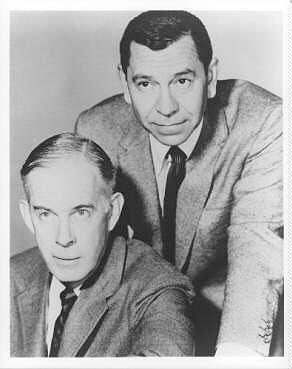
Dragnet, particularly its 1967-70 TV incarnation, among those works that display a distinct vision of Los Angeles. The vision here, however, springs not from a romanticized vision of social utopia, or anything so Hollywood as the mind of, say, a Quinn Martin, but instead from an officially sanctioned representation of the Los Angeles Police Department—their imprimatur and the names of official department consultants, who sometimes appeared in the shows themselves, were stamped on the end credits of every episode. So was the credit “directed by Jack Webb,” who, as teacher/theorist/director Thom Andersen observed in his recent film
Los Angeles Plays Itself (more, much more on this film a bit later), emerged within this series as a formally rigorous stylist— don’t mistake the show’s visual boxiness and robotic dramaturgy as anything but deliberate-- who could stand with Ozu and Bresson in terms of sheer transcendental simplicity.
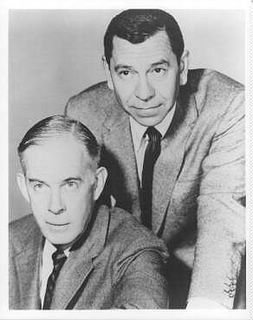
Webb’s mechanized Detective Joe Friday, curt, paranoid and witheringly superior to those he has been commissioned “to protect and serve,” is the Parker–era L.A.P.D’s idealized image of itself, and each speck of minutiae in each episode (Friday: “It took us 12 minutes to drive up the Hollywood Freeway, exit at Vermont Avenue and arrive at the corner of Franklin Avenue and Commonwealth Street, where Mrs. Freeman stood outside her gray stucco apartment building”) is built for police-report verisimilitude and, despite all the fruitcakes and weirdos that comprise the populace, civic pride. This is, as Thom McG correctly points out,
the city, Los Angeles, California, and Webb wastes not a second of the episodes’ 25-minute running time on anything that might distract from his detailed vision of how that city is laid out, how it ought to run, and why it often doesn’t. Webb’s L.A.P.D. is paranoid and distrustful of its public, but what makes
Dragnet distinctive is that neither Webb nor the L.A.P.D. positioned these attitudes as drawbacks, but as elements of necessary detachment, and this perception suffuses the actors’ clipped, deader-than-deadpan delivery and the director’s pared-down, claustrophobic, austere mise-en-scene. It also makes
Dragnet valuable beyond its camp quality— Webb serves up Nixon-era harsh realities and attitudes, and the attendant indulgence in ridiculous stereotyping of anyone who doesn’t dress and sound like Joe Friday, all captured in celluloid amber. The distance of some 35 years has done nothing to dilute the power of their singlemindedness and righteous disdain for the criminal and crackpot element, not to mention the impatience and condescension left in reserve for the general citizenry.
Dragnet may be one of the best documents we have of Los Angeles, both geographically speaking, and in terms of its almost insider’s view of the philosophy of a police department that had not yet scaled the heights of its own paranoia and self-intoxication.
Now on to the titles of which, shockingly, I had to be reminded.
Fast Times at Ridgemont High (1982) has to be considered one of the premier Los Angeles movies, not only for its reflection of a specifically Southern California high school milieu that, as it turned out, was a hell of a lot more generally recognizable everywhere else in the country than could have been anticipated, but because it itself perpetuated fashion trends (the popularity of Vans tennis shoes), other movies (
Valley Girl, The Wild Life) and even music (Frank Zappa’s satirical top-40 hit "Valley Girl") that would help to define a dominant strain of pop culture of the ‘80s.

There’s even a certain amount of romanticism for the teen mall culture in director Amy Heckerling’s approach, mixed in with a clear-eyed view of teenage sexuality and fumbling romantic mores, that is as evocative in its details as that of cruising the streets of 1963 Modesto in George Lucas’
American Graffiti.
And Quentin Tarantino’s adaptation of Elmore Leonard’s
Rum Punch, which the director rechristened
Jackie Brown (1997), is in one aspect another geographically brilliant mall movie—the movie’s last third is an elaborate con staged at the Del Amo Fashion Center seen in its entirety from three separate points of view, thus highlighting not only different aspects of the job, but also different aspects of what, to a casual observer, might appear to be just a typical, overly recognizable shopping space.

But Tarantino’s movie (his finest, in my estimation) shows the same sensitivity to all of its locales, largely those situated in the city’s South Bay area, a flat, arguably nondescript section of Los Angeles that is neither expensive beachfront or Hollywood Hills familiar, nor populated with gleaming skyscrapers of the kind frequently documented in the Los Angeles downtown cityscape (the wild car chase in the original
Gone in 60 Seconds served as a virtual tour of this same area, circa 1974).
Another part of the city that has been largely ignored by the movies, either as location or history, is the vital and bustling Central Street of Walter Moseley’s Easy Rawlins novels, vividly brought to the screen in Carl Franklin’s
Devil in a Blue Dress (1995). The set designers recreated the jazz clubs of this downtown district, an area vibrating with promise for African-American veterans of World War II, and the neighborhoods just south of downtown where these vets could find affordable, good-quality housing when they returned from service, in a completely believable, lived-in fashion.
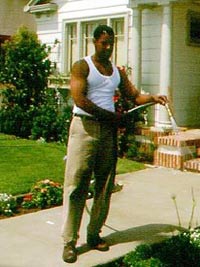
The movie, in addition to being a crackling good noir yarn, as Virgil suggests, on the order of
L.A. Confidential, serves as a reminder, or perhaps a fresh bulletin to those who only perceive those neighborhoods now as urban war zones (a perception reinforced with plenty of help from local and nationwide media, and, of course, the movies). South Central Los Angeles was once a place where the reigning feeling was hope for the future, a part of the city that may have evolved for African-Americans essentially segregated from the dominant, white socioeconomic and geographical culture and substructures, but a place nonetheless where happiness could be pursued and life could be lived. That bleak undercurrents of desperation exist for Moseley’s Rawlins, as depicted by director Franklin and star Denzel Washington, does nothing to dampen the spirit by which
Devil in a Blue Dress has been cinematically realized; those undercurrents are magnified by the dimension of reality brought forth by the film’s characters, which, in turn, the realistically elaborate sets help to expand to fuller expression, for once, rather than to serve merely as an inadvertent means of smothering fertile performers amidst all the pretty sights.
Three other visions of a romantized Los Angeles of the past are just as interesting, and evocative, in their own way. Hal Ashby’s
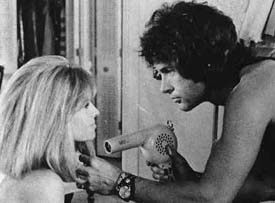
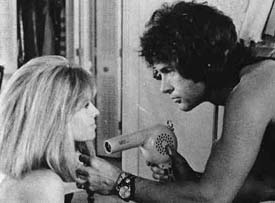
Shampoo (1975), set in Beverly Hills in the days just before Richard Nixon was first elected to the presidency in 1968, is a precise and deeply felt comedy of vacuity and swinging sexuality as the State of the City.
But it cuts far deeper than might a shallow parade of stereotypes masquerading as tribute (
L.A. Story) because it allows for a vision of characters, and by extension the city, teetering on the brink of disillusionment, about to enter an era where the party could only go on by acknowledgment, however fleeting, of the existence of a much bleaker social landscape beyond the swaying palms.
The decaying milieu of Hollywood’s underbelly circa 1955-- desperate characters with plenty of zeal but little talent and the ghastly movies they made-- is highlighted in Tim Burton’s delightfully cracked “biopic” of the man commonly thought to be the worst film director ever,
Ed Wood (1994).
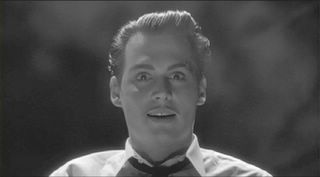
The movie isn’t much interested in whether there’s any truth to this conventional wisdom— Burton obviously recognizes that Wood’s “vision” is definitely on a par with his fumbling ability to realize it, but I’d bet he could think of several directors who could be considered worse; I know I can. But I think this movie might have to be included on a list of great Los Angeles movies simply because of its nonjudgmental and, yes, romanticized view of Wood and his stock company of friends and assorted show business cast-offs, and their own pie-eyed infatuation with their personal vision of Hollywood, bitter realities, shimmering fantasies and all. Any movie that could make me pine for companionship with the kinds of marginalized, cluelessly enthusiastic tinseltown characters that Ed Wood celebrates must understand something profound about survival and desire, and friendship, in the movie business, and by the extension the city for which that business is so central.
Finally, I’m thankful to Virgil for mentioning a movie I most certainly should have thought to highlight, a movie that has a spot on my list of all-time favorites, a movie that ended up influencing my own bejewelled fantasies of Los Angeles in the days before I ever set eyes on the city myself. Steven Spielberg’s unjustly maligned
1941 (1979) is a comedy which makes fun of American paranoia and hysteria in the early days of our involvement in World War II, and it does so in a manner which many of its detractors decided was itself hysterical, and bloated and sloppy and undisciplined. I humbly submit my disagreement.
There are set pieces within this gigantic movie that can stand with the director’s funniest, most nimble work-- I’m thinking here of the entirety of
Jaws and
Duel, as well as parts of
E.T. and the stunning musical number/action sequence that opens the otherwise shrill and overwrought
Indiana Jones and the Temple of Doom. And the whole of
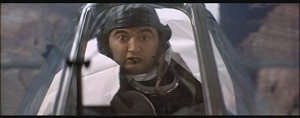
1941, despite the broad pitch of most of its humor, is far more graceful and expansive than its reputation suggests. Its overwhelming night vistas of a sprawling Los Angeles, as seen from the hills over which passes a fighter plane (piloted by John Belushi’s Wild Bill Kelso) on its way to a date with destruction along Hollywood Boulevard, belie a fascination with the cityscape that informs the film’s every falsified depiction of famous Los Angeles locales. These vistas, despite actually being only miniature model layouts of the city, capture the optimistic infatuation of Americans for their homeland during this wartime, and they are vibrant and alive. They give truth to Roman Polanski’s famous assertion that there is no more beautiful city in the world than Los Angeles, provided it’s seen at night and from a distance. But even up close, in
1941, the city lives up to the glittering promise of those city lights. The views of a partially blacked-out Santa Monica, from off the coast as well as from inside an abandoned amusement park, are velvety and rich and funny, as is the brilliantly reconstructed Hollywood Boulevard that serves as the site for the movie’s spectacular dogfight sequence. But I’m also thinking about scenes like the sensual, eerie stillness (which, naturally, erupts into mayhem) in which Spielberg stages Wild Bill’s moonlit meeting with a crazed general (Warren Oates) who has stationed himself and his remaining troops somewhere in the fields outside of Pomona, awaiting an imagined Japanese air attack. Scenes like these, and the dogfight, and almost every other sequence in the picture, have nothing of “reality” to represent as far as the existing city—they are exclusively the creations of brilliant technicians working for a director who became convinced that his movie was careening out of control. But the resultant imagery, rooted in fantasy though it may be, serves to construct an alternate vision of Los Angeles’s past that may have nothing to do with geographical and architectural reality, but that is every bit as evocative and intricately detailed as MGM’s Oz— it comes together in your head (or at least mine) as a uniform realization of how Los Angeles might have been, a city population every bit as off their nut as the hippies and freaks of Jack Webb’s
Dragnet, sans all that gaseous condescension, placed amidst settings as fantastical and idealized as Webb’s were unadorned and matter-of-fact.
1941 directs its barbs at the lunacy of Americans overreacting to misperceived threats (usually unwittingly generated by their own populace) and obliviously underreacting (with the exception of Ned Beatty’s character, of course) to the real Japanese sub floating just off the Santa Monica shore. But it has nothing but love and spectacular eyes for Los Angeles.
All this, and I’m really only at the halfway point of where I wanted to be for this post. I’ll have to leave part two for tomorrow night. But before I stop, I just want to go back to what I wrote in my previous entry. Coming from a place of my own disillusionment with everyday life in this city-- its struggles, its frustrations, its inordinate expenses, its hostilities, its detachment— I wrote:
“I’d like to maybe not exactly believe again, but at least see the city through the eyes of someone who still finds room to be amazed and inspired and swept away by the spectacular sprawl of cars and culture clashes that make up this city of no seasons, where almost everything seems somehow effected by viral corporate groupthink or the venality and superficiality of the movie business.”Of course what I had in mind was a narrative film that might encompass such a wide-ranging vision, but what became quickly apparent was that there probably was no one such beast. To stitch together a vision of what Los Angeles means, how all its many cultures survive together and bash up against one another, you would have to look at a broad range of films, as broad as the city’s geography and the origins of its multiethnic populace, and try to see the city the way the movies have seen it. And no sooner than I realized what I was really talking about, I opened up last week’s
Los Angeles Times “Weekend” section and saw that Thom Andersen’s
Los Angeles Plays Itself (2002) would be screening at the American Cinematheque Egyptian Theater through Tuesday, May 10. Andersen’s movie, a spectacular attempt to grapple with nearly 100 years of film history as it pertains to images and perceptions of Los Angeles in films, had screened almost everywhere BUT Los Angeles before this past weekend, and every impulse told me this was an opportunity I really couldn’t afford to pass up, especially given the back and forth on this blog over the last month or so.
Well, against all odds, I managed to get a ticket, and Tuesday night, the last night of its brief run, I made my way to the Egyptian, and for three hours I was enthralled.
Los Angeles Plays Itself turned out to be the answer I was looking for, the most compelling and entertaining and masterful piece of documentary film criticism I can ever remember seeing, and I’ll take some time to detail more about the movie and my experience with it in my next post-- it’s getting much too late to start writing about it, because I wouldn’t be able to even begin to do it justice before the sands of sleep started interfering with my ability to hit the proper keys on my laptop. Tune in tomorrow, same bat time, same bat channel.
One thing that I do want to make you aware of, though, is that apparently the Cinematheque’s presentation of
Los Angeles Plays Itself was so successful in terms of patronage that this past Tuesday night was, in fact, NOT the end of the movie’s engagement here in Los Angeles. The Cinematheque has extended the movie’s run. A quick click to their
web site will give you all the information you need to know about upcoming weekend screenings on May 14, 15, 20, 21 and 22. Before I say another word about this film, just know that if you have a love for movies, Los Angeles, or both, it is worth any and all effort it will take from you, outside of something really absurd like purchasing plane fare, to arrive at the Egyptian Theater for one of these screenings. No DVD release has yet been announced, and the movie’s low-tech usage of film clips, sans the requisite clearances, may be too big a hurdle for it to clear in order to make it to your home theater, so this extended engagement may be the only chance for Los Angeles residents to see this remarkable work. At the risk of sounding a bit too Siskelian, I can’t imagine seeing a more fascinating, stimulating film all year, and I look forward to talking about it next time. Is there a movie that is in love with Los Angeles? Yes. That movie is Thom Andersen’s
Los Angeles Plays Itself.


 Posts
Posts