Wednesday, April 06, 2016

CLOUDS OF SILS MARIA (2015)


How did I miss the boat on Clouds of Sils Maria (2015) so completely last year? I suppose I liked it well enough when I first saw it, but I also remember feeling impatient with it, dare I say slightly bored, and I never connected with it emotionally. That detachment extended to the rapturous praise I heard coming from most of the smart, articulate people I knew who loved it-- what they said made sense, but it didn't resonate with my experience of the film. My admiration for Clouds remained largely intellectual, and I certainly didn’t rank it among the best of the films of Olivier Assayas that I’ve seen—to my mind it was no Summer Hours, or Irma Vep, or Carlos, or even Demonlover.

So here I am, head in hands after having seen it a second time, disbelieving that I was so blocked off from this movie as to not key into the magnificently understated, exquisitely played push-pull between Juliette Binoche’s aging actress and Kristen Stewart, never better, more empathetic, more sensitive, as her personal assistant. Stewart, following Binoche on a European swing to pay tribute to, and then unexpectedly eulogize the playwright who wrote her first major part, becomes increasing impatient with her boss’s reluctance to understand and accept the new role she has just agreed to play. Against her instincts, Binoche has been cajoled into revisiting that first great stage triumph, only this time playing the older, “defeated” woman in an office-bound tragedy instead of the ingénue role, that of a determined woman whose romantic rejection drives her boss/lover to suicide, the role that brought Binoche to stardom.

The melodrama of the play’s situation is contrasted with the relationship between Binoche and Stewart, but as potentially trite as that paralleling sounds, the scenes of these two seemingly disparate actresses running lines from the play, in which the borders between reality and artifice, acted emotion and real emotion, objective truth and subjective fear are so delicately blurred that we remain exquisitely off-balance, are modulated with such surety that we’re never sure which character, written or flesh, is speaking at any given time. 

Matters are complicated when we meet Chloe Grace Moretz as the Lindsay Lohan-esque Hollywood starlet who is to assume the role that made Binoche famous. Moretz tilts the balance between actresses from emotional investment to a detached willingness to get dirty at play in the fields of Internet scandal, and her Eve Harrington moment, as understated as anything that transpired between Binoche and Stewart, is even more chilling for its clinical deposing of Binoche with a smile, and in her mentor’s preferred milieu, the glassy confines of the play’s London set.

Writer-director Olivier Assayas is so confident that he constructs his lovely, emotionally challenging narrative around a metaphor that remains opaque-- the Maloja snake, a drift of clouds that moves through the valleys of a section of the Swiss Alps like an untouchable serpent, which is never assigned definition beyond that of its status of a natural warning of bad weather to come, despite the mystical visual beauty with which it permeates the dramatic essence of the director’s approach. One of the most haunting images of abandonment I can think of is the moment when Binoche, with Stewart trailing close behind, descends into a small valley on the way to witness the formation of the Maloja snake at the culmination of an early morning hike. Assayas and his cinematographer, Yorick Le Saux, shoot the two women’s approach head on, with a long lens, so that when they disappear from our view they seem to have been absorbed into the landscape of the mountain itself. After a moment we see Binoche appear over the rise and pass by the camera, which lingers, waiting for her companion who, before the image cuts away, never appears. It takes Binoche several moments, chattering about the nascent formation of the snake she sees before her, to realize that suddenly she’s alone.

Clouds of Sils Maria is a gorgeous movie, awash in sadness and insecurity and the fear that accompanies subsuming one’s own personality to that of an author’s imagination, and it represents this filmmaker at his peak. Shame on me for not recognizing it more the first time around.

************************************

Friday, April 01, 2016

SECRET MOVIES: FLICKER


Seeing Edgar G. Ulmer’s The Black Cat (1934) again recently, my appetite was whetted to re-read Theodore Roszak’s Flicker, which uses Ulmer’s strange career as a master stylist exiled to a career toiling in B-movie obscurity as a jumping-off point for a sinister story engorged with a decadent and whispered history of movies. Three years ago I was commissioned to write about Flicker for writer Bill Ryan’s annual October consideration of horror at his great blog The Kind of Face You Hate. I had to admit, I never really thought of Flicker as a horror novel in the strictest sense while I was immersed in it-- the first half reads more like an indulgent orgy of movie lore woven expertly into a pleasingly reluctant, expertly teased detective story.

But the book certainly qualifies as horror in that it shares the obsessive nature of its protagonist, film historian Jonathan Gates, who follows the decaying nitrate trail of long-forgotten genre filmmaker Max Castle (apparently at least partially inspired by Ulmer and his travails, from set designer for a series of great German films-- Nosferatu and Metropolis included-- to a career as a subversive director of Poverty Row B-movies) all the way down the rabbit hole, beneath the deceptively tacky first layer of the director's strangely seductive imagery and into a nightmare world of secret movies. Here, bathed in the sinister interplay of shadows and light, where something always seems to be just hidden from view, the hooks of the past are set, dragging the academic, and us, into a present where Castle's subliminal text is developing, with the help of a mysterious religious sect and a newly emerging cult phenomenon by the name of Simon Dunkle, into malignant foreground. 

Flicker's vampires and creatures of the night may remain locked in tattered celluloid, the remains of Max Castle's oeuvre, but like Castle's mysterious technique, known as the flicker, Roszak's book gets under your skin, makes you shiver, and makes you think about how elastic the horror genre really can be. Read Flicker and think of Max Castle, and of Edgar G. Ulmer, and much, much more. I did, and I will again soon. Here’s what I wrote about it in 2013:

*******************************

“Tell me again, what’re we lookin’ at here, man?” he asked, peering, tilting his head this way and that. “Secret movies,” I answered in a hushed tone, trying to sound as mysterious as possible.

--Theodore Roszak, Flicker
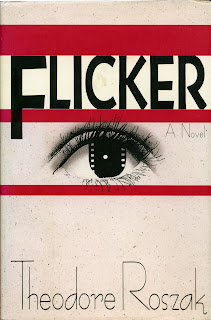
A long time ago, in a galaxy far, far away, one in which the movies had a much different relationship with their audience (and vice versa) than they do today, Pauline Kael suggested, in her review of Robert Altman’s Nashville, that it was “an orgy for movie lovers.” She meant, among other things, that the movie was capable of providing a level of ecstasy and engagement for the viewer, through its almost off-handed command of all of the elements of character and vision and performance that typically make audiences bliss out on the possibilities within the movies, that it was practically guaranteed to elicit a rapturous response comparable to her own. I thought of Kael and her Nashville review when I first began reading Theodore Roszak’s Flicker (1991), a tantalizing, immersive and sometimes maddening investigative fiction revolving around a metaphysical mystery that traces deep into the musty corridors and crypts of ancient religion and of film history itself. (It would not be the last time the book would evoke the spirit and the specter of the late and great film critic.)

Flicker is an orgy for movie lovers too, but not precisely the kind Kael was suggesting. Roszak isn’t a humorless writer, but he’s not given to flights of fancy either-- in some circles he might be considered a bit of a scold—and the book, in its own dispassionate way, indulges in some of the sort of excess Kael, in her review, praised Nashville for lacking. Much of Flicker, especially in the book’s first half, is given over to analytical ruminations on the way cinema is processed, by cultists, academics and poseurs. Through a group of entirely concocted scenesters and various hangers-on, the author has a condemnatory boatload to say about the burgeoning avant-garde movement of the ‘60s, and Roszak isn’t much easier on what he sees as the indiscriminate, self-flagellating tastes of the cult cinema devotees who emerged in the wake of the reflection inspired by pieces like Kael’s “Trash, Art and the Movies.” Here he, as elsewhere in the voice of his narrator/protagonist Jonathan Gates (think “film gate”), names names:


“Watching a cult favorite like Jodorowsky’s El Topo-- it screened regularly once a month—I would have said this is the antipodean swamp, the absolute, godforsaken edge of the world. Mayhem, mutilation, rape, surrealistic sadism. Beyond this, nothing.”

But years later, when the world really does seem to be circling the drain in the presence of a strange new cult director sensation (or is that apocalyptic perception just the residue of all the imagery searing into the eyes Gates has managed to perhaps regretfully sensitize?), the post-punk aesthetic of a Super-8 production entitled American Fast Food Massacre manages to cut through Gates’ disgust, compelling him toward a hesitant level of respect:

“In its up-close details, the film was a stomach-turner, no question. But it moved briskly and with great precision, so that, in spite of myself, I was beginning to find it satirically effective. A great American cannibal feast as Mack Sennett might have handled it if he lacked all inhibition.”
  
For Gates, such concessions would have been unthinkable before discovering an almost-forgotten director, Max Castle, and the world beneath the world he conjured. And that discovery will most certainly change his life, as it has for many others…

On its most inviting level Flicker seems to be written to delight serious film buffs, critics and historians who will dig the cinephiliac name-dropping that begins within the first few paragraphs of the book’s dense 608 pages -- the book’s chronology begins in the mid ‘50s, when movies began to evolve into “films” worthy of increasingly serious academic study. But the book’s orgiastic impulses almost immediately extend beyond that sort of facile fun and toward the dark shadows and dank atmosphere of the lost, perhaps sinister ambitions of a past represented only by fragile plastics and nitrate, the fleeting images committed to film by a low-rent auteur who may have pioneered filmmaking techniques that might possibly have gained access to the darkest impulses lying dormant within the movies themselves.

That past includes the sketchy history of repertory and revival house culture, specifically represented by a fictional Los Angeles cinema called the Classic, a skuzzy 200-seat auditorium fashioned from the moldy basement of a once-opulent movie palace of the ‘20s, a venue not unlike a downtown theater like the Los Angeles (pictured here) or other beauties of Broadway whose vast auditoriums have fallen dark or been appropriated for other uses. The art-deco glory of the Classic, gutted by fire and eventually overtaken by soup kitchens, medicine show hucksters and fly-by-night evangelists, has been lost, but its basement is eventually reclaimed by the movies and refashioned into the vessel which facilitates Gates’ revival house refinement. Gates traces his own path down into the basement Classic, from childhood fascination with the exploits of a fictional serial heroine, busty Nylana the Jungle Girl, through an adolescent fixation on James Dean and Marlon Brando. But it’s the inevitable revelatory, college-age breakthrough, when he stumbles into Louis Malle’s The Lovers-- a more adult consideration (with subtitles!) of the erotic tremors Nylana had first snapped into action-- that precipitates his more serious immersion into the movies.


                         Photo courtesy of Nick Lacy Photography

Afterward, Gates becomes a fixture at the Classic, under the guidance of Sharkey, the theater’s good-humored, burnt-out projectionist, and Clare, a proudly brusque would-be film historian (and failed student) who manages the cinema and writes its long, expressive, brutally honest program notes. Our narrator soon falls under the influence of Clare’s persuasive intellect, fired by the erotic spell she casts simultaneously for him as lover and teacher, the conduit for exposure to entirely new facets of film experience. (Clare’s personal history and temperament, as described by Roszak and his narrator, are clearly meant to invoke Pauline Kael, even though Kael herself is referenced later on as existing separately in Flicker’s parallel universe.)

One night, after having dismissed his work in the presence of some French enthusiasts, Gates discovers Clare viewing a tattered print of a low-budget horror film by one Max Castle, a minor and largely forgotten German expatriate whose trashy, poorer-than-Poverty-Row horror films of the ‘30s—Edgar G. Ulmer with a tendency toward the transgressive impulses of a Herschell Gordon Lewis—were largely lost or left to indifferent decay. Intrigued by her casual, dismissive interest in Castle’s Feast of the Undead, which seems to mask a strange fascination/revulsion for the movie’s surprising technique and grotesque imagery, Castle and the output of his marginal career-- which ended under mysterious, undocumented circumstances in the early ‘40s-- becomes Gates’ pursuit, his way of validating his own intellect in the shadow of Clare’s influence and ambition. What about the way Castle’s camera moves proves so mesmerizing, even when what he’s showing is, atypically for the time in which it was shot, the goriest sort of impaling and other violence? Why is the viewer left with the feeling, during the vampire seductions he choreographs, that there might be real sex going on beneath the veneer of familiar horror iconography? Gates can’t stop asking these questions, and his initially tentative curiosity becomes full-blown obsession, the apocalyptic celluloid through which Flicker casts its plays of light and ever-deepening shadows down into a seemingly bottomless rabbit hole.

To speak in much more detail about what comes of Gates’ pursuit would be to rob those inclined to gobble it up of the surprises set within the deliberate, yet intricate levels of metaphysical development, critical commentary and even historical inquiry into the cold clutch of religious zealotry (and its practical applications) that Roszak brings to the table. But I don’t think it’s unfair to reveal that woven into the thicket of Gates’ gradual understanding of the basis of his helpless attraction to Castle’s imagery, and the unshakable feeling of uncleanliness that it inspires, is a sort of playfully lingering commentary on, of all things, the viability of the auteur theory.

The author’s conceit is that lying almost imperceptibly beneath the visuals of vampires and werewolves and human sacrifices that make up the core of Castle’s disregarded American output are levels of imagery-- or perhaps more precisely levels of manipulation of imagery-- that express Castle’s specific point of view, or personality, about matters of, shall we say, urgency to the director. (Forgive me as I try to remain as spoiler-free and vague as possible.)  It was Castle’s particular talent to bend the narratives and visual style of the piecemeal low-budget assignments he received as a bottom-rung Hollywood director to accommodate, in a manner both obvious and simultaneously subliminal, his own personal concerns. 

This is certainly nothing if not Roszak’s pointed attempt to position Max Castle as perhaps the most extreme, and maybe even the most successful expression of critic Andrew Sarris’ assertion, in his “Notes on the Auteur Theory in 1962,” that "the way a film looks and moves should have some relationship to the way a director thinks and feels.” When Sarris wrote, “Interior meaning is extrapolated from the tension between a director’s personality and his material,” he might, if the man had actually existed, have been thinking of Max Castle, who Gates comes to realize is in some very important and horrifying ways the ultimate auteur. But Roszak, thankfully, is not a wielder of editorial frying pans in the manner of a Paddy Chayefsky-- given the way the book plays out, whether or not Castle’s status as an auteurist poster boy is something he should be proud of is left to the wisdom and consideration of the reader.

Flicker trades in a sort of free-floating anxiety about our relationship with classic cinema, meaning not just the movies that have been deemed “classics” by the usual cultural gatekeepers, but in a more sweeping and general sense the films of a classic era, the films that have spoken in echoes to us, some strong and bold, some faint and dying, from ever since the first films were made. Part of the experience of watching old films, especially on TV in the days predating VCRs and the home video movement but even during the heyday of revival theaters, was the feeling of being visited by ghosts, by thoughts and intentions and expressions that lay just outside of articulation, generated by people on and off screen who were often years, decades dead. Seen from this perspective, the whole of cinema history can be painted, if not with the malevolent strokes hinted at by Max Castle and his legacy, then at least with a sort of gothic mournfulness, pictures of a past that cannot entirely accurately represent or express the intricacy of their origins. The films have their own purpose, their own urgency, but they also call to us like a lighthouse through a very thick fog, and perhaps only part of that purpose makes it through the mist.

As one moves through Flicker it becomes clear that, for Roszak, some things should be unclear, should be left unseen. Even so, Roszak’s narrative, as it moves simultaneously forward and backward through time—a simple effect achieved without the clever structure of chronological compressing and stretching that marked  Steve Erickson’s also-marvelous Zeroville—preserves not just the feeling that we, as the audience, cannot help but look. It’s also saying that the ominous shiver which makes us suspect that what we’re watching is somehow watching back, through time itself, is well justified. Flicker’s progression through the mysteries of Max Castle, the world that spawned him and the world that now seeks the successor who will fulfill his ominous potential, will seem at times perhaps a bit too dense and schematic, Roszak too in love with extrapolating the complex history that serves as a backdrop for his particular brand of anxious dread. But if this is so, it is also true that the author has reserved his most awful, frightening joke for last, and patience will reward the reader who makes his way toward the light at the end of the tunnel, and the dimming of that light, pinched off as if by the closing of an iris.


**************************************

Saturday, March 26, 2016

KARLOFF ENTERS! THE BLACK CAT (1934)


By 1934 Boris Karloff was certainly no stranger to great movie entrances. In 1931, under the direction of James Whale, he seared his image, and that of the monstrous creation of Dr. Henry Frankenstein, into the collective consciousness by shuffling on screen and staring down his creator, and of course the terrified audience, embodying and fulfilling unspeakable nightmares. Frankenstein, an instant phenomenon, was one of 16 pictures Karloff made that were released in 1931.

And in the following year, 1932, in addition of Howard Hawks’ Scarface, Whale’s The Old Dark House and Charles Brabin’s The Mask of Fu Manchu, Karloff had another terrifying entrance in cinematographer-turned-director Karl Freund’s horror landmark The Mummy. As the title fiend, Imhotep, Karloff is first glimpsed in full bandage, sarcophagus laid open behind an unfortunate archaeologist who, engrossed in the parchments he’s discovered, doesn’t notice the mummy’s arm slide down from its bound position. A withered land lays itself on one of the documents, the archaeologist turns, sees the full visage of Imhotep (which we, as yet do not), and slides straight into cackling madness. The last we see of Karloff, in this scene, is a trail of dusty, ruined bandages, dangling from his reanimated corpse, being dragged out the door of the ancient chamber and into the modern world.

In 1934 director Edgar G. Ulmer gave Karloff yet another bone-chilling introduction in his “adaptation” of Edgar Allan Poe’s The Black Cat. Ulmer arose from the German theater around 1910 working as a set designer and eventually made his way to the cinema, working on such landmarks of German cinema as The Golem (1920), Kriemhild’s Revenge (1924), Nosferatu (1927), Sunrise (1927), Spies (1928), City Girl (1930) and M (1931). Ulmer emigrated from Germany to America but found few opportunities to make his mark as a director—by 1933 he had only a few undistinguished westerns and a syphilis education film, Damaged Lives, to his credit.  The Black Cat was Ulmer’s big opportunity, a horror movie which teamed the stars of Universal’s biggest horror hits to date, Boris Karloff and Bela Lugosi, and Ulmer poured himself fully into it.

In reality, Poe’s name was appropriated by Ulmer mainly for its associative qualities, the director having cast aside several existing screen treatments in favor of an original tale that bore only the slightest hints of the author’s original text, claiming that “the Edgar Allan Poe story is not a story that you can dramatize.” Rather than attempting a literal adaptation of the 1843 tale of interior horror and psychological collapse, Ulmer reached back to an encounter he had during the filming of The Golem with novelist Gustav Meyrinck, who had told him of a French fortress that had been decimated by German forces in World War I. Some survivors of the devastation apparently did not emerge from the ruins for years after, and in an interview with Peter Bogdanovich Ulmer talked of the commander of the fortress, “a strange Euripides figure who went crazy… because he walked on that mountain of bodies.”  

That fortress became The Black Cat’s Fort Marmaros, upon which, high in the hills of the Hungarian countryside, Ulmer’s commander, Hjalmar Poelzig (Karloff) has built a monstrous, modernist spectacle of 1930’s Deco architecture, Castle Poelzig, a cavernous mansion of sharp angles, vast spaces and harsh, metallic, chilled beauty that perfectly reflects the detached, vaguely inhuman posture of its central resident. Castle Poelzig is widely considered to be Ulmer’s finest achievement in production design, and some of its most outre, modernist qualities are reflected in Karloff’s physical presence and carriage in the film—his hair and brows are sculpted into sharp angles that resemble the clean, brittle design of the castle’s staircases and hallways, down and through which he glides garbed in minimalist robes and adorned with medallions sporting vaguely sinister patterns that hint at Poelzig’s darkest, as-yet-unrevealed machinations.

But about that Karloff entrance… Near the beginning of the film, Poelzig is summoned from his chambers late at night by the arrival of a pair of newlywed travelers (Jacqueline Wells and David Manners, Karloff’s costar in The Mummy) and Dr. Vitus Werdegast (Bela Lugosi). Stranded after their bus crashes during a thunderstorm, the visitors seek refuge in Poelzig’s mysterious mansion, with only Werdegast, who shares a previous association with Poelzig related to the horrors of Fort Marmaros, aware of their host’s genuinely sinister nature. And Poelzig is introduced to us in brilliant fashion, a flourish of directorial style that entirely indicates Ulmer should have had a greater, more illustrious career than, critical reappraisals aside, the one he ended up with.


Ulmer starts on a close-up of a futuristic-looking intercom—it resembles a neon-girded porthole crossed with an old school drive-in movie speaker— through which the arrival of the visitors is announced, then pulls back to reveal a darkened bed chamber where lies a sleeping woman, lit for our benefit, the rest of the room in shadow. We suddenly realize the woman is not alone when her partner in repose—Poelzig, as it turns out--  rises purposefully, almost robotically, turns on the bedside lamp which, in a perversely beautiful touch, lights only the space behind the curtained wall behind Poelzig and keeps him entirely in crisp silhouette. He moves toward the door.

Ulmer transitions to another room where Werdegast tends to the injuries of the young woman, who was slightly injured in the crash. He and the woman’s husband are leaning over her bed when there is a cut to the door, a vertical line bisecting the screen which slowly opens, revealing Poelzig in all his malevolent imposition, glaring at these intruders with an ominous portent that rivals that of the first appearance of the Frankenstein monster. There follows a painterly medium shot of Werdegast on the left, the woman sleeping in center, her husband doting on the right, all from Poelzig’s point of view,  and then a most unexpected dissolve to a tight close-up of the unconscious woman as her husband tenderly brushes her hair from her face and then retracts his hand. 


Cut sharply to the same angle as before of Poelzig, who is no longer lingering in the doorway but has now moved fully into the room, still keeping his distance and having not yet made a sound that would alert the two men to his presence. He pushes the door closed with a slam. Cut to the same painterly medium shot, only this time the husband turns and recognizes that someone has entered the room. Ulmer then cuts back to Poelzig from the same angle, but instead of the static shot the camera is caught in movement, dollying toward the sinister figure as he continues to silently stare.

And just as the shot becomes a head-and-shoulders close-up, Ulmer shocks us with a cut to a position on Poelzig even further back than the shot that introduced him to the room, with the camera dollying once again toward him, this time ceding to a medium shot of the master of the house. He never breaks his stare, only moves his head to his left in acknowledgment of Werdegast, who enters frame right. Werdegast explains the situation in a series of statements, between any one of which the doctor (and Lugosi, of course) leaves plenty of space for Poelzig to interject. Instead, Poelzig continues to direct that menacing stare at Werdegast. After a moment, Werdegast turns away from Poelzig and back to his patient, and we see Poelzig isolated in a vanity mirror reflection, still staring, now imagined by Ulmer as an actual element of the castle in which Poelzig will entrap these visitors and subject them to the unspeakable evil that echoes from the past through his bizarre, self-constructed world.

The Black Cat and its sinister game of chess between Polezig and Werdegast, two men scarred and consumed by the horrors of the past and ones much more current, entirely lives up to that brilliant entrance. Ulmer lets fly with a pre-Code blast of sadism, Satanism, and even a climactic and vicious flaying, and it’s truly mind-boggling to see what he managed to get away with in regard to pushing the envelope of Hollywood standards of the time.

Even so, Universal studio head Carl Laemmle Sr. and producer Carl Laemmle Jr. were reportedly repulsed by the degree to which Ulmer indulged in these various horrors and demanded reshoots to tone down some of the (implied) violence and to make Lugosi’s Werdegast, himself driven by revenge for Poelzig having stolen his wife and murdered his daughter (or so he thinks), a more sympathetic character. Ulmer initially, and begrudgingly agreed to the reshoots, and then cleverly seized the opportunity to subversively deepen the movie’s depravity by devising a new sequence in which Poelzig gives Werdegast a tour of his castle’s prize trophies: a basement room filled with exquisitely preserved, quite dead and embalmed women, all housed in glass display cases which are occasionally opened to afford the master’s taste for necrophilia. (How this one made it past the scolding Laemmles is a mystery for the ages. And wouldn't you just love to get a look at Ulmer's original cut?)

Despite the huge success of The Black Cat, Ulmer was never afforded the career he might have had-- a romantic relationship with, and eventual marriage to the wife of one of Laemmle Sr.’s nephews, ensured that he would be ejected from Hollywood for the margins of the film industry. Instead of the mainstream Hollywood career he apparently hoped for, Ulmer would spend the rest of his career making microscopically-budgeted B-movies and independent films, including films made in Yiddish (Green Fields, 1937), a film cast entirely with African-Americans (Moon Over Harlem, 1939), a film made for Ukrainian immigrants (Cossacks in Exile, 1939) and several memorable noir-inflected melodramas like Bluebeard (1944), Strange Illusion (1945) and his Poverty Row masterpiece Detour (1945).

Ulmer enjoyed an auteurist-fueled critical reappraisal in the 1970s and is now considered, rightfully, one of the movies’ master minimalists of style, having routinely spun cinematic silk purses from the crudest of sow’s ears. But The Black Cat, his sole contribution to the legacy of Universal horror movies, would have emerged a classic no matter what, a masterful work of dread which gave us moving and nuanced work from Lugosi, as well as that absolutely memorable first appearance of Boris Karloff and the great performance that fulfilled it. Every time I see this movie I can imagine the twisted pleasures of audiences in 1934 and the screams that must have filled theaters when Karloff first rises from the shadows of that eerie bed chamber. They are easy to imagine, because they echo my own.

(Next week I'll examine Theodore Roszak’s Flicker, a brilliant novel about the movies which uses Ulmer’s strange career as a master stylist as a jumping-off point for a sinister story engorged with a decadent and whispered history of movies. See you then!)

******************************

(My thanks to Bret Wood for some of the background on The Black Cat provided by his article on the movie published on the Turner Classic Movies Web site.)

******************************

Saturday, March 12, 2016

GREAT DOUBLE FEATURES I’VE SEEN #1: SMOKEY AND THE BANDIT & CONVOY


(This is the first in an occasional series in which I remember some of the best double features I’ve been lucky enough to see projected in a theater.)

The New Beverly Cinema, the oldest surviving revival theater in Los Angeles, has this week dished up a time-capsule glimpse into America’s popular obsession with CB, or citizen’s band, radio and the largely mythological outlaw trucker culture through which it crackled. If you’re of a certain age (mine), and you ever cruised around town or down the highway jabbering to friends and strangers on an open channel frequency (I did—my handle was The Godfather!), given the opportunity I don’t see how you could possibly resist the chance to see the ultimate trucker-CB action-comedy pairing, Hal Needham’s Smokey and the Bandit and Sam Peckinpah’s Convoy. (I couldn’t!) As of this writing, the morning of March 12, there is still one more evening screening of this knockout combo, and if you’re anywhere near the intersection of La Brea and Beverly in Los Angeles, I urge you to check it out.


I never really thought much of Smokey and the Bandit growing up, maybe because by the time it arrived, near the end of May in 1977, I was already in the process of putting away childish things, only to be replaced by other only slightly less childish things as I transitioned to college life. I didn’t even see Smokey until the following summer, at the drive-in, and paired rather strangely with Taxi Driver. (This was not one of the best double features I’ve ever seen.)

As obsessed with CB culture and movie car chases as I was in high school, you would have thought I would have been first in line to see this Burt Reynolds hit—after all, I’m pretty sure I ran over a couple of people racing my way to pictures like Gone in 60 Seconds, Vanishing Point, The Seven-Ups, Dirty Mary, Crazy Larry, Race with the Devil, W.W. and the Dixie Dance Kings and many others at my local outdoor movie emporium. Instead, I turned my nose up to it, and for the life of me I can’t remember why. Once I did see it, I thought it was tacky and dumb and I remained, for the next 40 years, stubbornly disinterested in revisiting it. (The onslaught of awful Needham-Reynolds pairings in the late ‘70s and into the ‘80s—junk like the Cannonball Run movies, Stroker Ace and, of course, Smokey and the Bandit II—did nothing to make me consider changing my mind, although I would be willing to give Hooper another twirl.)


Of course, Smokey and the Bandit very much is tacky and dumb, and crass and silly and crudely pieced together. Would we really want a goofy comedy about running a truckload of bootlegged beer with a demented Texas sheriff in hot pursuit, to be anything else? In addition to subtle sophistication, Smokey and the Bandit is also absent much more than a hint of rudimentary filmmaking skill, which is, as it turns out, something different from the skill necessary to be a great stunt coordinator. Hell, with the exception of that nifty bit when the Bandit jumps his Trans-Am over a washed-out bridge and a sequence in which that same Trans-Am escapes pursuing bears (state troopers, for the uninitiated) by hiding in between fast-moving trucks (in the rocking chair) in a sympathetic convoy, even the stunts in Smokey and the Bandit aren’t really anything too memorable. (There always seems to be a pond or a deep puddle waiting those addled, brainless troopers when their cars go spinning off the road, choking on the Bandit’s dust.) Needham knew in spades how to choreograph cars and trucks in front of the camera, but he didn’t have much in the tank in the way of imagining for the camera ways to make those stunts expand and explode cinematically.


The shine on Smokey’s 18 wheels comes almost exclusively from its players. It was really fun, 40 years after the fact, to rediscover (or in my case, essentially discover for the first time) the playful chemistry between Burt Reynolds’ Bandit and Sally Field as Carrie, the runaway bride passenger Bandit picks up off the side of the highway. The two actors were romantically involved at the time and made three other pictures together— the Reynolds-directed comedy The End, Hooper and that crummy Smokey sequel—but they never clicked on screen the way they do here. A friend of mine, tongue planted at least partially in cheek, I suspect, describes Smokey and the Bandit as “deep-fried Sturges,” and from the minute Bandit loads Carrie into Bandit One, she begins to shed her bridal finery and toss it out of the speeding Pontiac and they initiate their tentative, high-velocity courtship, I could see what he meant. (My friend also reminded me that Smokey and the Bandit was the movie Alfred Hitchcock claimed to be his favorite movie of all time!)

The supporting players are funny too, from the strange symbiotic relationship between Big Enos (Pat McCormick) and Little Enos (Paul Williams) that puts the story in motion, to Jerry Reed’s genial crystallization of the Good Ol’ Boy archetype (Reed, with rock and roll pioneer Bill Justis, also wrote the movie’s music, including the immortal “Eastbound and Down”), George Reynolds’ put-upon Sheriff Branford (who, yes, ends up in a watery ditch) and Mike Henry’s numskull daddy’s boy, Field’s jilted groom, who spends almost the entire movie whimpering for his papa’s approval, one hand planted on the old man’s hat to keep it from blowing away in the breeze created by the sudden conversion of their police cruiser from a hardtop sedan to a convertible.


And about that old man. Jackie Gleason’s Buford T. Justice, the blustering, apoplectic Texas sheriff who crosses state lines in pursuit of that runaway bride and, eventually of course, the Bandit, is hardly a comic creation of great nuance, and thank God for that. Gleason’s slow burn frequently erupts into a raspy voiced rage against irreverence for the law and “what this world is coming to”— he’s squinting with contempt at you, African-American Sheriff Branford—and in the process he steals Quintessential/Stereotypical Redneck Southern Sheriff honors right out from between J.W. Pepper's sausage-shaped fingers. I once saw Albert Finney on stage in London, and he spent so much of his time in a red-faced rage that I seriously feared he might have a stroke. Gleason reminded me of Finney in that way here. But with Buford T. Justice that fear gets processed into laughs and makes you wonder just how far Gleason will go, even when one of his funniest moments, after a fellow officer calls his highway patrolling into question (“Who do you think you are, Broderick Crawford?!”) is a simple, seething sneer of contempt. I never thought I’d say it, but after seeing Jackie Gleason again as this unhinged, entitled and outraged lawman it’s clear to me that Buford T. Justice truly belongs in the company of the great Ralph Kramden.  


It was nice to see Smokey and the Bandit again and realize that I could finally appreciate this movie, which I’d pooh-poohed for so long. But the real attraction of the night was most definitely the chance to see Convoy projected on the big screen for the first time. I’d only ever seen it in terrible cropped presentations on VHS and HBO, and I’d never thought much of it until I stumbled upon it on the MGM HD channel several years ago. Enough years had passed that, offered such a beautiful-looking wide-screen transfer, I felt that it was an opportunity to see the movie as close to what it looked like in 1978. It was also a chance to assess it on its merits alone, divorced from the notoriety of its cocaine-and-madness-fueled production history and its insistent reputation as the nadir of a once-great director’s career, the penultimate act of an artist desperately slumming for a hit. (My nominee for that honor would go to the film Peckinpah made previously, The Killer Elite.)

I never thought I would ever see the movie looking better than it did on that HD channel, but fortunately I was wrong. The print featured at the New Beverly was spotless and pristine, struck from an original answer print which makes Convoy’s shimmering, grimy, hallucinatory imagery pop like it hasn’t popped since the day the movie first opened. I’m well aware of the movie’s reputation, but if you could ever see it the way I did last night you might be much more inclined to rethink the presumptions that have clogged Convoy’s tailpipes since August 1978.


I wish I could say that Convoy is a movie entirely misrepresented, like Mandingo, by a critical community blinded by conventional wisdom, one worthy of a complete reappraisal and repositioning within Peckinpah’s oeuvre. Alas, it is not a masterpiece. Some of Convoy’s dialogue scenes are marred by atrocious overdubbing and indifferent staging (usually the ones involving people standing around, talking at each other), and even some of the hand-to-hand action, like the truck-stop fistfight that opens the movie—Peckinpah’s bread and butter a mere decade earlier— is hampered by an overly deliberate editing scheme that looks pawed over, slapped together. (There is a good joke in there, though, involving a trucker who draws first blood in a coffee shop fight with a broken ketchup bottle shattered over someone’s head, which draws immediate comic commentary on the director’s reputation amongst lazy critics as an indiscriminate blood-letter. But honestly, it made me think not so much of Peckinpah past as Peckinpah parodied.)

But if Convoy isn’t a masterpiece, it certainly is a masterwork, and Peckinpah’s passion for camaraderie and obsession with the depths, and sometimes the shallowness of loner mystique come through this movie as clearly as anything he ever made, even though the passions and obsessions by this point may have been muddled by creeping desperation. (The director is even visible in the movie, next to DP Harry Stradling, Jr., ostensibly directing the camera crew of a news reporter who rides alongside the truckers, interviewing them on the fly. It’s clear, though, that Peckinpah wasn’t there as an actor—armed with his walkie-talkie, he’s on screen directing Convoy. The reverse shots of the truckers are often what is being seen by the 35mm camera seen riding in the pickup bed with the crew.)

The movie, based on C.W. McCall's novelty top-40 hit, was a smash, especially on the drive-in circuit, though Peckinpah’s on-set antics ensured he wouldn’t work again for nearly five years. No, it’s not a maligned work of genius, but it is goddamned entertaining despite its flaws, mainly because, in trolling for box-office gold by exploiting the then-popular CB craze, the director manages to pump a goodly amount of nihilistic steam into the idea of a political movement, a trucker’s protest convoy which gains populist momentum without anyone-- least of all its ostensible leader, Rubber Duck (Kris Kristofferson)-- seeming to have any coherent agenda or ability to agree on what it all means. For Rubber Duck, and for Peckinpah, the director desperate to shoot film who increasingly lost his grip on the reality of what to shoot and why, the only act with any meaning at all is the simple act of forward movement. 


It happens that forward movement through vividly rendered space is something Convoy does as well as any of the acknowledged classics of the genre, like Vanishing Point. And like Charley Varrick or Electra Glide in Blue, Convoy is one of those wonderfully tactile films from the ‘70s that seems kinetically, electrically connected to the landscapes on which its dramas take place. The soaking up of the spectacular Panavision vistas, deepened by darkening clouds, a line of trucks skating across the bottom of the frame silhouetted in the dusk, is as dramatic as any action set piece in the movie.

And one of the movie’s most memorable chases, a band of troopers pursuing Rubber Duck and company through blinding, back-road desert dust, is a beautiful, inexplicable evocative piece of surreal choreography. There’s nothing like it in any other action movie. And all of Convoy’s set pieces are shot and edited with an identifiable precision and poetry that is clearly derived from Peckinpah’s sensibility, this despite testimony to the effect that James Coburn and others were called in to direct shots and sequences when Peckinpah arrived on set too drunk and/or deranged to do the job himself. (Coburn has a credit as second unit director.)


The cast is more than game too. Kris Kristofferson has never looked leaner or better on screen than he does here; he seems to understand his genetic-level function as a laconic, graphic extension of the muscularity of his vehicle. And of course Ernest Borgnine’s mustache-twirling devilry as evil sheriff Dirty Lyle is memorable, as it’s played a little closer to Earth than Gleason's Justice and is all the scarier for it. The supporting cast are all welcome and worth watching; it includes Burt Young and Franklin Ajaye as fellow truckers Pigpen (whose cab bears the legend “Paulie’s Hauling”) and the ill-fated Spider Mike; Seymour Cassel as an opportunistic governor who wants to turn the populist support for Rubber Duck’s convoy into votes; and Madge Sinclair, whose 18-wheeler takes a hell of a spill around a tight curve early on and isn’t left with much more to do to hitch a ride in another cab, but who brings her customary warmth and generosity as a performer to the hot asphalt nonetheless. Only Ali McGraw’s well-documented nostril acting rubs the wrong way, but she’s hardly a stake through the movie’s engine.

Especially seen as the meal after a Smokey appetizer, Convoy emerges even more clearly as a pedal-to-the-heavy-metal, meat-and-potatoes Hal Needham action flick directed by an artist, or at least a man still enough of one to elevate even the genre’s hoariest conceits and lowest comic pitches into classifiably forgivable sins.  The movie and its milieu are both spectacular; it’s a dusty, greasy, sweaty testimony to the desperate beauty of the road, of trucks, and of desperate, disillusioned men.

*************************************

Sunday, March 06, 2016

MURIEL AWARD WINNER BEST FEATURE FILM 2015: MAD MAX FURY ROAD


And the winner of the Muriel Award for Best Feature Film of 2015 is...


Andrew Bemis on Mad Max: Fury Road:

"Fury Road also makes most other blockbusters look puny on a purely aesthetic level. In a movie filled with exhilarating images, one of my favorites is towards the beginning, when Max is trying to escape his captors. It's a dark, chaotic sequence that suddenly gives way to blinding light and silence as we get our first look at Immortal Joe's Citadel. It's a moment that has the same kind of power as Dorothy opening her front door and stepping into Oz. Mad Max has many moments like this, reminding that, though blockbusters offer plenty of loud spectacle, few even bother with trying to manipulate scale, perspective, light, sound or any of the other basic tools at their disposal to create a genuine sense of awe. For a movie that uses every state-of-the-art filmmaking tool at its disposal, Fury Road is surprisingly classical in its approach to visual storytelling."

Read the entirety of Andrew Bemis's  conversation with Justine Smith about Mad Max: Fury Road at the official Muriels Web site, Our Science is Too Tight.


*******************************************

MURIELS 2015 COUNTDOWN TO BEST FEATURE: FROM #48 ALL THE WAY TO #2


Here's a guide to the Muriels Countdown to Best Feature Film as it stands so far, from #48 all the way to #2, the movie that almost made it to the top of the heap...


#48: Buzzard (Joel Potrykus) Essay by Patrick Miller


#45: Jauja (Lisandro Alonzo) Essay by Jaime Grijalba


#41: Horse Money (Pedro Costa) Essay by Michael Lieberman


#34: A Pigeon Sat on a Branch Reflecting on Existence (Roy Andersson) Essay by Cole Roulain


#29: 45 Years (Andrew Haigh) Essay by Jim Emerson


#28: Mistress America (Noah Baumbach) Essay by Josh Bell


#26: Room (Lenny Abrahamson) Essay by Dennis Cozzalio


#20: Tangerine (Sean Baker) Essay by Scott von Doviak


#18: The Assassin (Hou Hsiao-hsien) Essay by Sam C. Mac


#16: It Follows (David Rbert Mitchell) Essay by Jason Alley


#13: Spotlight (Tom McCarthy) Essay by Daniel C. Johnson


#10: Phoenix (Christian Petzold) Essay by Alice Stoehr


#9:  Inside Out (Pete Docter) Essay by Clayton Walter


#8:  The Duke of Burgundy (Peter Strickland) Essay by Justine Smith


#7:  Magic Mike XXL (Gregorgy Jacobs) Essay by Kenji Fujishima


#6:  Anomalisa (Charlie Kaufman and Duke Johson) Essay by Melissa Starker


#5:  The Hateful Eight  (Quentin Tarantino) Essay by Simon Abrams


#4:  Creed (Ryan Coogler) Essay by Vern


#3:  Sicario (Denis Villeneuve) Essay by Luke Gorham


#2:  Carol (Todd Haynes) Essay by Donald G. Carder

And the winner of the 2015 Muriels Award for Best Feature Film is...

***********************************