(The following essay was written for
The John Williams Blog-a-thon now playing at
Edward Copeland on Film. Ali Arikan is coordinating the effort which will be celebrating this most popular and influential film composer throughout the Memorial day weekend with numerous links to tributes and analysis of Williams' music. Check in with
Edward Copeland On Film all through the weekend for more updates as new pieces come rolling in.)
***************************************************
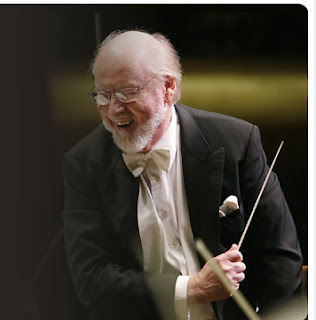
Though it actually extended back to the mid-50s, my awareness of John Williams’ career as a composer—if not with the name, then with the style of driven, bombastic, action-oriented music scores that he came to represent—is directly traceable to his involvement with producer-director Irwin Allen. Allen made four TV series that were crucial to the feeding of my sensibility as a consumer of American pop culture, especially the genre of science fiction, during the time I was growing up in the 1960s--
Voyage of the Bottom of the Sea, Lost in Space, The Time Tunnel and
Land of the Giants. All of them spurred my imagination and the menu of my playground adventures (and looking back at the shows now, there were a lot of gaps left unfulfilled by the threadbare production of the programs which we kids could gladly fill in with our own imaginations), and all of them excepting
Voyage featured music composed by John Williams. Later, Williams would continue augmenting the imaginations of TV and movie junkies who followed Allen from sci-fi TV to the disastrous worlds of
The Poseidon Adventure (1972) and
The Towering Inferno (1974). Soundtrack geeks weren’t exactly legion where I grew up, but there were a couple of us, and by the time
Inferno came out we already revered Williams based largely on that output alone. (Appreciation for his scores for Robert Altman--
Images in 1972 and, of course,
The Long Goodbye in 1973-- would come much later.) And of course I gobbled up the soundtrack album for
The Eiger Sanction with unabashed love, even if my feelings did not extend to the film itself.
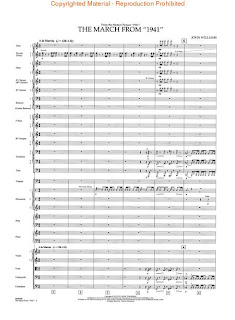
For most of us the game changed, regarding Williams and, I suppose, popular movies as well, with the release of
Jaws. Williams scored Steven Spielberg’s relentlessly entertaining epic with equal measures dread, gut-trembling anticipation, release and high-spirited sea-faring themes that reflected beautifully the mixture of tones—from menace to a lively insouciance regarding the subject of the expectations of men at sea—that could be mined from the film itself. With
Jaws Williams proved he was capable and willing to produce more than just aural bombast to beef up all those expensive images conjured by the likes of Irwin Allen. With Spielberg he found a budding artist with whom to collaborate, which is why his work with this particular director seems to be connected not just to sensation but to the very breadth and depth of emotion possible in the cinematic form itself. I always thrilled to the first two scores Williams wrote for the
Star Wars films--
Star Wars (1977) and
The Empire Strikes Back (1980)—but even those scores don’t hold for me the surprise or delicate ambience or driving passion to be found in Williams’ scores for
E.T.—The Extra-terrestrial (1982),
Indiana Jones and the Temple of Doom (1984) or
Empire of the Sun (1987). (His impersonal scores for the
Jurassic Park films are the closest Williams has come for Spielberg to the overly busy showmanship of his
Star Wars symphonies, and
The Empire Strikes Back may be his greatest achievement in intimacy through spectacle that occurs outside the Spielberg oeuvre.)
Williams has done great work for other directors, of course—his scores for Brian De Palma’s
The Fury (1979), George Miller’s
The Witches of Eastwick, Lawrence Kasdan’s
The Accidental Tourist (1988), and two of the three he did for Oliver Stone--
JFK and
Nixon-- are remarkable and complex masterworks that stand among the best movie scores of their era. Since the advent of the new century, however, Williams’ only work outside the realms of George Lucas, Steven Spielberg and Hogwarts has been for Roland Emmerich--
The Patriot in 2000—and Rob Marshall--
Memoirs of a Geisha in 2005. But his work for Lucas and Spielberg, due to the volume of music he has created for their films as much as its influence on other composers, has become the go-to sonic imagery when the name “John Williams” is conjured in conversation or in a sudden stream of melody that bubbles up in a hum, a mental symphony centered around a theme you just can’t let go.
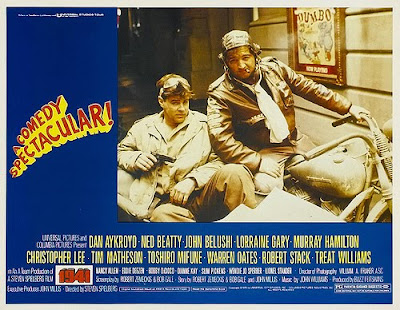
And as much as it is has been sport for many writers and moviegoers to attempt to blow holes in the great galumphing mastodon of Spielberg’s career—his gleefully overblown World War II comedy
1941 (1979)-- even that film’s detractors generally tend to admit that Williams’ score for that movie is among his finest. There are
detractors from even this bit of generosity, of course, but no matter—on the subject of
1941 there is likely to be continued disagreement as to its quality because, beyond matters of whether or not Spielberg’s overriding excess is defensible aesthetically (and I certainly think it is), the verdict on
1941 will always depend on its success as comedy. If it makes you laugh, then all else, if there need be anything else, is forgiven. My own point of view is that there is damn little to be ashamed of here--
1941 is a layered, scattershot, fringe satire on American jingoism and paranoia, the kind where the bits of absurd business in the corners and in the background get flattened by the “Look, ma, no brains!” antics in the foreground when usually blown up to these sorts of proportions. (Exhibit A:
It’s a Mad, Mad,. Mad, Mad World.) Undoubtedly, the theatrical cut has problems of continuity and rhythm that render it even for fans a relatively choppy experience. But somehow in the more fleshed-out extended cut, which restores about 30 minutes of connective tissue, character comedy and brilliantly goofy set pieces (Slim Pickens attacked and kidnapped by Japanese soldiers dressed as Christmas trees is but one hilarious example),
1941 feels more fully formed and felt, much more of a piece, and Williams’ score doesn’t have to work as hard to cover up the holes that are apparent in the shorter theatrical version. But holes or no, both versions provide a brilliant showcase for the kind of score that has few equals in the history of Hollywood comedies.
The complaint often heard about the score-- that Williams doesn’t use the opportunity to provide a “serious” musical undercurrent to the antics of a group of Americans who, in their panic over a supposed Japanese invasion of American soil wreak more havoc than the enemy ever comes close to achieving-- seems a particularly perverse one, as if Williams was bound by some cinematic mission statement to maintain the spirit of sober observation of the moral seriousness of war when all else around him is the mode of satiric chaos. Fortunately, he accesses film history while at the same time giving us almost as many laughs in the score itself than the movie does. The portent of doom underlying the hushed, low frequencies, the whispered intimation of a march that Williams’ layers under the film’s opening crawl, which sets up the film’s basic situation in a parody of sober docudramas like
The Longest Day, almost immediately gives way to a send-up of his own work (the Stravinsky-inspired chopping bass that once signaled the presence of a shark now indicates a more military undersea presence). Williams indulges in his mastery of swing-tinged symphonic themes in the introduction of several characters who will figure in the film’s just famous USO dance number. But it is with the eruption on screen of the movie’s main bulldog, Wild Bill Kelso (John Belushi), a certifiable madman in a fighter plane tracking an imaginary Japanese airplane down the California coast, that Williams brings on the movie’s signature piece, the “March from
1941,” which will inform and underlie almost everything that comes after it. The march, instantly hummable, melds the fighting spirit of everything from Kenneth Alford and Malcolm Arnold’s “Colonel Bogey March” (
The Bridge on the River Kwai), to the playful exuberance and bombast of Elmer Bernstein’s
The Great Escape, to the echoes of lost national spirit that tumble through Jerry Goldsmith’s rousing score for
Patton. Yet Williams is never caught cribbing lines or themes—the genius of the music is that is finds its own spirit, equivalent to the cacophonous madness of the film, yet also coursing with a generous and goofy charm and sense of its own scale that makes a listener laugh even without the attendant imagery.
With
1941, Williams calls to mind not only those previously mentioned moments of brilliance in scoring for war films. In the USO dance sequence he gets to flex his own muscles and create an entire mini-symphony in the swing style, 15 minutes or so of sheer exuberance and good-natured ribbing of the popular music of the era that is gasp-inducing in its accuracy and reverence, yet also astonishingly alive to the moments that are unfolding on screen. I can’t think of another instance (perhaps the
Anything Goes sequence that opens
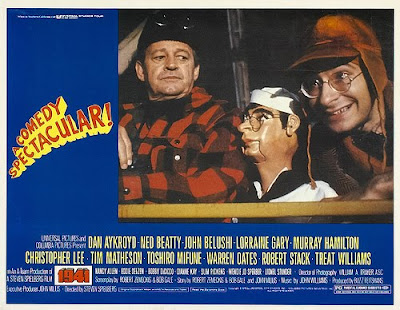
Indiana Jones and the Temple of Doom) where Williams has so willingly given in to the rush of creating a pop spectacle within another pop spectacle, but the spirit that explodes out of that USO sequence permeates the rest of the film. There are moments during this sequence, like the separating of lines between army and navy men readying to meet on the dance floor in full-on battle, or in isolated moments like when Treat Williams’ deranged Sgt. Sitarsky reacts with mock disgust when an upside-down dancer’s crotch gets shoved at him (he’s a perv, but he’s got bigger fish to fry at the moment), that Williams gets in touch with his inner Carl Stalling—familiar musical cues are embellished and twisted to provide warped communion with the blast of energy zapping from the screen. That connection never really abandons the composer for the rest of the show, and Williams’ lets it inform his own tendencies toward overembellishment in surprising, often delicate and even subtle ways. One of my favorite moments in the movie could almost go unnoticed—as Treat Williams and the busty force of nature Wendie Jo Sperber make their way out of Hollywood and toward Santa Monica, Belushi pulls up on a sidecar motorcycle he has stolen from a general’s messenger. Clearly enamored by Sperber in the midst of all the chaos of a crumbling Hollywood Boulevard, he pulls up next to the two of them and offers them a ride. Munching on a well-worn cigar, Belushi’s eyebrows vault ever higher-- hairy, bouncing parachutes Wild Bill’s ridiculous impersonation of a smooth operator (“Which way ya goin’ sister?”)—and the orchestral score settles into a impish firmament of flutes and woodwinds fluttering about the soundtrack, sonically decorating each puff of smoke in rhythmic unison as they bloom off the end of Wild Bill’s stogie. It’s a singular, some might say insignificant detail in a film packed with details and the broadest of brush strokes, yet it is completely representative of the openness and attention toward comedy wherever it may bloom that Spielberg and Williams use to such great effect in
1941. It’s a moment that reminded me of Stalling, but also of Max Steiner, in the way that Steiner so memorably times the escalation of his orchestra accompaniment to match the footfalls of the island natives as they ominously approach Robert Armstrong and company in
King Kong. It’s a beautiful, funny touch if you notice it, but mysteriously right even if you don’t.

The score written by John Williams for
1941 is one that wins you over, not with a musical club, but with its own kind of grace and ebullient vigor. It is among the happiest movie music I can think of, not because the chaos of its subject matter, however comically rendered, is itself happy—you’d have to be a spectacular brand of moral idiot to believe that. No,
1941 arrives at a state of blissful happiness through the sheer command Williams displays in communicating musically with the raucous display of manic fireworks on screen. It is music that simply makes me happy whenever I hear it, in much the same way as the scores for
Jaws, or
Planet of the Apes, or
The Good, the Bad and the Ugly do. It’s a tribute to Williams’ achievement that whenever I think of
1941 I think of the music; whenever I clamor to see the film again, it is Belushi buzzing Hollywood Boulevard to the strains of the "March from
1941" that I think of first. But the greatest tribute is that I cannot imagine this grand, grotesque, hilarious movie without it.
***************************************************


 Posts
Posts


