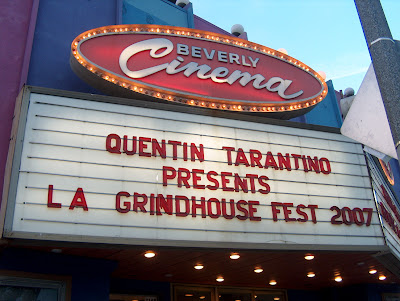
You’ve seen the ubiquitous ads on TV, on buses, on bus kiosks and billboards, and you’ve more than likely read at least one movie magazine or blog article (perhaps on these very virtual pages) devoted to explaining the back story of how directors Quentin Tarantino and Robert Rodriguez conceived their latest opus, the self–contained trash horror double bill that is Grindhouse. And in the next two weeks, before the movie is actually released, if you watch TV or go to the movies you will undoubtedly be subject to much more of the same, albeit at an even more amped-up rate of exposure as the release date continues to creep one day closer.
 But if you live in Los Angeles and are of a mind to appreciate it, there’s been a very unique promotion of Grindhouse going on every night at the New Beverly Cinema, an organic offshoot of the monthly Grindhouse Film Festival nights featured at the theater courtesy of exploitation experts Eric Caidin and Brian Quinn. For the months of March and April, Brian and Eric have joined forces with Tarantino to showcase a blistering blitz of exploitation double and triple bills, all culled from Tarantino’s own apparently vast collection of 35mm prints. The two-month long Los Angeles Grindhouse Festival, now near the halfway point of its run at the New Beverly, is designed both to promote and give context to the upcoming Tarantino/Rodriguez homage (after all, it wouldn’t be much of a jump to presume that a good percentage of Grindhouse’s intended demographic has little or no firsthand experience with the golden age of drive-in and downtown movie exploitation that the new movie glorifies), as well as give over one cinema for two solid months to celebrate the real deal, sticky floors, scratched prints, musty smells and all.
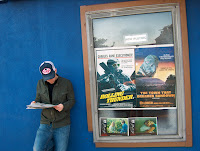 And if you do have firsthand experience with said exploitation fare, having seen a goodly amount of it during the ‘70s and early ‘80s, attending the New Beverly’s festival is likely to be a rush of sense memory that seems rare and, dare I say, somehow precious in this age of Moviefone, pristine digital restoration, cup holder-laden stadium seating and, however ominously, 60-inch flat-screen plasma TVs. After over ten years of denying myself the double features the New Beverly has routinely offered, I finally made it out to La Brea and Beverly Sunday night, March 11, for my first Grindhouse Fest double feature, John Flynn’s Rolling Thunder and Charles B. Pierce’s The Town That Dreaded Sundown. According to the calendar, the show was to begin at 7:30, and having no idea what to expect as far as crowds, I made sure I got there in plenty of time to find a parking spot somewhere in the surrounding neighborhood and get a place in line. I strolled up to the box office at about 6:15, and there were two other people already there. I bought my ticket, unrolled the magazine I’d brought along and began to read. It wasn’t long before others arrived in anticipation of the doors opening. And it wasn’t much longer again before the box office attendant came out and informed us devoted standees that the films were running behind schedule (the double feature played that Sunday afternoon as well) and that we wouldn’t actually even be admitted into the theater until about 7:45 p.m.
 But I didn’t really much mind. I’ve always enjoyed keeping company with fellow fanatics in joint anticipation of something special, even if just to stand around and people-watch. Soon there was a bustling crowd in line behind me and milling loosely about the general area of the box office window. A bald, mustachioed gentleman and an older, distinguished-looking fella began animatedly talking with a couple of other folks, presumably theater management, who kept rushing in and out of the theater to check how close the afternoon program was to actually finishing. It finally did, at about 7:50, and the attendees of the afternoon show came pouring out, visibly glad to not have to blanch at direct sunlight (it was the first day of Daylight Savings Time, but even so the sun was by now well down), but otherwise looking rather worn, perhaps even bored. Hmm, thought I, not a good sign. They would have just seen The Town That Dreaded Sundown, a period thriller that I saw and enjoyed multiple times in high school, based on accounts of the Texarkana Phantom Killer. The case, and the movie, have superficial parallels with the Bay Area murders chronicled in David Fincher’s superb Zodiac, in that the apparently motiveless killer, who favored lovers’ lane-type locations, was never caught, an open-ended scenario based on case files that the movies (Fincher’s, anyway) explore and exploit for maximum tension. Yet these grindhouse-goers didn’t look wrung out with fear. Could it be that my memory of Sundown was far more generous that the movie deserved?
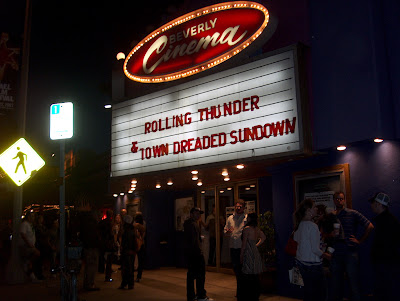
I found a sweet spot in the smallish auditorium on the right side, on the aisle, and settled in. It soon became apparent that one of the most endearing elements of the Grindhouse Festival experience-- and I can only imagine this holds true for the regular monthly Grindhouse nights at the New Beverly-- was the sense of kindred spirits that made its way rather nimbly through the crowd. Almost immediately, I ran into three people I knew, none of whom I was aware would be attending, and I made two other acquaintances who introduced themselves when they overheard me talking about my blog. And there was a generous vibe that was present in the crowd from the start that was markedly different from the usual hip L.A. scenester gathering that shows up at screenings of bad movies with the express purpose of making sure all around them know that they know enough to laugh at the piece of shit unspooling in front of them. No, these people seemed, for the most part, genuinely respectful, if that’s the right phrase, of the grimy roots of the experience, even if tonight’s double feature wasn’t composed of the usual specimens— both Rolling Thunder and Sundown seemed a little more respectable than the cookie-cutter chopsocky or badly-dubbed Italian gore-fests usually associated with the phrase “grindhouse.” (That particular fix would be addressed by the prodigious bill of trailers on tap that evening.)
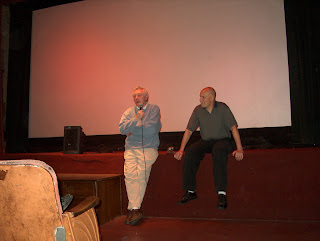
I was able to corral Brian for a few minutes and introduce myself. He recognized me from the blog and admitted to posting a gently good-humored harangue in the comments column about my admitting not having been to the New Beverly in 10 years. We talked about mutual friends Haruka and Max, both regular Grindhouse Night attendees who have been trying to get me to come for months, and Brian expressed his excitement for how things had been going during the first week of the Tarantino collection. He also clued me in as to who the Bald Mustache and the Distinguished Gentleman outside the box office were—they were tonight’s special guests, Rolling Thunder director John Flynn (D.G.), and screenwriter Heywood Gould (B.M.) who apparently rewrote Paul Schrader’s original script and fashioned it into what made it onto film. My mind started tumbling— Heywood Gould… Why should I know that name? I didn’t remember at the time, but if I had, I might have actually introduced myself. For, as I discovered when I ran his name through IMDb when I got home, Heywood Gould was not only the director of the atrocious Michael Keaton-Rene Russo vehicle One Good Cop, he also wrote the screenplay for one of my holy texts, the sublimely absurd The Boys from Brazil.
Soon Brian and Eric took the stage in front of the screen to introduce the film, and Mssrs. Gould and Flynn, who spoke for about 15 minutes, telling tales of attempted censorship, threats of bodily harm after marketing screenings, and how the movie was dumped by Fox over its relentless violence and, after being picked up by Samuel Arkoff and American International Pictures, ended up the top-grossing independent picture of 1977. (Fox presumably licked their wounds with the gold-flaked drool generated by Star Wars.) Then 15 or so minutes of wild and wooly trailers for several of the movies coming up at the New Beverly, and finally, at about 8:30, the movie that was supposed to have started at 7:30, finally got underway.
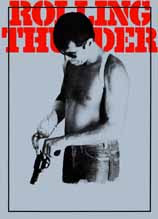 Back to that sense memory of what it was like to see these pictures, in venues both seedy and somewhat more above ground—I’d forgotten what seeing a badly maintained 35mm print of a movie was really like, so obsessed are we these days with sprucing up original negatives and cleaning up visual and aural artifacts and making sure the DVD transfers are struck from the best possible prints and properly color-corrected, usually with the input of the cinematographer and/or director. So even though all those things are good things, I forgave myself the cheap thrill that ran up my spine when that familiar fuzz of the optical soundtrack running over the heads of the projector began popping and crackling and otherwise partying like it was 1977 all over again. There was a direct and immense and palpable pleasure to being able to feel the film the way one feels it while watching a run-down, worn-out, occasionally bleached-out print. It’s a natural phenomenon of age and dust and general disrepair that Tarantino and Rodriguez are reportedly going to great lengths to duplicate in the look and sound of Grindhouse, and if that theatrical trailer is any indication, they’re rumbling up the right alley. Suffice to say, the prints from Tarantino’s collection have not been hermetically sealed in a humidor vault to protect them from the onslaught of elements that lend themselves to the decay of celluloid. I realized, 10 or so minutes into Rolling Thunder, that I was glad for all the rumble and warble and popping and thumping and scratches on this print. As pro-restoration and preservation as I am, all of the prints I’ve seen so far in this festival feel like nothing so much as genuine surviving documents of a certain kind of theatrical distribution and exhibition that is almost as lost as this low-budget strain of B-movie is itself.
I’d never seen Rolling Thunder (1977), but I’d heard plenty of good about it, and it did not disappoint. William Devane is satisfyingly grim as the tortured Vietnam vet who loses his wife and son in a horrific home robbery gone wrong and recedes behind his aviator sunglasses into a private hell of repressed, yet reemerging, memories of wartime violence, and of seething desire to wreak protracted vengeance on the attackers. It’s a good, vicious thriller, directed with plenty of gusto by the undervalued Flynn, who was also responsible for the underrated mob drama The Outfit (1973) starring Robert Duvall, Karen Black, Joe Don Baker, Robert Ryan and my beloved Sheree North.
 Alas, The Town That Dreaded Sundown (1977) was not the movie my memory had been telling me it was over the past 30 years. In his pre-show speech, Eric admitted it was always one of his favorites too and that, after seeing it at the early afternoon screening, even he had to admit it wasn’t very good. Eric was right. Directed by regional filmmaker Charles B. Pierce, who made his hay four-walling The Legend of Boggy Creek into a notable hit in 1972, Sundown may be based on an actual case, but Pierce’s touch as writer-director (and Barney Fife-esque supporting cast member) is so wobbly that the movie, hobbled from the get-go by portentous Encyclopedia Brittanica-style narration that fills in the holes where all the interesting storytelling should go, never finds a proper tone from which to build a true sense of fear.
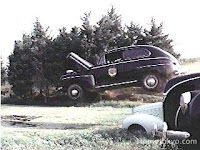 The movie veers wildly from ineptly staged murders, to long scenes of the police investigators, including an apparently legendary Texas Ranger played by Ben Johnson, standing around wondering what to do, to comic car chase set pieces that advance the story not a whit. By the time the familiar boots worn by the killer (who was never caught) are seen striding into a movie theater line in “modern-day” Texarkana for a screening of, yes, The Town That Dreaded Sundown, all common and narrative sense have been sucked into the black hole of Pierce’s incoherent point of view, and I was just glad to finally have one of my childhood boogeymen exorcised for good. My first night at the Los Angeles Grindhouse Festival finished around 12:30 a.m., just about an hour and a half behind schedule, and although one of the movies was a marked disappointment, the experience was anything but. I was already looking forward to my next chance at a juicy, vintage double feature. I’d done violence. Next up: sex.
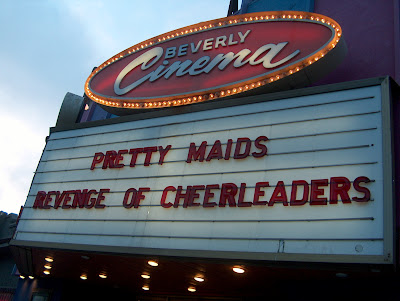
Sunday, March 25. I was back in line for another double feature, one that promised another combination of relatively high quality and bottom of-the-barrel contact high that was the exclusive province of the mid-70s drive-in sex comedy. There I was, the only one in line at 6:30 p.m. for a double feature of Roger Vadim’s erotic high school satire Pretty Maids All in A Row (1971) and Richard Lerner’s Revenge of the Cheerleaders (1976). At first I worried that the bloom had worn off Tarantino’s stinking rose already, that the novelty of an all-grindhouse schedule had, after three weeks, started to seem less exciting to the general moviegoing public than it had when all this kicked off at the beginning of March.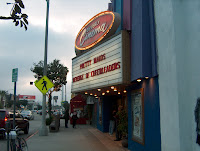 I shouldn’t have worried. By the time my pal Michael and I got our seats, the New Beverly was packed once again, and that same sense of eager, happy anticipation was in the air. Maybe it was because the audience was looking forward to pretty maids gamboling in various skimpy outfits under the tutelage of lecherous high school guidance counselor Rock Hudson instead of William Devane dispensing vigilante justice with a hook where his hand (sacrificed to a kitchen garbage disposal) once was, but the vibe was considerably lighter leading up to show time. (The fact that the screening was on time for 7:30 might have had something to do with it too.)
 Brian took the pre-show stage again to talk about some upcoming features (it’s possible that Asian star Nancy Kwan may be in attendance for the upcoming screening of Wonder Women-- stay tuned!) and introduce two of Vadim’s original “pretty maids” who were in the New Beverly audience. Actress June Fairchild, dressed like a cross between Stevie Nicks and Susan Janet Ballion, and the considerably more conservative Margaret Markov bantered for four or five minutes and reminisced about Vadim’s talent as well as his lechery, and then Pretty Maids All In A Row got underway. This was one I was particularly looking forward to, as I’ve always liked Pretty Maids based on one viewing of an understandably cut-and-pasted TV version that I saw when I was 18 or so.
 And it was a pleasure to see the eroticism that peeked through the rough seams of that censored broadcast patch job blossom into its fullness (sorry) uncut on the big screen. Pretty Maids is a surprisingly spry and funny submersion of unbridled male fantasy into a high school setting—tortured virgin Ponce de Leon Harper (played by John David Carson in his first movie, and no, I’m not kidding about that name) is taken under the wing of genially lecherous guidance counselor and football coach Michael “Tiger” McGrew (Rock Hudson), who enlists comely substitute teacher Betty Smith (Angie Dickinson, and no, I’m not kidding about that name) to help Ponce through what he terms a rough patch of ineptitude and sexual dysfunction. Of course, Ponce’s only dysfunction is that he hasn’t yet had actual sex, and darned if Betty, after spying his boner and proclaiming her work done, doesn't develop a little attraction to him that eventually leads to the solving of Ponce’s real problem.
 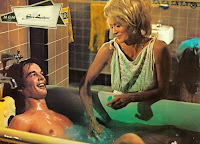 But Ponce has at the same time discovered the dead body of a cheerleader dumped in a men’s room stall (or cubicle, as he keeps inexplicably referring to it—only screenwriter Gene Roddenberry knew for sure why, and he’s not talking), a body homicide inspector Sam Surcher (Telly Savalas, and again, no, I’m not kidding about that name) begins to believe may have some connection to Tiger McGrew-- especially when the bodies of lovely naked ingénues (including June Fairchild’s) start piling up. If it weren’t so unapologetically goofy and genuinely sexy, Pretty Maids All in a Row might seem a tad on the tasteless side. But even so, its pedigree—Vadim, Roddenberry, a Lalo Schifrin score, and even a main title tune sung by the Osmonds-- and its cast, like Rolling Thunder’s, seems to lift it out of the purview of what would have been considered typical grindhouse fare of the time. It’s down and dirty, to be sure, but it was also a sizable hit upon its release, and it played in a lot nicer cinemas than most of the other movies on the 2007 Los Angeles Grindhouse Fest schedule.
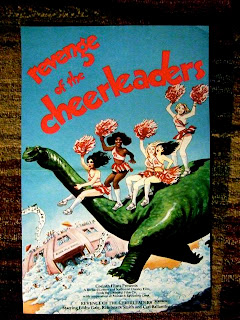
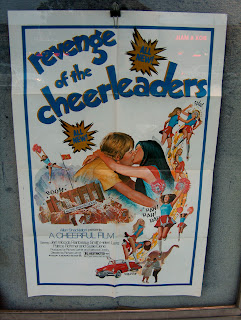
Certainly nicer ones than the ones in 1976 that stooped to exhibit Revenge of the Cheerleaders. I don’t remember if I was ever near a theater that even played this ostensible sequel to the original 1972 comedy The Cheerleaders, and my own awareness of the movie remained vague at best until Tarantino’s festival schedule was announced a month or so ago. I’d already decided I’d see it, mainly because it was attached to Pretty Maids. Then I got an e-mail from Jim Emerson encouraging me to see Revenge-- apparently he’d seen it and vouched for its singularity amongst the spate of R-rated cheerleader comedies of the time. Jim also sent along the keen nontheatrical poster displayed here which, as you might notice, differs somewhat from the original release one-sheet on display at the New Beverly. I saw that poster and immediately began preparing myself for some sort of rally squad take on Caveman, complete with low-grade stop-motion animation, but alas, that brontosaurus ride was conjured up entirely by the marketing wizards at Corinth Pictures, who sustained the movie into the video age after its brief theatrical run.
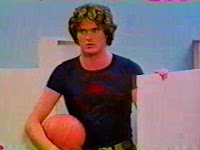
 But who needs rampaging brontosauruses in a movie when you’ve got these cheerleading babes? Revenge of the Cheerleaders roars out of the gate with an exuberant main title sequence chronicling the squad’s happy adventures in both cruising and changing out of their street duds and into their uniforms while driving. Nudity within the first minute of the movie, and scored to a pretty good rock tune too (“I Feel Good,” sung by Cathy Carlson)—so far, so good. Well, incredibly, ROTC sustains that exuberance for almost the entirety of its 88-minute running time. The movie consists of one outrageous, disarmingly funny, unapologetically ridiculous set of hi-jinks after another, with these sociopathic sexpots always placed front and center, and shedding their tops (and bottoms) at the drop of a hat. There is no narrative drive to be interrupted, so when the gang-- the cheerleaders and their basketball-playing boyfriends (one of whom is essayed by a lanky young actor by the name of David Hasselhoff, in the role of Boner) take time out for one of several hilariously choreographed dance sequences, well, it’s like the drive-in equivalent of a musical interlude from Chico and Harpo. (Only a cafeteria food fight in which stuffed shirt school board members, as well as unsuspecting students, are drugged into hysteria commits the capital sin of going on too long.)
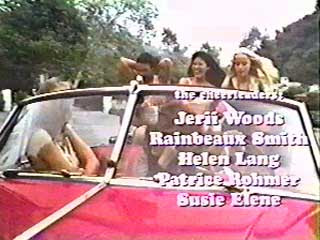 There is no curriculum at the "morally compromised" Aloha High School, only figures of authority to disregard or blatantly undermine— these cheerleaders and the rest of the Aloha student body make Riff Randall and her crowd look like straight-A honor society members. The girls and boys only want to have fun, which translates into a heady brew of screwing, playing basketball, cheering, robbing students at a thug-happy rival high school of their drugs (during class!) and riding around in a cherry red 1955 Buick convertible with the top down, and their tops off, of course. (The nudity is democratic too—there’s more than a flash of full frontal male twiggery on view here, including Hasselhoff, though his Boner status, based on this evidence, is overinflated.)
  It’s been a long time since I’ve encountered such a relentlessly likable feel-good-at-all-costs vibe in any movie, let alone one as low-rent as this one. Tarantino said in a recent interview, referring to discovering treasures in the world of exploitation movies, that not only do you have to drink a lot of milk to get to the cream, with exploitation fare you have to drink a lot of curdled milk to get to the milk. And that’s what Revenge of the Cheerleaders felt like to me Sunday night—the reward for having slogged through a lot of similar comedies that had the sex and nudity but none of the zip and tang and spirit this one has in buckets.
 The spirit at work in Revenge of the Cheerleaders is best illustrated by the participation of Cheryl “Rainbeaux” Smith as one of the main pepsters, known as Heather. Smith, an exploitation queen familiar to fans of films such as The Swinging Cheerleaders, Caged Heat, The Pom Pom Girls, Massacre at Central High, Slumber Party ‘57 and Vice Squad, as well as appearances in above-ground titles like Phantom of the Paradise, Farewell, My Lovely, Up in Smoke and Melvin and Howard, was a natural for this movie, and apparently the director and probably everyone else, wanted pretty badly for her to be in it. Because it’s quite apparent, from that opening credit sequence on, that Rainbeaux Smith is about six months pregnant while playing a high school cheerleader in this film. Her being in the family way just happens to fit perfectly with the movie’s theme of a high school under siege by developers who want to justify razing the property and building a mall on it by publicly condemning the student body as amoral hooligans. But one of the marvels of Revenge of the Cheerleaders is how matter-of-fact everyone is about her pregnancy. They’re so matter-of-fact, it’s never even mentioned until the movie’s epilogue, when someone pats her belly and comments on how nicely that little bun in the oven is coming along. But before that, Smith has romped nude in a wild group shower scene (protruding belly and engorged breasts in full view, obscured only by some soap bubbles), and she’s right in there smoking J’s and hanging out (albeit sometimes in nice, roomy frocks) with the rest of the gang, smack in the middle of all the chaotic comedy.
Right up through that epilogue, which has as much gratuitous nudity, silly laughs and salacious dancing in it as any other section of the picture, I remained giddy over how much I liked this movie. After the end credits, the movie jumps ahead (“Three Months Later” says the title card) and treats us to one last cheer from the titular (sorry) rally squad, who finishes off with a wave to an off-screen observer. The camera then cuts to a shot of a suddenly slender-again Rainbeaux Smith holding her baby in her arms, waving back at the girls and smiling with the shimmer of a real rainbow. It was at that point that Revenge of the Cheerleaders did something no other sex comedy of its kind has ever done—it genuinely moved me.
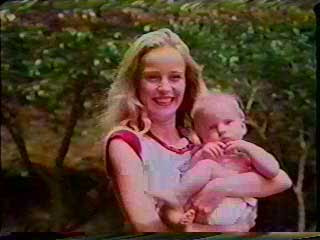
What a tribute to this plainly beautiful young actress. These nickel-and-dime filmmakers thought so much of her that wanted her in their cheerleader movie no matter how bulbous her belly, and felt so little needed to be made, thanks to her genuinely likable personality, of her condition during the film, that they gave her this touching moment to end their B-movie shenanigans. Earlier I turned to my pal Michael and remarked I was enjoying the movie so much that I was kind of shocked—I told him I was in awe of Revenge of the Cheerleaders. After seeing Rainbeaux Smith, who died in 2002 from complications with hepatitis, cradling her newborn baby at the end of what film historians will never recognize as anything but a crass piece of junk, an artifact from a generally worthless trend in American movies in the ‘70s, I embraced that awe as something genuine-- genuinely unexpected, genuinely touching. Revenge of the Cheerleaders, and the raucously appreciative crowd I saw it with at the New Beverly (whose enthusiasm spilled out onto the street audibly afterward), provided me with more fun than I’ve had at the movies in a long time. How could a comedy this funny, this saucy, this genuinely wild not have a big fat cult following it around and proclaiming its special joys?
UPDATE March 29, 12:04 p.m.: The link to the story of Cheryl “Rainbeaux” Smith’s life, as written by Chris Barbour, who was close to Smith for a time, and spoke to her shortly before her death, features excerpts from a short letter written by Smith to a friend during the summer of 1985. In it she recounts her favorite film experiences, among them Revenge of the Cheerleaders. Here’s what she wrote to her friend (spelling are grammar are as Smith wrote in the letter):
“REVENGE OF THE CHEERLEADERS: This is my absolute favorite of it's kind. Actually the other one's I'd personally like to forget. And if ever I become a millionaire--there will be a couple of the other ones (we know which!) missing off the shelves forever! Ha. REVENGE is a unique, musical comedy. To get the record straight: The guys--Richard Lerner, great guy. Did the original film (I'm not in it) X rated THE CHEERLEADERS. He did it for 1 reason, $. Which he made & used for his real love REVENGE. This was his joy. I must tell you about the casting. While doing my unfavorite of all times STAND UP & HOLLER I get a call from my agent. After the days shooting I'm to go on this interview. I find out its about CHEERLEADERS. Shit. "You want to see a cheer? I know a bunch!" I say, while I'm thinking this must be what I get for staying out of school to become a working actress. Several days after my appointment, not quite, finished w/ the other picture. I discover I'm pregnate w/ my 1st son, to my 1st husband, ('till this day the last). Anyway when I get called back to see Lerner again, I find his more than serious about me for his film. So I told him of my condition. He was very saddened. I was shocked when my agent called & said they wanted to see me again. Honestly, I couldn't understand why. I went on [word illegible]. Boy was I in for a shocker...Lerner had discussed w/ his partnerrs & writers & decided to write in a pregnate cheerleader! They thought it would be funny--& as it turned out it was a crazy twist. They tried to get a zebra as a mascot & have me ride it, until I told they weren't timable. I worked up until my 9th month w/ an excellent group of gals. Here are these beautiful girls w/ all this energy & me waddelin 'round like a fat duck. One day actually we're doing a night shoot in a giant, closed furniture mall. We're in overtime. The dir. is goin nuts & want to rap the entire thing. He wasn't in the best of moods thats for certain. With our budget overtime wasn't his favorite time! We were, us cheerleader's, in a good mood. The more the dir. yelled, the more outta hand we became & for the life of us couldn't stop laughing. "Shut up!" Lerner yelled. "Now when I say action I want you girls to run down this hallway after the guard as fast as you can!" Then "action!" And we were off runnin as fast as we could. I'm waddling down the way & start to laugh, back to the camera. "Wait! wait you guys, You guys..." 10 feet ahead of me, "please! wait up." Finally I'm laughing so hard i fall to the ground! The girls turn around & see me way back there & they point at me, look at each other, unable to speak. I'm hysterical laughter, fall down on their knees as well. Lerner goes "Thats a take!" Laughing. "Print it!" “
*************************************************************************************

More from the Los Angeles Grindhouse Festival 2007 coming soon! A peek through the New Beverly box office window reveals a gruesome triple feature coming this weekend-- The Blood-Spattered Bride, Asylum of Blood and Mary, Mary, Bloody Mary. Stay tuned.


 Posts
Posts


 I don’t think I’ve ever been witness to as ghastly a juxtaposition as that Mimzy/Eyes 2 disaster, or the kind of subliminal augmentation that so made Tyler Durden’s day in Fight Club. My stories of projector problems, growing up with my local movie house in the ‘60s and ‘70s, make up a pretty familiar laundry list—hallucinatory melting frames; the gradual fade-to-black that signaled a dying carbon-arc stick; reel changeovers accompanied by inexplicable sonic booms on the soundtrack; if it was a ‘Scope film being shown, the anamorphic lens would almost always need to be radically adjusted mid-film after every reel change; or any combination of the above at once, which usually resulted in complete shutdown of the movie, a tidal wave of flop sweat in the projection booth, and a chorus of “Put a quarter in it!” from the razor-sharp wits sitting among us in auditorium peanut gallery. And there was one instance I remember pretty vividly—a quiet pastoral scene which ended one of the reels in Disney’s original version of The Incredible Journey was interrupted rather shockingly when the changeover occurred and it was revealed that the projectionist had, instead of the next reel of the movie, accidentally loaded up the cartoon he’d showed before the feature—dogs and cats at rest together under the night sky suddenly, mercilessly gave way to a giant close-up of a grinning Donald Duck, shafts of light streaming from behind his head, and a fanfare leading into Donald’s theme song. The lights went dark, the quiet mood of the movie ruined, a few of the older patrons picked themselves up off the floor, and the rest of us did our part to uphold a tradition that I’m sure still continues in my hometown, where a hilarious comment only gains in hilarity if it can be passed down to a new generation of impatient morons—of course, we all began chanting “Put a quarter in it! Put a quarter in it!”


