


SUMMIT MEETING

SAM PECKINPAH, GUISEPPE ROTUNNO, SERGIO LEONE and MONTE HELLMAN commiserating on the set of Hellman’s AMORE, PIOMBO E FURORE (CHINA 9, LIBERTY 37) (1978).
(Thanks to Alex Cox.)


 Posts
All Comments
Posts
All Comments



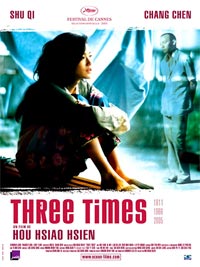 And in that spirit, one last round of links, these connected to some current reviews for the new film by Hou Hsiao-hsien, revered director of Café Lumiere, The Puppetmaster, Flowers of Shanghai and Millennium Mambo, among many others, none of which have gotten much in the way of U.S. distribution. His new film, Three Times, starring Shu Qi (Millennium Mambo, The Transporter, So Close) and Chang Chen (Crouching Tiger, Hidden Dragon, Happy Together and 2046), looks to be the exception which, hopefully, will pave the way for even more extensive distribution for Hou’s next film, and generate interest in a whole new group of uninitiated cinephiles and cinemagoers for whom Hou is still only a familiar name, a critic’s darling whose films, especially in theaters, are nearly impossible to see.
 I have not yet seen Three Times myself, but plenty of good writers have. (It opens here in Los Angeles today, Friday, May 12, exclusively at the Laemmle Music Hall on Wilshire Boulevard in Beverly Hills-- a small venue, so plan ahead.) Here are some insightful reviews to check out that will hopefully convince you to go out of your way, avoid the Poseidon/Mission: Impossible 3 crowds, and find a seat in the Music Hall before Three Times disappears:
 One more link for the week: Film critic Charles Taylor, late of Salon, writes this week in the New York Observer about the release of the extended cut of Casualties of War, which he calls “Brian De Palma’s masterpiece and one of the greatest of all American movies.” This is an opinion with which I happen to concur, although I haven’t been able to bring myself to watch this film again in a very long time, despite its stylistic-thematic brilliance, because the pain it presents is so raw, inglorious and horrific. However, the arrival of this new cut is definitely an excellent occasion to submit again to the film’s agonies, its insights and, of course, its resonance and pertinence to us as we find ourselves mired, as a nation, in a new age of war.
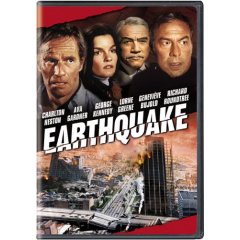 And Universal Home Video has jumped on Allen’s coattails this week with the DVD release of Earthquake, in remastered 5.1 Dolby Digital stereo but, alas, no Sensurround (just boost your subwoofer to 11—that’s about all Sensurround was anyway). Though I haven’t seen the slipcase packaging, I’m assuming this new edition of Earthquake will also be sans one of my favorite film critic blurbs ever to appear on a DVD, an endorsement from no less than Pauline Kael--—“The picture is swell!” But anyone familiar with her review of Earthquake (from the Reeling collection) will remember that the piece was anything but enthusiastic—it was, in fact, a scorching pan. And a close look at that review reveals that whoever edited the copy for that original Earthquake DVD probably just, um, made an honest typographical error—yeah, that’s it. Kael’s original review reads, “The picture is swill, but it isn’t a cheat, like Airport 1975, which was cut-rate swill.” (And in case that’s not clear enough for you, she goes on in the next paragraph to say that “Earthquake is Universal’s death wish for film art.”)
 “It's a compact, satisfying genre piece that honors tried and true Hollywood formulas, delivering the goods with a minimum of foolishness. And the always-dependable Kurt Russell is the film's ace in the hole. America's most underrated actor once again proves himself incapable of being anything less than absolutely forthright and sincere. ‘You know it's not fair who lives or dies,’ Russell admits during the movie's single pause for speechifying. ‘It never is.’”
 But easily the most satisfying and hilarious take on Unofficial Disaster Movie Week 2006 comes from our friend That Little Round-Headed Boy, who offers up a real gut-buster: the comprehensively titled ”WHEN TIME RAN OUT on THE POSEIDON ADVENTURE to THE TOWERING INFERNO because an EARTHQUAKE unleashed THE SWARM on a ROLLERCOASTER near the AIRPORT”, a very special round-up of the top 10 actors to ever appear in a ‘70s disaster movie. Strap yourself in, Ms. Swanson— we're in for a bumpy ride!
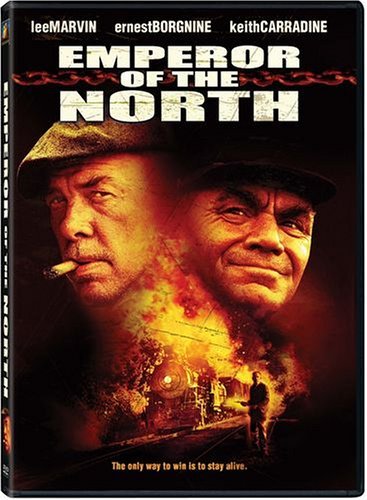 A few days ago I posted my own answers to Professor Van Helsing’s Spring Quiz, and in addition to Mean Streets, The Godfather, The Godfather Part II and the emergence of Robert Altman, the other film I listed as a highlight of the “golden era” of American filmmaking, roughly 1970-1975, was perhaps a bit of a surprise: Robert Aldrich’s Emperor of the North Pole (1973). It’s not a film that’s talked about much some 33 years after its theatrical release. But for those who saw it in theaters years ago, or consequently on TNT or some other cable network highlighting “Movies for Guys Who Like Movies,” it remains a powerful experience. And I admit I chose it out of a mixture of admiration for its brutal lyricism and also precisely because it seemed like such a relatively forgotten work, both as a product of American cinema in the ‘70s and even within Aldrich’s filmography—when the subject of Aldrich comes up, you’ll hear about The Big Knife or Kiss Me Deadly or The Dirty Dozen or Whatever Happened to Baby Jane? or The Longest Yard every time, but you’re unlikely to hear much about this one.
