Wednesday, October 19, 2005

GIANT GORILLAS ARE GO!


From deep within the ever-increasing shadow looming from Peter Jackson's King Kong comes this cheerful news from New York Press columnist Jim Knipfel-- Warner Home Video will bestow a high-quality, two-disc, official spiffification upon the original 1933 Merian C. Cooper/Ernest Schoedsack classic King Kong. As Knipfel notes, DVD's and VHS's culled from excessive repetition on Turner Movie Classics and other, far more degraded sources have been available for years-- and if memory serves me correctly, King Kong was among the first Criterion laserdiscs when the format was in its infancy in the late '80s. But it is great news that Warners, second now only to Criterion in quality and reputation as regards its treatment and preservation of its classic film library, will be taking advantage of the spotlight being thrown back on the Eighth Wonder of the World as Jackson's movie is readied for unveiling.

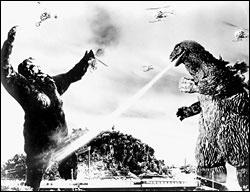
And, of course, others will be pulling out their giant apes to hitch a ride on the Cooper/Schoedsaack/Jackson bandwagon, including a dream DVD pairing of the Toho classics King Kong vs. Godzilla (which was based, believe it or not, on a concept originated by the 1933 Kong's special effects wizard, Willis O'Brien) and King Kong Escapes. Knipfel has the details on this and more in his round-up of giant gorilla DVDs coming your way in November.

PITTSBURGH VULNERABLE TO ATTACK BY UNDEAD?


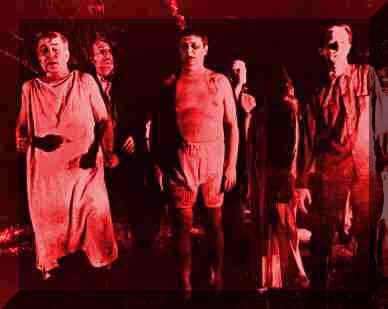
This just in: The Onion reports this morning on a new study that reveals Pittsburgh as apparently woefully unprepared for a full-scale zombie attack. Neither George A. Romero, Danny Boyle, Edgar Wright nor Zach Snyder, all considered experts in the field, could be reached for comment.

A CLICK AWAY FROM TIKI MOVIE HEAVEN


Well, I’m on my second late night compiling all the great answers to Professor Wagstaff’s Summer of 42 (Questions, That Is) Movie Quiz, and if I can get an early start tomorrow evening, I dare say there’ll be a little morsel to keep you occupied over about a week’s worth of bathroom sittings by sometime Thursday. (I’m always thinking of you, Mysterious Adrian Betamax. Always.)

Until that time, however, I didn’t want to let much time pass without trumpeting the new Web site for one of my favorite places (and hopefully yours too one day), the Mission Tiki Drive-in. The site went on-line Tuesday, and it’s a real beauty. Some of the departments are still under construction, but for the most part it’s up and running and looks to be a great harbinger of the complete tiki vision that will have overtaken and enhanced this already marvelous drive-in by May of next year. So give the site a click and start making plans to take advantage of the fact that, whether it’s at the Vineland, the Van Buren, the Rubidoux, the Mission Tiki, or even outdoor cinema locations in Barstow, 29 Palms or San Diego, drive-in season in Southern California doesn’t come to a screeching halt in October like it does in many other regions of the country.


I’m rounding up a group of hearty outdoor film fans for an invasion of the Mission Tiki this coming Saturday, so if you see a bunch of us lined up outside our cars, wrapped in blankets and thoroughly enjoying a double feature of Doom and Serenity, stop by and say hello!

Wednesday, October 12, 2005

MY FRIEND BILL SAYS, "SEE INTERSTATE 60!"


My wife and I have a close friend, Bill Hamilton, who lives in Daly City, California, just outside of San Francisco. Bill is a passionate cat lover, an editor, an opera singer and aficionado, a proud skeptic, a prouder Libertarian, and a lover of film. Given the high level of connoisseurship involved in his interests, I’m always amused and delighted that his taste in movies is so eclectic. Some would say “unsophisticated,” but I wouldn’t—Bill’s a man who is an appreciator of arts for which many of us are either too impatient or too, yes, unsophisticated, but he’s remarkably unpretentious, especially when it comes to movies. His taste runs from the mainstream-- Lawrence of Arabia and the Lord of the Rings trilogy are particular favorites—to artier fare, but he also has an unquenchable taste for pulpy, grind-house horror and science fiction. It was his recommendations that led me to Brian Yuzna’s Society and Mark Herrier’s Popcorn, among many other tasty treats. And while I would never say that everything Bill has recommended has panned out for me (he was very enthusiastic about Queen of the Damned), I tend to go the extra mile when he offers a recommendation of something I’ve never heard of, largely because he’s one of the few discriminating viewers I know of who still looks closely at straight-to-video titles, the dregs of the video universe, and decides to see them if he’s intrigued, rather than dismissing them out of hand simply because they were assigned B-level status or otherwise dumped by a studio without much more than a whisper of publicity.

Many terrific cinema classics and underappreciated gems have come from these ranks. Right now director Carroll Ballard (The Black Stallion, Never Cry Wolf) has a new movie, probably already in its last hours in movie theaters, that you’ve never heard of called Duma, about a boy’s struggle to return a pet cheetah into the wilds of Africa. Warner Bros. decided that no one would go to see the movie, and only after the likes of Roger Ebert, Stephanie Zacharek and others came out stumping for it, encouraging audiences to see it in limited engagements, did Warners mount a measly ad campaign and dumped it in a few theaters nationwide with little or no fanfare. They want the movie to die so they can say they were right, and Duma will eventually end up fighting for attention amongst all the more heavily hyped hits on the new releases shelf of your local Blockbuster, getting rented only when all the copies of Kicking and Screaming and The Interpreter are cleared off the shelves. Bill wouldn’t set foot in a Blockbuster—he’s a Netflix man—but I don’t doubt Duma will end up in his queue, along with a host of other films that few of us have ever heard of or seriously considered renting.

He e-mailed me tonight to let me know about one such movie, and a quick glance at its credits convinced me to go out on a limb and pass the recommendation along. Here’s what Bill wrote:

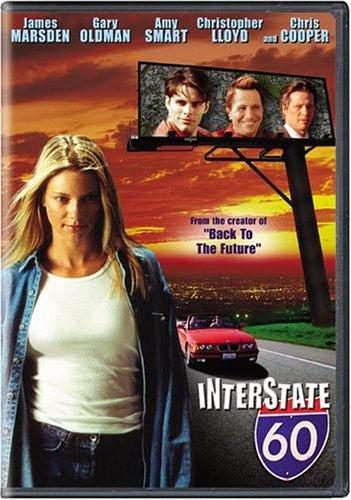
"I rented a wonderful movie over the weekend, a fantasy with several great actors, a couple of lousy actors and a great script that more than redeems it: Interstate 60. One of my favorite actors, Chris Cooper, is especially memorable. It went direct to video, which is a shame. It should be required viewing in high schools.”

I found that last comment pretty intriguing, but a glance at the name of the writer-director was even more revealing. It turns out that Interstate 60 is written and directed by Bob Gale, who, with Robert Zemeckis directing, produced and co-wrote the Back to the Future trilogy and, much more importantly for me, a trifecta of brilliant comedies from 1977-1980-- Zemeckis’ I Wanna Hold Your Hand, Steven Spielberg’s 1941 and the hilarious profane and astringently amoral farce Used Cars, also directed by Zemeckis. Interstate 60 features a cast of cameos that will look pretty familiar if you love those movies—Christopher Lloyd and Kurt Russell both makes appearances—and the rest of the cast, including Art Evans, Ann-Margret, Amy Smart, James Marsden and Bill’s favorite, Chris Cooper, is a pretty good one. This 2002 release certainly sounds like one that got away—John Ulmer, on Rotten Tomatoes, says “It’s a shame that the majority of moviegoers and families seeking quality films will never even see this film, much less hear about it.” Comments like that, my interest in seeing what a acerbic writer like Bob Gale will have done with his directorial debut, and my appreciation for the odd and charmingly eclectic movie tastes of my friend Bill Hamilton, have made me reserve a place on my own Netflix queue for Interstate 60. Thanks for the heads-up, Bill!

Monday, October 10, 2005

AARDMAN ANIMATION WAREHOUSE LOST IN FIRE


CNN reports that a warehouse fire has claimed almost the entirety of the props, sets and character models of the Aardman Animation company in Bristol, England. “Our whole history has been wiped out,” said a company spokesman. Incredibly, the man who has more invested than most in the destroyed studio inventory, Nick Park, the Academy Award-winning creator of Aardman Animation and its most beloved characters, Wallace and Gromit, was the one with the clearest perspective about the loss. "Even though it is a precious and nostalgic collection and valuable to the company, in light of other tragedies, today isn't a big deal," he said.

Apparently, the sets from the studio's latest film, Wallace & Gromit and the Curse of the Were-rabbit survived the blaze, perhaps in part due to their presence in an exhibit currently on display at the Arclight Cinemas in Hollywood, in conjunction with the movie's recent release. The exhibit continues at the Arclight through October 16.

Friday, October 07, 2005

AUTUMN NIGHTS AND OUTDOOR CINEMA: September Drive-In Update


One of the pleasures of getting older is coming to the realization, however gradually, that being uncool is okay, that there are many worse things that could happen to a person than getting in touch with one’s inner geek, whatever that geekdom might revolve around. Of course, like anything, one really should have enough perspective to realize when one’s enthusiasm is crossing over into obnoxious behavior, and that not everyone, if pressed, is going to share that enthusiasm. Fortunately, this summer I’ve become a geek all over again in my enthusiasm for drive-in movies, and luckily, I happen to be surrounded by a bunch of very sympathetic friends, family and coworkers who all have their own personal histories with drive-ins on which to draw. They have been very receptive to, if not jumping whole-hog onto the drive-in bandwagon along with me, then at least coming along for some terrific nights of socializing and movies under the stars, even as the summer nights turn to the chillier desert nights of autumn. What’s gratifying is the level of enthusiasm that I have encountered among almost everyone I’ve talked to since becoming a member of the Southern California Drive-In Movie Society. There’s so much more interest in the experience of seeing movies at drive-ins than any of us expected to discover, including the owners and managers of these heavenly centers of cinema—almost everyone I’ve spoken to has expressed fond memories and a love of attending “ozoners,” and almost no awareness that, far from being dead, there is a very small, but thriving and (here’s the wonderful part) growing community of drive-in moviegoers whose entertainment budget is built around regular weekend visits to one of the four terrific drive-ins in the immediate Los Angeles area. And as the word spreads, it’s exciting to think about the possibility of that business increasing to levels significant enough that other drive-ins will begin to see the financial wisdom, as well as the treasure trove of public relations windfall, to be gained by following the trail being blazed by De Anza Corporation at the Mission Tiki Drive-In in Montclair.

SATURDAY, SEPTEMBER 17, 2005: MISSION (TIKI) ACCOMPLISHED


I NEED A TRIPOD: If my hand were steadier, everything would be clearer-- but at least you can see the moon above the Mission Tiki

About a month ago I put the word out at my office that I was intending to assemble a convoy of cars for a big night at the Mission Tiki Drive-in. The e-mails I got back expressing interest were a lot more plentiful than expected, and also a lot more excited about the idea than I thought would be the case. Unfortunately, a lot of people had to bail out when they looked on their calendars and realized that they already had others things (parties, art gallery openings, vacations) planned that would take up the night I had announced. So I promised that we would reschedule another trip for October, and the five of us who could make it would hightail it out to the MI on Saturday night, September 17, in the hopes that everyone would have such a good time that they would themselves want to return for the October event and talk up the Mission Tiki in between now and then. I found out too that it’s a lot easier to get five people to agree on a double feature than to convince 15 or more to see the same movie, the idea being that if we all stuck together, there’d be more of a block party, or at least family barbecue kind of atmosphere with everyone pulling out chairs, hanging out on tailgates and chatting, all the while enjoying the show. When Saturday night came, Paul, Andrew, Liz and myself headed down the 210 toward a little bit of Technalight paradise, and Michael drove up from Long Beach, where he was attending an art gallery opening (See? I wasn’t kidding).

I contacted the Mission Tiki’s ever-gracious manager, Jeff Thurman, and asked if, since it was getting darker earlier and I was bringing out a group of friends, it would be possible if we could come in a half-hour or so earlier than when the box office officially opened. Jeff had no problem with that. We all arrived just after 6:00, proceeded through the back gates and set up camp in front of our screen, which was showing The 40-Year-Old Virgin and The Skeleton Key-- two good movies, as it turned out, that were the perfect combination of raunchy laughs and atmospheric, cheap thrills for our group. We then met up with Jeff, who brought us all up to the projection booth to show off his Technalight beauties and give us a little glimpse into his routine as he prepared for a Saturday night crowd. All of us were, to a man (and woman), impressed with Jeff’s knowledge, his experience in the business, his friendliness and his generosity, and as we headed away from the booth—we probably yakked with him for a good half hour—everyone was feeling pretty special already, and the movies hadn’t even started. They would very quickly, though, so we hit the snack bar, fast and hard, in an attempt to make it back to our cars without missing too much of the movie. Liz, in particular, was a little stressed about missing the beginning of the movie, but I think she (and we all, to be honest) felt a little better about it once we decided to sit through the second intermission and watch as much of the second screening of The 40-Year-Old Virgin (late night start time: 11:45pm) as we’d missed the first time around. The group’s positive reaction to the Mission Tiki went even further when they saw the immaculate snack bar. We ordered a ton of food amongst us, and I don’t think any one of us spent much more than $5.00—for the princely sum of $3.75, I got a hot dog and the best double cheeseburger I’ve ever tasted at a drive-in-- $3.75! And without the specter of food poisoning rattling its chains in the back of your mind all night after you’ve finished off the chow! There are plenty of multiplexes where you’d be lucky to be able to park your car for $3.75, let alone make a serious run through a snack bar. And $3.75 would buy you just over a third of an admission price to most AMC and Mann Theatres in my neighborhood if you like to go to the movies at night. Is it any wonder that drive-ins are becoming the number-one movie entertainment option for many families? Then add to that the fact that the projection at the Mission Tiki is about as bright as what you’d see at any of these indoor theaters, and the bargain ($5.00 a person at the box office for a double feature!) becomes flatly undeniable.

From left: Liz, Michael, Andrew and Paul-- that's me behind the camera-- lounging amidst the firmament at the Mission Tiki

We popped the hatch on my minivan, dragged out the camp chairs and settled in for a grand time soaking up a terrific double feature under a full moon. The 40-Year-Old Virgin was hilarious—perfect, raunchy drive-in fare—and I think we were all surprised at how good The Skeleton Key turned out to be—its mixture of familiar thrills, creepy atmosphere and sharp pacing did the trick for each of us, and the occasional glimpse of Kate Hudson in black panties made 4/5 of our group even more glad we’d chosen to see it. When it came time to pack up, Paul, Michael and I were lucky enough to bump into Jeff one last time before leaving and thank him again for a wonderful night at the movies. And as we drove away, Paul and I didn’t even notice until we were on the streets cruising back toward the 10 Freeway that we could still hear the dialogue from The 40-Year-Old Virgin fighting a losing battle to ambient static as we moved further and further away from the movie’s low-wattage, FM-transmitted sound source. The soundtrack crackled and buzzed and finally gave way to the hiss and growl of several faraway signals crowding the same frequency, and Paul and I talked all the way home about what a fine night of entertainment it was. It surprised me to realize how happy I was to hear Paul say that he was looking forward to coming back in October.

SATURDAY, SEPTEMBER 24: VINELAND FINELAND


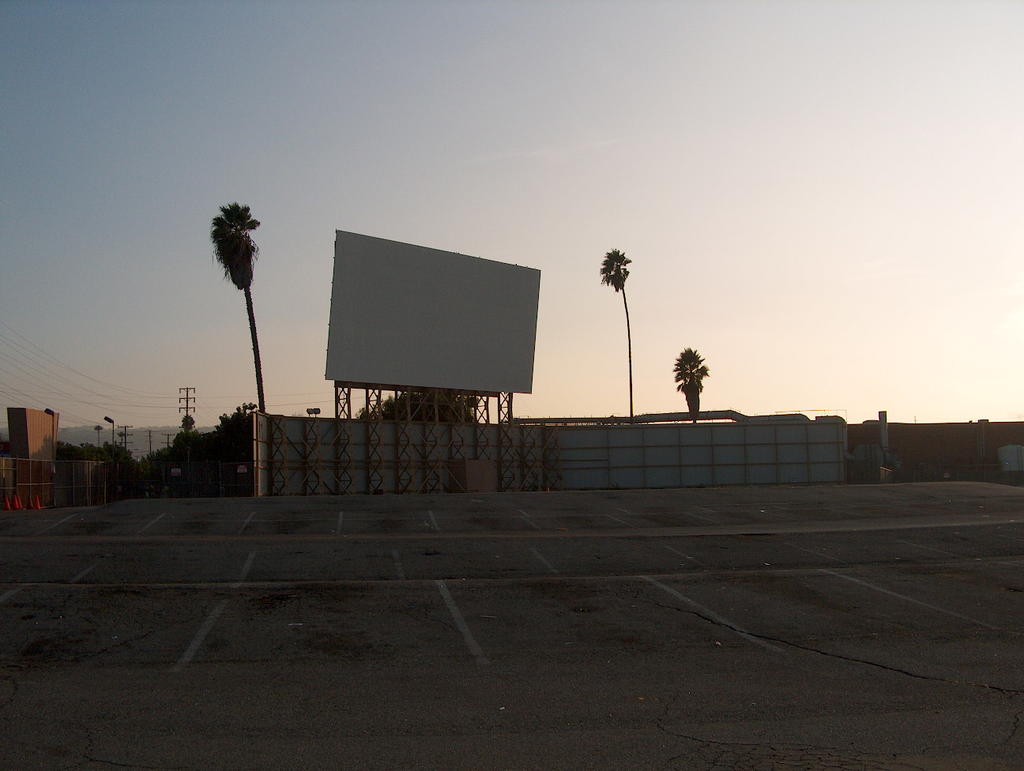
The latest meeting of the Southern California Drive-In Movie Society convened a week later, Saturday, September 24, at the only operating drive-in left in Los Angeles County, the Vineland Drive-in, on Vineland Avenue off Valley Boulevard in the City of Industry. I missed the group’s dinner meeting thanks to hellacious traffic on the 210 going through Sierra Madre, so I proceeded right to the theater, where I was first in line at the box office gates at about 5:50 p.m. I climbed out of the van and walked around, took a few shots of the lot and screens, and then headed back to keep an eye out for others who I knew were coming that night. But before I caught up with the faces with which I was familiar, I got a little taste of the fact that the Southern California Drive-In Movie Society has become, in its own small way, somewhat of a known entity in the local drive-in world at large. A man who I observed shooting videotape of the grounds while waiting for the gates to open made his way over to my car and struck up a conversation.His name was Rick, and it turned out that he was a drive-in fan with knowledge of theaters, open and closed, all up and down the West Coast (and probably beyond). And literally the first thing he asked me was, “Are you a member of that Southern California Drive-In Movie Society?” (Holy schnieke, what did people starting groups like these ever do before the advent of that godsend, the Internet? Thank you, Al Gore!) Rick told me he’d been bringing his family to the Vineland for years and years, and though he knew about the Rubidoux Drive-in in Riverside, he was unaware of the Mission Tiki. But was he ever excited to find out about it! We talked for 15 minutes or so until the crew cleaning up after the swap meet finally started to get a handle on all the swirling trash on the lot and it began to look like the gates would finally swing wide and let us in. By the end of the evening, Rick and several others had become members of SoCalDIMS, and Rick was already making plans to head out to the Mission Tiki to check out Technalight. Wow, I hadn’t even gotten onto the property yet, and I’d already gotten to yak it up with a fellow drive-in fanatic. The evening was beginning to look a little brighter, and the ghastly experience of the traffic I endured to get out to the Vineland was becoming a fading memory. In addition to looking forward to hooking up with the core of SoCalDIMS again, I’d also invited some more friends out to experience the joys of outdoor cinema with me, and just after I got parked on the lot for screen #4, I saw them driving in. Paul was back, in the company of fellow buddies Steve and Michelle, and two other compadres, Kimberly and Fiontann, would arrive shortly after. They parked next to my van and started setting up the chairs while I headed in to meet up with the group and start putting up the SoCalDIMS posters I’d designed in strategic spots around the snack bar.

Our meeting nights are always fun, not only because we get to meet up with each other again and share each other’s enthusiasm for drive-ins, but because nowadays there are events to discuss and ideas to bandy about in preparation for things we want to do as a group to promote this marginalized but still vital aspect of American pop culture. And perhaps most exciting for me is simply standing next to one of the snack bar tables we commandeer as our center of operations, handing out sign-up sheets for the club, passing out some of Kathy’s terrific photo postcards of drive-ins she’s visited, drive-in-related articles from this blog and copies of the group’s mission statement, and most important of all, connecting with the many, many folks who wander into the snack bar looking for a popcorn and a Coke and end up talking to us at great length about what we’re trying to do and about their enduring love for their drive-in. This night was no different, and like the Van Buren and the Mission Tiki, this snack bar was processing people all the way through each feature. It’s nice to see that people frequent these refreshment counters as faithfully as they do, because that’s where the drive-ins are making almost all of their money—most of the admissions go toward the rental fees of the features themselves, and it’s not unless a movie hangs on for several weeks that the studios’ percentages of the take decrease and begin to favor the exhibitor. The Vineland’s snack bar is, fortunately, plenty vast, with tables and chairs on the inside, and while its food is not quite up to Mission Tiki standard (which is itself eclipsed by the spectacular carne asada grill at the Van Buren), they still pop a fine corn and pour a frosty carbonated beverage with the best of them, and really, that’s all a snack bar need do to be a welcome pit stop at any drive-in.

The Vineland is currently celebrating its 50th year of continuous operation, and many drive-in lovers, who watched location after location disappear from the Pacific Theaters advertisements in local newspapers like the Los Angeles Times during the ‘80s and early ‘90s, have assumed for a long time that the Vineland was the only game in town. Thanks in part to the efforts of the Southern California Drive-In Movie Society, it can now be said that that perception is beginning to change. But it is no one’s intention to take any of the spotlight away from the Vineland and its ability to survive the grimmest period in the history of the American drive-in movie theater, and emerge into the 21st century still doing the kind of sell-out business that it does 52 weeks out of the year. And after our group night at this vintage Los Angeles outdoor theater, it’s clear that one of the main reasons the Vineland continues to thrive is Pacific Theaters’ ace in the hole, manager Juan Gonzalez. Within seconds of meeting this man, his love of the drive-in business becomes clear, and he never wavered in expressing his appreciation of the efforts of SoCalDIMS to keep the flickering flame of drive-in love burning amidst some pretty breezy conditions nationwide. His enthusiasm after so many years in the business, and undoubtedly so many years of worrying when the bottom was going to fall out from underneath his baby like it had for so many other drive-in managers, was frankly awesome to behold. And, last but certainly not least, he couldn’t be a nicer, more affable fellow. He was very proud to show off the platter system in his sparkling projection booth, which is capable of running one print of a film on multiple screens—Juan could show Flightplan on all four lots if the situation ever called for it (I doubt if he, or anyone, would ever really want to, but that’s another story).Chris and the core membership of SoCalDIMS have always been pretty up front with Juan, however, about our main ulterior motive as regards the Vineland, and that is our mounting an effort to convince his bosses at Pacific Theaters of the wisdom of investing a relatively small amount of money to equip his four projectors with Technalight, the brilliant illumination system that has literally, over the course of one summer, changed the fortunes of the Mission Tiki and is about to do the same for the Van Buren. Juan himself is so excited about Technalight that he accompanied SoCalDIMS member Sal Gomez on a field trip to see Jeff Thurman’s Technalight fleet in operation at the Mission Tiki earlier that week. Jeff, of course, gave him the four-star tour and was very excited to be able to talk shop with another manager/projectionist, expressing just how important Technalight has become to the De Anza line of drive-in theaters in California and other states. If the Southern California Drive-In Movie Society could choose one concrete accomplishment to be able to brag about in the coming year, I’d have to think that playing a role in making Juan’s Technalight wishes come true would have to be tops on the list. And if Pacific Theaters could somehow be convinced, through the letters from our group and anyone else who has a stake in seeing the Vineland endure and improve and carve out another 50 years of unique movie experiences in Los Angeles County, that their business would see an increase comparable to that which Jeff and the Mission Tiki have enjoyed this year, I can’t imagine that there would be much hesitation at all to bring Technalight into Juan Gonzalez’s world, and to the faithful families and couples and groups of friends who pack the Vineland every week. (If you want to become a member of the Southern California Drive-In Movie Society, or if you’d like more information on how to get in touch with Pacific Theaters and let your voice be heard regarding the Vineland and Technalight, contact Society founder Chris Utley at socalozoners@comcast.net.)

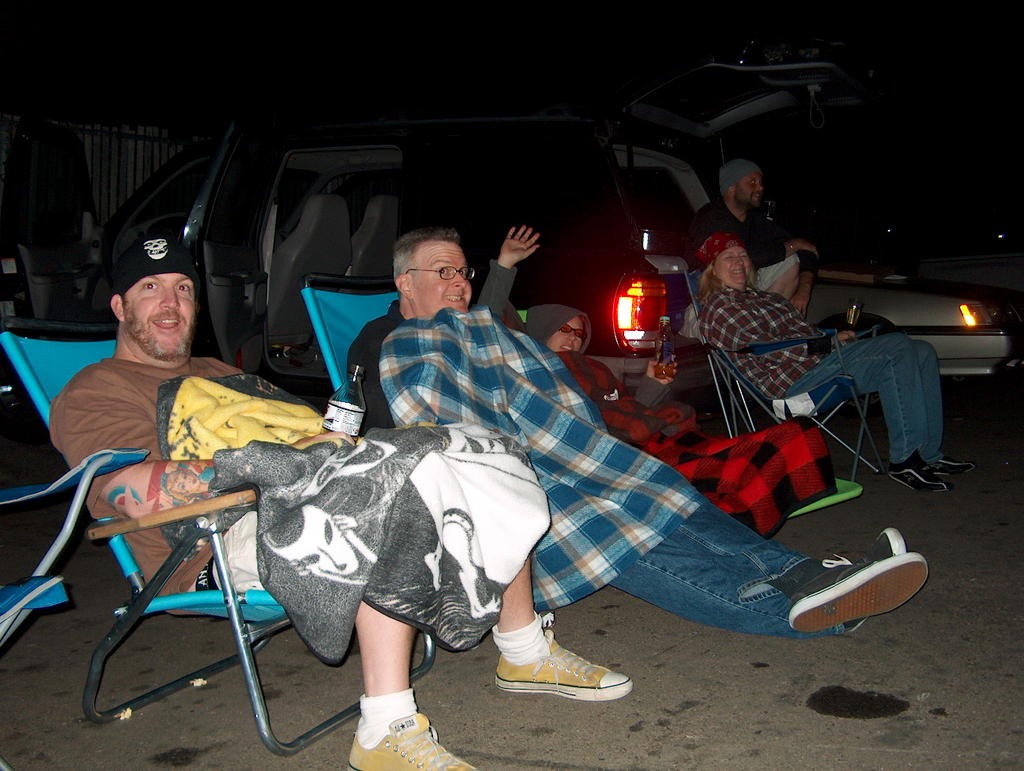
From left-- Steve, Paul, Michelle, Kimberly and Fiontann enjoying an outdoor Exorcism at the Vineland (that's me behind the camera)

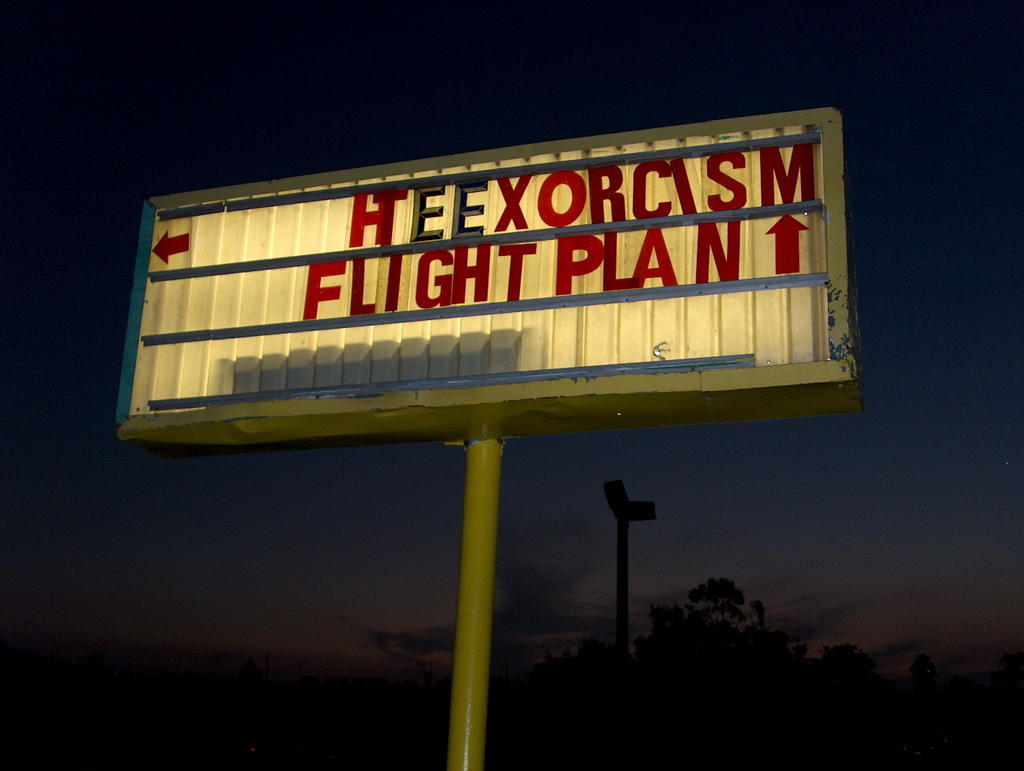
Even after all this activity, I was still able to join all my pals as we lined up the chairs behind our two vans and settled in for another great drive-in double feature—horror and action this time around, courtesy of The Exorcism of Emily Rose and Transporter 2. It was quite a bit chillier this time around, so much so that even I, renowned among our group for being able to endure the nippy air at the Mission Tiki the previous weekend clad only in shorts and a T-shirt, had to break out the blankets halfway through the first feature. Not that The Exorcism of Emily Rose contributed any of the chills, however. It’s a watchable, rather literal-minded thriller that tries to split the difference between courtroom drama and grotesque horror, effectively diluting both approaches in the process. Seen at the drive-in, a place where snarky remarks and inappropriate laughter are less likely to bother fellow filmgoers, it went down just fine, but I could imagine that seeing it indoors might be just a little on the dull side. Dull is the last word I’d use to describe Transporter 2, which is just about as outlandish an action picture to have come down the pike in a long while. I enjoyed that outlandishness well enough, but I still couldn’t help feeling slightly let-down, my expectations having been raised so high by the marvelously exciting Jet Li thriller Unleashed, director Louis Letterier’s previous 2005 release. And to be honest, as well-made as Transporter 2 is, it’s somewhat less grounded in physical reality than was The Transporter (co-directed by Letterier and martial arts choreographer Cory Yuen), and therefore far less urgent and truly exciting. And perhaps most importantly, for me anyway, the filmmakers have traded away the lovely screen presence of Hong Kong starlet Shu Qi (So Close, Millennium Mambo), who spent a good portion of the original film in the trunk of transporter Jason Statham’s Audi, for a villainous, skanky-looking, 20-pounds-too-skinny runway model-type brandishing raccoon eye makeup and matching automatic machine guns. Again, good drive-in fare to be consumed amongst friends, but nowhere near as emotionally ambitious and technically skillful as Unleashed. And to top things off, we, of SoCalDIMS, did get a very nice couple of treats courtesy of Juan Gonzalez at intermission—first, an radio announcement of our presence in the snack bar along with an invitation to stop by and get more information about what we were going to be up to in October and beyond, and a very heartfelt expression of appreciation, for all four lots to hear, for our efforts on behalf of the Vineland and all the drive-ins of Southern California. And as if that weren’t enough, Juan laid some Pacific Theaters passes on us, for which I’m sure we can all find some very good use—who’s up for a return trip to the Vineland?

COMING ATTRACTIONS

So what is on the drive-in schedule for the month of October? Well, my beautiful little girls have been bugging me for a month now, ever since our successful Sky High/Herbie: Fully Loaded double feature at the Mission Tiki, about when we’re gonna get to go back. Answer? This coming Saturday night! The classic car club Great Autos of Yesteryear will be gathering their collection of fine automobiles on one screen, and they’ve procured a brand-new, pristine Technicolor print (one of only two in existence, according to Jeff) of the 1966 20th-Century Fox feature Batman, the big-screen companion to the hit TV show to be shown off in all the incomparable fashion and splendor that Technalight can splash onto the screen. In fact, Fox is so protective of the print that they’re insisting Jeff sit at the side of the projector and baby-sit the film for its entire running time, lest the unthinkable happen…

Unfortunately, as much as I’d love to see the cheesy splendor of Adam West and Burt Ward crawling up the sides of buildings and being attacked by rubber sharks, as well as the entire back catalog of Batman villains, it’s an event for car club members only, and, unfortunately, it’s been a long time since I fired up the sewing machine in the butt-end of my old ’68 Volkswagen Beetle. So instead, the Mrs. and I will be enjoying Wallace and Gromit and the Curse of the Were-rabbit with the girls amidst the luxury of throw pillows and blankets out the popped back end of our minivan. And since the show starts at 7:30 and the co-feature is the persistently unappealing Just Like Heaven starring Reese Witherspoon and Mark Ruffalo, we’ll be able to head home at the relatively decent hour of 9:06 p.m., according to the schedule on the Mission Tiki web site. The first dance my wife and I danced together after we got married was to “Just Like Heaven” by the Cure, but even I’m not sentimental enough to think that that means I have to sit through that movie…

As for that projected get-together of coworkers for our second assault on Jeff and the Mission Tiki, it’s scheduled for Saturday, October 22. I’ll be sending out the e-mail for convoy recruits tomorrow in the hopes of not getting sabotaged by everyone’s social calendars this time around. But I’ll guarantee that, no matter how many end up coming, they’re very likely to have a great time. Just ask Paul!

And that’s not all, folks! The next meeting of the Southern California Drive-In Movie Society at the Mission Tiki has been on the books for Halloween weekend, Saturday, October 29, but recent developments have cast that date in doubt. Look for an update on this page when the date has been firmed up. But SoCalDIMS meeting or no, my best friend Bruce, another long-time drive-in enthusiast, as well as a fellow enthusiastic pursuer of his inner geek, will be in town for an increasingly rare visit, and it just wouldn’t be right, after all this hype, not to treat him to a night at the Mission Tiki. So we’ll be there one way or another. If you see us on that night, or on October 22, say hi. You’ll know us— we’ll be the ones sporting the mile-wide grins, giddy at the prospect of yet another night wrapped up in the firmament off-screen and on at the Mission Tiki.

To paraphrase something James Garner once said (and I heard him say it at the ozoner of my youth, the Circle JM), support your local drive-in!

Wednesday, October 05, 2005

DON'T LOOK NOW: REVISITING BRIAN DE PALMA'S BODY DOUBLE


Recently I participated in an informal poll over at 24 Lies A Second regarding the films of Brian De Palma in which I casually commented that Body Double was one of three Brian De Palma films for which I essentially had little use (the others were Obsession and Scarface). My friend Peet, founder of the site and a vigorously articulate De Palma enthusiast, expressed surprise in an e-mail that I could so blithely dismiss the movie, as he has had much love for it ever since first seeing it years ago. So I wrote back inviting him to talk about it, as I had never really heard anyone mount much of a defense for this movie, much less someone who I knew would have well-formulated opinions and a good handle on his own responses to it. A little over a week ago Peet dropped a comment on this blog in which he took up my suggestion to elaborate upon why he holds Body Double so dear. Here’s what he said:
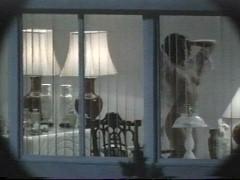
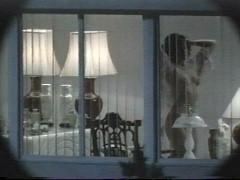
“I've always had a huge crush on this movie. I'm sure hormones played a part in that, since I was 13 or 14 at the time. But the film has never failed to mesmerize me since. It's one of the most hypnotic movies I know of and a masterpiece of mise-en-scene. I could marvel at that beach scene forever.

The subtext of the film is all about De Palma raising his middle finger to the critics who slaughtered him for
Dressed to Kill and Scarface. He openly confronted them with the very things they accused him of (excessive violence, misogyny) and made sure to enthrall them at the same time, just to point out their hypocrisy.

Feminists who hate the film will love me agreeing on this, but I really do think Gloria Revelle - her name says it all - is strictly an object of desire. Besides a bunch of other things,
Body Double is very much about male fantasy. Gloria's good looks and vulnerable attitude make her the perfect projection of male obsession. There's nothing real about her. She's an ideal, a goddess. (Mind you, the way De Palma uses a sexual archetype in order to explore the theme of male desire is hardly the same as portraying ALL women as sex objects.)

Her death scene isn't exactly devastating, but a cold shower. Because De Palma puts so much effort into the visual "foreplay", Gloria becomes our object of desire as well. When the killer breaks into her house, we are torn between two extremes: wanting to save her and wanting to have her (there's no way I'll ever accept the drill is not a symbol for penetration, no matter what De Palma has said to defend himself). Especially because we don't get to see the actual killing ourselves, the emotional result is a double anti-climax. Not Gloria but Jake is the victim here, and it's ourselves we pity. In the end, the audience is revealed to be just as voyeuristic as Jake, and that thought made a lot of people uncomfortable. If Gloria's death scene doesn't seem emotionally satisfying, well... that's the whole idea, really... It's just about the cinematic equivalent of premature ejaculation if you think about it. De Palma's death scenes are really love scenes and his love scenes are really death scenes.

Despite the likes of Armond White calling him a "weak actor," I've always thought Craig Wasson was perfectly cast in this. Yes, he totally lacks the star power that could have helped to make the film a commercial success and he doesn't exactly deliver what can be described as a powerhouse performance. But the man's playing an unemployed actor, for God's sakes--a born loser, a regular Joe longing for a little excitement in his lousy life. A charismatic star like John Travolta in the same everyman role wouldn't have been believable.

Because Craig Wasson plays Jake as such a goody two-shoes, you never really believe he's a pervert, eventhough he's peeking at naked women and digging up panties from trashcans. I even like the part where Jake is pretending to be a sleazy porn producer. His performance is quite impossible to take seriously and it makes perfect sense, since we're looking at the reason why the guy's unemployed to begin with...

I guess it's more the character that the actor that annoys people, because weakness isn't exactly considered a virtue. But this is the story of somebody who tries to overcome his weakness. The story of an actor trying to act. The story of a sexless nobody wishing to become a stud. The weakness is an essential element of the narrative.”


I wrote back on the comments page that I was really happy to hear his words on the subject, and I promised I would respond. A little over a week later, with some good-natured prodding from Peet himself, I have finally done so. The following article is that response. Thanks for your patience, Peet, and again in advance for enduring the length of my comments. As you know, I am nothing if not long-winded, especially absent someone to crack the whip and wield the straight razor…

(Also, I am assuming, Dear Reader, a certain level of familiarity on your part with Body Double, which is why I have eschewed including a synopsis of its narrative. If you’re unfamiliar with what goes on in this movie, arguably one of De Palma’s most notorious, and still feel compelled to read on, you can catch up on a brief sketch of the plot before continuing on.)

***********************************************************

Peet, the first thing that struck me when I revisited your comments re Body Double was that I didn’t really disagree with any of your observations per se, just maybe some of the conclusions. I never really cared much for Body Double when it was first released. Though it strikes me somewhat more mildly than it once did in terms of its subject matter, and, paradoxically, perhaps a little more potently as a whole film, I still think it’s among De Palma’s weaker efforts. (Is my tolerance/acceptance/understanding of Body Double a result of the aging process? Or is it that, in 2005, the envelope has stretched so far beyond recognition that a film so steeped in the desire to shock, to rub the audience’s nose in the supposed transgressions of its creator, seems relatively tame now compared to some of the raunchy roads traveled by R-rated films since it came out 20 years ago?)
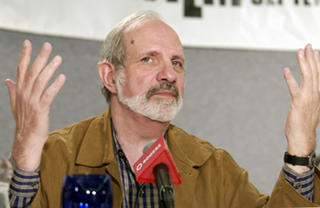
I wrote in a review of the film in 1985 in which I expressed the opinion that one-upsmanship borne of anger was a fairly unstable foundation on which to build a film. I still feel that way. De Palma said in an Esquire interview at the time of Scarface’s release that he was so disgusted with the hypocrisy of the M.P.A.A. (the ratings board saddled the movie with an “X” until the director toned down the infamous chainsaw torture sequence) that he was really gonna let “them” (The M.P.A.A.? The paying audience? De Palma fans and supporters?) have it next time, saying, essentially, that if they want an “X,” by God, I’ll give ‘em one. The fundamental problem with .Body Double, as I see it, is not that impulse of anger itself, but how it seems to have clouded the director’s normally sharp instincts for what he can get away with, narratively speaking, through his visual style, even to the point of rendering that style itself relatively muddled, indifferent, uninspired.

AN INDIFFERENT STYLE AS SUBSTANCE

I agree wholeheartedly with the contention of your latest 24 Lies a Second essay that style can often be substance, especially in “the strange case of Brian De Palma”—and maybe this assertion is at the root of my own indifference toward the movie, because his visual style here seems wildly inconsistent. Body Double showcases, to my mind, one thrilling set piece-- the porno production number which doubles as a Frankie Goes to Hollywood video— but the movie seems more heavily weighted and mixed up with riffs on past, more successful efforts. To look at actor Craig Wasson as Jake Scully peering across the canyon at a woman dancing in her apartment, and then ultimately being stalked and attacked by an “Indian,” is to revisit a similar situation that was much more cleverly and fruitfully staged in Sisters; Wasson following Deborah Shelton through the maze of Beverly Hills shops and stealing her discarded panties is a warmed-over, and not nearly so heart-stopping, rehash of Angie Dickinson’s museum encounter in Dressed to Kill; the fetishized seduction at the beach tunnel recalls the florid theatrics of Obsession.

Most damning, though, is the indifference with which De Palma stages the many expository scenes required to get the little engine of the plot cooking. For the first time in his career, the director comes across as being bored—most of the conversations between Wasson and actors Gregg Henry and Melanie Griffith are comprised of flat-out uninspired, routine two-shot/medium close-up visual designs that have seemingly little going on in them other than their function to clunkily advance the narrative. All you have to do is look at the staging of the conversation between Griffith and Wasson in which she describes what she won’t do in a porno film up next to comparable scenes between, say, Nancy Allen and Keith Gordon in Dressed to Kill (the Psycho parody, for example, in which Allen explains transsexualism to Gordon and is overheard by some horrified diners), or sound man John Travolta describing his increasing paranoia to Allen, framed by the technological tools of his trade and shot by a probing, gliding camera, in Blow Out, to see how detached De Palma’s style seems in Body Double. Ironically, I find myself agreeing with almost all the observations you make about the movie and still feeling like it’s a half- baked project because of this tendency I perceive in the director to rush through the setups to get to what he must have, at the time, looked at as “the good stuff,” the stuff that would rile his detractors in the wake of Scarface’s initial M.P.A.A. reception. Body Double seems at times so detached from the hot red blood running through most of the rest of De Palma’s films that it almost feels like it was made by a De Palma imitator.

POWER TOOLS

The director’s “fuck you” to the ratings board turns out to be more of a threat, in retrospect, than a reality though because, despite its setting in the sleazy underbelly of the Hollywood entertainment industry (and De Palma takes swift satiric aim at the idea of the legitimate movie business and the porn industry being two sides of the same coin), nothing in Body Double is nearly as graphically violent or as grotesquely, comically over-scaled as what could be seen even in the expurgated version of Scarface. That drill murder can’t hold a candle to the chainsaw sequence in Scarface, even if it was cut down, in terms of bloodshed or emotional intensity, and some of your observations about what’s going on in that drill sequence—the idea of Gloria being simply, and unapologetically, an object of desire, and the audience being torn being wanting to save her and simply wanting her, and then of course being made implicit in that fatal penetration—touch upon why.

I think you’re essentially right about that infamous scene. The drill clearly is a none-too-subtle visual metaphor for penetration, or more accurately, I think, rape. But is metaphor even the right term here? It’s such an explicit image, and the use to which it is put so closely resembles a savage sexually violent act, right down to the way the scene is framed, and the way the actual murder is alluded to—the drill emerging from the ceiling above Scully’s head—that to imagine it having even the slightest level of ambiguity that an assignation as metaphor might imply seems patently silly. De Palma going on the defensive to deny that this was his intention is either an instance of uncharacteristic submission to the general outrage of responses to the scene or, more likely, I think, a perverse way of continuing to goad his detractors and call attention to the elements that were being focused on in the press at the time. (Do you remember in what context his comments were made?)

SEXUAL OBJECTIFICATION AND THE MYTH OF MISOGYNY

I do agree with you that Gloria can really only be seen and taken seriously as an object, a projection of fantasy; I might even describe her as an abstraction. But given that this is how we are encouraged to see her—as Scully does—I think in sharing, as you describe, Scully’s indecision about wanting to save her and wanting to have her, we end up coming down fairly squarely on the more conventional side of saving her. Had Gloria been conceived in a more fleshed-out manner, had she been a real character (on the order of Dressed to Kill’s Kate Miller, say) rather than a relatively simple erotic abstraction, I think those of us who find Body Double a hollow experience might have found this scene as compelling and ambivalently disturbing as your description of it. We might have found Scully’s (and our) implication in her fate far more haunting in the way I’m sure De Palma intended. And given this “if,” perhaps even the charges of misogyny that seem to focus most intensely and insistently on this scene in De Palma’s oeuvre would have been at least partially defused—it’s harder to imagine, at least in my mind, a director being perceived as expressing a blanket attitude toward a gender (or an ethnicity, or a sexual orientation) if he’s taken the time to make the character who takes the brunt of his alleged violation a “real” person. In her mannequin-like beauty, actress Deborah Shelton comes across as an inexpressive actress in a straitjacketed role—therefore there’s no character to distract from the far more simplistic reading of her as simply an empty receptacle in which to contain the director’s supposed feelings of hatred and disgust for women.

In fact, one of the major revelations for me upon this viewing of Body Double was how little water those time-honored and quite tired accusations of misogyny seem to be able to hold. I’ve never felt that the charges made much sense in regards to De Palma anyway. Films like Sisters, Phantom of the Paradise, Carrie, Obsession, The Fury, Dressed to Kill and Femme Fatale are erotically charged, to be sure, and it would be silly to insist that De Palma hasn’t an appreciation of the sensual quality of many of the women in those films. But, as SLIFR reader Blaaagh has observed, De Palma’s films have always featured interesting women, women who have been subjected to as great a variety of directorial attitudes as one would expect they would encounter in the real world, a quality they share with the male characters in his films. Not many film artists working in the suspense genre, perhaps not even Hitchcock, have approached a variety female characters as rich as Carrie White, Margaret White (Carrie), Daniele Breton/Dominique Blanchion (Sisters), Kate Miller (Dressed to Kill), Sally (Blow Out) or Laure Ash (Femme Fatale). To say that De Palma is a misogynist, or even a sadist, because some of these characters meet horrific fates, or are the cause of horrific violence, or are the victims of some fairly sardonic jokes orchestrated by the director, is to dismiss all the other levels on which these women operate dramatically and emotionally, and quite satisfactorily so.

I think you could add Melanie Griffith’s Holly Body to this list too—she seems to literally hot-wire the second half with sexual impertinence and confidence, she’s very funny and likable and, whether credit is due to her leather bustier or her magnetism as an actress, Griffith and her comic turn are the elements that have made for my strongest associations with Body Double over the years. Shelton’s Gloria Revelle, of course, cannot exist on the same plane with these women because, as you point out, she’s explicitly a fantasy, as opposed to Holly, who embodies fantasy but is clearly a woman with her own thought processes and desires. She is insistent that she not be perceived as anyone’s pawn, though it will be revealed to her that she has, in fact, been used exactly this way in the villain’s plot. Gloria Revelle, on the other hand, amounts only to a pawn to get Scully, and the audience, in the right place at the right time. It’s a miscalculation to assume that she can sustain that level of visual/narrative abstraction when she’s being tortured and eventually cored out by a three-foot drill brandished by a man who will turn out to be her husband. But given the fact that gender has never been a meaningful boundary when it comes to De Palma and the assignation of dire fate to his characters—can John Cassavettes and Andrew Stevens in The Fury, or Lisle Wilson in Sisters, or Michael Caine in Dressed to Kill be said to be any luckier than Deborah Shelton?—it seems absurd to label this confrontational director, who has never courted easy responses to either his characters or his scenarios, as a misogynist based largely upon his treatment of one of the most plasticized characters, female or male, in his entire body of work.

INNOCENT SLEAZE

At the same time, I don’t think I’m buying that De Palma’s strategy was to rub the audience’s collective noses in the more extreme elements of his narrative, and then make sure to enthrall them at the same time, in order “to point out their hypocrisy.” There just doesn’t seem to be much evidence, in box-office numbers-- the movie was a financial disappointment-- or anecdotal ruminations on the film from those who did pay to see it, that the audience was sufficiently enthralled. (Peet, you’re perhaps the first person I’ve known who has clearly loved the movie, had it speak to you in a profound way, and been able/willing to articulate why these things were so.) And you’re right-- it would be an act of supreme hypocrisy to rail against the violence and perceived misogyny of Body Double, then slink to the nearest multiplex, submit to the spell it might cast, enjoy (openly or not) those aspects of the movie that were once the focus of your ire, and then come out claiming to have been disgusted by what you saw on the screen. But I honestly don’t think many people approached or experienced the movie this way. Those who saw and loved it clearly are comfortable with the elements of the film that De Palma escalated in order to assault the sensibilities of those who would be offended at the mere announcement that he was making such a film. Those who saw it and were dissatisfied with it (like me) are obviously capable of holding the movie accountable for perceived insufficiencies that have less to do with the size of Gregg Henry’s drill and what he does with it than with De Palma’s script and direction of the entire film. And those who were shocked and horrified when they heard what De Palma intended to do probably stayed away, which may account, in some part anyway, for the movie’s tepid ticket sales in the U.S.

Of course, De Palma does takes advantage of the setting of the movie’s second half for some pretty explicit talk, particularly when Melanie Griffith’s Holly Body rattles off that very funny laundry list of porno “don’ts” to Craig Wasson’s Scully, whom she believes to be an adult film producer. Griffith, back when she was a recognizably unaltered beauty has a budding starlet’s excitability, piquancy and ripely funny sexuality (her body is only one consonant removed from holy) that really wakes the movie up from listless pacing through its overly familiar, and far less interesting, suspense motifs. But one of the most striking things to me about revisiting Body Double 20 years later is how relatively innocent it seems vis-à-vis its own sleaze factor, and I think this might be a direct result of De Palma, all anger and frustration aside, discovering, in the process of either writing the story or making the film, that that anger was giving way to his sharper satirical instincts. The second half of Body Double seems to perk up considerably, not just because of the luscious presence of a pre-plasticized, robustly curvy Griffith in a leather bustier and spiky dye job, but because De Palma puts his own shaky suspense story into lower gear in order to lounge around in this MTV-friendly porn universe for a while and have some fun with his characters, particularly Scully and his desire for role-playing in roles for which he is entirely and obviously inadequate as an actor (desirable stud, slicked-back porn entrepreneur, and finally, heroic savior).

HOLLY'S BODY: BODY DOUBLE'S EROTIC COMEDY

I think Body Double is much more of a success, and much more fundamentally interesting in the light of the rest of the De Palma canon, as a satirical jab at the movie business, especially in the way it indulges in a somewhat playful compare-and-contrast between the trials and tribulations of a underemployed actor and the comic undertones of the porn business. The Frankie Goes to Hollywood sequence is terrific, both as a parody of the ridiculous plotting of porn films (an excess which has all but disappeared in the video age) and a parody of music videos at a time when the phenomenon was still in its white-hot infancy. (Is it my feeble imagination, or did De Palma actually direct a video for “Relax” incorporating elements of this scene which actually played on MTV?) It’s also a terrific stylistic sequence that serves to reflect Scully’s heady disorientation at being plunged into this world and at the same time dismantle what it is we’re seeing as it is happening-- the surprise of seeing the film crew at one point reflected in a mirror is shocking and funny and emphasizes the artifice of the situation even as Scully finds himself responding to Holly sexually during the scene (a big porno no-no?) and remembering/superimposing his earlier moment with Gloria on the beach upon the on-set encounter. Finally, the end credit sequence of Body Double, which visualizes and parodies what we imagine were the behind-the-scenes action during the shooting of Dressed to Kill’s opening shower scene, must have had Angie Dickinson rolling in the aisles. It’s a premier example of the director’s multileveled design that works as comedy, as titillation, as an exposure of the utter absence of eroticism on a movie set (the blotchy-faced body double instructs Jake, holding stiff for the camera in full vampire regalia while she gets into position in the shower, to go easy on her nipples—they’re extremely sore due to her having just started her period) and as a means of encouraging the audience to tally up the ways in which a real situation sheds light on elements of their fantasies. The movie’s final image is a close-up of blood overflowing from the vampire’s arterial feast and trickling down the chest, over and between the painfully sensitive, but nonetheless lovely breasts, of the body double, and it’s funnier, more exciting and alive and provocative than almost anything else in the movie. It’s here that Body Double reveals its true place in De Palma’s work less as a pastiche of themes utilized more effectively in previous films than as a fitfully vital kissing cousin (with bared fangs) to the satirical sensibility displayed in films like Hi, Mom! and Phantom of the Paradise.

CRAIG WASSON, LEADING MAN

Finally, your comments have managed to shed light on one of the elements of Body Double that has always been problematic for me—the casting and performance of lead actor Craig Wasson. Over the past 20 years, whenever I’ve thought about it, I’ve always marveled that such a nondescript talent had, for a brief period in the early to mid ‘80s, such a run of work, and his appearance in the De Palma film always seemed to me the apotheosis of his white-bread “appeal.” But your argument is a very convincing one:
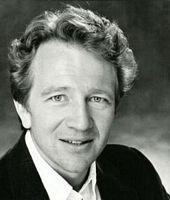
“I've always thought Craig Wasson was perfectly cast in this. Yes, he totally lacks the star power that could have helped to make the film a commercial success and he doesn't exactly deliver what can be described as a powerhouse performance. But the man's playing an unemployed actor, for God's sakes--a born loser, a regular Joe longing for a little excitement in his lousy life. A charismatic star like John Travolta in the same everyman role wouldn't have been believable. This is the story of somebody who tries to overcome his weakness. The story of an actor trying to act. The story of a sexless nobody wishing to become a stud. The weakness is an essential element of the narrative.”

It makes sense to me that De Palma would have an understanding that Wasson is no Jimmy Stewart everyman here—he’s investigating a very specific backstage world of which not many people outside of Hollywood (all efforts of Entertainment Weekly to the contrary) have any real understanding-- and it would be silly to think that’s what he had in mind. Nor does it seem much of a stretch at all to imagine a formally experimental film artist as De Palma playing with expectations to such a degree that he wouldn’t hesitate to cast a “regular-Joe” actor as a “regular-Joe” actor. So to that end I can accept that Wasson’s casting could be, in the terms laid out by the film, a success. And I can also accept that weakness can be, and perhaps is here, an essential part of the narrative. But again, to invoke Vertigo, Jake Scully is no Scottie Ferguson-- Hitchcock uses Scottie’s weakness to infuse his film with a creeping malaise and undercurrent of dread, to allude to the ever-present shadow of curdling obsession. But it seems De Palma embraces Jake’s weakness to such a degree that the film is less an illumination of that weakness as a subject than a victim of it as it is manifested in De Palma’s own relatively by-the-numbers approach. The weakness may truly be essential to the conception of Jake Scully as a character, but in Body Double it is also a symptom of a director momentarily spinning his creative wheels, looking to pump fresh blood into concepts he perhaps felt compelled to revisit for essentially compromised reasons.

20 YEARS LATER...

Looking at Body Double 20 years later, knowing that De Palma would recover his bearings, that works as masterful and resonant and audacious as Casualties of War and Femme Fatale were laying in wait, and even that he would rediscover his commercial footing with one of the most formally adventurous of Hollywood blockbusters (Mission: Impossible), it’s easier for me to forgive some of the flaws that I still find so apparent. And it’s even easier, given the passage of time, to look at the movie with new eyes and see that it’s nowhere near the viral offense to decent sensibilties that its most vocal detractors claimed in 1985 and still do today, that it actually does have some value, even though I still value it less than almost every other De Palma film. Why, I dare say I even had a good time seeing it again. It’s nice to be reminded that even the lesser films of a genuinely gifted film artist can yield plenty to think about and connect up with other films if given the space in a viewer’s mind in which to expand. In a million years, even at my most logorrheic, I would have never imagined that I would have been able to spend this much time in consideration of Body Double so long after its initial release. Such are the delights of considering cinema closely, I suppose. Thanks, Peet, for giving me yet another good reason to do so!